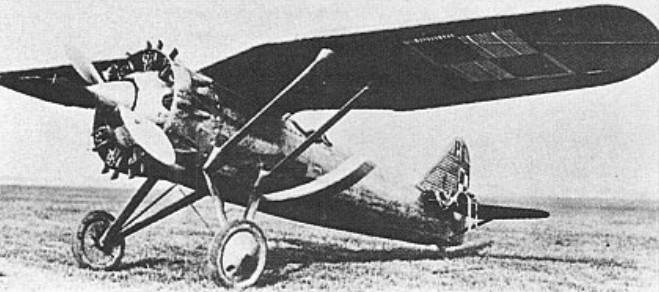
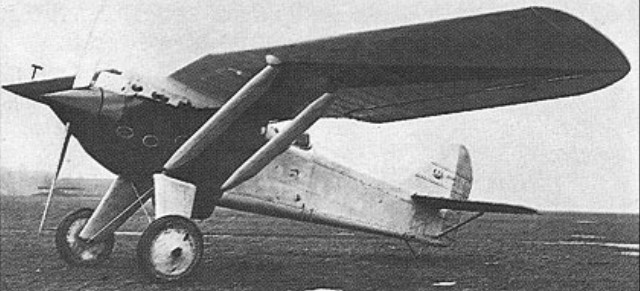
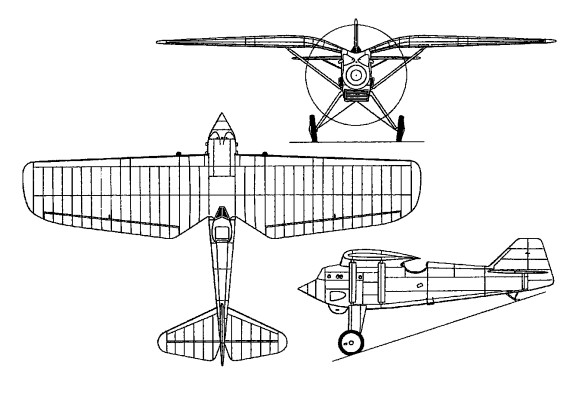
Evolved from the P.1 by Zygmunt Pulawski and developed in parallel with the P.7, the P.6 was powered by a low-altitude Gnome-Rhone Jupiter 9Ac (VI.FH) nine-cylinder radial rated at 450hp. The principal change from the P.1, apart from the power plant, was to be found in the fuselage structure and fuel disposition, the rear fuselage being a semi-monocoque and the wing tanks of the earlier fighter giving place to a jettisonable fuselage tank. Armament remained two Vickers “E” machine guns (rebored to 7.92mm calibre). The first of two P.6 prototypes was flown in August 1930, and, in the following year, participated in the National Air Races at Cleveland, Ohio. The second prototype, the P.6/II, differed primarily in having a Townend ring cowling in place of the narrow ring of the P.6/I. The Lotnictwo Wojskowe elected to order the contemporary P.7 for series production and no further development of the P.6 was undertaken.
Max take-off weight: 1355 kg / 3 lb Empty weight: 908 kg / 2002 lb Wingspan: 10.30 m / 34 ft 10 in Length: 7.16 m / 24 ft 6 in Height: 2.75 m / 9 ft 0 in Wing area: 17.30 sq.m / 186.22 sq ft Max. speed: 292 km/h / 181 mph Range: 600 km / 373 miles
The first fighter of indigenous Polish design, the P.1 produced by the Paristwowe Zaklady Lotnicze (P.Z.L.), or National Aviation Establishment, embodied several technical innovations. Designed by Zygmunt Pulawski, the P.1 was of all-metal construction, its most novel feature being the “gulling” into the fuselage of the centre section of the high wing, thus eliminating the normal cabane. This both reduced drag and improved the forward view for the pilot. Powered by a 12-cylinder water-cooled Hispano-Suiza 12 Lb Vee-type engine affording 630hp for take-off, the first prototype, the P.1/I, was flown on 25 September 1929. Armament comprised two 7.7mm Vickers machine guns. The second prototype, the P.1/II, featured a repositioned radiator bath and redesigned vertical tail surfaces, and joined the test programme in March 1930. Further development was discontinued in favour of radial-engined variants, as the Polish air arm, the Lotnictwo Wojskowe, was biased against liquid-cooled engines.
Engine: Hispano-Suiza 12 Lb, 630hp Max take-off weight: 1580 kg / 3483 lb Empty weight: 1118 kg / 2465 lb Wingspan: 10.85 m / 36 ft 7 in Length: 6.98 m / 23 ft 11 in Height: 2.96 m / 10 ft 9 in Wing area: 19.50 sq.m / 209.90 sq ft Max. speed: 302 km/h / 188 mph Range: 600 km / 373 miles Armament: two 7.7mm Vickers machine guns
Around 1955, Walter Horten was interested in developing a long-distance drive for his flying wing aircraft. He commissioned Prof. Karl Lürenbaum ‘s Institute for Engine Dynamics at RWTH Aachen University to develop a suitable engine. Walter Horten commissioned his childhood friend Alfons Pützer to build a suitable test vehicle for long-distance wave testing. Pützer suggested using a Fritz Raab Doppelraab design, which had already been used in the Pützer Motorraab.
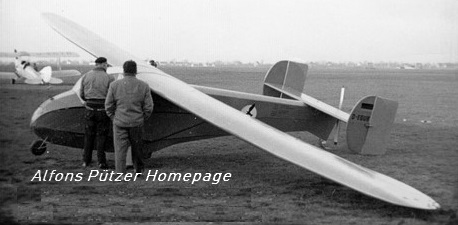
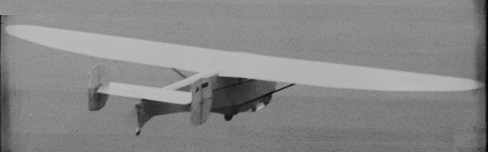
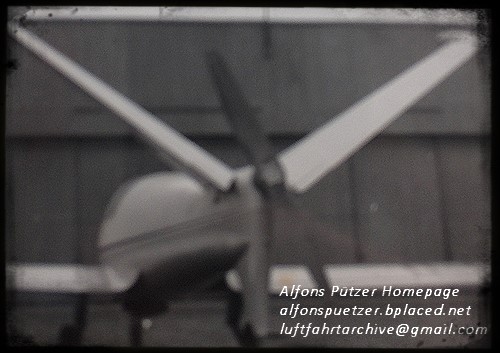
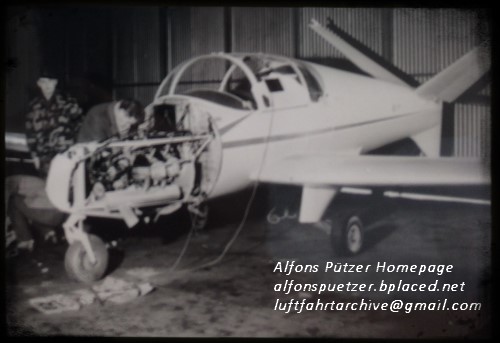
Pützer then commissioned Fritz Raab to modify a Doppelraab 6, in which a small engine was placed in the center of gravity behind the pilot’s seat. The tailplane of the Doppelraab was replaced by an endplate tailplane with two fins, in the middle of which a pusher propeller was placed at the rear of the aircraft. The two-cylinder, two-stroke engine Hansa-Lloyd with 400 cm³ displacement and 12 hp drove the propeller at the rear via the long-distance shaft developed by Karl Lürenbaum. The test vehicle was created by Alfons Pützer KG in Bonn.
In December 1956, the Pützer Dohle took off on its maiden flight in Bonn-Hangelar. The air sports club in Bonn received the jackdaw in early 1957 for its training operations to test in continuous operation. There were several disturbances in the area of the long-distance wave. The propeller, which had little ground clearance at the rear, was also damaged several times.
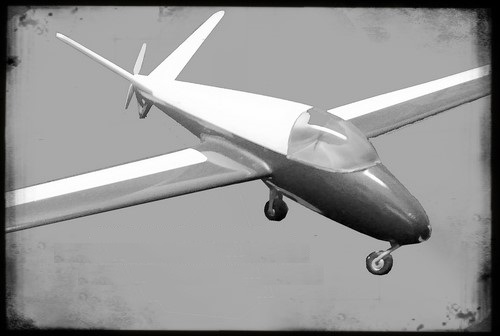
By arranging the engine in the center of gravity of the aircraft and the pusher propeller at the rear, the fundamentally good gliding characteristics of the Doppelraab were retained with the Dohle. Alfons Pützer then developed the jackdaw as a motor glider. He replaced the weak and too heavy Hansa engine with an Ilo F2x376 with 30 hp, with which the Dohle II should be able to self-launch. The small 14 kg fuel tank was replaced by a 40 kg fuel tank for longer cruising flights. This allowed the Dohle II to remain in the air for up to five hours. To protect the rear propeller from touching the ground, the Dohle II was fitted with a spur wedge at the rear.
The Dohle II was created in 1957 by converting the Dohle I at Alfons Pützer KG. It took off on September 2, 1957 in Bonn-Hangelar with the provisional approval D-EGUB for its first flight under its own power. In 1957, the Dohle II was one of the first usable motor glider constructions in Germany. However, Alfons Pützer had to stop further testing a short time later, since the start of series production of the Pützer Elster in the winter of 1957/58 occupied all capacities at Alfons Pützer KG.
The basic structure of the Dohle II was later the starting point for the development of the Pützer Bussard trainer aircraft , which was also to be equipped with a pusher propeller at the rear in order to achieve jet-like behavior. The first drafts of the buzzard show a completely redesigned fuselage and low-lying wings. As with the Dohle II, however, the terminal plate tail unit with wedge spur was used. This tail was later replaced by a V-tail on the Bussard.
Only after the successful start of Elster production did Alfons Pützer take up the development of a motor glider again at the end of 1958. Drafts from this period show a further developed jackdaw with the V-tail already used in the Bussard and a low-lying wing. From 1959, however, Alfons Pützer gave up further development of the Dohle in favor of the completely new Pützer MS-60 motor glider design. The Dohle II was shut down in 1960.
Jackdaw I Engine: 1 × Hansa-Lloyd, 12 hp Wingspan: 13.20 m Wing area: 18.00 m² Aspect ratio: 9.7 Length: 7.20 m Height: 2.00 m Empty weight: 300kg Maximum take-off weight: 420kg Payload: 120kg Crew: 1
Jackdaw II Engine: 1 × Ilo F2x376, 30 hp Wingspan: 13.20 m Wing area: 18.00 m² Aspect ratio: 9.7 Length: 7.20 m Height: 2.00 m Crew: 1 Empty weight: 325kg Maximum take-off weight: 450kg Payload: 125kg
In the mid-1950s, the German Air Force showed interest in an inexpensive training aircraft for their budding jet pilots. Based on his experiences with the Pützer Dohle, Alfons Pützer suggested a propeller-driven piston aircraft for this purpose, the pusher propeller of which was arranged at the rear of the aircraft between a double tail unit.
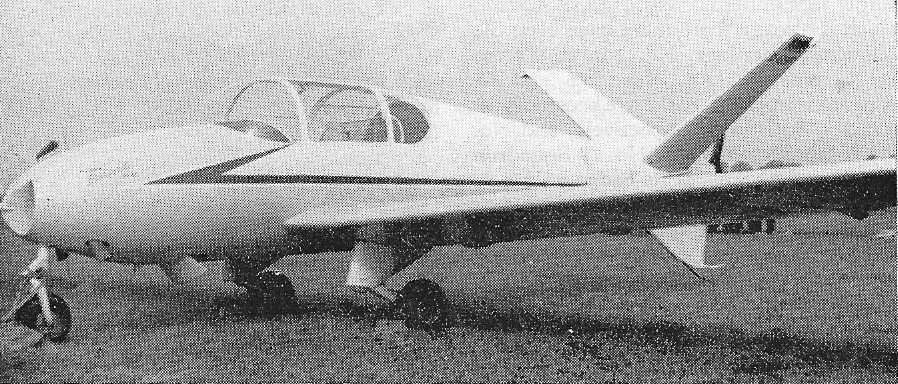
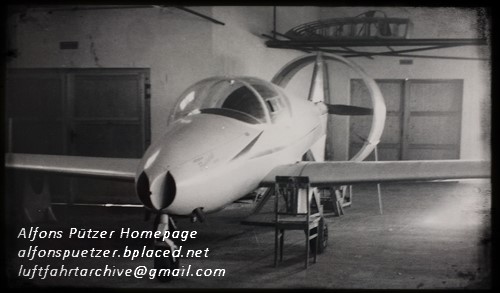
Alfons Pützer and Karl Lürenbaum had already tested a long-distance shaft between the engine located in the fuselage and the propeller located at the stern as part of the Pützer Dohle, which, however, had only delivered unsatisfactory results. Karl Lürenbaum therefore applied to the Ministry of Economics and Transport for the Institute for Engine Dynamics at the RWTH Aachen for funds to further develop existing long-distance wave concepts under the project name SR-57. The research project also included the construction of a test vehicle for the drive, which Alfons Pützer KG operated under the name Pützer Bussard. Originally, Alfons Pützer saw a design similar to that of the Fouga Magister jet trainer for this test vehicle with two seats arranged next to each other and a low-wing construction, which had the double tail unit known from the Pützer Dohle in the rear area and a fuselage wedge to protect the propeller arranged at the rear. However, due to the power loss observed in the Pützer Dohle due to turbulence in the rear propeller, Walter Horten suggested using a V-tail instead of the twin tail of the Dohle. For the first time, Pützer also envisaged a retractable undercarriage for the Buzzard. The Continental C90-12F drive known from the Pützer Elster was used as the engine.
Problems were caused by the 6-metre-long remote shaft running through the entire hull, which showed frequent failure of dynamic components on the remote shaft test bench in Aachen and whose vibration behavior only showed satisfactory results after a complete redesign in the form of a three-part shaft.
In January 1959, the drive was installed in the test vehicle in Bonn. The German Research Institute for Aviation (DVL) in Cologne-Wahn was commissioned to test the test vehicle. There the Pützer Bussard took off for its maiden flight in February 1959 with provisional traffic approval D-EHIV. During the subsequent testing, the Pützer Bussard showed satisfactory results at the DVL up to the end of 1959, especially in the take-off and landing phase.
After the introduction of the Fouga Magister jet trainer, the German Air Force changed its training concept for its jet pilots. In the new training concept, the use of inexpensive upward trainers was no longer provided. Despite the positive testing, the Luftwaffe was no longer interested in purchasing the Pützer Buzzard in 1959. With the end of the SR-57 project, the test vehicle was shut down in the fall of 1959.
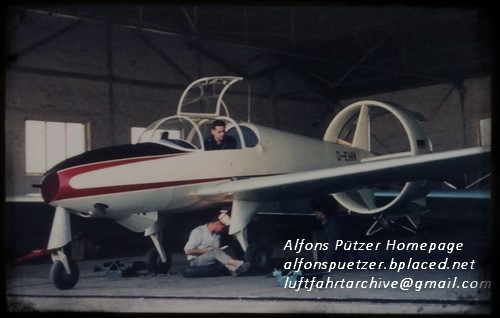
Erich Ufer has been working at Bölkow GmbH in Nabern since 1956 on the development of ring tail units. As part of this development, Bölkow GmbH planned to build the Bölkow P.103 test vehicle. After Ludwig Bölkowand Erich Ufer had not received any funding from state programs for the test vehicle by 1959, Alfons Pützer suggested converting the Bussard long-distance test vehicle that was no longer required to accommodate a ring tail unit. Apart from the redesign of the entire tail unit area with the ring manufactured by Bölkow in GRP construction, the Pützer Bussard received a new landing gear, also designed by Bölkow as part of the P.103, which ensured the necessary ground clearance for the ring tail unit. Due to the high weight of the ring tail, Alfons Pützer exchanged the Continental C90 engine for a 145 hp Continental O300, for which Karl Lürenbaum made the necessary changes to the remote shaft in Aachen.
After completion of the model tests in the wind tunnel in Stuttgart, the conversion of the Pützer Buzzard took place until the end of 1960, which was then given the designation SR-57-2K. In order to gain further experience with the ring tail, before the first flight in early 1961 another wind tunnel program was carried out, in which the finished prototype was examined aerodynamically. On July 12, 1961, the first flight of the Pützer Bussard with a ring tail took place in Bonn-Hangelar. Satisfactory results were demonstrated in a three-month flight test. On March 22, 1963, the Federal Aviation Authority issued a provisional license for the ring tail carrier SR-57-2K. With the submission of the final report in June 1964, the test vehicle was shut down again.
After completing the ring tail testing, the Pützer Bussard came to Karl Lürenbaum’s Institute for Engine Dynamics in Aachen. Together with the Rhein-Flugzeugbau RF-1 developed by Hanno Fischer at Rhein-Flugzeugbau, the Buzzard was used in ground and test bench tests in Aachen to develop turbofan engines, such as those used for the first time in 1968 on the motor glider Rhein-Flugzeugbau Sirius. The Pützer Bussard was largely dismantled during these tests and was later stored in Merzbrück near Aachen.
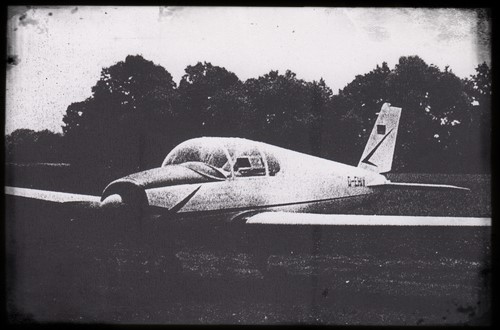
Walter Horten took over the dismantled Pützer Bussard in 1971. With the support of the Oskar Ursinus Vereinigung (OAV), Horten replaced the annular tail unit with a conventional tail unit and removed the long-distance shaft. Instead, the engine located in the bow was connected to a bow propeller of conventional design. Wings, landing gear and center fuselage with cockpit remained unchanged.
The Pützer Bussard was probably used in this configuration by the OAV for a number of years as a touring aircraft. It is said to have been destroyed later in a fire.
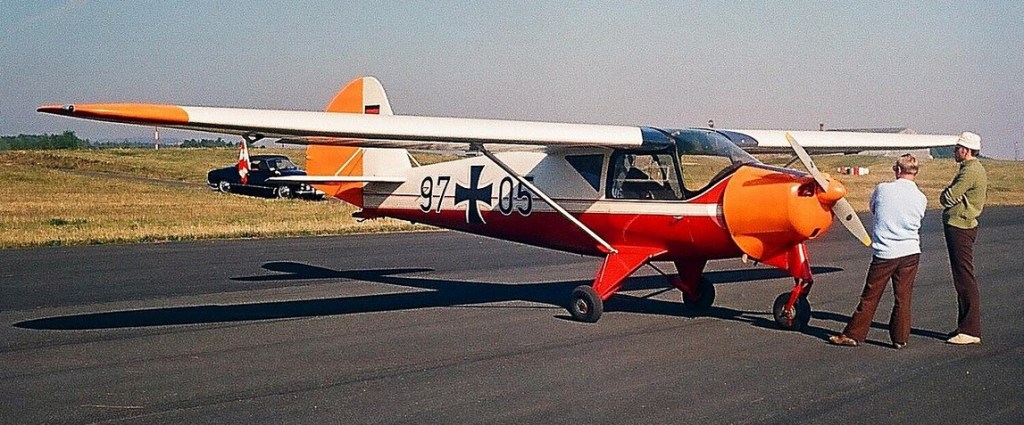
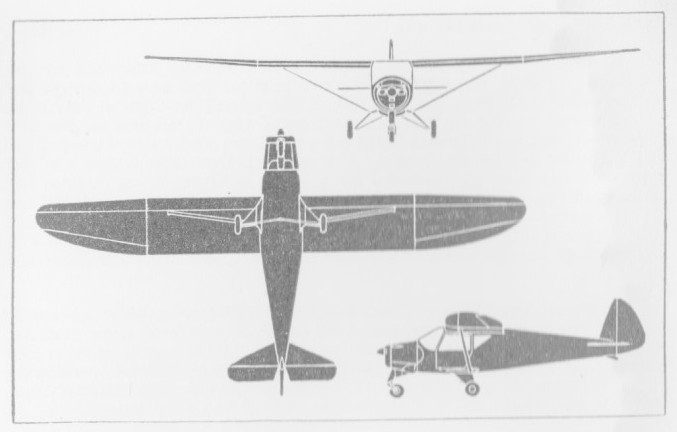
Alfons Pützer KG known primarily as sailplane manufacturer; produced an improved motorized version of the Doppelraab sailplane, known as the Elster in 1957. Small batch produced for German club use.
In post war Germany, General Aviation flight was not permitted until 1956. At the time of this rejuvenation, the Porsche 678 aircraft engine was being developed. This was based on the 4 cylinder Porsche 356 car engine. This air cooled engine was modified for the aviation environment.
At this time Alfons Pützer was also developing the Elster A airframe, powered by the 52HP 678/3 Porsche engine. The prototype was powered by a 52 hp Porche 678/3 engine.
This was followed by the Elster B version powered by the 75 HP Porsche 678/4 engine and the Rolls Royce Continental C-12F and C-14F engines. The 95 hp C90-12F version was selected for use by the Federal German Luftwaffe’s sport flying groups and production deliveries began in 1960, 21 being built.
The Elster-C is specifically for glider towing, powered by a 150 hp Lycoming O-320 engine.
Elster B Engine: Continental C90-12F, 95 hp Wingspan: 43 ft 4 in Length: 23 ft 3.5 in Height: 8 ft 2.5 in Wing area: 188.368 sq.ft Empty weight: 1014 lb Loaded weight: 1543 lb Max speed: 104 mph at SL Cruise: 93 mph ROC: 720 fpm Service ceiling: 16,100 ft Range: 272 mi
The 6-seater is the Pulsar Aircraft Super Cruiser 600, built when the company was located in El Salavador. Design of Rich Trickel and derived from his TR-4 Cruiser (Tri-R Technologies) 4-seater. This was later marketed by Pulsar Aircraft.
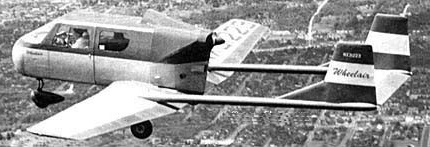
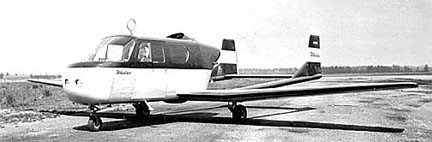
Designed by Donald Wheeler the 1947 III-A was a prototype all-metal, twin-boom, rudderless twin-tail, tricycle-gear, post-war “plane of tomorrow” based on Wheeler’s prize-winning design in a national magazine. The prototype first flew in April 1947.
Featuring a two-control system and offered for $5,000-5,500, only the one was built (NX31223). Originally powered by a 190hp Lycoming O-435 pusher, and also with 170hp a Lycoming GO-290-AP.
Single seat single engined high wing mono¬plane with two axis control. Wing has swept back leading and trailing edges, and tapering cord; no tail, canard wing. Pitch control by fully flying canard; yaw control by tip rudders; no separate roll control; control inputs through stick for pitch/yaw. Wing braced from above by kingpost and cables, from below by cables; wing profile Klaus Hill (Fledgling); double surface. Undercarriage has three wheels in tricycle formation; bungee suspension on all wheels. No ground steering. No brakes. Aluminium tube framework, without pod. Engine mounted below wing driving pusher propeller.
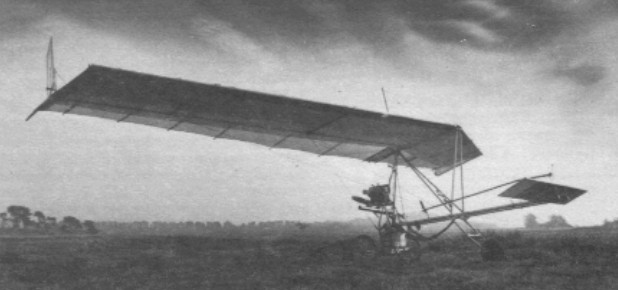
The Ptraveler is a Pfledgling 430D with a fully flying canard, and can be regarded as a ‘back to front’ Pfledgling NFL, with the elevator moved to the front. The two main horizontal lateral tubes of the Pfledgling frame are elongated towards the front to carry the extra control surface, creating a two axis control ultralight with a side mounted stick. This operates the canard via a pushrod with ball joints at the end, and acts on the tip rudders via control cables. However, the seat is still a simple band of cloth as in the earlier models and allows the Ptraveler pilot to adjust the aircraft’s centre of gravity in flight by weight shift.
Making its appearance in 1980, this single-seater retains the Cuyuna 430D engine with¬out reduction drive. Apart from the canard, the structure remains unchanged from the Pfledgling 430D and the performance is similar. Various options are, however, now available on the Ptraveler, of which the most important is a three axis conversion using large spoilerons mounted some 6 inch (15 cm) above the wing. These spoilerons deploy by rotating forward and down and, depending on the installation method chosen, can be moved either by the pedals or by the stick (the tip rudders being operated by the pedals in the latter case); the customer can thus choose unconventional or conventional three axis control.
Other options are nosewheel steering, both push right go right and push right go left arrangements being available, and a parachute system.
Price in kit form: $4926 in 1983.
Engine: Cuyuna 430D, hp at 5500 rpm Propeller diameter and pitch 36 x 16 inch, 0.91 x 0.41 m No reduction Max static thrust 165 lb, 75 kg Power per unit area 0.19hp/sq.ft, 2.0 hp/sq.m ¬Fuel capacity 2.5 US gal, 2.1 Imp gal, 9.5 litre Length overall 16.8 ft, 5.08 m Height overall 9.1ft, 2.77m Wing span 33.0ft, 10.06m Mean chord 5.5 ft, 1.65 m Chord at tip 4.5 ft, 1.34 m Total wing area 173 sq.ft, 16.1 sq.m Main wing area 162 sq.ft, 15.1 sq.m Canard area 11.0sq.ft, 1.0sq.m Main wing aspect ratio 6.7/1 Nosewheel diameter overall 14 inch, 36 cm Main wheels diameter overall 20 inch, 51 cm Empty weight 200 lb, 91kg Max take off weight 465 lb, 211kg Payload 265 lb, 120kg Max wing loading 2.87lb/sq.ft, 13.9 kg/sq.m Max power loading 15.5 lb/hp, 7.0kg/hp Load factors; +4.4, 3.3 ultimate Max level speed 55 mph, 88 kph Never exceed speed 55 mph, 88 kph Max cruising speed 40 mph, 64 kph Economic cruising speed 35 mph, 56 kph Stalling speed 24 mph, 38 kph Max climb rate at sea level 400 ft/min, 2.0 m/s Min sink rate 400ft/min, 2.0m/s Best glide ratio with power off 8/1 Take off distance 125 ft, 38 m Landing distance 50 ft, 15 m Service ceiling 15,000 ft, 4570 m Range at average cruising speed 120 mile, 193 km
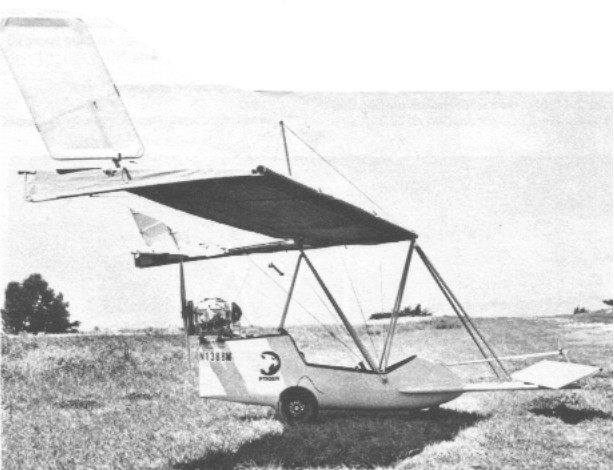
Single seat single engined high wing mono¬plane with conventional three axis control. Wing has swept back leading and trailing edges, and tapering chord; no tall, canard wing. Pitch control by fully flying canard; yaw control by fin mounted rudders; roll control by spoilers; control inputs through stick for pitch/roll and pedals for yaw. Wing braced from above by kingpost and cables, from below by cables; wing profile Klaus Hill (Fledgling); double surface. Undercarriage has three wheels in tricycle formation; glass¬fibre suspension on all wheels. Ground steer¬ing by differential braking. Brakes on main wheels. Aluminium tube/glass fibre/foam fuselage, partially enclosed. Engine mounted below wing driving pusher propeller.
The Ptiger is basically an up market Ascender II, from which it princi¬pally differs by the addition of three axis control and the complete fairing in of the lower fuselage with a polyurethane foam/glass fibre structure having an open cockpit. It also has a smaller wing. Shown at Oshkosh in August 1982, the Ptiger is the most recent variation on the Pfledge theme and is the top of the Pterodactyl range.
Although the Ptiger can be fitted with the spoilerons (as described under Ptraveler), it normally gets its roll control from smaller spoilers. In either case, it is a conventional three axis control ultralight, with the stick operating spoilers or spoilerons and the fully flying canard. Pedals operate the tip rudders, which may be deployed together to act as air brakes, and also control individual main¬wheel brakes to provide ground steering. Under American legisation, the Ptiger is too fast to be an ultralight and is classified as an experimental aircraft, with its pilot need¬ing a licence to fly it. For this reason, Pterodactyl deliver it as a single kit, which according to the company requires around 100 h for assembly. Mainwheel fairings are an option. The price in January 1983 was $5460.
Engine: Cuyuna 430RR, 30 hp at 5500 rpm Propeller diameter and pitch 54 x 27 inch, 1.37 x 0.69 m V belt reduction Fuel capacity 5.0 US gal, 4.2 Imp gal, 18.9 litre Length overall 14.0 ft, 4.26 m Height overall 9.0 ft, 2.74 m Wing span 29.0 ft, 8.84 m Total wing area 150 sq.ft, 13.9 sq.m Nosewheel dia¬meter overall 11 inch, 28cm Main wheels diameter overall 13 inch, 33cm Empty weight 240 lb, 109 kg Max take off weight 550 lb, 249kg Payload 3101b, 140kg Max power loading 13.5 lb/hp, 8.3kg/hp Max level speed 65 mph, 104 kph Max cruising speed 55 mph, 88 kph Economic cruising speed 40 mph, 64 kph Stalling speed 30 mph, 48 kph Max climb rate at sea level 600 ft/min, 3.0 m/s Min sink rate 400 ft/min, 2.0 m/s Best glide ratio with power off 10/1 Take off distance 150 ft, 45 m Landing distance 120 ft, 36 m Service ceiling 18,000 ft, 5490 m Range at average cruising speed 130 mile, 209 km
Fledgling, a name which rapidly became abbreviated to Fledge. In 1978, Jack McCornack adapted this wing for powered flight and formed the Pterodactyl company to sell the aircraft thus modified. Wanting to link the product unmistakably with his company, he added a silent ‘P’ to the model name, and the Pfledgling was born.
The Pfledge, as this aircraft is usually known, is the basic model from which all the Pterodactyl range is derived, apart from the Light Flyer.
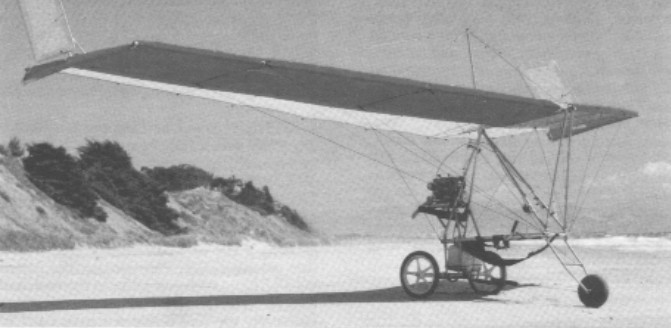
Single seat single engined high wing monoplane with hybrid control. Wing has swept back leading and trailing edges, and tapering chord; no tail. Pitch control by weight shift; yaw control by tip rudders; no separate roll control; control inputs through weight shift for pitch and stick for yaw. Wing braced from above by kingpost and cables, from below by cables; wing profile Klaus Hill; double surface. Undercarriage has three wheels in tricycle formation; bungee suspension on nosewheel and glass fibre suspension on main wheels. No ground steering. No brakes. Aluminium tube framework, without pod. Engine mounted below wing driving pusher propeller.
This aircraft owes its existence to Klaus Hill, who was tragically killed on 10 October 1978 while testing the Voyager, a hang glider of his own design which he had just motorised.
Klaus had earlier designed a rigid tip-rudder hang glider with hybrid control called the Fledgling, a name which rapidly became abbreviated to Fledge. In 1978, Jack McCornack adapted this wing for powered flight and formed the Pterodactyl company to sell the aircraft thus modified. Wanting to link the product unmistakably with his company, he added a silent ‘P’ to the model name, and the Pfledgling was born.
The Pfledge, as this aircraft is usually known, is the basic model from which all the Pterodactyl range is derived, apart from the Light Flyer. In February 1979, Jack McCornack and Dan White made a flight of 50 mile (80 km) in a straight line between Watsonville and Morgan Hill to get to the Great Barnstorming Airshow. One of the first ultralight cross-countries, this was acknowledged as a veritable exploit and the Pfledge received the best new design award and several glowing reports in the specialised press.
That August, Jack, with Keith Nicely, completed in 71 flying hours the trip from Watsonville in California to Oshkosh in Wisconsin. There they teamed up with Jack Peterson and Pat Hirst, who had already flown to Oshkosh with their own Pfledges from Los Angeles on the West coast, and flew on to Kitty Hawk on the East Coast the first transcontinental flights in the history of ultralights. The destination was chosen in honour of Orville and Wilbur Wright, who took off from Kitty Hawk in their famous Flyer back in 1903. This first transcontinental Pfledgling is now on show in the Smithsonian National Air & Space Museum in America. The Pfledge prides itself on being the first American ultralight with ‘all terrain’ capabil¬ity, thanks to its tricycle undercarriage with large wheels and efficient suspension. Initial¬ly fitted with a Zenoah engine, the airframe underwent various modifications during the course of summer ’79, acquiring a Sachs 340 cc engine, the resulting machine being dubbed Pfledgling OR (Oshkosh Replica) , a high performance, double surfaced beast based on the Fledgling rigid-wing hang glider. It was this variant that Jack McCornack and Keith Nicely used on their transcontinental flight.
The next modification was to fit a twin-cylinder Cuyuna 430D (without reduction drive), this model coming out the same year with the name Pfledgling 430D. The wing used was the Manta Fledge II B.
A hybrid control machine, the Pfledge has a swing seat which allows the pilot to control pitch by weight shift. The original aircraft and its OR derivative used a twist grip for each rudder, one either side of the pilot on each main horizontal tube, but for the 430D Pterodactyl substituted a single side mounted stick.
Although the Pfledgling OR was still available in 1983, the company is not actively marketing it and does not quote a price. The mainstream Pfledge now is the 430D which is sold as a kit, a 40 60 h assembly time being claimed. In addition to power pack and airframe, the kit comprises seat, shoulder harness, storage covers (the aircraft is cartoppable), ASI and altimeter. Price: $4547.
The Pfledgling NFL was produced at a time when US law required all ultralights to be foot launchable (theoretically at least!), the NFL was as its title suggests Not Foot Launchable and was aimed at the experimental aircraft market. It consisted of a Pfledgling 430D with an elevator added, carried on two booms behind the frame, where it was exposed to the propwash. A fixed seat replaced the swing seat of the ffledgling 430D, the NFL thus becoming the first Pterodactyl with two axis rather than hybrid control. Though not many of this now obsolete model were sold, the NFL is significant because it paved the way for the Ptraveler. The Acro Dactyl is the result of development work carried out in the summer of 1981, when Pterodactyl undertook trials on two specially reinforced Pfledglings, designed for elementary aerobatics.
Pfledgling 430D Engine: Cuyuna 430D, hp at 5500 rpm Propeller diameter and pitch 36 x 16 inch, 0.91 x 0.41 m No reduction Max static thrust 165 lb, 75 kg Power per unit area 0.19hp/sq.ft, 2.0 hp/sq.m ¬Fuel capacity 2.5 US gal, 2.1 Imp gal, 9.5 litre Length overall 10.0 ft, 3.05 m Height overall 9.1ft, 2.77m Wing span 33.0ft, 10.06m Chord at root 5.5ft, 1.65m Chord at tip 4.5 ft, 1.34 m Total wing area 162 sq.ft, 15.1 sq.m Wing aspect ratio 6.7/1 Nosewheel diameter overall 14 inch, 36 cm Main wheels diameter overall 20 inch, 51 cm Empty weight 165 lb, 75 kg Max take off weight 425 lb, 193kg Payload 260 lb, 118 kg Max wing loading 2.62 lb/sq.ft, 12.8 kg/sq.m Max power loading 14.2 lb/hp, 6.4kg/hp Load factors; +4.4, 3.3 ultimate Max level speed 55mph, 88kph Never exceed speed 55mph, 88 kph Max cruising speed 45 mph, 72 kph Economic cruising speed 35mph, 56kph Stalling speed 23 mph, 37 kph Max climb rate at sea level 400 ft/min, 2.0 m/s Min sink rate 400ft/min, 2.0m/s Best glide ratio with power off 9/1 Take off distance 125 ft, 38 m Landing distance 100 ft, 30 m Service ceiling 15,000 ft, 4570 m Range at average cruising speed 125 mile, 201 km