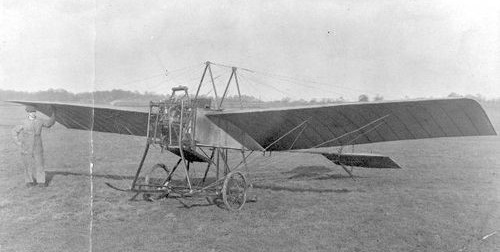
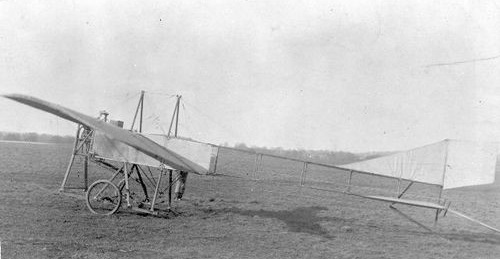
The 1911 Proudhon monoplane was designed and built by Proudhon in France.
Monoplane
Protech PT2
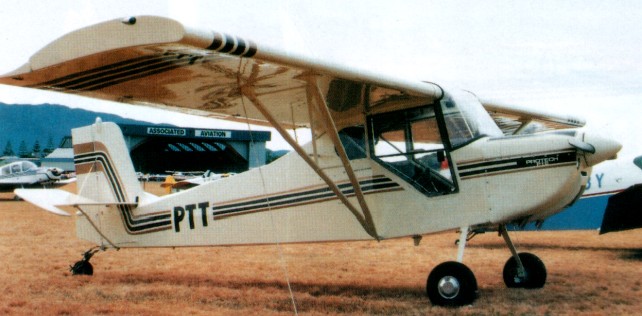
A high wing aircraft with all aluminium wings that can be easily and quickly folded rearwards, parallel with the steel tube, ceconite-covered fuselage. It has transparent doors which hinge upwards under the wings and can be opened in flight. The undercarriage is one-piece spring steel and either two or four 20 lt fuel tanks in the wing roots. Standard tires are 600×6, with optional 700×6.
The Protech PT2 Sassy origi¬nates from Houston, Texas circa 1988. Being a high wing side by side two seater of taildragger design, power comes from a 75hp Revmaster, providing a maximum speed of 140 mph. An interesting feature is the aircraft’s fold back wings to facilitate storage. The first was N211PT.
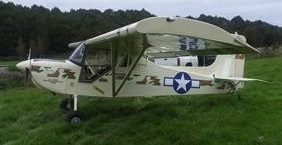
PT-2 Sassy
Engine: 75hp Revmaster
Wingspan: 31’9″
Length: 17’6″
Useful load: 604 lb
Max speed: 115 mph
Cruise: 105 mph
Stall: 29 mph
Range: 420 mi
Seats: 2
Engine: Continental O-200, 100 hp
Cruise: 85 kts
Stall: 38 kts
Landing dist: 100-200 m
Take off dist: 100-200 m
Seats: 2
PT-2C
Engine: 150hp Textron Lycoming O-320
Wingspan: 32’6″
Length: 22’0″
Useful load: 750 lb
Max speed: 130 mph
Cruise: 115 mph
Range: 300 mi
Seats: 2
Prosper Monoplane
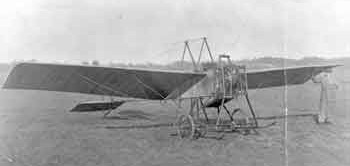
A fifty-five horsepower Viale 5-cylinder radial-powered monoplane from Canada circa 1909, constructed by Louis Prosper, possibly of Montreal.
Prospective Concepts Stingray
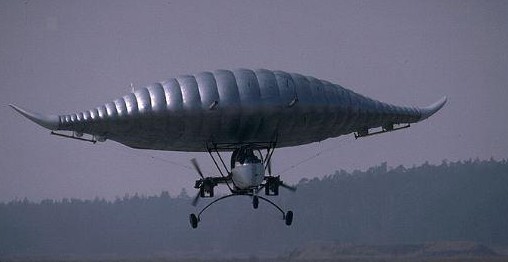
The media talked about a “flying stingray” when Prospective Concepts AG finally unveiled its secretive technology demonstrator in May 1998. Stingray is designed by this Swiss company, with a wing that derives its rigidity from compressed air. Later versions will be filled with helium. The second radical concept developed especially for the Stingray is a pneumatic catapult to be placed in the aicraft’s tail. The concept has been tested on the “Kangarou,” a light airplane with slow flight characteristics similar to the Stingray’s: a cylinder that extends to 5 meters catapults the craft right into the air and accelerates it from standstill to flying speed at 1.5 g.
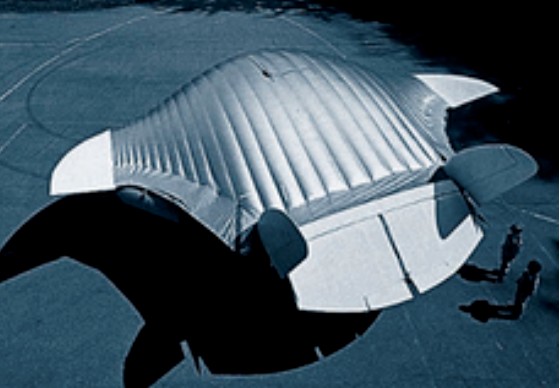
According to the company, a significantly larger successor to the Stingray is also planned. It will derive 25 percent of its lift from helium in its wing and integrate propulsion and the gondola into the wing. Development of the Stingray was supported by the German pneumatic conglomerate Festo.
Stingray
Wingspan: 13 m
Length overall: 9.4 m
Wing surface: 70 sq.m
Volume: 68 cu.m
Max. speed: 130 km/h (85 mph)
Prosch Loki
The 1973 formula racer ‘Loki’ was built by Ernest Prosch. A single-place, mid-wing monoplane, it raced at Reno in 1973 and 1974.
Wingspan: 17’10”
Length: 19’11”
Seats: 1
Promavia Jet Squalus / General Avia Jet Squalus / Alberta Aerospace Phoenix FanJet
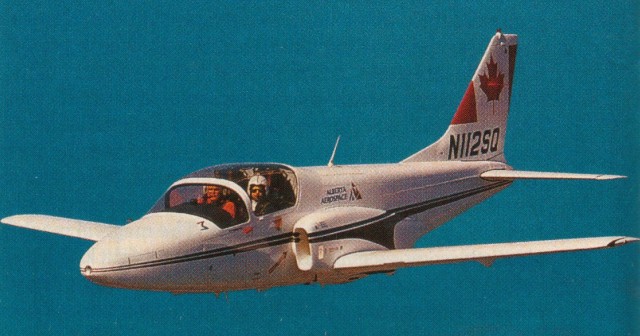
A Belgian enterprise, the Jet Squalus was designed and built around the Garrett TFE109 engine by General Avia in Italy. Designed by Stelio Frati, the prototype Jet Squalus made a successful first flight on April 30, 1987. Three prototypes of the “all through” side by side seat trainer were built and flown to Belgium. The Squalus was promoted as “the first and only third generation global trainer”, offering ab initio and advanced training from one cockpit.
Two proto¬types of the Jet Squalus are being built by General Avia in Italy, the first powered by a Garrett TFE-109 turbofan, and the second by a more powerful Williams International FJ-44. Following completion of initial flight trials the aircraft will be flown to Belgium, where production, marketing, and support of the “all-¬through” jet trainer will be administered by Promavia.
The initial 1,330 lb st (5.92 kN) -1 unit was replaced by the Garrett TFE 109-3 turbofan of 1,600 lb st (7,12 kN).
Light weapons and/or drop tanks can be carried on underwing hardpoints.
No orders had been placed for the aircraft by 1988.
In 1995 the Belgian company Promavia licensed Alberta Aerospace to begin development of an ab initio trainer version of its Jet Squalus, under the name Phoenix FanJet. Eventually Promavia sold Alberta Aerospace the flying Jet Squalus prototype for conversion (to include new Williams- Rolls FJ44 turbofan engine in a revised airframe, new “glass” cockpit, larger flying control surfaces and more), allowing certification in about the year 1999. After Promavia ceased trading, Alberta Aerospace purchased other Promavia assets, allowing eventual production in Canada.
Based in Calgary, Canada, Alberta Aerospace obtained the two prototypes built with plans to install Williams-Rolls FJ44-1a engines. Almost 80% of the structural and stress testing for certification was completed by Frati, who tested the airframe to +7 and –3.5G. With a 140 kt gear extension speed, the aircraft did not meet the 61 kt stall speed required for civilian certification for single engine, so the wing span was to be extended by four feet.
A flight demonstrator was fitted with the Williams FJ44 engine.
Jet Squalus
Engine: 1 x Garrett F109-1, 1,330 lb st (5.92 kN)
Span: 9 m
Length: 9.4 m
Wing area: 13.6 sq.m
Empty wt: 1200 kg
MTOW: 2000 kg
Max speed: 584 kph
Initial ROC: 975 m / min.
Ceiling: 11,280 m
T/O run: 366 m
Ldg run: 336 m
Fuel internal: 720 lt
Range: 1850 km
Combat radius: 460 km
Hardpoints: 4
Jet Squalus
Engine: 1 x Garrett TFE 109-3 turbofan, 1,600 lb st (7,12 kN).
Jet Squalus
Engine: 1 x Williams-Rolls FJ44-1A, 1600 lb
ROC SL: 2360 fpm
Max cruise: 315 kt at 20,000 ft
Max range; 715 nm at 261 kt
MTOW: 5100 lb
Equipped weight; 3408 lb
Useful load: 1692 lb
Fuel capacity: 185 USG
Projekt 8 Dolphin
The Danish Dolphin tandem two-seater motor glider was designed and built by the Projekt 8 I/S company of Roskilde, and 10 construction of the prototype was taking place at three separate sites near Copenhagen,
and it was expected that the first flight was to be made late in 1978.
The Dolphin is a cantilever mid-wing monoplane of mixed constrution with a T-tail, powered by a 54hp Volkswagen VW1600 engine driving a two-blade pusher propeller, mounted on a pylon and retracting rearwards behind closed doors into the top of the fuselage aft of the wings. The wings, which have 4° dihedral, have an aluminium centre section and wood and glassfibre outer panels, flaps and ailerons; there are aluminium air brakes in the upper surfaces just ahead of the flaps. The forward fuselage is a welded steel tube framework covered with a light glassfibre shell, and the rear fuselage is a wooden structure reinforced by glassfibre. The tail unit is likewise of wood, with a fixed incidence tailplane, a central trim tab in the elevator and an inset tab at the base of the rudder. There is a semiretractable rubber-sprung mainwheel plus a nosewheel and a steerable tailwheel, as well as retractable wing tip balancer wheels. The one-piece cockpit canopy opens sideways.
Span: 61 ft 5 in
Length: 27 ft 10.75 in
Height: 4 ft 3.25 in
Wing area: 223.9 sq ft
Aspect ratio: 16.8
Empty weight: 1,058 lb
Max weight: 1,653 lb
Max speed: 163 mph
Max aero-tow speed: 77.5 mph
Min sinking speed: 2.30 ft/sec at 50 mph
Best glide ratio: 32:1 at 62 mph
Progressive Aerodyne Sting Ray
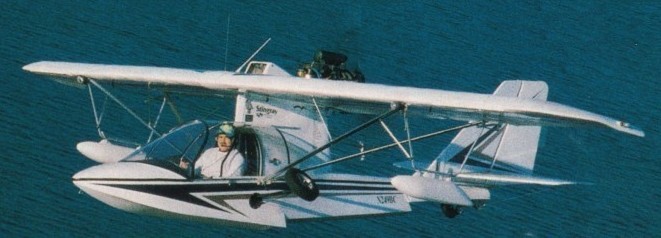
The Stingray is the single seat version of the Searay.
Engine options include the Rotax 447, 503, and 582.
Engine: Rotax 447, 40 hp
HP range: 40-65
Height: 6.2 ft
Length: 21.4 ft
Wing span: 30.83 ft
Wing area: 150 sq.ft
Weight empty: 470 lb
Gross: 800 lb
Fuel cap: 6 USG
Speed max: 85 mph
Cruise: 65 mph
Range: 100 sm
Stall: 27 mph
ROC: 600 fpm
Take-off dist: 175 ft
Landing dist: 200 ft
Service ceiling: 9,000 ft
Seats: 1
Landing gear: retractable tail wheel
Progressive Aerodyne Sea Rey
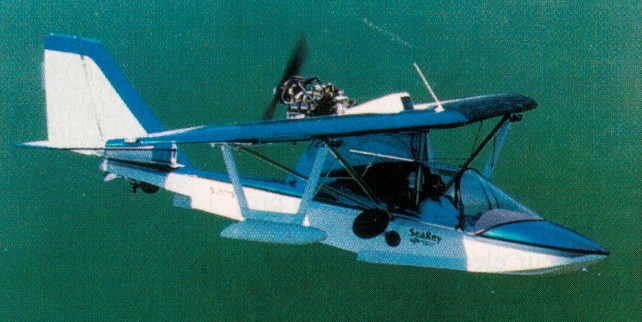
A side-by-side, high wing amphibian, related to the Adventure Air Adventurer 333. It is a high wing, pusher, tail dragger configuration, and a panoramic lexan cockpit. The wings are swept back at the leading edge with a straight trailing edge to form a tapered wing. The engine is mounted on top of the wing, which is supported above the fuselage by a vertical pylon.
The Cabin is designed with side-by-side seating. Entry into the cabin is through a sliding canopy into the 44 in/112cm cockpit. Dual flight controls enable flying from either seat. There is storage space behind the seats (L48 x W44 x H17 in.) for baggage.
The SeaRey is the ability to fly unaffected with the individual dual sliding canopies either opened or closed. The retractable landing gear handles unimproved grass runways. The take off roll on land at gross weight is about 375 feet (115m). Lift off takes place at around 45-50 mph (40 – 45 knots), and 65-70 mph (55-60 knots) is the best rate of climb speed. Rate of climb is 1,000+ ft per min (300m+ per min) Solo and around 800 feet per minute (245m per min) at gross weight.
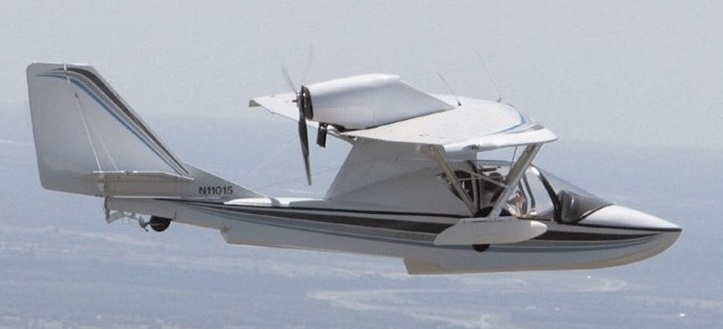
In cruise the SeaRey settles at 90 mph (80 knots). Top speed is 113 mph (98 knots). Due to the installation of special leading edge extensions on the wings, the stall is very docile and the aircraft is spin resistant. Upon throttling back and applying 20 degrees of flaps, the aircraft slows to the stall speed of around 40 mph (34 knots). The stall is gentle and straightforward and recovery is conventional. The retractable undercarriage comes with a simple manual system or alternatively an electric mechanism. An over center lock mechanism is a feature of this simple design.
Best approach speed for a water landing is 65 – 70 mph (55-60 knots) with 10 degrees of flaps. Upon reaching short final, 20 degrees of flaps can be initiated to further slow the aircraft’s touch down speed on the water. Landing flare begins lower than conventional land-only aircraft. A nice touch down speed is 45-50 mph (40-45 knots). This lands the aircraft “on step” and produces very smooth contact with the water.
The SeaRey is capable of handling quite rough water conditions but until such time as the pilot has developed their seaplane water experience, operations in moderate conditions with wave size under 12 inches (30cm), is recommended.
With 20 degrees of flaps for takeoff the SeaRey will come “on plane” in around 4 seconds. A further 6 to 8 seconds to get airborne. The hull produces a very flat spray pattern preventing water from going through the propeller. Accelerating to 45-50 mph (40-45 knots) to rotate and lift off. Established in the climb and at a safe height, reduce the flaps to 10 degrees.
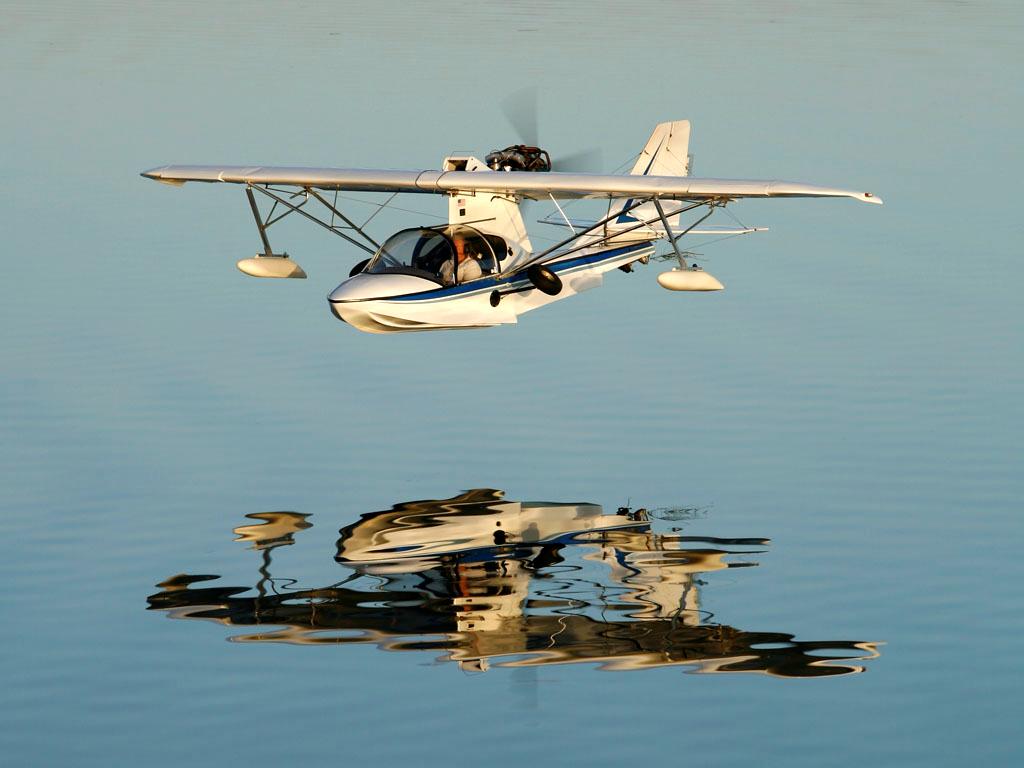
The LSA Searay has dual controls with electric trim, and engine options include 65, 74, 80, and 115 hp Rotaxs.
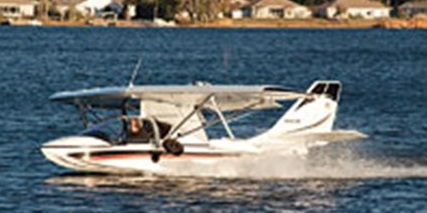
The basic kit was $21,900 less engine in 2000.
By 2012, the American-made SeaRey has been out in kit form for 21 years (600 kits delivered) and was also an S-LSA. The 2012 models were the Sport and Elite S-LSAs, and the LSX kit (E-LSA or EAB). Prices: US$144,000 (Elite); US$125,000 (Sport) and US$34,900 (LSX airframe-only kit).
SeaRay
Engine: Rotax 912 (80hp)
Cruise Speed: 85 mph
Top Speed: 105 mph
Stall Speed: 40 mph
VNE: 120 mph
Rate of Climb: 650 fpm
Takeoff Land: 400 feet
Takeoff Water: 400 feet
Empty Weight: 820 lbs
Gross Weight: 1370 lbs
Useful Load: 550 lbs
Length: 22′ 5″
Wheel Track: 78 inches
Height: 77 inches
Fuel Capacity: 18 US gallons (optional 26 gal)
Wing Span: 30′ 10″
Endurance: 3.5 to 4 hours
Wing Area: 157 sq. feet
Cabin Width: 44 inches
Root Chord: 76 inches
Cabin Height: 38.5 inches
Tip Chord: 46 inches
Above Seat: 33.5 inches
Aspect Ratio: 6.055
Baggage Area: 13 cubic feet
Taper Ratio: 0.6
Baggage l w h: 48 x 44 x 17 in.
L.E. Sweep: 7.5 degrees
Hull Draft: 10 inches
Stab. Span: 110 inches
Flap Settings: 13, 24, 35 degrees
Engine: Rotax 912s (100hp)
Cruise Speed: 93 mph
Top Speed: 113 mph
Stall Speed: 40 mph
VNE: 120 mph
Rate of Climb: 800 fpm
Takeoff Land: 375 feet
Takeoff Water: 375 feet
Empty Weight: 830 lbs
Gross Weight: 1370 lbs
Useful Load: 540 lbs
Length: 22′ 5″
Wheel Track: 78 inches
Height: 77 inches
Fuel Capacity: 18 US gallons (optional 26 gal)
Wing Span: 30′ 10″
Endurance: 3.5 to 4 hours
Wing Area: 157 sq. feet
Cabin Width: 44 inches
Root Chord: 76 inches
Cabin Height: 38.5 inches
Tip Chord: 46 inches
Above Seat: 33.5 inches
Aspect Ratio: 6.055
Baggage Area: 13 cubic feet
Taper Ratio: 0.6
Baggage l w h: 48 x 44 x 17 in.
L.E. Sweep: 7.5 degrees
Hull Draft: 10 inches
Stab. Span: 110 inches
Flap Settings: 13, 24, 35 degrees
Engine: Rotax 914 (115hp)
Cruise Speed: 100 mph
Top Speed: 120 mph
Stall Speed: 42 mph
VNE: 120 mph
Rate of Climb: 900 fpm
Takeoff Land: 350 feet
Takeoff Water: 350 feet
Empty Weight: 850 lbs
Gross Weight: 1370 lbs
Useful Load: 520 lbs
Length: 22′ 5″
Wheel Track: 78 inches
Height: 77 inches
Fuel Capacity: 18 US gallons (optional 26 gal)
Wing Span: 30′ 10″
Endurance: 3.5 to 4 hours
Wing Area: 157 sq. feet
Cabin Width: 44 inches
Root Chord: 76 inches
Cabin Height: 38.5 inches
Tip Chord: 46 inches
Above Seat: 33.5 inches
Aspect Ratio: 6.055
Baggage Area: 13 cubic feet
Taper Ratio: 0.6
Baggage l w h: 48 x 44 x 17 in.
L.E. Sweep: 7.5 degrees
Hull Draft: 10 inches
Stab. Span: 110 inches
Flap Settings: 13, 24, 35 degrees
Pro.Mecc Sparvieo
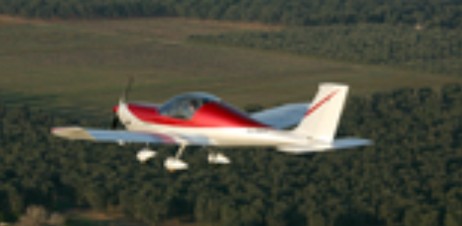
Entirely in composite and carbon-fiber. Engine options include the Rotax 912UL 100Hp.
2009 Price: 49500 EURO. The kit price was 27.000€ (without engine and instruments).
Sparviero
Stall: 31 kt / 36 mph / 58 kmh
Cruise: 103 kt / 118 mph / 190 kmh
VNE: 130 kt / 149 mph / 240 kmh
Empty Weight: 290 kg / 639 lbs
MTOW Weight: 450 kg / 992 lbs
Take-off distance (50ft obstacle): 390 ft / 120 m
Landing distance (50ft obstacle): 490 ft / 150 m

