Santos-Dumont 19 Demoiselle / La Libélula

Demoiselle in 1908

The original Santos-Dumont Demoiselle is said to have supported 260 pounds on 100 square feet of area, making a speed of sixty miles per hour. Its proprietor was the first aviator in Europe of the heavier-than-air class.
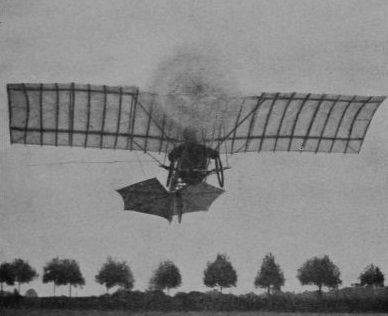
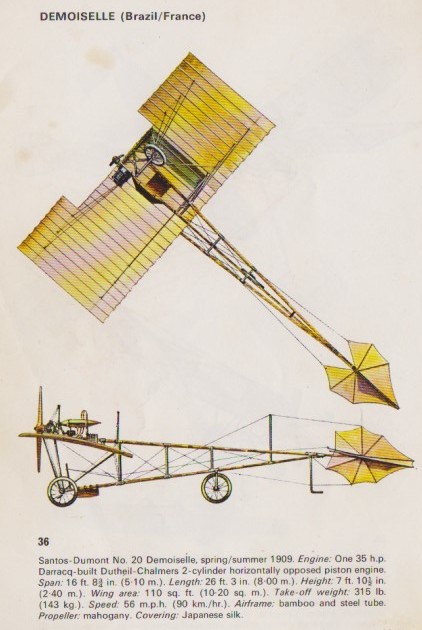
The La Libélula (later changed to Demoiselle) was the most popular aircraft model created by Dumont, with appreciable improvements in flight control and in the ailerons of its aircraft. They were the smallest and cheapest airplanes of their time, (5000 francs) expressly manufactured at very popular prices, by at least forty workshops throughout France. The design was constructed in various versions, powered by 24 to 30 hp Duteil-Chalmers or 30 hp Darracq engines. The Darracq engine radiators were under the wings.

After having done pioneer work with dirigible balloons, he won the Deutsch prize for a hundred meter aeroplane flight (the first outside of the United States) in 1906; the speed being twenty-three miles per hour. His first flight, of 400 feet, in a monoplane was made in 1907. Alberto Santos-Dumont displayed his original Demoiselle at the Aero-Auto Salon in France in 1908.
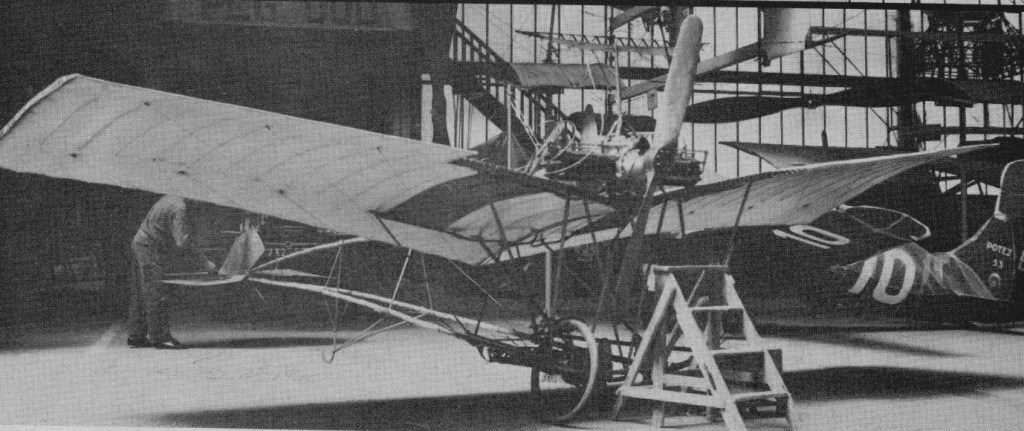
Original Demoiselle Musee de L’Air

It was a small high-wing monoplane, with only 5.10 m wingspan, 8 m long and weighing 260 lb empty little more than 110 kg with Santos Dumont at the controls. With optimum performance, easily covering 200 m of ground during the initial flights and flying at speeds of more than 100 km/h. Santos-Dumont first flight of 1.24 miles was made on 5 April 1909 and on 13 September he made a flight of 4.96 miles at a speed of 56 mph in a 5 minute run at St. Cyr.

Original Demoiselle Musee de L’Air

In total, Santos Dumont built nine types of Demoisellles, always refusing to patent his inventions, expressing that his interest was not to hinder other researchers, who could use his discoveries freely and also because his dream was that costs would be so cheap that planes were familiar and cost the same as a car. He never opposed those who wanted to copy his projects or those who wanted to sell prototypes made from his designs. Clément Bayard, an automotive maker, constructed several units of Demoiselle.

In 1909, Santos Dumont produced an airplane capable of flying kilometers in one go, the Demoiselle IV, with an 18-horsepower Dutheil-Chalmers engine and arched wings, which produced quite a bit of lift. In the first test, carried out on March 9, the aircraft fell immediately after takeoff and was left with one of the wheels shattered, but the aeronaut was not injured. On April 8, Dumont, with the aircraft already repaired, made a flight of 2,500 meters at an altitude of 20 meters.

In September Santos Dumont fitted a 30-horsepower Darracq steam engine to the plane and wrapped the radiator tubes around the wings, creating the Demoiselle VI. It was in that device that he made his most durable and extraordinary flights by plane. On the 13th of that month, it flew the 8 kilometers that separate Saint-Cyr from Buc in 5 minutes, at an average of 96 km / h, unprecedented speed for an air vehicle. The next day he made the flight in reverse, this time using 12 minutes due to the opposite wind.

On the 15th, in Saint-Cyr, he broke the world start record, with a takeoff of 70 meters, timed in 6.25 seconds. On the 16th she broke her own record, taking off at 60 meters, and took the opportunity to fly in 10 minutes and 27 seconds. Shortly thereafter she rose again, now carrying a dead weight of 20 kilos. This additional load, contrary to what was expected, did not hinder the maneuvers and when released in mid-flight, before an enthusiastic audience of about three thousand people, caused tension among the spectators, who feared that the delicate plane would destabilize and hood. The aircraft, however, continued its trajectory with perfect harmony and grace, landing 2 minutes later near the Saint-Cyr hangar.

Constructed with a fine structure, lightness characterize the monoplane of Santos Dumont justifying its name. It is made up of a 8 meter long bamboo spine. At the front it carries the Dutheil and Chalmers horizontal two-cylinder engine, with characteristics such as: diameter: 125 mm, length: 100 mm giving it a power of 18-20 horsepower. The supporting plane or wing, presents a dihedral for stability. The propeller is directly coupled to the engine, being two blades and 1 metre in diameter, at the rear end of the bamboo it is cruciform acting as an elevator and steering wheel. The set is mounted on a rectangular frame consisting of three wheels. The entire unit weighs 106 kg.

On November 21, Santos Dumont, during one of the flights, an accident occurred when the wooden propeller of his Mademoiselle broke, making an arrangement to the propeller in his Modemoiselle II model to avoid such a dangerous mishap.

Built of bamboo and canvas in an attempt to produce a low-priced aeroplane that could be assembled and flown safely by anyone. Santos dumont’s Demoiselle was the first aeroplane to be sold in ‘kit’ form. The advertised price in England was £300.
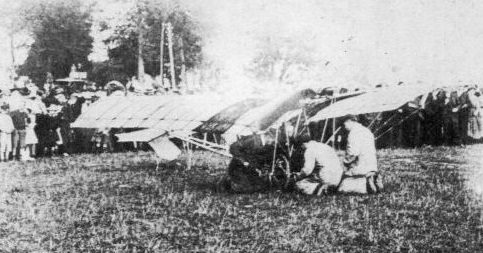
In 1908 Hélène Dutrieu was asked by the Clément Bayard factory, in France, to be the first pilot of its new ultralight aeroplane, the Santos-Dumont-designed no.19 Demoiselle (Young Lady) monoplane. She crashed on take off during her first flight and the aeroplane was wrecked.
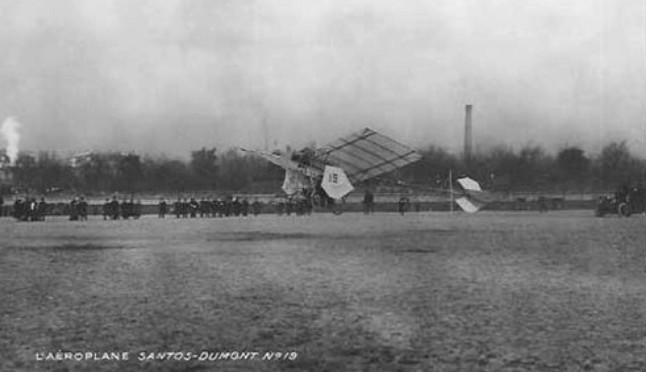
Santos-Dumont no.19

Replica:
Bianchi Santos-Dumont Demoiselle

Gallery

Engine: Dutheil and Chalmers two-cylinder, 18 – 20 HP
Empty weight: 106 kg
Seats: 1

Engine: Darracq, 25 hp
Span: 16’5″ – 18 ft
Length: 26’3″
Weight: 242 lb

Engine: Darracq, 30 hp
Prop: 5 ft dia, 1600 rpm
Span: 18 ft
Wing chord: 6 ft
Length: 26 ft
Weight: 250 lb
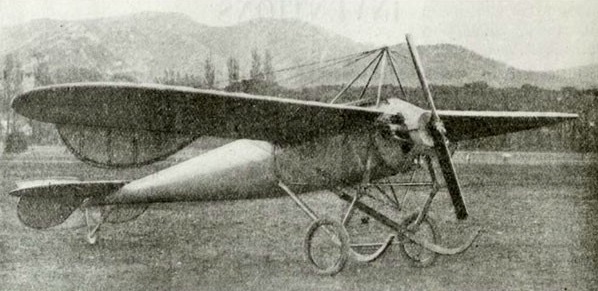
Santo 1912 monoplane

The Italian engineer M. Santo of Marseilles. France, designed this monoplane. Its streamlined circular cross section hull was made of wood covered with tarred fabric and was stated to be absolutely waterproof, allowing it to float indefinitely in the event of a fall to the sea. The fuselage of 7 meters length rested on a patented landing gear. The wing area was 16 square meters. The empennage of this aircraft was with two small surfaces on each side of the rear fuselage that provided lateral and longitudinal stability at the same time. Instead of being hinged, the surfaces rotated about an axis in the fuselage parallel with the direction of travel; they lowered or rose “like the wings of a bird”, depending on whether the pilot wants to descend or climb. They could also tilt to the right or left to restore the lateral balance, or to turn the device. It was intended for an 80 hp Anzani engine, but the photo shows a Dutheil & Chalmers engine giving only 18 hp.

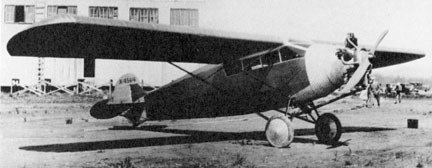
Santa Ana Aircraft Co VM-1 / Grays Harbor Airways Activian

Santa Ana VM-1 NX4564

Designed by J O York and built by Santa Ana in 1928, the sole 1928 VM-1 three place semi-cantilever monoplane was registered NX4564 c/n J-1.

The production rights were bought from Santa Ana Aircraft Co by Grays Harbor Airways and the aircraft renamed Activian as a prototype, with possible modifactions for commercial use. Later it was repowered with a 100hp Kinner engine. The craft cost around $2,500.

Engine: 80hp Anzani
Wingspan: 38’3″
Length: 25’0″
Useful load: 750 lb
Max speed: 90 mph
Stall: 45 mph
Range: 500 mi
Seats: 3

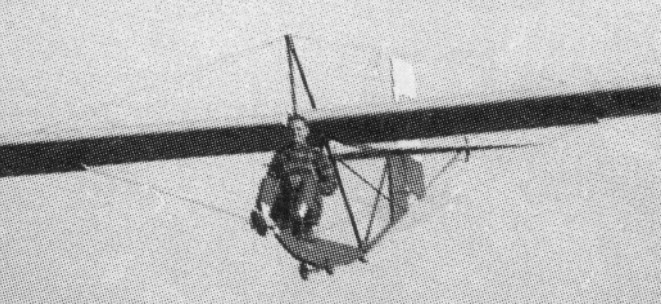
Sands Primary Glider (1929)

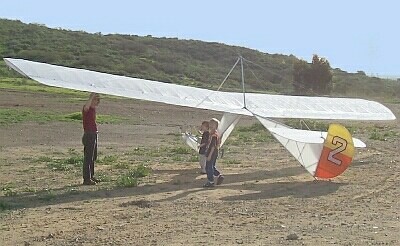
A replica 1929 Primary Glider

Features:
All Wood/Fabric Construction with minimum welding for fittings and control system
Easily disassembled for moving on trailer or auto roof rack
Downhill flyer or tow by auto
Much safer than hang gliders or ultralights
Excellent project for school or clubs
Plans Set consists of 2 highly-detailed 24″ by 36″ sheets, Materials Sheet and Safety Tips

Fuselage Steel Tube Conversion available.

Wing Span: 32 ft
Chord: 60 in
Height: 7 ft
Wing Area: 157 sq.ft
Length (inc. rudder): 17 ft. 8 in
Take off Speed: 15 to 20 mph
Top Speed: 30 mph
Weight (empty) (wood construction): Approx. 150 lb
Seats: 1
Landing gear: fuselage skid

Sandpiper Aircraft Sandpiper

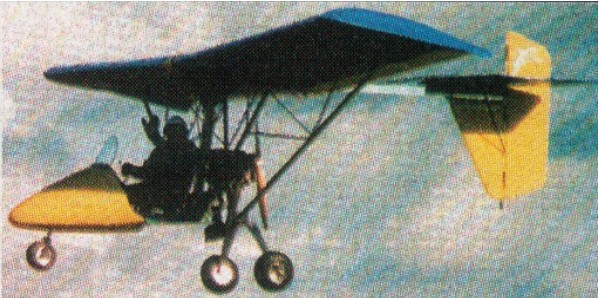
Sandpiper XP-1

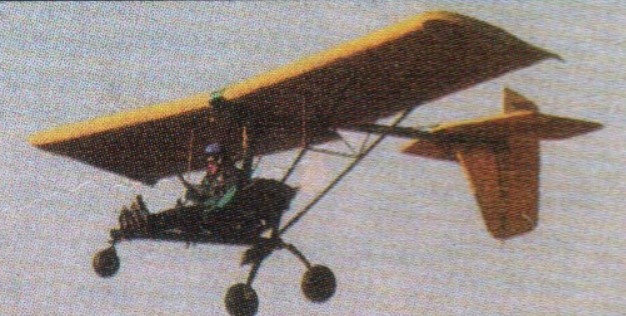
The Sandpiper XP-1, UL-1, and XP-2 kits includes engine, prop and instruments, and is equipped with full span ailerons and steerable nose wheel.
The Hirth engine was available with either gear or belt reduction.

Sandpiper UL-1
Sandpiper XP-2

Sandpiper UL-1
Engine: Rotax 277, 28 hp
HP range: 28-65
Height: 8 ft
Length: 16 ft
Wing span: 26.5 ft
Wing area: 148.9 sq.ft
Fuel capacity: 5 USG
Empty weight: 243 lb
Gross weight: 650 lb
Top speed: 60 mph
Cruise: 55 mph
Stall: 26 mph
Rate of climb: 400 fpm
Takeoff dist: 45 ft
Landing dist: 40 ft
Seats: 1
Landing gear: tri

Sandpiper XP-1
Engine: Hirth 2702, 35 hp
HP range: 35-80
Height: 8 ft
Length: 16 ft
Wing span: 26.5 ft
Wing area: 148.9 sq.ft
Fuel capacity: 24 USG
Empty weight: 305 lb
Gross weight: 790 lb
Top speed: 90 mph
Cruise: 85 mph
Stall: 27 mph
Rate of climb: 1200 fpm
Takeoff dist: 35 ft
Landing dist: 40 ft
Seats: 1
Landing gear: tri

Sandpiper XP-2
Top speed: 85 mph
Cruise: 80 mph
Stall: 30 mph
Rate of climb: 940 fpm
Takeoff dist: 85 ft
Landing dist: 90 ft
Engine: Hirth FP23, 60 hp
HP range: 50-85
Fuel capacity: 24 USG
Empty weight: 380 lb
Gross weight: 900 lb
Height: 8 ft
Length: 16 ft
Wing span: 32.5 ft
Wing area: 182.5 sq.ft
Seats: 2
Landing gear: tri

Sandlin Sundog

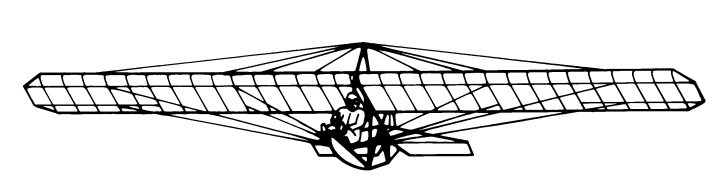
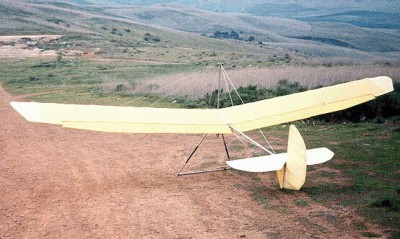
The Sundog is a rigid wing that was designed by Californian Mike Sandlin. The Sundog is an evolution of the Skypuppy,

Sundog was a rigid wing built to test the usefulness of flaps on a hang glider. This version has full span flaps which fold under the wing for transport. There are spoilerons on the top surface of the wing for turning, actuated by side motion of the hang loop. The flaps were pulled down by a rope. The tail surfaces are just fixed stabilizers.

It was too heavy, at 90 lb and the static balance was non-existent (special launch procedures required), but it was fun to fly once you got it in the air. Full span flaps allow simple, easy landings, very similar to a drogue chute.

They were up-only ailerons, actuated from the hang loop, then returned to neutral by a bungee cord (like the spoilerons, which came later). A good system, but Sandlin wanted bigger flaps.

Low performance landings were the easiest and safest.

Sandlin Goat / Red Goat

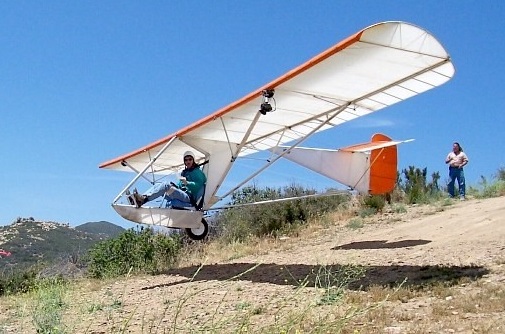
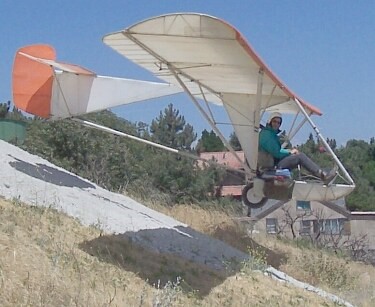
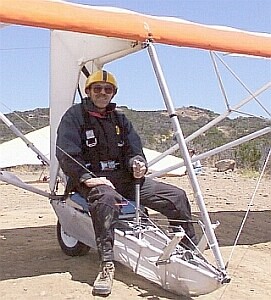
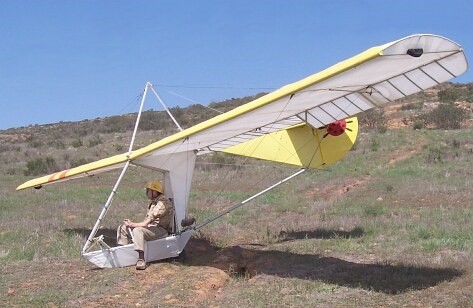
The Goat monoplane glider has been soaring in one version or another since the spring of 2003. The Goat is technically an ultralight sailplane (under United States weight rules) with conventional three axis controls, similar to the Bug4 and the commercial Super Floater. It is designed for slow speed recreational gliding and training. This glider ia an all purpose airchair, allowing comfortable open air soaring, good crash safety, quick assembly, and convenient car top transport.

The idea of an “airchair” is that it flies like a hang glider or paraglider but with improved stability, control, comfort, and crash safety. The glider can be kept at home and transported to the flying site on a simple car top rack. It can be assembled by one person in about 20 minutes. With a wing loading about the same as a hang glider, it flies and soars like a hang glider, making it compatible with many existing hang glider operations, using rolling launches, ground tows, or ultralight aerotows.

The varioius Goats feature:
Five or six major separable parts, the heaviest being the the wing panel at 35 to 42 lbs.
Emergency parachute, hang glider type, hand deployed 22 gore round canopy PDA, with bridle & swivel
16″ or 14″ diameter wheelbarrow or ultrlight aircraft wheel, tube tire
nose skid for braking (no wheel brake), tail skid at rear (or wheel)
drogue chute, hang glider type, 5 ft. diam. (flat octagonal) canopy, attached to main struts or flying cables, 27″ outboard from centerline on left side
tow hookup with weak link loop, to break at about 110% gross weight
Altimeter/variometer mounts on nose tube or strut, hang glider type
Quick assembly pins, handles & tapered ends for “drift pin” assembly, all fasteners attached to airframe
Flap panels in fixed position, or fixed trailing edge.
Four point seat belt
Conventional stick and rudder controls

There are no formal values established for performance, pilot weight, or maximum speeds or loads, because no rigorous tests have been performed to measure these values.

The Goat does not foot launch, but is either towed into the air or else launched by rolling down a hillside. Rolling launches are usually made at a site shared with hang gliders and paragliders. This glider flys very much like a hang glider and readily adapting to hang glider techniques and procedures. The Goat1 has made a cross country flight of more than sixty miles, reaching an altitude above 13,000 feet.

Goat1

The Goat1 made it’s first flight on February 1, 2003, and since then has been flying as a weekend soaring glider. It has proven to be a pleasant and practical glider for slope launching and local flying. It is easy to tow behind an ultralight airplane. The struts fold onto the wing for transport. As of December, 2009, Goat1 had new fabric and removable, folding main struts,and is now called the Red Goat.

Goat1

The biggest drawback to the Goat1 design was the large size and heavy weight of the main wing panel with regard to loading or unloading it onto a car top rack. The folded wing half weighs 42 pounds. The primary reason for the Goat2 design was to have a lighter wing panel to reduce the burden of assembly and loading.

Goat1

Goat2 is a simpler, lighter version of Goat1 with almost exactly the same significant dimensions. In contrast to Goat1, the wing and tail boom are cable braced (no struts) and a 14″ diameter ground roll tire is used instead of a 16″ tire. The elevator control lines now run directly to the elevator control arms without any push rod mechanisms, and the removal of the tail plane for storage and transport has been simplified.

Goat2 (February 2005)

Goat3 has a smaller wing than the other Goats, with a fancier, sailplane style airfoil. The struts are removed for transport, and the wing does not have folding panels on the trailing edge. The seat back and shoulder belts are fixed in place on the nose section and do not require attention during assembly.

The reduced wing area of Goat3 forces flying faster, and the new airfoil doesn’t seem to be producing any dramatic performance improvement. As it stands, it looks as if the larger wing with the simpler airfoil (as used by Goat1 & Goat2) may be a suiperior combination for an airchair. Goat3 probably won’t stay up in light conditions as well as the others.

Goat2 was light and eliminated the bulky struts, but all those long cables created their own transport and assembly problems. This led eventually to the creation of Goat4, which retained the cable braced wing but simplified a lot of the assembly mechanics.

Goat4 (March 2007)

Goat4 is essentially a Goat2 wing with Goat3 nose and tail.

The gliders fly at about the same speeds as a hang glider, readily mixing with hang glider and paraglider traffic. No formal performance measurements have been made, but all are in the hang glider range and can stay up in good lift conditions. The Goats 1-4 have soared thousands of feet above take off altitude.

Goat1

Slow flight provides the unique ability to self launch by rolling down open slopes, usually at the same mountain launch sites used by hang gliders and paragliders. This rolling launch has become a standard procedure for local weekend soaring. A launch slope of a vertical drop of about 17 feet over a rolling distance of 72 feet (so, the rolling distance is two wing spans for the Goat) is suitable.

Quick assembly & roof rack transport make flying convenient. A Goat can be strapped down onto an ordinary hang glider rack, with no special saddles or pads.

A Basic Ultralight Glider is not a hang glider (it cannot be foot launched) nor is it what is usually meant by an ultralight airplane (it has no engine). Its construction is “low tech”, at the hand drill and hacksaw level, for easy home building, from readily available materials (it is made mostly from aluminum tubing and steel cable with polyester fabric covering).

This is a home built glider, made with a low level of technology (no welding, no special machining, no molds or jigs, no spray rig) from readily available materials (mostly aluminum tubing, steel cable, aircraft bolts and heat shrink fabric). The Goat is a noncommercial project, with no product or plans for sale, but complete descriptive drawings of the Goat1 through Goat4 are on the Web. These drawings are freely available for whatever purpose the user may desire.

Gallery

San Diego Aeroplane Mfg Co 1910 [1]

The first San Diego Aeroplane Mfg Co aircraft of 1910 was a Cameron automobile motor powered single place, open-cockpit, mid-wing monoplane, based on the smaller Blériot XI.

Walsh tried several times to get airborne on 23 Januaray 1910, but finally crashed into a fence on a take-off run, and the plane was damaged beyond economical repair. The major claim was being the first powered airplane built in San Diego.

Wingspan: 50’0″
Length: 40’0″
Seats: 1