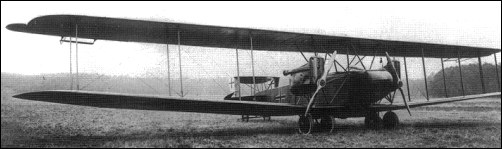
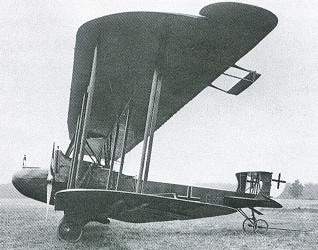
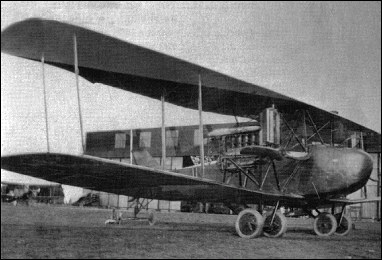
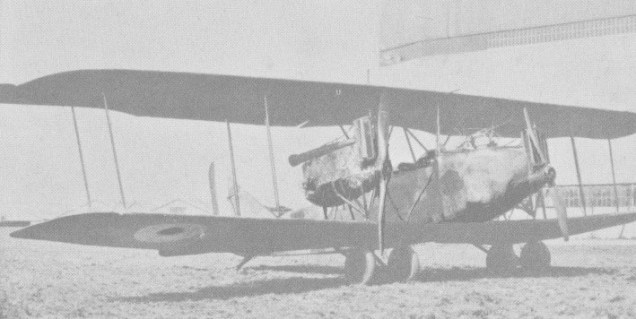
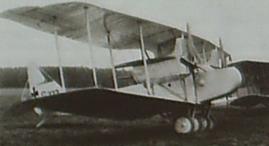
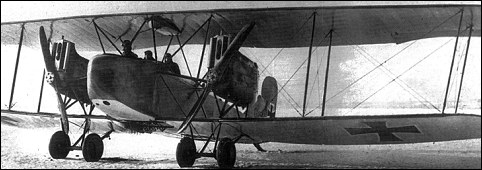
A larger three-bay design and carrying three times the bomb load of the G.II, the G.V entered service in 1918. The G.V was AEG’s last bomber, the end of the war prevented the G.V from becoming operational and it was after the war that a number were operated as six-passenger civil transports by Deutsche Luft-Reederei – an airline company financed by and connected with AEG.
In 1919 the G.V was the only large German 1914-18 aircraft employed commercially to any great extent. As a makeshift transport (with an open cockpit for passengers) a Limousine version was developed. This had a new cabin fairing attached to enclose the passenger area, a downward-hinging fuselage nose to provide a baggage locker (which could also act as a buffer if the aircraft overturned) and a toilet aft of the cabin. One was recorded as flying from Berlin to Eskjo, Sweden in 4 hours and seven minutes.
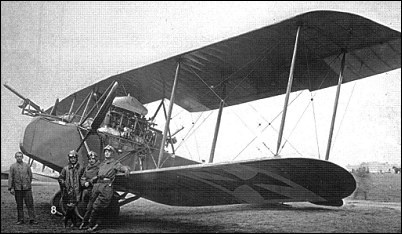
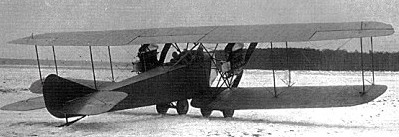
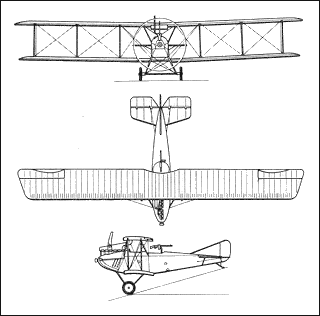
The twin-engine, three-man aircraft was of a biplane design with two steel tube spars, wooden ribs, and wooden leading edge and wire trailing edge. Ailerons were on the top wing only. Of welded steel tube construction and covered in fabric except the plywood skinned nose section, the crew of four could change positions through connected cockpits.
Up to 882lbs of ordnance was carried on the aircraft and this was complimented with two defensive machine gun positions at fore and aft of the pilots mid-position.
The G.IV served the German air force in an offensive capacity but was limited by the short range when carrying a crew of three and full bomb load it was used mainly as a tactical bomber between allied lines on the Western Front. Without a bomb load, it was able to be used for long range reconnaisance and aerial photography. The units equipped with the G.IV fought against the Italians on the Southern Fronts to good effect and would even be called upon to complete night bombing missions. About 50 G.IVs were being used for night bombing behind Allied lines in August 1918.
Small numbers were built for assessment by the Schistas at the front. These included the G.IVb with a three bay wing cellule of increased span, and the G.IVK with a 20mm Becker cannon in the nose.
An example was captured almost intact by the Allied forces and evaluated in flight in the UK, where it was found to be deficient in elevator control and extremely difficult to land. The absence of a passenger in the front gunner’s cockpit apparently made the machine almost uncontrollable.
About 500 of the 542 AEG G bombers built were of G.IV type. Fifty were still in use in France in August 1918.
G.IV Engines: 2 x Mercedes D.IVa, 260hp Prop: 2 blade wooden Wingspan: 60 ft 4.5 in / 18.4m Length: 31 ft 9.5 in / 9.7m Height: 12 ft 9.5 in / 3.9m Wing area: 721.21 sq.ft / 67 sq.m Empty wt: 5291 lb / 2400 kg MTOW: 8003 lb / 3630 kg Fuel capacity: 123 Imp Gal Climb to 3280 ft / 1000m; 5 min Max speed: 103 mph / 165 kph / 89kt Service ceiling: 14,765 ft / 4500 m Time to 9000ft: 24 min Max endurance: 4-5 hr Maximum Range: 466miles / 750km Max bomb load: 882 lb / 400 kg Crew: 3 Armament: 2 x trainable 7.92mm LMG 14 Parabellum
A 1916 development of the AEG G.II equipped with 164kW Mercedes D IV engines driving opposite turning propellers. Produced in limited numbers, the G.III could carry a 50% increase in bomb load on the G.II but was built only for limited service, mostly away from the major fronts.
Engines: 2 x Mercedes D.IV, 220 hp. Bombload: 661 lb / 300 kg
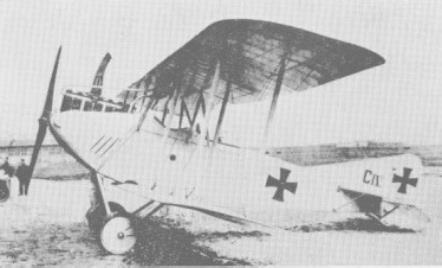
A development of the AEG G.I and powered by 112kW Benz Bz.III engines, the G.II of mid-1915 was a slightly larger version of the G.I, armed with up to three machine-guns and 200kg of bombs. A number of these aircraft had at various stages, single or triple vertical tail surface on each side of the fin and rudder. About 15 G.Is were built before the type was superceeded by the G.III.
Engines: 2 x Benz Bz.III, 150 hp. Crew: 3 Armament: 3 x 7.92mm mg Bomb load: 441 lb / 200 kg
In 1915 the first of the AEG G.I to G.V series twin engined bombers appeared. The G.I was essentially an enlarged version of the C.IV. Only a single example was built which led to the development of the G.II.
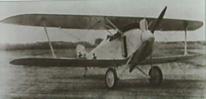
AEG’s first fighter design was the D.I, a short single-bay biplane of mainly steel tube construction under a fabric covering. A notable feature of the D.I was the use of single-spar wings. Three prototypes were built, and the first of these appeared in May 1917. Type testing took place later in August and September after the fuselage had been lengthened by 1 ft 3 ¾ in (0.4 m). The second and third prtotypes (D 440/17 and D 5002/17 respectively) differed by having cheek-type radiators, those of the D.III being longer than those of the D.II. The D.I proved difficult to fly, and one of the prototypes crashed during testing. Nevertheless, 20 pre-series examples of the D.I were ordered for front line evaluation with the standard fighter armament of two 0.312in (7.92mm) LMG 08/15 fixed forward firing machine guns with a synchronisation system to allow them to fire through the propellor disc. The contract was cancelled after the loss of a second prototype in a crash on 5 September 1917.
Type: 2 seat biplane fighter Engine: Daimler D.IIIa inline, 160hp Wing span: 27 ft 10.5 in / 8.5m Length: 20 ft 0.5 in / 6.1m Height: 8 ft 8.5 in / 2.65m Wing area: 173.73 sq.ft / 16.14 sq.m Empty wt: 1510 lb / 685 kg MTOW: 2072 lb / 940 kg Max speed: 137 mph / 220 kph Climb rate: 2 min 30 sec to 3280 ft (1000m) Armament: 2 x fixed 0.312 in (7.92mm) LMG 08/15 forward firing machine guns
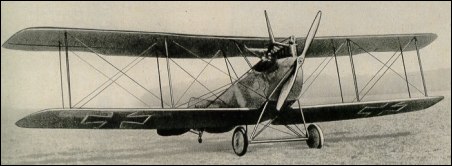
The AEG C.V was a prototype two-seat biplane reconnaissance aircraft of World War I. A single AEG C.IV was modified to utilise a more powerful engine, but the results were disappointing enough that further development was cancelled.
Engine: 1× Mercedes D.IV 8-cylinder, liquid-cooled, inline, 164 kW (220 hp) Length: 7.16 m (23 ft 6 in) Wingspan: 13.46 m (44 ft 2 in) Height: 3.35 m (11 ft) Wing area: 39 sq.m (420 sq.ft) Empty weight: 802 kg (1,764 lb) MTOW: 1,120 kg (2,464 lb) Crew: two, pilot and observer Armament: 1 × forward-firing 7.92 mm (.312 in) LMG 08/15 machine gun 1 × 7.92 mm (.312 in) Parabellum MG14 machine gun in ring mount for observer
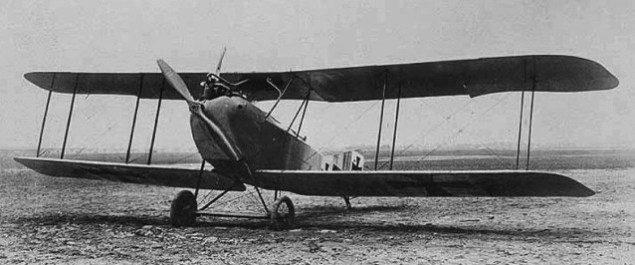
The C.IV was a twin-seat biplane aircraft primarily fielded as reconnaissance platform from 1916 onwards though it also served as a bomber escort and saw service with the German air service through to the end of World War 1in 1918. The C.IV represented one of AEG’s most successful wartime ventures with production exceeding estimated 658 examples.
Designed by Georg König and a little larger than the C.III, the C.IV was a conventional biplane which introduced the D.III engine, a fixed forward firing machine gun for the pilot, and a three position variable incidence tailplane (ground adjustable). The wings featured and equal span upper and lower wing assembly with double bays and parallel struts. The wing main structure was welded steel tube, including main spars of 40mm tubes, with wooden ribs which were fabric covered.
The engine, a single Mercedes D.III water-cooled in-line type of 160 horsepower – was mounted in the extreme forward portion of the fuselage with the distinct radiator “horn” protruding the top. The engine powered a two-blade wooden propeller. The forward portion of the fuselage was contoured to an extent, producing a somewhat aerodynamic look while the rest of the body maintained a boxy-like appearance. The fuselage was a primary box structure of welded steel tube decked on top with plywood and covered at the sides and bottom with fabric.
Seating was for two, made up of the pilot and an observer in tandem, with the pilot in the forward cockpit behind a simplistic windscreen. The pilot had access to a single Spandau machine gun offset to his right side. The system was synchronized to fire through the spinning propeller blades without damaging them via an interrupter gear. The observer manned the rear cockpit, facing aft, and sat inside of a Schneider-type gun mount ring. His position was dominated by a Parabellum machine gun with adequate traverse to engage trailing enemy fighters. The J.1 version carried an extra machine gun firing backward and downwards at 45 degrees.
Over 900 lb of armour plate protected the crew and other vital parts.
The undercarriage remained fixed, characterized by the two large main landing gears at front and a simple tail skid under the tail section. The empennage featured a sharp-angled vertical tail fin with low-mounted horizontal stabilizers.
Performance was good for the time with the C.IV yielding a top speed of 98 miles per hour with a service ceiling of 16,404 feet. Endurance from the Mercedes engine was reported to be roughly 3 hours of flight time.
The C.IV entered service with Germany in early 1916 during the spring season. By June of 1917, no fewer than 150 examples were operating along the Western Front alone. The mount proved a success for the time it was fielded and several models continued in service after the cessation of hostilities. An estimated 400 C.IV and C.IVa models were constructed by Fokker factory at the Schwerin.
The C.IV was produced in two other lesser-known variants designated as C.IVa and C.IV.N. The C.IVa distinguished itself from the base model by fitting an Argus engine of 180 horsepower. The C.IV.N was the prototype form of a C.IV night bomber developed sometime in 1917 with increased span three-bay wings. The night bomber form was powered by a single Benz Bz.III series engine of 180 horsepower and would have carried 6 x 110lb bombs externally.
The C.IV was used by the air forces of Bulgaria (which declared war on Romania in September 1916) and Turkey (engaged in war from 1914, but most Turkish Flying Corps aircraft flown by German pilots).
The C.IV was also fielded by Poland in the years following the war (at least 64 examples).
C.IV Engine: Mercedes D.III 6 cyl inline, 160hp Wing span: 44 ft 1.5 in / 13.45m Wing span: 44.16ft (13.46m) Length: 23.46ft (7.15m) Height: 10 ft 11.75 in / 3.35m Wing area: 419.81 sq.ft / 39 sq.m Empty wt: 1764 lb / 800 kg MTOW: 2469 lb / 1120 kg Max speed: 98 mph / 158 kph / 85kt Cruise speed: 87 mph / 140 kph Climb rate: 6 min to 3280 ft (1000m) Service ceiling: 16,405ft / 5,000m Endurance: 4 hr Max range: 348 sm / 560 km Seats: 2 Armament: 1 x fixed 0.312 in (7.92mm) LMG 08/15, 1 x trainable 0.312 in (7.92mm) LMG 14 Parabellum mg.
C.IVa Engine: Argus inline, 180 hp
C.IV-N Engine: Benz Bz.III, 150 hp Wing span: 15.3m. Bomb load: 6 x 110 lb (50 kg) bombs.
 All Aero