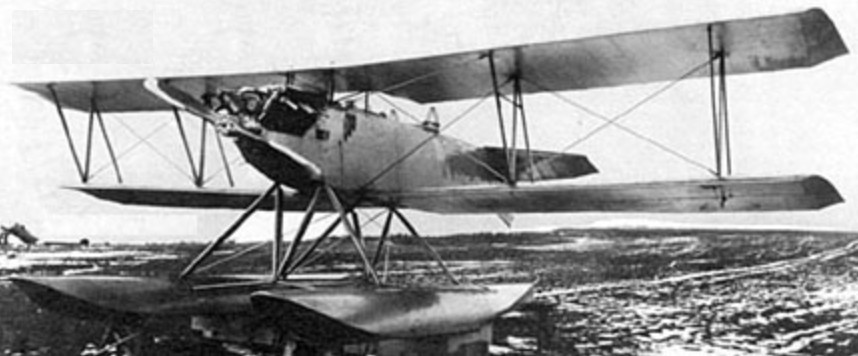
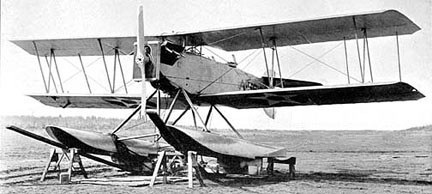
The 1920 AS-1 and 1921 AS-2 were twin float scout-observation aircraft for the US Navy. Costing US$18,450, one AS-1 (A5612) and two AS-2 (A5613 and A5614) were built.
Aeromarine AS-2 A-5613
AS-1, -2 Engine: Hisso, 300 hp Wing span: 37 ft 6 in Length: 30 ft 6 in Speed: 117 mph Ceiling: 16,000 ft Seats: 2
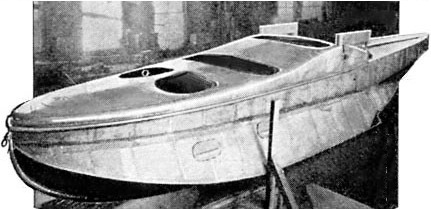
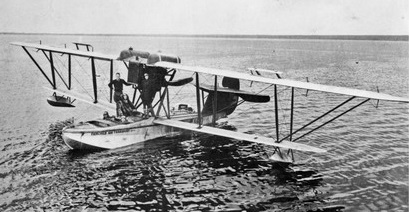
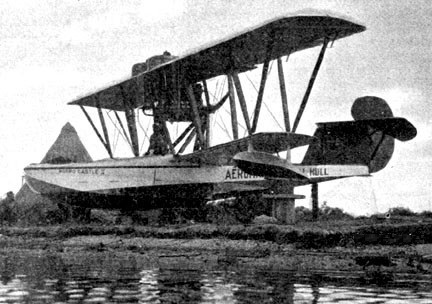
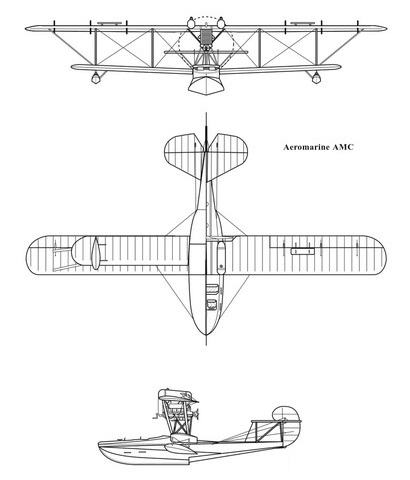
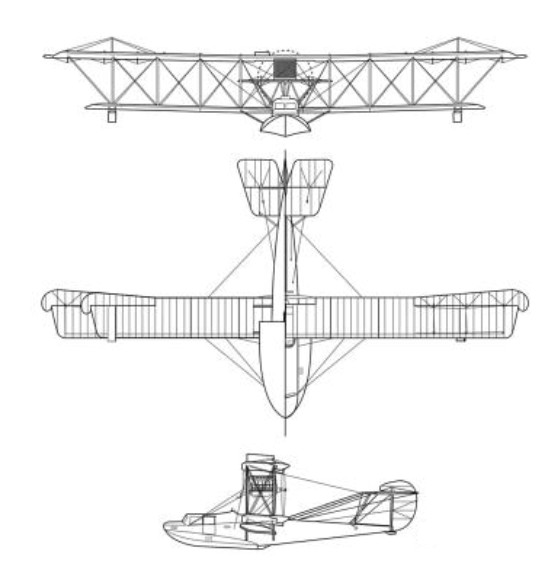
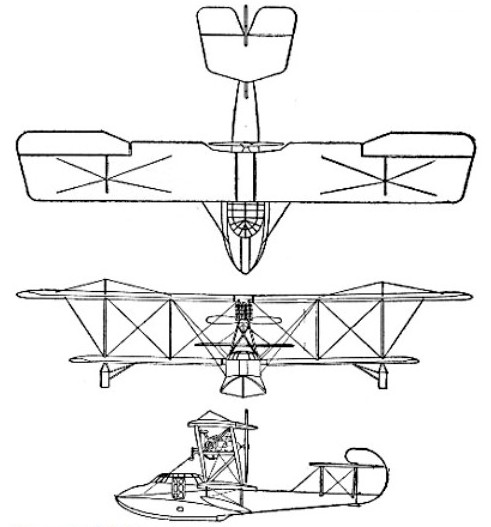
Similar in configuration to the Curtiss HS series, the AMC (Aeromarine Metal Commercial) was an effort to introduce a civil flying boat of conventional two-bay biplane design that possessed a more modern airframe, most notably an all-duraluminium hull and a dural-framed empennage.
The 1923 AMC was built with spruce I-beam spars and ribs, dural-framed empennage; fabric-covered wings and tail; all-duraluminum hull. The AMC was designed to replace the 75s of Aeromarine Airways and first flew on 1 June 1923.
The AMC flew for the first time in June 1923 and soon afterwards commenced a trial route between New York and San Juan, Puerto Rico, however, Aeromarine and its airline subsidary ceased operations in late 1923, and no more AMCs were completed.
The Morro Castle II can be recognized by its shorter lower wings.
Aeromarine AMC in Canadian registration after being sold to Fairchild Air Transport
While not a commercial success, the AMC did establish a new standard for flying boats with more durable metal hulls.
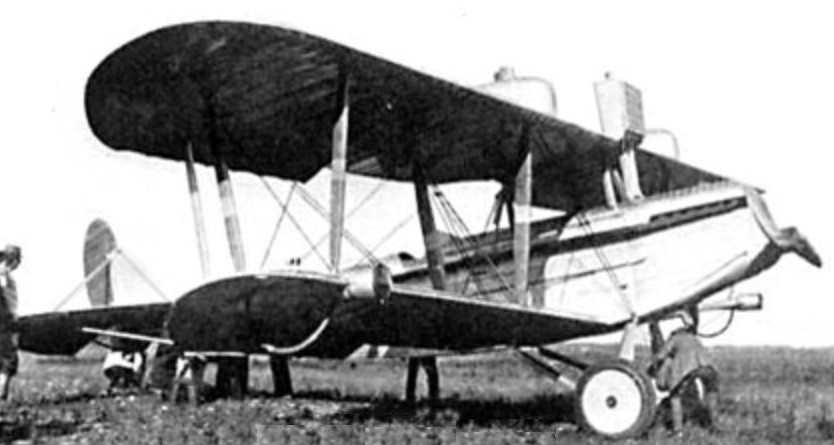
Long before Photoshop, this bit of “creative enhancing” asks more than it tells. It could be a short-wing version of AMC, dubbed Morro Castle II, but its placement in an Egyptian setting is a mystery—perhaps for an ad with a relevant headline. The plane appears to be pasted on the background—a small seam below the rudder hinge is visible. If it is supposed to be landing, it is doomed. The prop is stopped and the pilot sits on the coaming away from the controls, which are set for a severe left hand dive into the Nile.
Engine: Liberty 12, 400 hp Prop: 2 blade wooden fixed pitch Wing span (upper): 65 ft 0 in Wing span (lower): 48 ft 7 in Length: 32 ft 10 in Payload: 2440 lb Max speed: 98 mph Cruise speed: 80 mph Stall speed: 50 mph Ceiling: 14,000 ft Seats: 7-9
The AM-2 night mail carrier (circa 1923) was similar to the AM-1, but the radiator was relocated beneath the engine. One built. The AM-3 night mail carrier, circa 1923, had the radiator moved in front of the engine, like DH-4, and fuel tanks on the upper wing moved to inside fuselage. One built.
The 1923 AM-1 was the first aircraft with an all-metal fuselage covered with sheet aluminium in the US. Designed by Paul Zimmerman to be a replacement for de Havilland DH-4 in mail and cargo duties, but test flights were disappointing, and stability problems brought an end to the project. Only one was built.
Engine: Liberty 12, 400 hp Wing span: 50 ft 0 in Length: 32 ft 11 in Payload: 1575 lb Speed: 116 mph Stall: 44 mph Seats: 1
In 1921 Aeromarine modified a number of ex-Navy Curtiss HS-2L into six passenger flying boats as the Model 80.
At least one was place in service with Aeromarine Airways and another is known to have operated out of Baltimore during 1921 and 1922 with Easter Airways.
Engine: Liberty 12A, 425 hp Wing span: 74 ft 0 in Length: 38 ft 6 in Seats: 6
The Polar Bear derivative of Model 75 was a special model produced for Uppercu’s hunting expedition to the Arctic Circle in spring 1923 with a glazed nose.
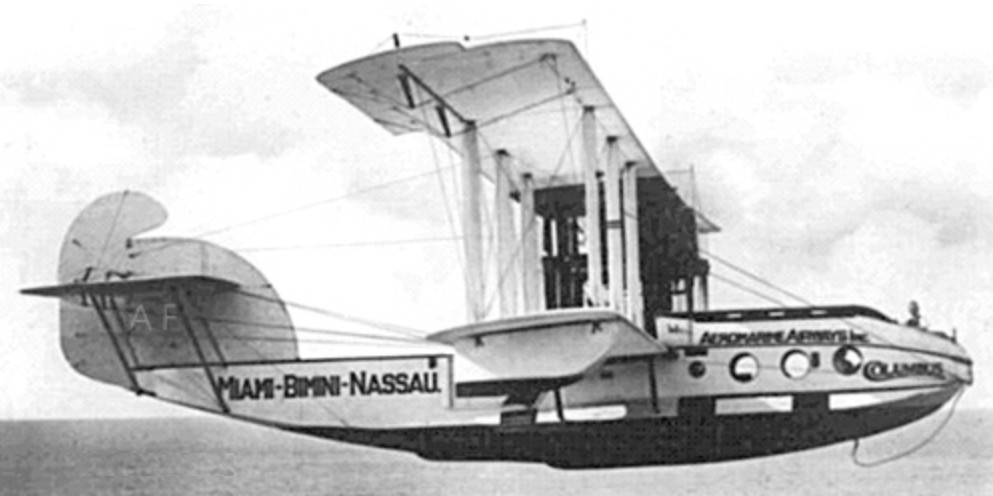
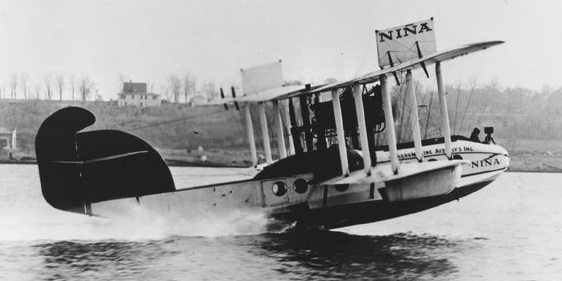
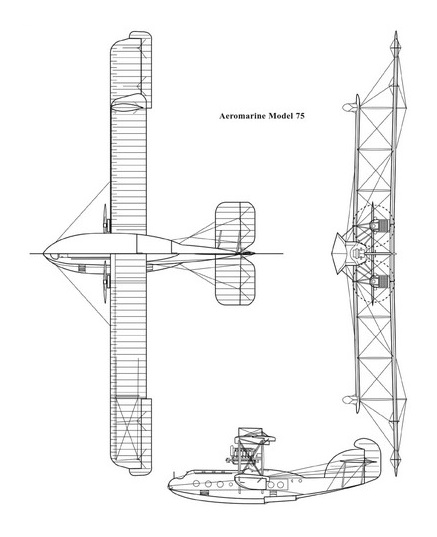
The Aeromarine 75s of 1920 were conversions of surplus USN Curtiss F-5Ls (actually ex-RAF Felixstowe F.5Ls). The conversion involved moving the two-place cockpit back to the trailing edge of the wings and installing passenger accommodations with side windows in the forward half of the hull.
Aeromarine 75 “Nina”
Completed in late 1920, the first two model 75s began operating in 1921 with Aeromarine’s subsidiary, Aeromarine East India Airways, where they commenced scheduled operations between New York City and Havana, Cuba, via Atlantic City, Beaufort, South Carolina, Miami, and Key West, carrying 12 passengers. The two-day air journey took only half the time required by train and boat. In 1922, as more model 75s came into service, the carrier opened a new route across Lake Erie between Detroit and Cleveland and extended southern services to include Nassau and Bimini islands.
In late 1923, after three year of regular flights, Aeromarine ceased operations due to financial difficulties.
Between 1920 and 1921 Aeromarine Plane and Motor Company modified for the needs for its subsidiary company Aeromarine Airways 8 F.5L coming from the surpluses of the US Navy. Arranged for the transport of 10 passengers, these sometimes baptized apparatuses Navy Cruiser they were used as of November 1920 between Key West, Florida, and Havana, Cuba. One of these seaplanes carried out as of the 1 {{er}} November 1920 the first international air postal connection on behalf of the US Post Office). Aeromarine Airways also exploited the seasonal connections Miami – Bimini – Nassau, New York City – Atlantic City, and the line Cleveland – Detroit starting from July 14th, 1922. These apparatuses were baptized Santa Maria / Wolverine, Pinta , Niña , Colombus , Balboa , Ponce of Leon , Buckeye and Mendoza. This last is famous to have flown over New York with 27 people on board in May 1922. The Polar Bear is a Aeromarine 75 especially arranged for a polar forwarding of hunting organized in spring 1923 by Inglis Moore Uppercu, sole distributer of the cars Cadillac with New York and managing director of Aeromarine.
Aeromarine 75
Seven HS-2L were also converted.
Two F-5Ls (Aeromarine Model 75) with accommodation for 12 passengers used on Key West-Havana run until 1923, when air mail subsidies withdrawn.
Engines: 2 x Liberty 12A, 420 hp Props: 2 blade wooden fixed pitch Wing span – upper: 103 ft 9 in Wing area: 1397 sq.ft Length: 49 ft 4 in Empty weight: 9000 lb est Loaded weight: 13,600 lb Max speed: 82 mph Cruise: 75 mph Ceiling: 5000 ft Range: 830 mi Passengers: 12-14 civil Estimated 4-5 completed
The Limousine Flying Boat twin-engine biplane flying-boat was a five seat passenger aircraft of 1922/3. Two designs; one unbuilt and one possibly built, but not flown. Found as the Model 60-U-8-D of 1922 and 60-S-2.
Engine: 2 x Hisso or Aeromarine U-8D, 180hp Wing span: 55 ft 6 in-55 ft 9in Length: 31 ft 9 in
A 1922 version of the Aeromarine 52 with Aeromarine U-8D pusher engine. (also known as Model 55-L8)
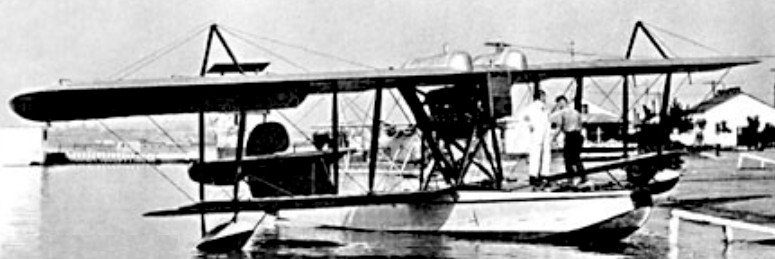
A total of 4 or 5 of the 3 or 4 place 1919 Aeromarine 50 / 52 / 55 Limousine Flying Boat were built.
The models 50, 52, and 55 represented an ultimately unsuccessful attempt to offer civil versions utilising components of the Navy A40 trainer utilising the wings, tailplane, and general hull structure of the model 40F.
The model 50B of 1919, model 52 of 1921, and model 55 of 1922 all featured enclosed cockpits.
A total of 4 or 5 of the 3 or 4 place 1919 Aeromarine 50 / 52 / 55 Limousine Flying Boat were built.
The models 50, 52, and 55 represented an ultimately unsuccessful attempt to offer civil versions utilising components of the Navy A40 trainer utilising the wings, tailplane, and general hull structure of the model 40F.
The model 50B of 1919, model 52 of 1921, and model 55 of 1922 all featured enclosed cockpits.
Aeromarine 52-U8D was a 1921, three seat version of the Aeromarine 50 with the Aeromarine U-8D engine.
Engine: Aeromarine U-8D Wing span: 48 ft 6 in Length: 28 ft 11 in Seats: 3


 All Aero