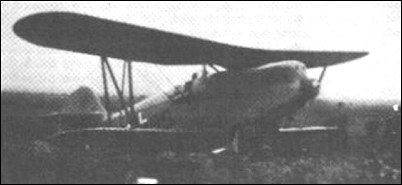
Development of the Ar.64 and powered by a 372kW BMW VI inline engine, the first prototype flew in 1931. Delivery of production Ar.65E single-seat fighters began in 1933 and the first Staffel became operational in April 1934. The Ar.65E was superceeded in production by the slightly heavier Ar.65F, but both versions were transferred to training units from 1935 with the arrival of better aircraft.
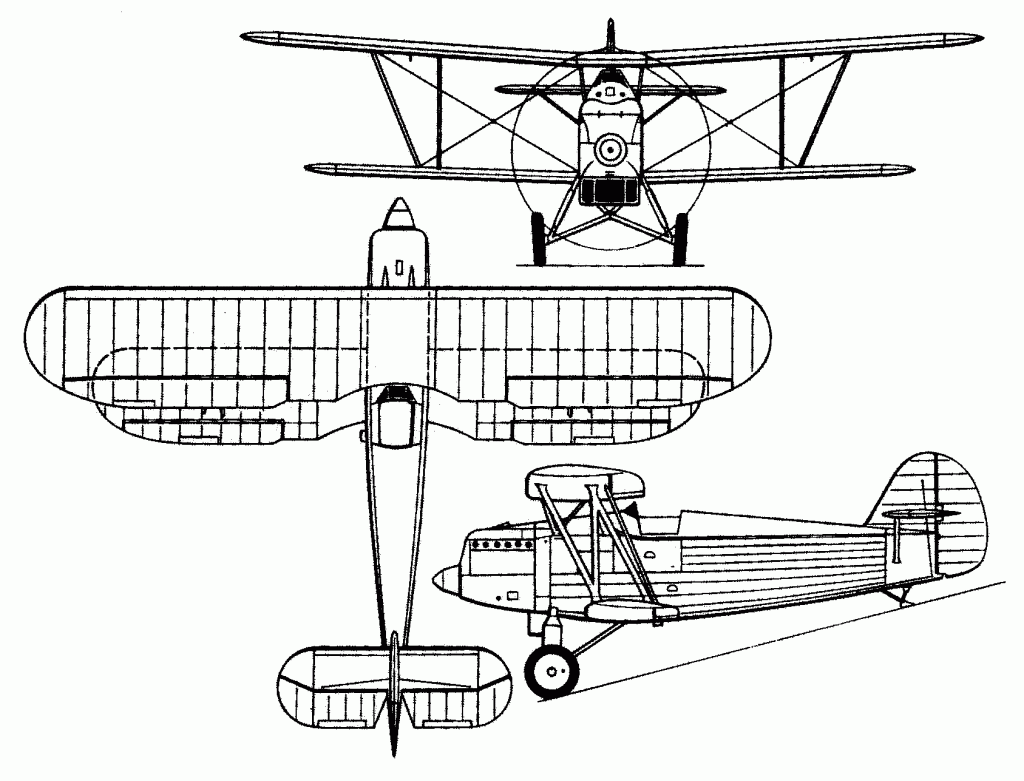
Developed from SD.II and SD.III prototypes that Walter Rethel produced at the request of Reichswehrministerium, the Ar 64 was a single-seat biplane fighter intended to succeed Fokker D.XIII. It was a traditional biplane with unequal wings of mixed construction, the aerofoil having a timber structure and the fuselage a metal tubular structure, both fabric covered. The landing gear was fixed, with a split axle.
Versions Arado Ar 64a: First prototype, powered by a Bristol-built Jupiter VI, 530 hp licensed built by Siemens Halske and with a four-bladed wooden propeller.
Arado Ar 64b: The second and third prototypes, tested with Lipetsk in 1931, were powered by a 12 cylinders BMW VI 6,3 of 640 hp and were used for the development of the Ar 65.
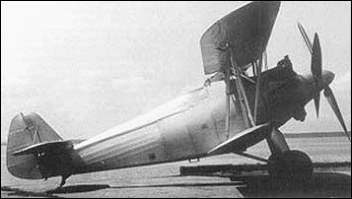
Arado Ar 64c: The last prototype appeared in 1931, and was distinguished from the first by a reinforced structure and a four-bladed propeller of large diameter.
Arado Ar 64D: A production version powered by a Jupiter VI, identifiable with a modified landing gear and a two-bladed propeller. The armament was proposed to be 2 7,9 mm machine-guns but it is very probable that they were not fitted on the 19 aircraft of the DVS during 1934/1935. These aircraft were used as advanced trainer by civil and military pilots.
Arado Ar 64E: The last version, powered by a Jupiter VI. Used by Jagdstaffeln of Fliegergruppe Döberitz and Damm, along with Ar 65.
Users: Germany: 30 Ar 64 were ordered by Luftwaffe clandestine between 1931 and 1934, including 12 to produce by Focke-Wulf. 6 Ar 64D and 5 Ar 64E were in account at April 1, 1933. The last specimens were delivered during 1934 and, in spite of the arrival of Ar 65, intended to succeed to him, 21 Ar 64 remained in service on July 1, 1936.
Soviet Union: The first Ar 64 had been used briefly for tests powered by a Rolls-Royce engine before ordering 24 to be delivered at the beginning of 1933, but by April 1936 they had received only 19 planes.
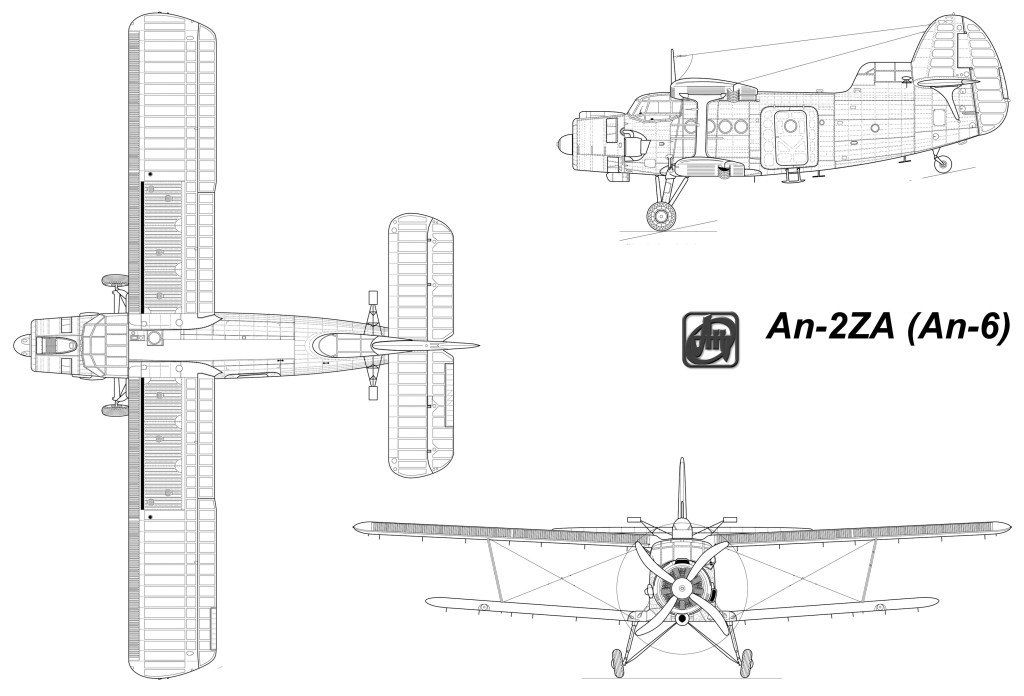
The An-2ZA variant of the An-2 (design bureau designation An-4) is intended specially for high-altitude meteorological research. The An-4 has a glazed position immediately in front of the tail fin for an observer. The ZA suffix standing for Zondirovanie Atmosfery, translatable as ‘air sampling’. The An-4 is able to maintain power up to 10,000m by the ASh-62IR engine has a TK supercharger mounted on the starboard side of the cowling. The spinner of the An-2 standard model is deleted to aid engine cooling, and the original ailerons have been replaced by an unslotted variety.
Over the years several efforts were made to improve the An-2 and several turbine engined versions have appeared.
ASTC (Antonov Aeronautical Scientific and Technical Complex) was the first to launch a turbine-powered variant. Design studies started in 1972 and in 1979 a photo was released of a modified An-2 (CCCP-30576) fitted with a 960 hp Glushenko TVD-10B turbine engine. Designated An-3, it was followed by a second test aircraft, now with a more powerful 1,430 hp Glushenko GTD-20. The upgraded variant was planned for production in several versions, but in the end no production aircraft were built.
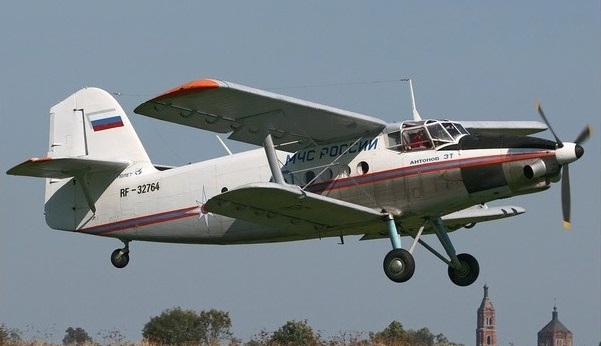
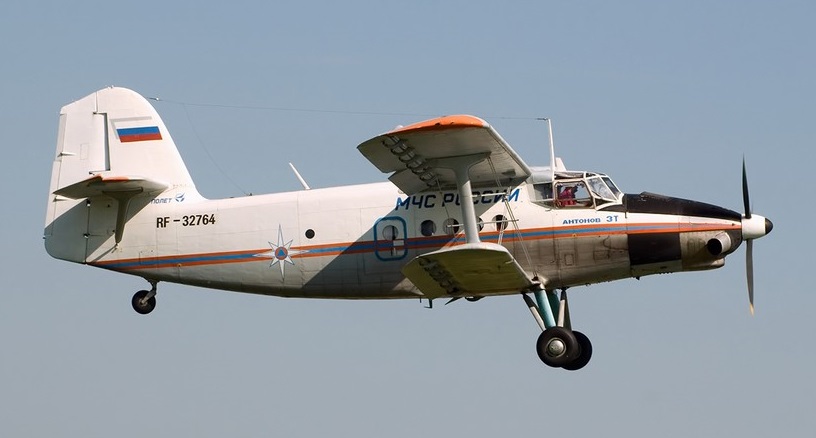
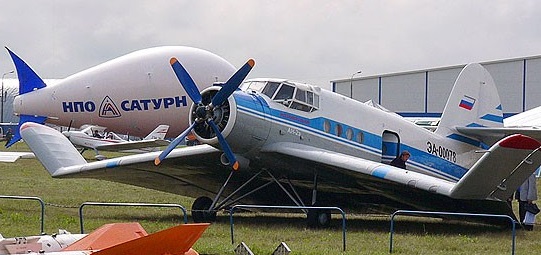
The An-3T was more or less a revival of the An-3 and was developed by Omsk-based Polyot State Aerospace Enterprises, reportedly in co-operation with ASTC. The first An-3T made its maiden flight on February 10, 1998, powered by a 1,375 hp Omsk (Glushenko) TVD-20M turbine. The An-3T had several changes compared to the original An-3 such as the larger An-2M vertical tail, a extra partition between the cockpit and cabin, and was mainly intended for transport work, rather than as ag-plane. No new An-3Ts were built, but the twenty or so that were completed were modified from An-2 airframes which had sufficient structural life left. Plans for production of the An-3T in Poland were abandoned.
An-3T
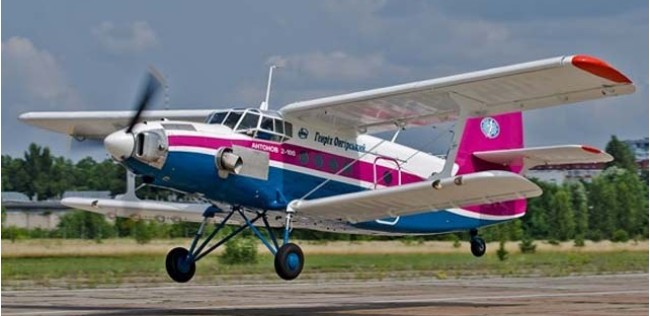
The An-3-300 designation was reported for a 2012 joint-venture of Tyumen Plant no.26 (Russia) and engine manufacturer Motor Sich (Ukraine) for a Motor Sich MS-14 turbine engine powered version. The joint-venture fell through and instead the Antonov Company developed the An-2-100 which had a 1,500 hp MS-14 engine. A prototype first flew on July 10, 2013 and the upgrade was mainly aimed at the many An-2s that were still in operation in countries such as Belarus, Uzbekistan, Kazakhstan, Russia etc.
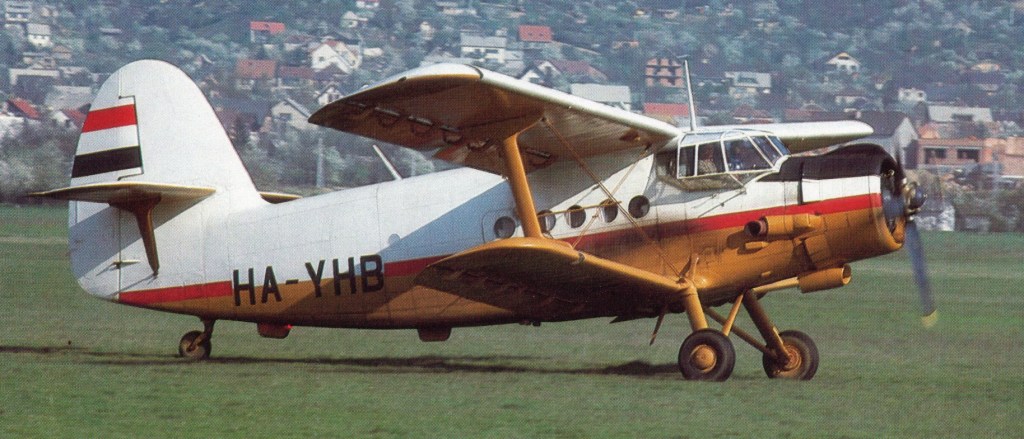
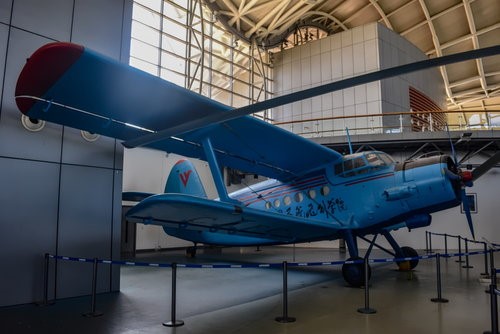
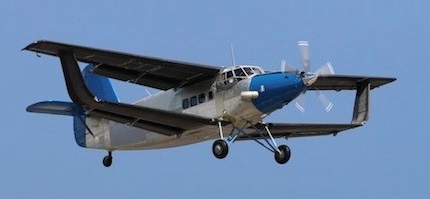
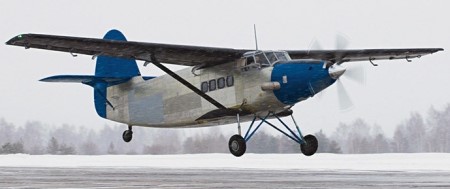
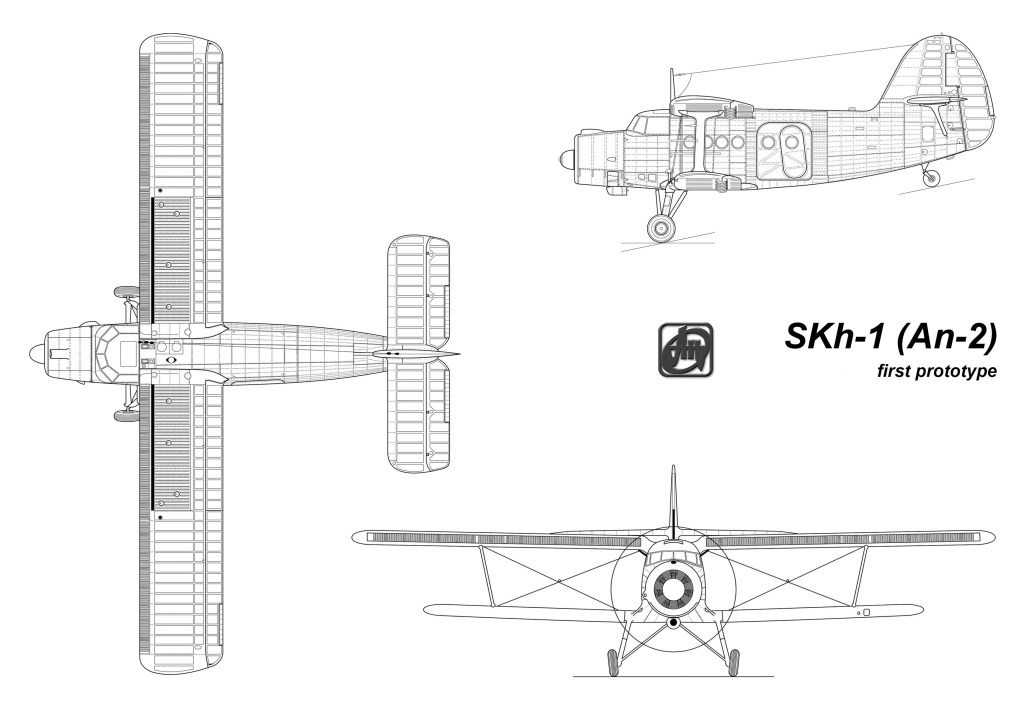
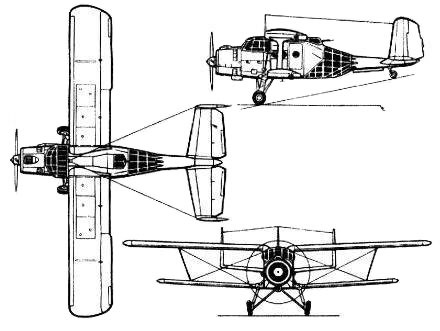
Designed originally for agricultural duties two prototypes of what became the An-2 were designated SKh-1 and the first example made its first flight on August 31, 1947. The type was developed by OKB-153 (Design Bureau 153) which was later named after Oleg Antonov. The prototypes had a 630-hp Shvetsov ASh-61, and ASh-62 respectively, radial engine with the latter being selected for production aircraft. With an all metal fuselage and fabric wings aft of the main spar, the aircraft can carry a crew of 2 plus 14 passengers. NATO code name ‘Colt’ and is designated in US DoD nomenclature as the “Type 22”.
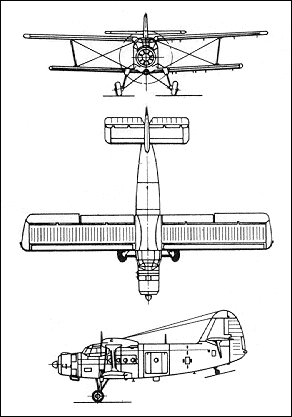
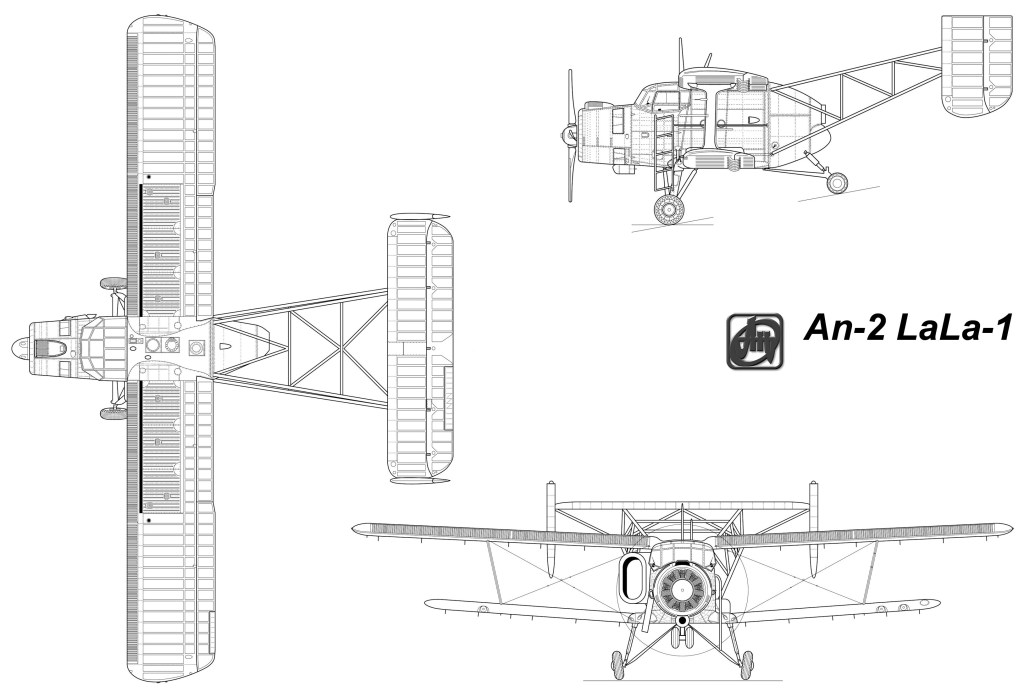
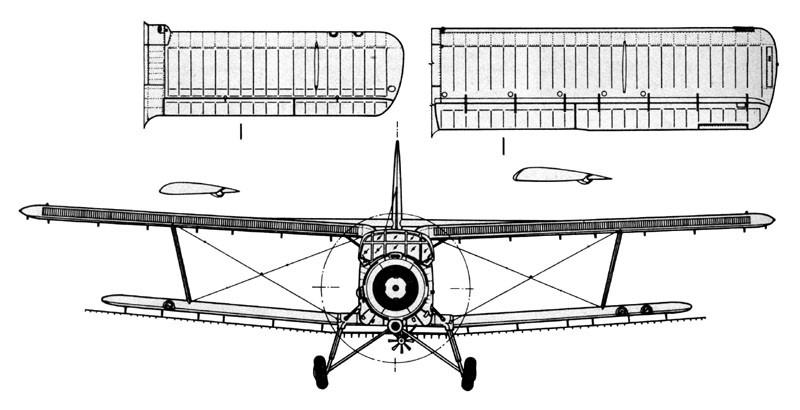
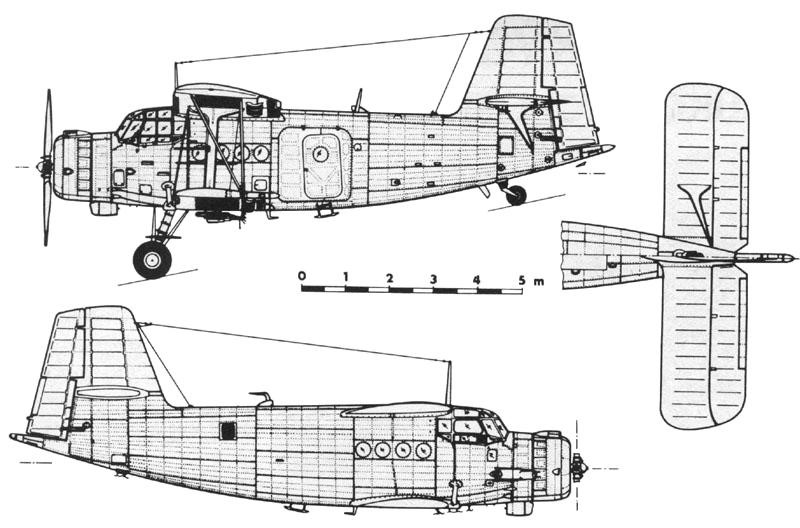
Externally, the An-2 engine – powering a four-bladed propeller – is held in the extreme forward of the fuselage with the cockpit directly aft. The cockpit is heavily glazed and observation port windows can be seen along the fuselage sides. Wings are of an unequal span single bay biplane design, all metal construction, with fabric covering. Each wing is connected via a single large vertical strut making up a single wing bay and each wing has dihedral. The wings have full length automatic leading edge slats and ailerons droop with flap actuation to provide great STOL performance. Fuselage is of all-metal stressed skin semi-monocoque construction. The fuselage tapers slightly into the empennage which has a single large, smooth-edge vertical tail fin and stabilizers mounted to either tail fin side. Tail is a braced all metal structure with fabric covering. Wing area is 770 square feet total. Ailerons, rudder, and elevators are all manually controlled with pushrods and cables. Flaps and trim electrically operated.
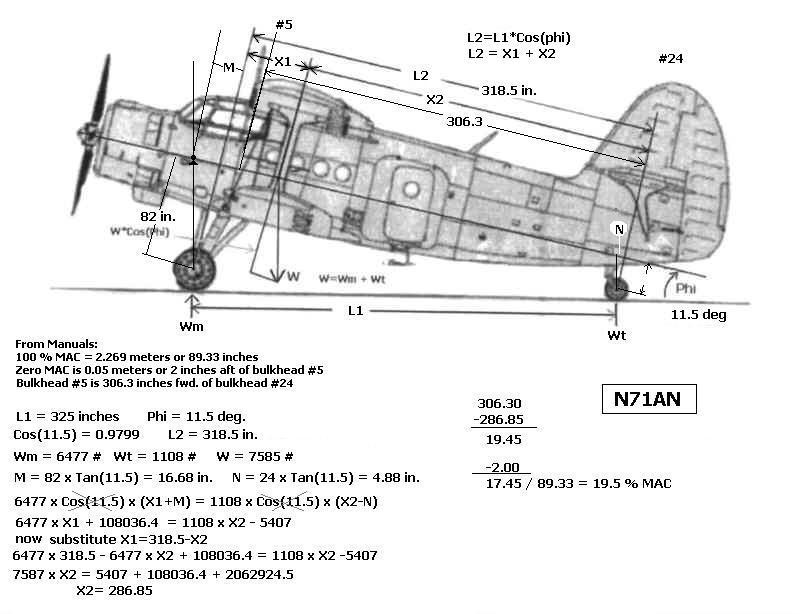
The landing gear is of conventional configuration (tail wheel design) with split axle, long stroke oleo shock absorbers on the main mounts and a fully castoring and self centering tail wheel. The main landing gear legs feature wheel bogies angled inwards with each leg braced at two points along the underside of the fuselage. Brakes are pneumatically operated. Normally two pilots, but may be flown single pilot when no passengers are aboard.
The compressed air system has an 8 litre (490 cu.in) air cylinder at 49 bars (711 PSI) maintained by an engine driven AK-50M compressor and AD-50 relief valve. A pressure gauge is on pilot’s left hand console. A pressure reducer supplies 10 bars (145 PSI) for the main brakes. The Air Pressure is required for the pneumatic main wheel brakes, but can be used to charge the landing gear shock absorbing oleo-pneumatic struts when dry nitrogen is not available. A fitting is also available to fill the tires from this system. The 8 litre air cylinder can also be charged from appropriate ground support equipment.
The electrical system has a 24 VDC battery with engine driven generator to maintain charge. A Voltmeter and Ammeter are on the Instrument Panel. The 28 VDC generator requires at least 900-1000 RPM to kick in. 36 Volt 3 phase 400hz AC power, supplied by two convertors, is used to power the Russian Gyroscopic compass, Artificial Horizon and ADF.
Nine fire detectors are located throughout the engine compartment. If the Fire Warning Lamp light, the CO2 system can be activated by breaking the safety seal and pushing the button. The CO2 bottle has an electrically activated pyro-technic cartridge to release the CO2 into the collector. Portable CO2 Fire Extinguishers are normally installed in the cockpit and cabin as well.
The Oil System consists of a 125 litre (33 gal) max permitted 22 gal tank, suction pump and an external oil cooler with electrically controlled shutters. They use Aeroshell 100 Oil.
Accommodations are generally made for a crew of one pilot and cabin seating can hold an additional 12 passengers.
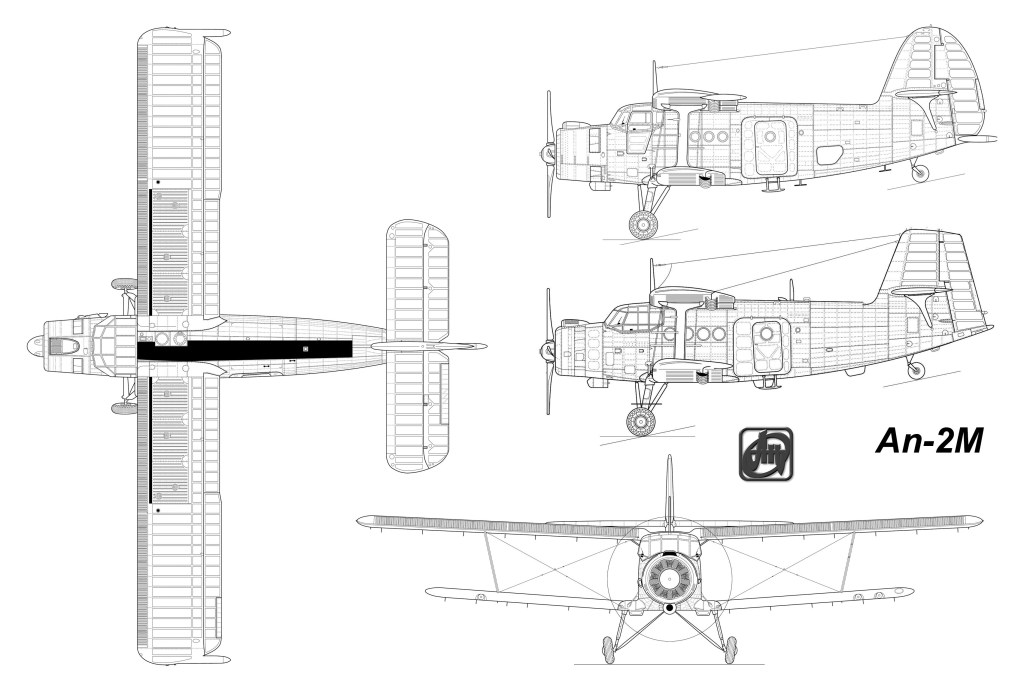
Almost 3600 An-2 were built at Kiev, ending in mid-1960s after limited manufacture of specialised agricultural An-2M. Production was transferred to PZL Mielec, Poland.
The An-2R developed and built by WSK-PZL in Poland was a special agricultar model. Introduced in 1964, it carried a fiberglass container for 1960 litre pesticides or 1350 kg fertilisers.
China acquired licence and has built Yunshuji-5 (Y-5) versions from 1957.China has produced many versions of the An-2 beginning with the Fong Shou-2 (“Harvester-2”). This was the first An-2 built to agricultural specifications. The Nanchang Y-5 is a transport version since taken over in production by Harbin with 727 examples delivered. Nanchang Y-5II was an agricultural form seeing production number 229. Shijiazhuang Y-5A was a light passenger model based on the An-2T and produced in 114 examples. The agricultural derivative became the Shijiazhuang Y-5B based on the An-2 SKh. The PLAAF makes use of the Shijiazhuang Y-5B(T) para-drop model. The Nanchang Y-5C is an amphibious version of the Y-5A while the Nanchang Y-5D is a bomber crew trainer. The Nanchang Y-5K became a VIP passenger transport seating five.
Y-5
By 1991 over 18.000 of the different types were built in the Ukraine (5000), Poland (12000) and China (1000). In 1994 the Polish manufacturer of the An-2, Meliec, produced a version which conformed to the US FAR 23 requirements.
The Antonov An-2 has seen combat action. It was debuted during the Korean War (1950-1953) and later in the Vietnam War – the latter by the North Vietnamese. Some An-2’s were converted from their traditional crop dusting roles to become make-shift bombers in the Croatian War of Independence (1991).
Notable operators of the An-2 have included Afghanistan, China, Cuba, East Germany (and Germany proper), Egypt, Georgia, Hungary, Iraq, Laos, Lithuania, Macedonia, North Yemen, North Korea, Poland, South Korea, Romania, Russia, Serbia, Somalia, Sudan, Syria, Turkey, Ukraine, Vietnam, Yemen and Yugoslavia.
The An-3 was originally considered as a turboprop development of An-2, but was offered as a midlife upgrade of the An-2 to have a turboprop engine and other improvements (first flown 1980).
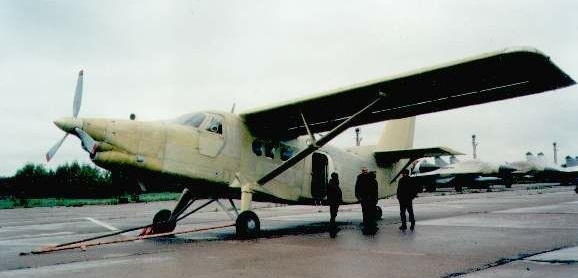
Another organization working on a “better” An-2 is SibNIA (Siberian Aeronautical Research Institute) in Novosibirsk, Russia. In this version, the An-2MS (An-2MC in Russian) and later usually referred to as the TVS-2MS), the radial engine was replaced by an 1,100 hp Honeywell TPE331-12UHR turbine, driving a five-bladed Hartzell propeller. The first An-2MS/TVS-2MS was first flown on September 5, 2011 and by 2015 well over fifteen examples had been delivered by SibNIA and Rusaviaprom JSC, all built, from existing An-2 airframes retaining the An-2 wings and tail feathers.
An-2-100
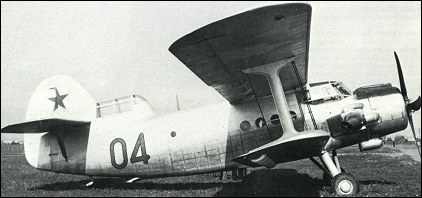
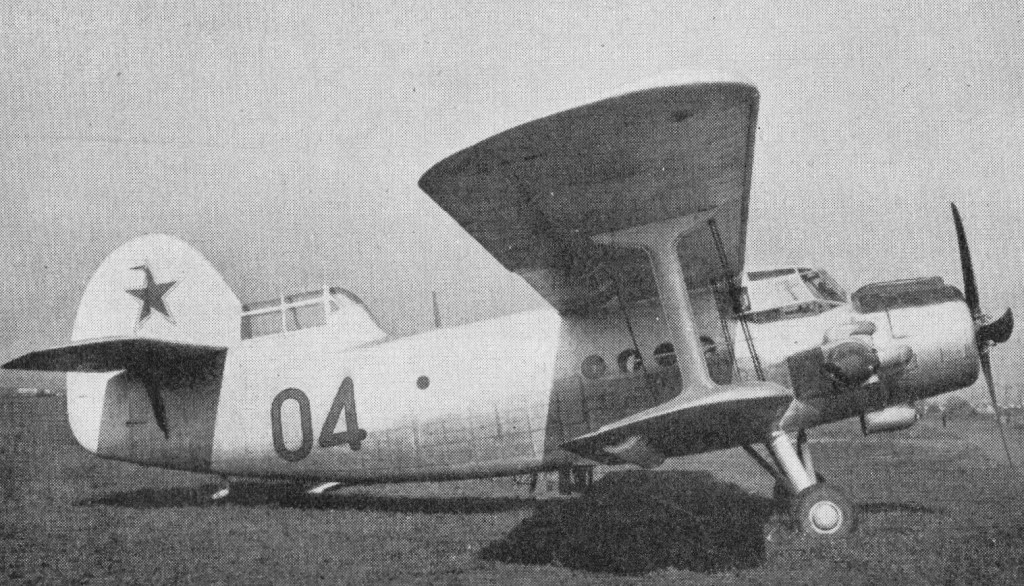
An-2 04 was modified for meteorological research by the addition of an observation cockpit in front of the fin, and a turbo-supercharger on its Ash-621R radial engine.
On 19 July 1954 it established an FAI altitude record for its class of 11,248 m (36,880 ft).
There was even a ground effect version, the An-2e WIG.
There have been various attempts to modernise the AN-2 over the years;
Antonov An-2 (Colt) Engines: 1 x Shvetsov ASh-62IR 9-cylinder supercharged radial, 1,000 horsepower. Length: 40.68ft (12.4m) Wingspan: 59.71ft (18.20m) Height: 13.45ft (4.10m) Empty Weight: 7,275lbs (3,300kg) Maximum Take-Off Weight: 12,125lbs (5,500kg) Maximum Speed: 160mph (258kmh; 139kts) Cruise: 100-110 kt. Maximum Range: 525miles (845km) Rate-of-Climb: 700ft/min (213m/min) T/O roll: 220 ft. Service Ceiling: 14,750 ft (4,500m) Accommodation: 2 + 12
Engine: Shvetsov ASz-62 IR, 1000 hp max Propeller: 4 blade AW-2 Wing Span: 59 ft 8 in / 18.18 m or 14.2 m / 46 ft 7 in Length: 41 ft 9 in / 12.74 m Height: 4.1 m / 13 ft 5 in Total Wing Area: 256.6 sq.ft Upper wing area: 156.2 sq.ft Lower wing area: 100.4 sq.ft Empty weight: 7,600 lb Max Take Off weight: 12,125 lb / 5500.0 kg Max Landing weight: 11,574 lb Max fuel: 2,000 lb / 312 USG Oil Qty: 22 Gallons Max / 13 Gallons minimum to 18 Gallons normal Useful load max fuel: 2,525 lb Useful load half fuel: 3500 lbs VNE: 162 kt VFE: 70 kt Best Glide: 65 kt Maximum Speed: 139kt / 160 mph / 258 km/h Economy Cruise: 100kt / 115 mph Minimum Speed: 49kt / 56 mph Take-Off Speed: 43kt / 50 mph (15 degrees of flap) Landing Speed: 46kt / 53mph (30 degrees of flap) Stall Speed: 35-40kt (controlled descents are possible at 25kt / 30mph) Typical SL Take-Off to 50 ft: 1600 ft Minimum SL Take-Off Run: 560 ft Typical SL Landing distance 50 ft: 1400 ft Normal Range: 485nm / 900 km with 45 min. res Max Range: 550nm / 6 hours endurance Max SL Rate of Climb: 680 fpm Time to 14,425 ft: 30 min Service ceiling: 16404 ft / 5000 m Ceiling: 14,425 ft with 1,100 lb cargo Cross wind component: 8 kt with full flaps Max wind speed for taxy: 20 kt Cargo compartment: 13.5 ft long x 5 ft wide x 5.9 ft high Cargo compartment capacity: 398.25 cu.ft Cargo door opening: 4.5 ft wide x 5 ft high Crew: 2 + 16
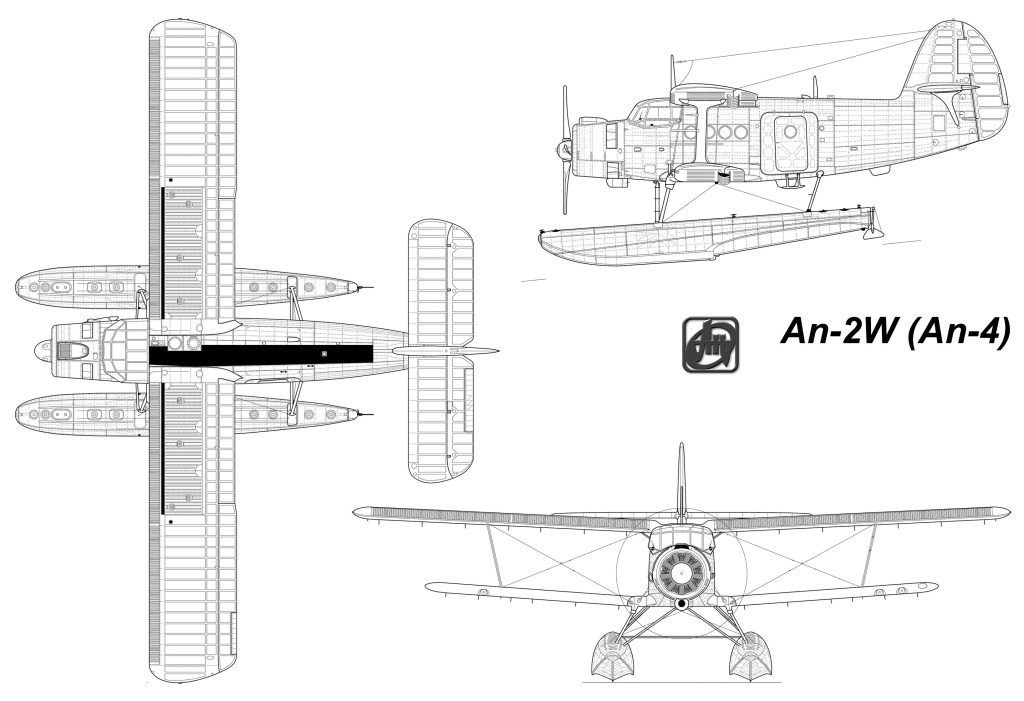
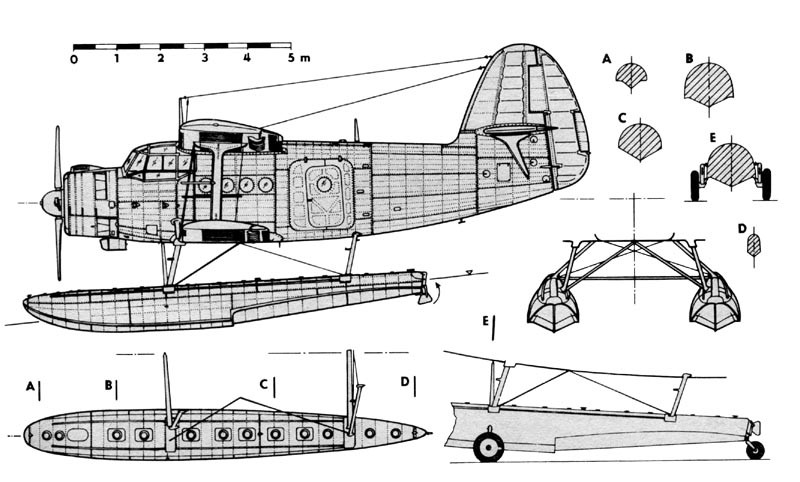
An-2V floatplane Wingspan: 59 ft 7.5 in Wing area: 769.6 sq.ft Max speed: 153 mph TO dist: 260-330 ft Landing dist: 195-260 ft Min water depth: 32 in Max wave height: 20 in
During the 1940 occupation of Bessarabia, light tanks may have been dropped from a few meters up by TB-3 bombers, which as long as the gearbox was in neutral, would allow them to roll to a stop.
The biggest problem with air-dropping vehicles is that their crews drop separately, and may be delayed or prevented from bringing them into action. Gliders allow crews to arrive at the drop zone along with their vehicles. They also minimize exposure of the valuable towing aircraft, which need not appear over the battlefield. So the Soviet Air Force ordered Oleg Antonov to design a glider for landing tanks.
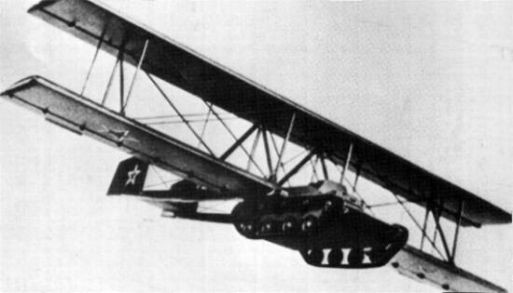
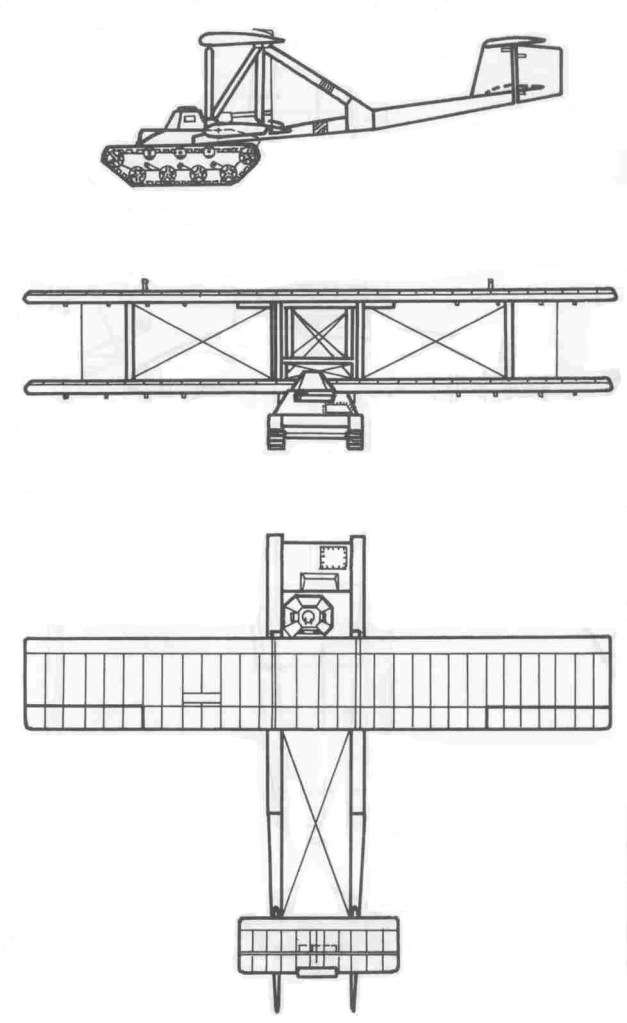
Instead of building a glider, he added a detachable cradle to a T-60 light tank bearing large wood and fabric biplane wings and a twin tail, the Antonov A-40 Krylya Tanka (Russian: крылья танка, meaning “tank wings”). Such a tank could glide into the battlefield, drop its wings, and be ready to fight within minutes.
One T-60 was converted into a glider in 1942, intended to be towed by a Petlyakov Pe-8 or a Tupolev TB-3. The tank was lightened for air use by removing its armament, ammunition and headlights, and leaving a very limited amount of fuel. Even with the modifications, the TB-3 bomber had to ditch the glider during its only flight, on September 2, 1942, to avoid crashing, due to the T-60’s extreme drag (although the tank reportedly glided smoothly). The A-40 was piloted by the famous Soviet experimental glider pilot Sergei Anokhin. The T-60 landed in a field near the airdrome, and after dropping the glider wings and tail, the driver returned it to its base.
Due to the lack of a sufficiently-powerful aircraft to tow it at the required 160 km/h (99 mph), the project was abandoned.
Crew: Two Capacity: 1 × T-60 tank Length: 12.06 m (39 ft 6¾ in) Wingspan: 18.00 m (59 ft 0¾ in) Wing area: 85.8 m2 (923.5 ft2) Empty weight: 2,004 kg (4,418 lb) Gross weight: 7,804 kg (17,205 lb)
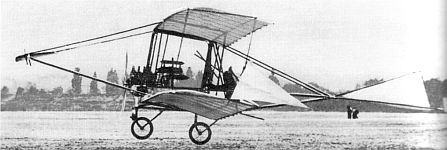
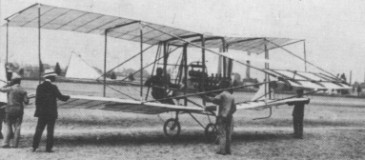
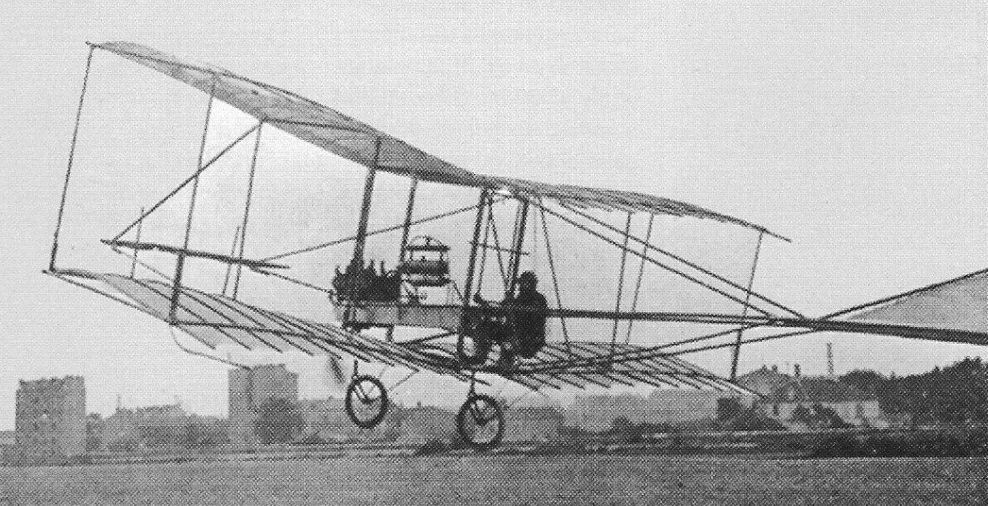
Aeroplane of bamboo construction was incremental improvements to the Gastambide-Mengin II, by French Army Capitaine Ferdinand Ferber also known as the Antoinette III, and powered by an Antoinette motor of 50 hp. On September 22, 1909 at Boulogne, while preparing for a cross-channel attempt, Capitaine Ferber, b.1862, was killed on this machine when after a half-hour flight it overturned when it struck a mound during its landing.
It has two identical wings, one on top of the other.
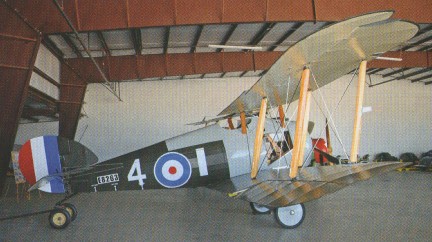
Chuck Wentworth’s Antique Aero spent four years constructing an authentic Sopwith 7F.1 Snipe replica for Javier Arango’s Aeroplane Collection at Paso Robles, California. The aircraft was made using original plans and even includes a pair of original (but deactivated) Cooper bombs. Built with a le Rhone rotary engine, arrangements had been made to obtain a Bentley in 2010.

 All Aero