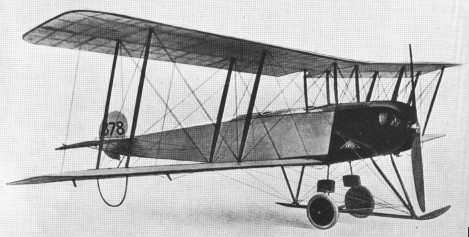
The Avro 504 was being designed at the end of 1912 and was introduced by entry in the second Aerial Derby, which was scheduled for 20 September 1913.
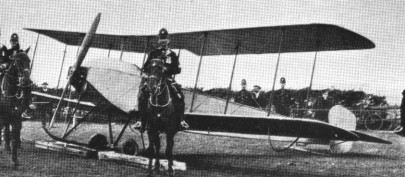
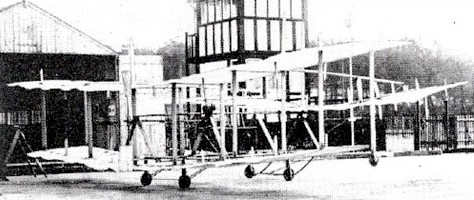
It was built behind closed doors and the prototype first flew in July 1913bpowered with an 80 hp Gnome engine inside a square cowling.
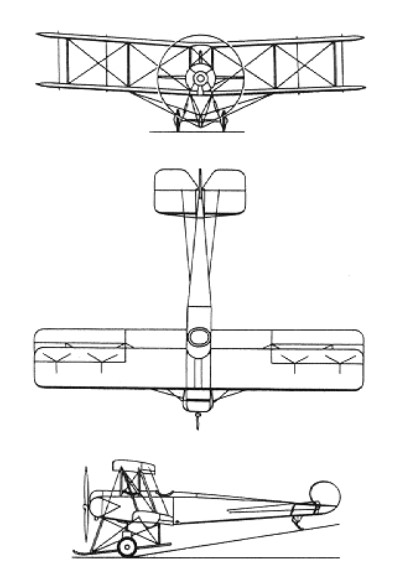
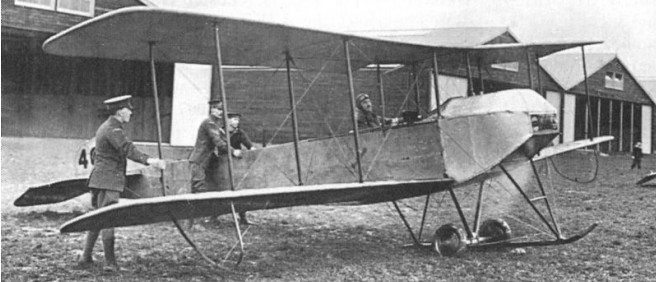
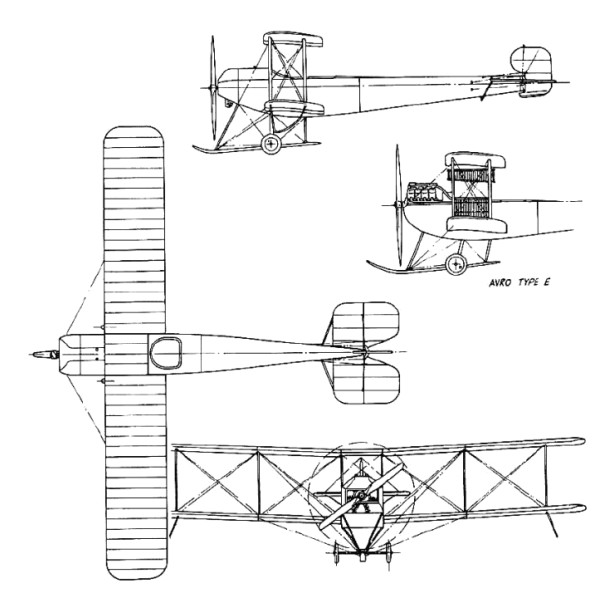
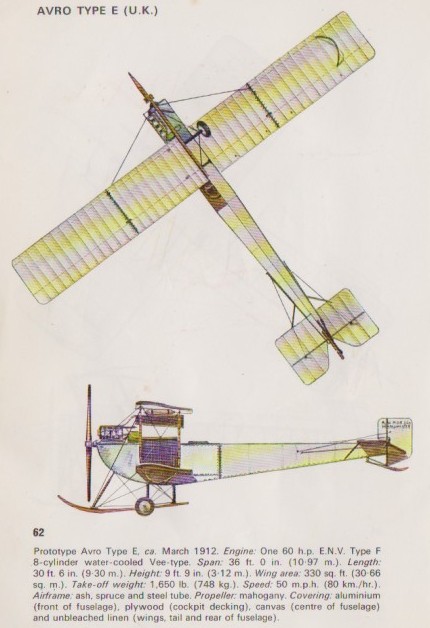
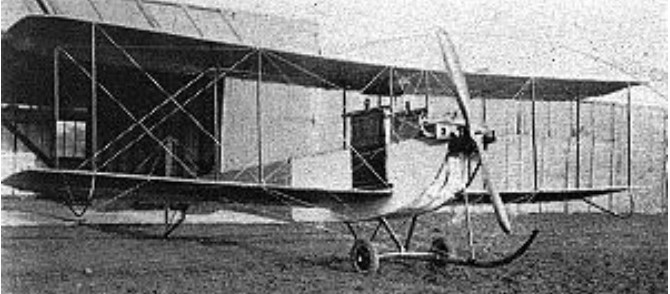
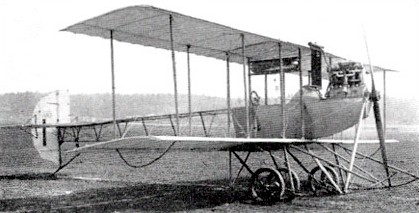
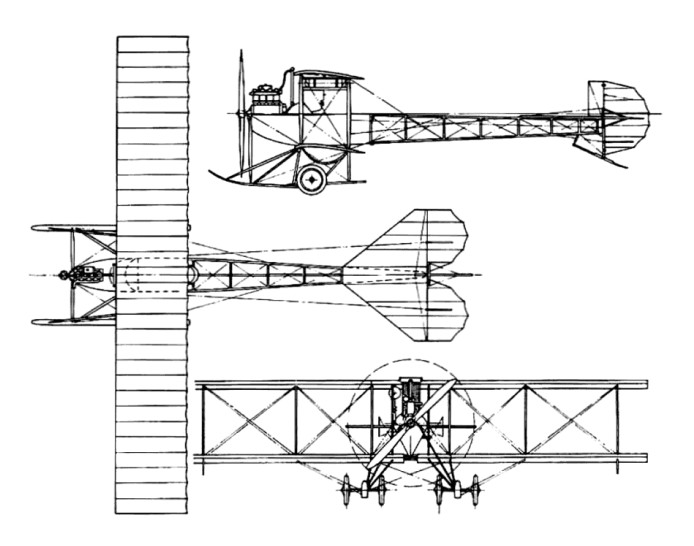
When flown to Hendon to take part in the race it was seen in public for the first time. It came fourth at an average 107km/h. An achievement for an aircraft first flown three days previously. The 504’s fuselage and undercarriage were designed by Roy Chadwick and a man called Taylor, while the wings were designed by H.E.Broadsmith. The fuselage was of a braced, box girder construction consisting of four spruce longerons and spruce cross struts. The cockpits were in tandem, the pilot occupying the rear of the two seats. The two-bay wings were staggered but of equal length, braced by hollow spruce strut. The undercarriage was similar to that of the Avro 500, but made much simpler and strengthened by means of anchoring the skid to the fuselage by means of a steel V struts, to which a steel tube axle was fixed, supported by two main undercarriage legs with built-in rubber shock absorbers. The tail skid was attached to the comma-shaped rudder.
With an order placed by the Royal Navy and Royal Army of Britain, the Type 504 was in service by 1913 with its Gnome Rotary engine generating a perceived 80hp which amounted to more like 60hp in practice.
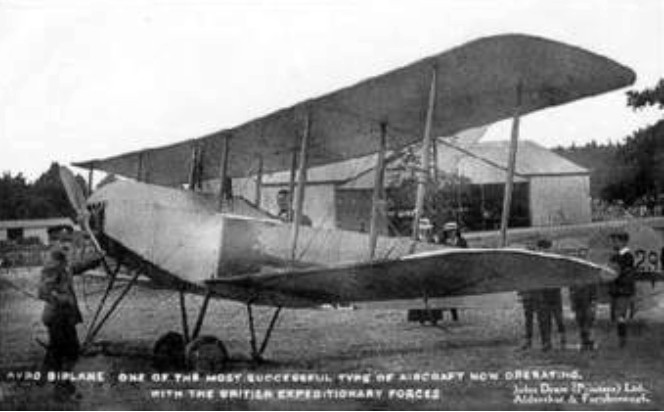
A small number entered service as light bombers in both the RFC and RNAS just as war broke out in 1914 and a few went to France with the original expeditionary force in August, 1914. Powered by an 80 hp Gnome Monosoupape in a semi-circular cowling and hinged ailerons in place of the original warping ailerons, the 504s were used by the RNAS raid on the Zeppelin sheds at Friedrichafen in November 1914. On 21 November 1914 three pilots of the RNAS made a successful raid on the Zeppelin Works at Friedrichsthaven The aircraft were flown by Sqn.Ldr E.F.Briggs, Flt.Cmdr J.T. Babington, and Flt.Lt S.V. Sippe. Within a year it was widely used as a trainer except by the RNAS as an anti Zeppelin aircraft.
The 504 was to remain standard equipment in the RAF until 1933 and 8340 were built during 1914-18, of which 5446 were delivered to the RFC mainly for training.
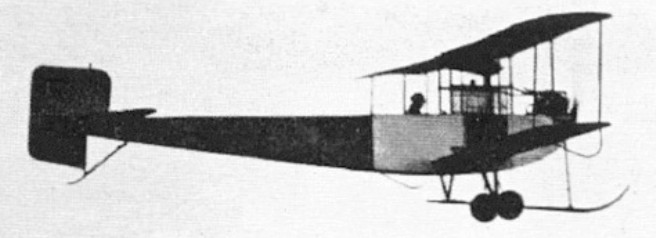
The Avro Type 504, at its core, was a single engine biplane design. Depending on the model series, crew accommodations amounted to one or two personnel. Armament was usually a forward flexible-mounted Lewis machine gun of 7.62mm caliber. Additional stores in the way of bombs could be affixed to underwing portions of the aircraft. Early models also contained a landing skid in addition to the fixed landing gears, though this skid would be removed in subsequent models.
The Avro 504 was made in larger numbers than any other aircraft prior to the Second World War, and served in many air forces for more than 20 years. The Avro 504 was very similar to the Avro 500, and likewise powered by the 80 hp Gnome rotary engine.
In November 1913 a 504 set a measured speed of 130.2 km/h (80.9 mph) and soon afterwards a British altitude record at 4395 m (14420 ft).
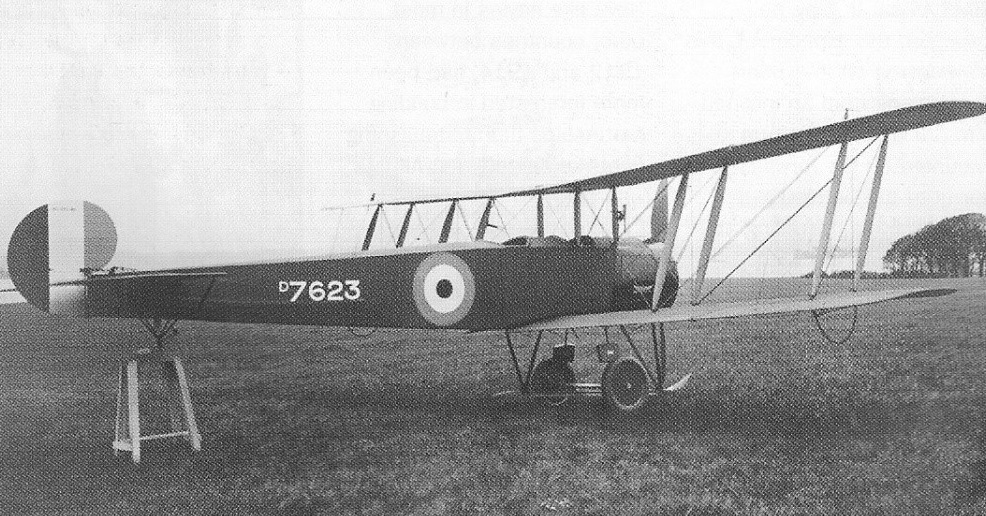
A total of 63 early models were supplied to the RFC (one was shot down on scouting duty over the Western Front as early as August 22, 1914 – the first British aircraft ever shot down) and RNAS. The RNAS used their machines as strategic bombers, three flying as single seaters from Belfort on November 21, 1914, each carrying four 9 kg (20 lb) bombs dropped on the Zeppelin assembly sheds and hangars (and a gasworks) at Friedrichshafen. One Zeppelin was destroyed. Such raids became impossible with the advance of German ground forces, but the RNAS machines con¬tinued to fight the enemy in every way, with light bombs under the wings and an observer in the front cockpit manning a 0.303 in Lewis gun. Two U Boats were destroyed in a raid by RNAS 504s on the submarine base at Antwerp, while many missions were flown in the ground strafing role.
Bulk production began with the RFC 504A (shorter ailerons) and RNAS 504B (normal ailerons but a fixed fin).
Powered by either an 80 hp Gnome or (later) LeRhone engine, the 504A and 504B entered service in quick succession early 1915. These incorporated several design and structural changes at the request of the RNAS, including the introduction of a new, hinged wooden tailskid that was retained on all subsequent variants.
The 274 single seat fighter conversions included 80 RNAS 504C with front cockpit faired over and, typically, a pilot aimed Lewis on the upper centre section. This single-seat version with a large fuel tank in place of the front cockpit, increasing the endurance to 8 hr 30 min. A cut-out in the centre section of the top wing enabled a 0.303-in Lewis machine gun to be mounted so that it could be fired upwards at 45 degrees. A few carried Le Prieur rockets or Ranken incendiary darts for anti-Zeppelin missions. The RFC counterpart was the 504D but this was not built in quantity.
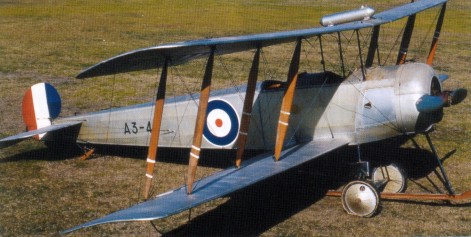
There were many other sub types, but the next major development was the fully aerobatic 504J of 1916, in which the Gnome was replaced by the 100 hp Gnome Monosoupape. This was the first purpose designed military trainer and was the aircraft which laid the foundation for all subsequent flying training in all countries. By 1916 the Avro 504J had been introduced into service as the standard British training aircraft, joining the School of Special Flying at Gosport, Hampshire, as well as almost every RFC and RNAS flying school.
Powered by a 100-hp Gnome Monosoupape engine, this model was identical externally to the 504A and introduced the Gosport Tube.
In 1917 the 504J was followed the 504K. The 503K had a new universal engine mount that consisted of two bearer plates that were capable of accepting any of a number of suitable engines. This led to the aircraft being fitted at various times with a 90-hp RAF 1A and Thulin, 100-hp Gnome B Monosoupape, Curtiss K6 and Sunbeam Dyak, 110-hp Le Rhone 9J, 130-hp Clerget 9B, 150-hp Bentley B.R.1, 170-hp A.B.C. Wasp and a 200-hp Hispano-Suiza.
2200 504K were built and others were converted from J models. In early 1918 the more powerful K sub types were again converted into single seat anti-Zeppelin fighters. A single-seat, night-fighter version of the 504K was produced to defend England against Zeppelin raids. With a 0.303-in Lewis machine gun mounted on the top wing and the forward cockpit covered, the aircraft was used by six Royal Air Force and Home Defence squadrons in the northern section of London.
The 504K equipped all of the RAF Flying Training Schools until 1924 when it was replaced by the Lynx engined 504N.
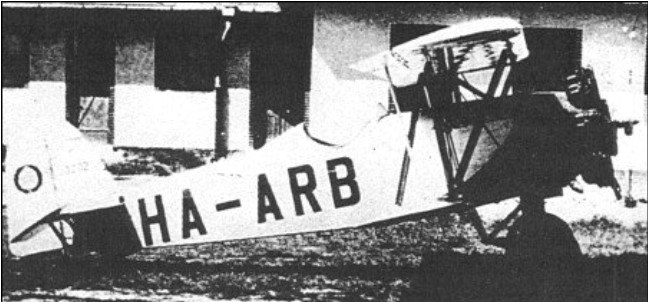
Immediately after World War One the Belgian Air Force obtained 50 504Ks for primary training. Of these, 28 were built at the SABCA factory between 1924 and 1927. They were fitted with either Clerget or Le Rhone engines, and one was experimentally equipped with a Renard engine. The last known order placed for Avro 504s was in October 1937 when Belgian company Societe Anonyme Belge de Constructions Aeronautics (SABCA) ordered ten aircraft. At the outbreak of World War Two a few examples were still in service. One 504K was to become O-BADB, but the registration was not taken up.
During the civil war after the October Revolution, the Avro 504 was used by white troops and foreign interventionists fighting against the young Soviet state. One was shot down in the Petrozavodsk region in 1919. It was manned by the pilot Ankudinov, a white guard. Sergei Ilyushin was commissioned to disassemble the apparatus and take it to Moscow where, at the Duks factory, several young builders drew up the plans under the direction of N. N. Polikarpov. Shortly thereafter, the GAZ No.3 “Krasni Liotchik” factory in Petrograd began to produce the Avro aircraft as U-1 (in Russian: ГАЗ №3 У-1), destined to the training of the young pilots of the future KA VVS.
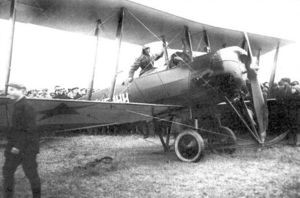
The U-1 was conceived as a two-bay two-seater biplane with a 30º offset in the upper wing and lacking a keel in the empennage. The construction of the aircraft was characterized by the absence of the use of plywood, but the initial examples had some peculiarities such as the use of mahogany and copper welds in the structure.
The wing spars were constructed of sawn pinewood pieces. The surface to area reached 33 m². Power was a 120 hp M-2 (licensed copy of the Gnôme) engine.
The landing gear was characterized by the use of an anti-canopy ash skid in the front area, something unusual in Russian or Soviet aircraft construction.
Familiarization with production started at GAZ No.5, but after building a few machines it was decided to transfer it in 1923 to GAZ No.3 “Krasni Liotchik” in Petrograd. Between 1923 and 1931 664 copies would be built here. In total about 700 copies were built.
The U-1 was the result of collective work in which the GAZ No. 3 collective “Krasni Liotchik” stood out in a fundamental way. Its specialists and workers were responsible for introducing the model into production and keeping it active for several years. The different modifications were introduced during the construction process directly by the factory engineers.
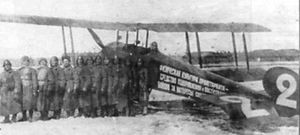
From the first year of operation, the U-1 proved to be capable of meeting all the requirements established for teaching piloting. With the 120 hp engine, the aircraft developed a speed of 135 km / h, with a landing speed of about 70 km / h and a take-off run of only 100 meters.
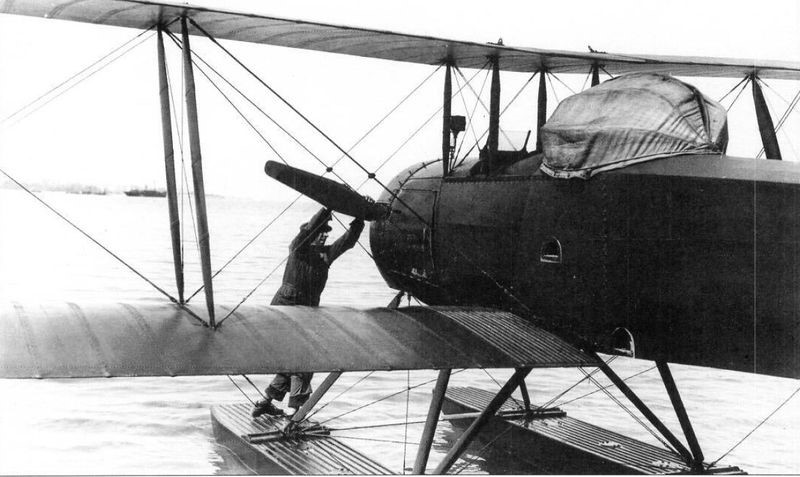
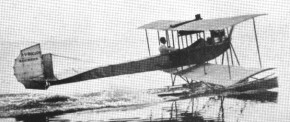
The good results of the airplane in training motivated to think about the formula to create an airplane capable of being used for naval pilot training. In this way, the MU-1 version with floats was developed.
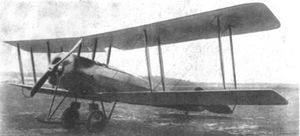
From 1922 the U-1 became the main primary training aircraft. Thousands of pilots were trained in this model in flight schools and flying clubs. The students affectionately called them “Avrushka.” It became the main Soviet training model until it began to be replaced by the Polikarpov U-2. The last U-1s were used in flying clubs until 1935.
In the USSR the first flight with solid fuel accelerators (TTU for the acronym of Tviordo-Toplivnie Uskaritieli) took place in May 1931 and was carried out in a U-1 suitably modified by the engineers of the GAZ No.3 VI Dudakov and VA Konstantinov. The experimental work began in March and after several tests, a program was carried out that included more than 100 flights. All were made by factory pilot S. I. Mujin. During these flights, the takeoff run time was reduced to just 1.5 seconds.
The final wartime production version was the 504L float seaplane. Total wartime production of the 504 in Britain amounted to 8340.
From the first year of operation, the U-1 proved to be capable of covering all the requirements established for piloting training. At that time, the Russian Fleet presented an enormous need to renew its fleet of trainers. Factory No.3 was asked to assess the possibility of manufacturing a version with floats on the coach.
The original English floats were made from thin 4 x 100mm strips placed in two layers. The inner layer was made of ash with the strips located at an angle of 45º with respect to the longitudinal axis of the float. The outer shell was mahogany located lengthwise. Between both layers was one of fabric soaked in a waterproof varnish. All fixings were made using copper rivets with aluminium washers. The internal structure of the floats was made of ash and the fixings were made using brass screws.
The construction of the floats was very strong, but heavy and above all expensive and complicated, using a significant amount of metals, expensive ash and imported mahogany. The weight of a pair of these floats was 211 kg. The fixing legs were made of steel tubes lined with streamlined wooden fairings.
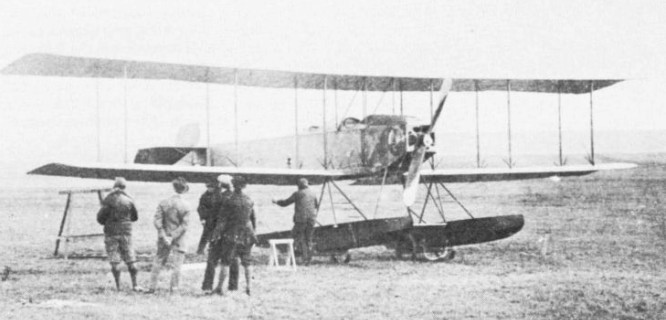
On the GAZ No.3 the construction of the floats was appreciably simplified without losing quality. Soviet floats were constructed of 4-5mm plywood and ash sheathing was used only for the bottom and sides up to the waterline. The weight decreased to 170 kg.
In its speed, ceiling, and takeoff and landing characteristics, the seaplane hardly differed from the land model. Only the turn time and the climb (both worsened almost twice as much) suffered deterioration. The seaworthy characteristics of the model were acceptable.
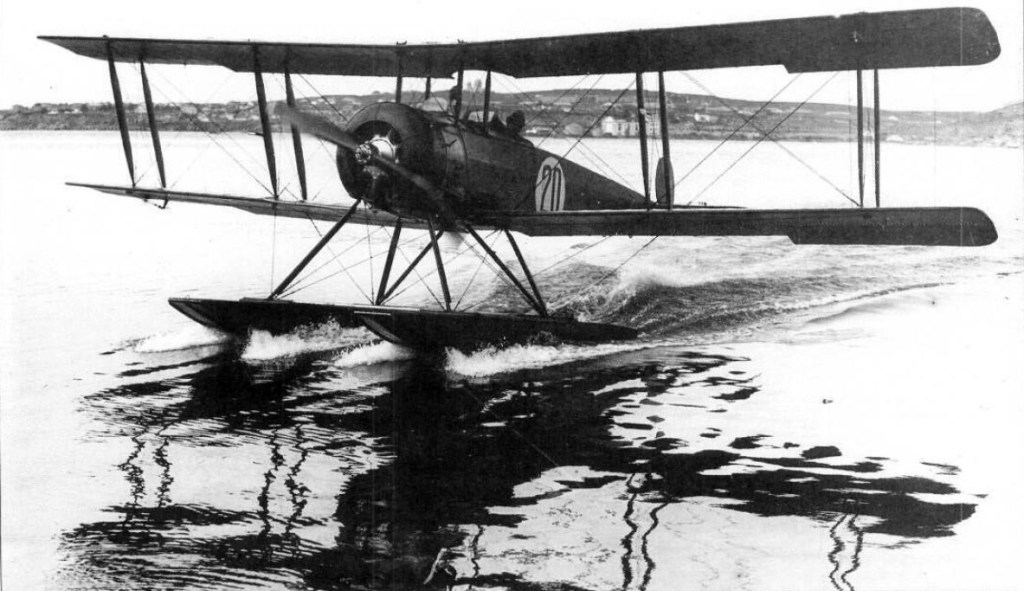
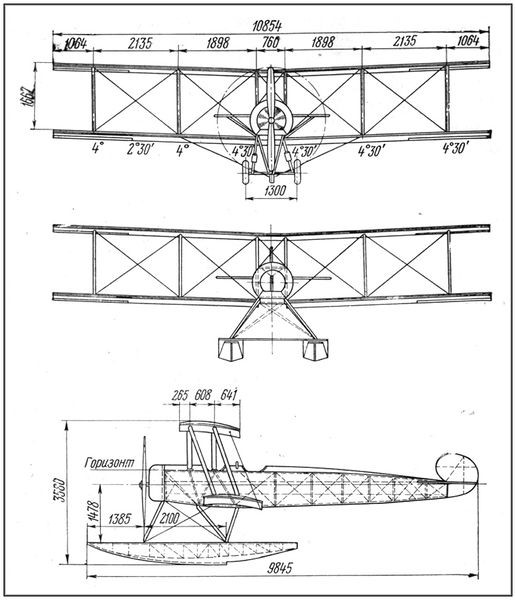
GAZ No.3 “Krasni Liotchik” would deliver Polikarpov MU-1 (Russian: ГАЗ №3 МУ-1) floatplanes between 1924 and 1930 for training naval pilots. Some sources state the number of copies produced at 120 units, although Shavrov sets the number at only 73. It was powered by the 120hp M-2 engine which was also a copy of the original British one and was produced from 1925 until 1929. Due to the larger, but lighter floats, it was 170Kg lighter than the original 504L which was the original floatplane version of the 504K.
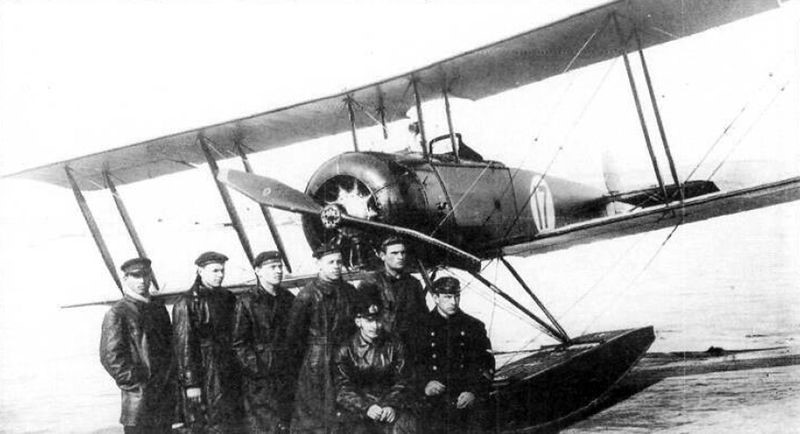
It only served with the Soviet Workers and Peasant’s Air Fleet as a trainer in the Sevastopol Maritime Flying School and saw also service in the training squadron of the Baltic Fleet, based in Leningrad during the 1920s. Apparently it was also briefly used as a scouting airplane for the Baltic Fleet. Some of them served until 1934, although isolated examples flew after that date.
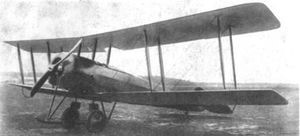
Production of the Lynx-powered Avro 504N or Lynx Avro began in March 1927. With a more modern appearance without a skid between the mainwheels and with an Armstrong Siddeley Lynx radial of 160, 180 or 215 hp, two fuel tanks were fitted under the upper wing and the fuselage was no longer square sectioned. This continued in production as an RAF primary trainer until 1933, which brought total production in Bri¬tain to considerably over 10 000.
The Belgian Air Force, also obtained 48 504Ns, of which 31 were built by SABCA, between 1934 and as late as 1939, When war broke out in May 1940 about 30 were in service. All were subsequently destroyed by the Luftwaffe attacks on the BAF airfields during the 18 day campaign.
The 504M, with 2 passengers in an enclosed cabin behind the pilot, was a post-war civil adaptation of the 504 trainer. The Japanese put into production a licence-built equivalent as the Tokyo Koku KK Aiba Tsubami IV, one serving until 1928.
The last major production model was the Lynx radial engined 504N which had a steel tube fuselage; 598 were built. The 504R Gosport was an attempt to produce a low-powered version that would equal the performance of the 504K.
By the end of the war, the 504 was still seeing production and would see nearly 600 more added to the 10,000 plus total between the years of 1925 and 1932. These would be designated as the Type 504N models and be new production or converted models of existing Type 504s. Type 504s would eventually be superseded by the Avro Tutor aircraft series.
On 31 October 1918 the 504 was retired from RAF service.
Seven civil 504N were impressed by the RAF for service in 1940 and used for glider-towing.
A small additional number were built in Canada in 1918, and probably more than 1000 were built in the Soviet Union with the designation U 1 between 1925 and 1933. The 504 had been an important type in the Revolutionary war in Russia, and was adopted by the Soviet government around 1922 as a standard interim multirole aircraft. Other 504s served with more than 30 air forces in the 1920s, many being fitted with floats or skis.
An arrangement was reached with Avros, H E Broadsmith, the Chief Engineer of Avro who was interested in living in Australia, and ex¬AFC fliers Nigel Love and W J Warneford, to sell and manufacture the Avro 504 in Australia. The agreement involved the supply of 20 Avro 504K biplanes in parts together with four fully assembled as demonstrators. AA&E fitted Sunbeam Dyak engines to the ‘504K aircraft they erected from parts brought out from England. The first, G AUBG, was acquired by QANTAS on January 30, 1921. The Australian Aircraft and Engineering Co Ltd was registered in October, 1919. Love chose Mascot as the site for their aerodrome and the Avro aircraft arrived on board the SS Commonwealth early in November. Love made the first flight from Mascot the same month when he carried a freelance photographer Billy Marshall for a flight over the City of Sydney. The Company also set up a factory in Botany Road, Mascot, where repairs etc, could be carried out. In order to secure long range orders for his Company, Love approached the government with an offer to build the Avro 504K, from Australian timber, at the Mascot factory. An order for six was eventually, secured despite strong and sustained opposition by the British aircraft manufacturing interests, and supplied to the RAAF (A3 48 to A3 53). The six were built in nine months by the Company’s 25 employees. They were only 80 lb heavier than the spruce built British 504K biplanes. The quality of the Australian built aircraft compared favourably with their British counterparts.
The Company was to receive orders to build seven more Avros. Delays meant that the Company lost money on the Government contract, however barnstorming activities kept the company out of the red. The Avros were all fitted with Clerget engines supplied by the Defence Department. The official handing over was performed by Dame Mary Hughes, the wife of the Prime Minister. Love took off for the official first flight with his wife as passenger.
On March 1, 1923, Avro 504K A3 49 was allocated to Headquarters for the purpose of enabling pilots of the staff to obtain flying practise, under an agreement with Shaw Ross Aviation Co, the machine being leased at their aerodrome at Port Melbourne.
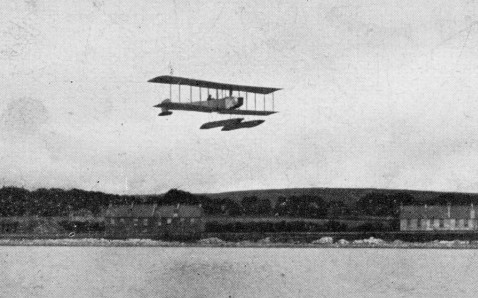
As Commodore Commanding the Australian Fleet, Commodore J Dumaresque suggested that a seaplane be embarked aboard his flagship to allow the Royal Australian Navy to obtain aircraft operating experience. The only aircraft available were the Avro 504K trainers of the AAC, two of which, H3034 and H3042, were converted to 504L floatplanes. One 504L was embarked in HMAS Australia in mid 1920 and flew successfully, frequently with Commodore Dumaresque on board. After transfer to HMAS Melbourne for an ‘Island Cruise’ the aircraft was not so successful as the tropical conditions so reduced power that it could not get off the water. By the end of 1921 the six Fairey IIID floatplanes had arrived in Australia and the two 504L floatplanes were apparently returned to Point Cook where they served out their days as trainers with the serials A3 46 and A3 47. AA&E converted one of their Avros to a floatplane but without the dorsal fin. It operated joy flights from Manly.
The Avro 504K trainers served in the main with No 1 Flying Training Squadron at Point Cook, however some were allocated to Nos 1 and 3 Squadrons in 1925. The Avro was replaced by the de Havilland Cirrus Moth in June 1928, the last Avros being marked for destruction the next year.
Among the uses to which the 504 was put, the outstanding reliability of the aircraft and the large numbers available led the autogyro pioneer Juan de la Cierva to use 504K fuse¬lages as the basis of several of his Autogiros.
Over 8000 were built during WW1 by A.V. Roe and sub-contractors such as Grahame-White Aviation at Hendon, and Sunbeam Motor Car Co, and it continued in production until 1937.
In 1925 the Blackburn Aeroplane & Motor Co concluded an arrangement with the Greek Government to organise an aircraft factory at Phaleron, near Athens, Greece. The factory constructed a series of Velos two seat torpedo planes, designed by Blackburn; a series of Armstrong Whitworth Atlas two seat fighters; and a series of Avro 504O and 504N trainers.
Twenty Avro 504Ks were received by the New Zealand government in 1920 as Imperial Gift aircraft, although only two (E3137 and H1966) were kept by the government, the remainder being loaned to commercial aviation companies. Several aircraft were taken back from the commercial operators for use by the New Zealand Permanent Air Force as basic trainers in the 1924 territorial refresher course. Early in 1925 a further six airframes (201-206) were ordered. They arrived later in 1925 and were used for the 1926 refresher course. Shortly after this the original 504Ks were withdrawn from service and the remaining six aircraft continued to be used until 1931. Following the 1931 refresher course the four survivors were withdrawn and sold by tender. All were sold, surviving on the New Zealand civil register until at least the late 1930s.
The 504 was used by Sir Alan Cobham’s “Flying Circus” and Capt Percival Phillips’ Cornwall Aviation Company, carrying large numbers of civilians on their first flight. It has been reported that Capt Phillips alone carried approximately 91,000 passengers into the air, the majority of them in an Avro 504.
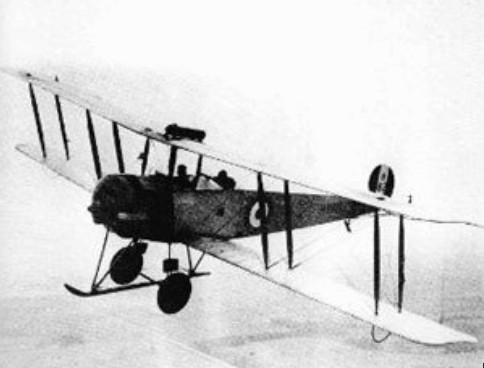
In 1921 The Master of Sempill’s British Aviation Mission took thirty Avro 504 primary trainers to Japan for use by the Japanese Navy. These consisted of twenty Avro 504K landplane trainers (now called 504L), and ten seaplane trainers (504S). The Japanese Navy decided to adopt these as its standard primary trainer and put them into production.
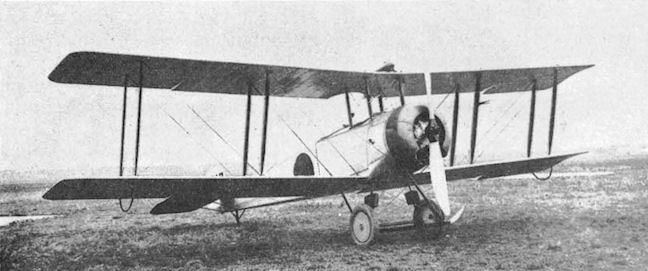
To prepare for production, the Navy sent several of its officers to Avro to study the process. Among them were Capt (Ordnance) Ryuzo Tanaka, Capt (Ordnance) Tomasu Koyama, Lieut Kishichi Umakoshi, Lieut Misao Wada, and Engineer Katsusuke Hashimoto. The Navy purchased the manufacturing rights from A V Roe, and supplied both Nakajima and Aichi with actual sample aircraft and manufacturing drawings for their production when placing its orders. The Avro trainer for the Navy was in Nakajima production from 1922 to 1924 during which time the company built 250 in various versions.
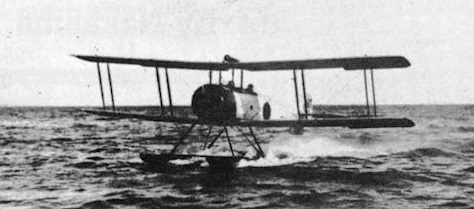
Aichi built thirty 504s fitted as twin-float seaplane trainers. The land-version was generally referred to simply as the Avro L and the seaplane model was the Avro S; however, the official Navy designation was Avro Land-based Trainer and Avro Seaplane Trainer.
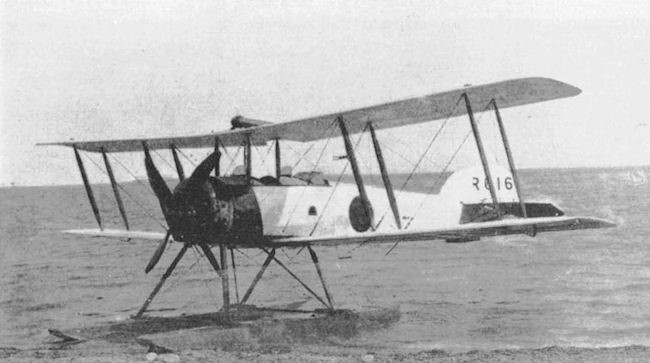
After the introduction of this aircraft by the Sempill Aviation Mission, it had a long life as the Japanese Navy’s typical primary trainer. The later model, the 504N, developed into the Navy Type 3 Primary Trainer. Around 1927-28, a number of these Avro-designed trainers were released for civil use and were highly regarded. They had good stability and control, and were good aerobatic aircraft. A few were still flying as late as 1937 and were the last of the rotary-powered aircraft in regular flying operations.
Replica:
AJD Engineering Replica 504K
Pur Sang Avro 504
Bellamy Avro 504K
Avro 504
Engine: 1 x Gnome, 74kW / 80 hp
Wingspan: 11.0 m / 36 ft 1 in
Wing area: 30.6 sq.m / 329.38 sq ft
Length: 9.0 m / 30 ft 6 in
Height: 3.2 m / 11 ft 6 in
Take-off weight: 816 kg / 1799 lb
Empty weight: 499 kg / 1100 lb
Max. speed: 132 km/h / 82 mph
Cruise: 62 mph at 6500 ft
Ceiling: 3960 m / 13000 ft
Range: 300 km / 186 miles
Endurance: 4 hr 30 min
Armament: 1 machine-guns, 4 x 9kg bombs
Seats: 2
Avro 504A
Engine: 1 x Gnome, 74kW / 80 hp
Wingspan: 36 ft / 10.97 m
Length: 29 ft 5 in / 8.97 m
Height: 10 ft 5 in / 3.18 m
Weight: 1574 lb / 714 kg
Max speed: 82 mph / 132 kph at SL
Ceiling: 12,000 ft / 3658 m
Endurance: 3 hr 30 min
Armament: 1 mg
Bombload: 80 lb / 36.3 kg
Crew: 2
Avro 504B
Engine: 1 x Gnome, 74kW / 80 hp
Wingspan: 36 ft / 10.97 m
Length: 29 ft 5 in / 8.97 m
Height: 10 ft 5 in / 3.18 m
Weight: 1574 lb / 714 kg
Max speed: 62 mph / 100 kph
Ceiling: 13,000 ft / 3950 m
Endurance: 4 hr 30 min
Armament: 1 mg
Bombload: 80 lb / 36.3 kg
Crew: 2
Avro 504C
Engine: 1 x Gnome, 74kW / 80 hp
Avro 504D
Engine: 1 x Gnome, 74kW / 80 hp
Avro 504E
Engine: Gnome Monosoupape, 100 hp.
Avro 504F
Engine: Rolls Royce Hawk, 75 hp.
Avro 504G
Engine: 1 x Gnome, 74kW / 80 hp
Avro 504H
Engine: 1 x Gnome, 74kW / 80 hp
Avro 504J
Engine: Gnome Monosoupape, 100 hp.
Wingspan: 36 ft / 10.97 m
Length: 29 ft 5 in / 8.97 m
Height: 10 ft 5 in / 3.18 m
Weight: 1825 lb / 828 kg
Max speed: 95 mph / 153 kph
Ceiling: 13,000 ft / 3950 m
Endurance: 3 hr
Crew: 2
504K
Engine: Gnome Monosoupape seven cylinder rotary, 100 hp.
Prop: 2 blade.
Wing span: 36 ft 0 in (10 97 m).
Length: 29 ft 5 in (8.97 m).
Height: 10 ft. 5 in.
Wing area: 330 sq.ft (30.66 sq.m).
Weight empty: 1300 lb.
Gross weight: 1,829 lb (830 kg).
Max speed: 82 mph @ 7000 ft.
Cruising speed: 75 mph (121 kph).
Service ceiling: 16,000 ft.
Typical range: 225 miles (362 km).
Seats: 2.
Endurance: 3 hrs.
504K
Engine: Le Rhone, 110 hp.
Max speed: 95 mph (153 kph) at sea level.
Climb to 3500 ft: 5 min.
Range @ cruise: 250 miles (402 km).
Cruise: 75 mph.
Fuel cap: 24 ImpGal (109 lt).
Span: 10.97 m (36 ft 0 in)
Length: 8.97 m (29 ft 5 in)
Gross weight: 830 kg (1830 1b)
504K
Engine: Clerget, 130 hp
Speed: 90 mph SL
Ceiling: 18,000 ft
Range: 250 miles
Seats: 3-4
504M
Crew: 1.
Pax cap: 2.
504N
504O
Engine: Lynx.
Undercarriage: Float.
504R
Engine: Mongoose.
504R Gosport
Engine: Avro Alpha, 90 hp.
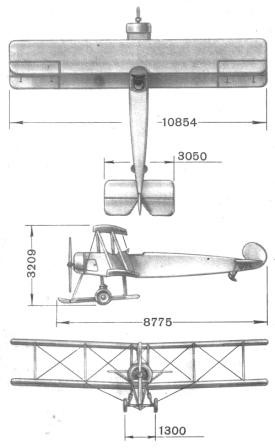
GAZ U-1
Engine: 120 hp M-2 (licensed copy of the Gnôme)
Wingspan: 10.85 m
Wing area: 30.00 m²
Length: 8.78 m
Height: 3.21 m
Empty weight: 600-610 kg
Normal TO weight: 840-850 kg
Max speed: 137 km/h
Cruise speed: 109 km/h
Landing speed: 65 – 70 km/h
Range: 185 km
Ceiling: 4500 m
TO run: 100 m
Seats: 2
GAZ-3 MU-1
Powerplant: 1 × 120 hp М-2
Wingspan: 10.85m
Wing area: 30.0 m²
Length: 9.85m
Empty weight: 840kg
Takeoff weight: 1080 kg
Fuel weight: 53kg
Oil weight: 24kg
Full load capacity: 240kg
Top speed: 137km/h
Cruising speed: 109km/h
Landing speed: 65 – 70 km/h
Practical range: 185 km
Practical ceiling: 4500 m
Accommodation: 2





 All Aero