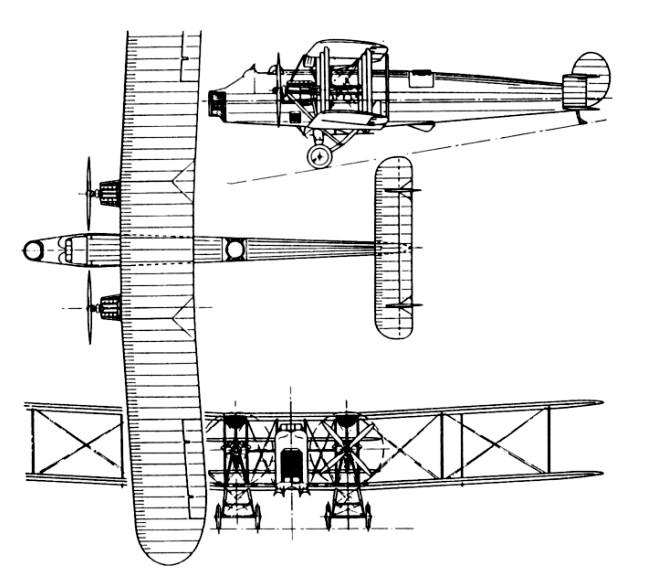
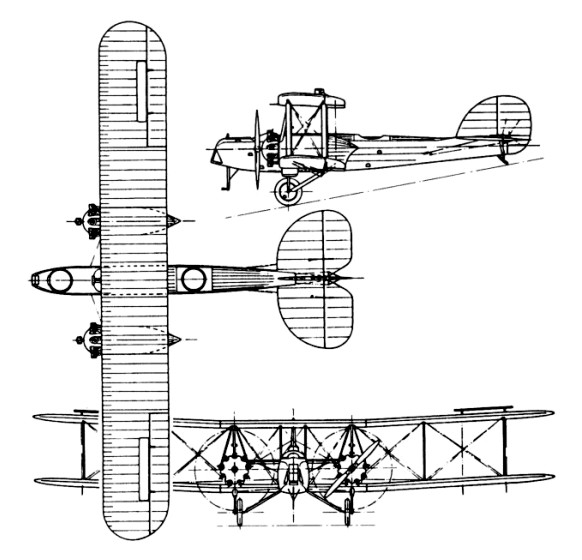
Avro 557 Ava Mk II Engine: 2 x 650hp Rolls-Royce Condor III Take-off weight: 9291 kg / 20483 lb Empty weight: 6040 kg / 13316 lb Wingspan: 29.06 m / 95 ft 4 in Length: 17.75 m / 58 ft 3 in Height: 5.99 m / 20 ft 8 in Wing area: 200.95 sq.m / 2163.01 sq ft Armament: 3 x 7.7mm machine-guns, 4 x 250kg bombs Crew: 5
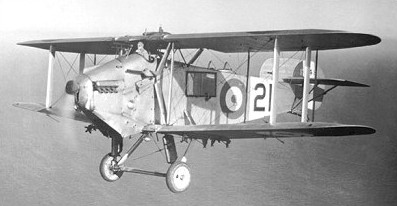
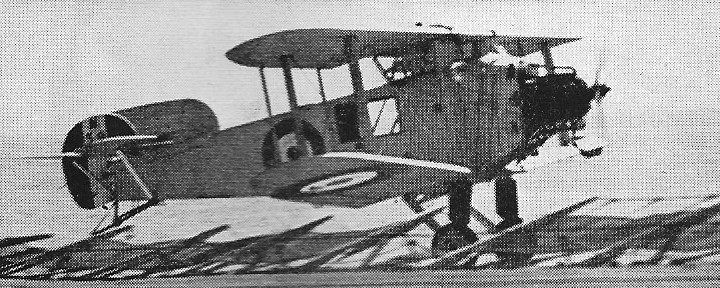
The Bison was designed to meet the British Specification 3/21 for a carrier based fleet spotter and reconnaissance aircraft. An order for three prototypes was placed in October 1921, together with three of the competing design from Blackburn Aircraft, the Blackburn Blackburn. Avro’s design, the Type 555 Bison, was a two-bay biplane, powered, like the Blackburn, by a Napier Lion engine. The deep slab-sided fuselage was constructed of steel tube, with the pilot sitting in an open cockpit forward of the wings, and the engine cowling sloping steeply down ahead of the pilot. An enclosed cabin with large rectangular windows on each side housed the navigator and radio operator and all their equipment, with sufficient room room to stand upright, while a cockpit for a gunner armed with a Lewis gun on a Scarff ring was provided in the rear fuselage. The upper wings were mounted directly on the top of the fuselage.
The first prototype flew in 1921, with an order for 12 Bison Is following. The aircraft had handling problems, however, caused by interference of the pilots cockpit with the airflow over the upper wing. This was resolved by revising the wing design of the second prototype, raising the centre section of the upper wing by 2 ft (0.6 m) and removed dihedral from the upper wings, flying in this form in April 1923. Further production orders followed with these modification incorporated as the Bison II, while some Bison Is were modified to a similar standard, sometimes known as the Bison IA. A Bison I was fitted with floats and retractable wheels but tests proved the design was not suitable for seaborne use.
Bison II
Although designed for a naval requirement the first deliveries were to the Royal Air Force in 1922 to replace the Westland Walrus for coastal reconnaissance work with No. 3 Squadron RAF. In April 1923, 3 Squadron was broken up to form a number of Fleet Spotter Flights of the Fleet Air Arm, Naval aircraft served on HMS Argus, HMS Eagle and Furious and on-shore at Gosport, England and Hal Far, Malta. The aircraft were retired in 1929 when they were replaced by the Fairey IIIF.
Bison II
Operators:
Fleet Air Arm 421 Flight FAA 423 Flight FAA 447 Flight FAA 448 Flight FAA
Variants:
Avro 555 Bison Three prototypes to Air Ministry specification 3/21.
Avro 555 Bison I Twelve Lion II powered production aircraft, survivors re-built as Ias
Avro 555 Bison IA Bison Is modified with a biplane gap and additional dorsal fin.
Avro 555A Bison II Improved variant with biplane gap modification, 23 built.
Avro 555B Bison I One Bison I converted to an amphibian to meet Air Ministry Specification 8/23, not ordered into production.
Specifications:
Bison IA Engine: 1 x Napier Lion II, 336kW Take-off weight: 2631 kg / 5800 lb Empty weight: 1887 kg / 4160 lb Wingspan: 14.02 m / 46 ft 0 in Length: 10.97 m / 36 ft 0 in Height: 4.22 m / 14 ft 10 in Wing area: 57.6 sq.m / 620.00 sq ft Max. speed: 177 km/h / 110 mph Cruise speed: 145 km/h / 90 mph Ceiling: 4265 m / 14000 ft Range: 547 km / 340 miles Armament: 1 x 7.7mm machine-gun
Bison II Engine: 1 × Napier Lion II, 480 hp (358 kW) Wingspan: 46 ft 0 in (14.02 m) Length: 36 ft 0 in (10.98 m) Height: 14 ft 2 in (4.32 m) Wing area: 630 sq.ft (58.6 sq.m) Empty weight: 4,116 lb (1,871 kg) Max. takeoff weight: 6,132 lb (2,787 kg) Maximum speed: 108 mph (94 knots, 174 km/h) Cruise speed: 90 mph (78 knots, 145 km/h) Range: 360 mi (313 nmi, 580 km) Service ceiling: 12,000 ft (3,660 m) Rate of climb: 450 ft/min (2.3 m/s) Armament: 1 × fixed forward firing .303 in Vickers machine gun and 1 × .303 in (7.7 mm) Lewis Gun on Scarff ring
The 1921 Avro 552 was a variant of the Avro 504N with a Wolseley Viper engine.
Avro 552
Engine: 1 x 180hp Wolseley Viper Wingspan: 10.97 m / 36 ft 0 in Length: 8.53 m / 28 ft 0 in Height: 3.18 m / 10 ft 5 in Wing area: 30.66 sq.m / 330.02 sq ft
A three-seat heavy bomber of 1922 powered by a 485kW Rolls-Royce Condor III engine. Fifteen were built for No 99 Squadron, RAF, serving between 1924 and 1926.
Aldershot testbed for 1000 hp Napier Cub engine, with an Avro Baby.
Avro 549 Mark III Engine: 1 x 650hp Rolls-Royce Condor III Take-off weight: 4971 kg / 10959 lb Empty weight: 2865 kg / 6316 lb Wingspan: 20.73 m / 68 ft 0 in Length: 13.72 m / 45 ft 0 in Height: 4.65 m / 15 ft 3 in Wing area: 98.85 sq.m / 1064.01 sq ft Max. speed: 177 km/h / 110 mph Ceiling: 4420 m / 14500 ft Range: 1050 km / 567 nm Armament: 3 x 7.7mm machine-guns, 4 x 240kg bombs or 8 x 110kg bombs Crew: 3-4
Avro 548 Engine: 1 x 80hp Renault Take-off weight: 882 kg / 1944 lb Empty weight: 607 kg / 1338 lb Wingspan: 10.97 m / 36 ft 0 in Length: 8.97 m / 29 ft 5 in Height: 3.18 m / 10 ft 5 in Wing area: 30.66 sq.m / 330.02 sq ft Max. speed: 129 km/h / 80 mph Cruise speed: 105 km/h / 65 mph Range: 282 km / 175 miles
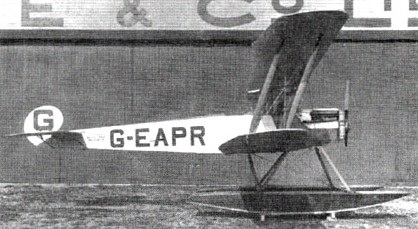
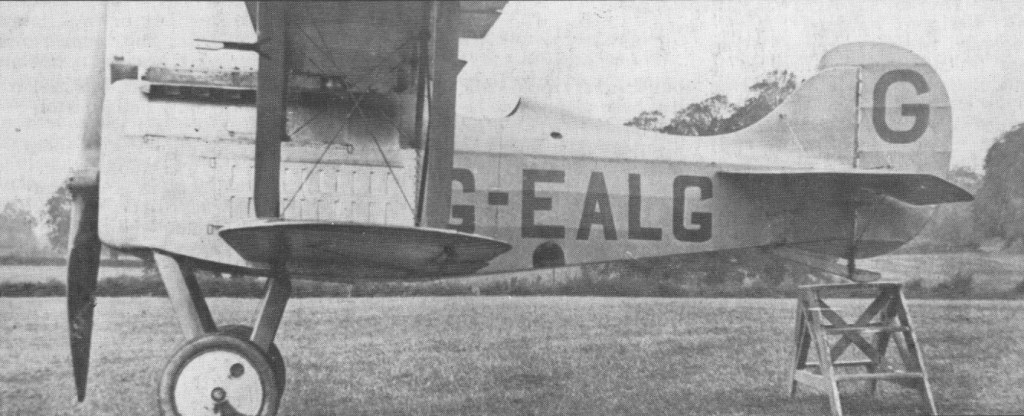
With the UK staging the first post-war Schneider Trophy contest in 1919, Avro decided to build and enter an aircraft, the Avro 539. In order to achieve the highest possible speed, it was the smallest practical single-engined aircraft that could be designed around the selected powerplant, a Siddeley Puma inline engine. An unequal-span biplane, with ailerons on both wings, it was of conventional construction with two single-step floats that were long enough to eliminate the need for a third float beneath the tail. First flown on 29 August 1919, only 12 days before the day of the race, the Avro 539 had performance that was considered to be generally satisfactory. However, when taking off from Cowes to take part in the seaworthiness trials, which were a compulsory preliminary to the speed contest, a float was seriously damaged by floating debris. Avro was given five days to repair, and used this time also to modify the tail unit. When the floatplane appeared again it carried the registration G-EALG, and because of the modifications was re-designated Avro 539A. When tested, its performance was not good enough to warrant selection for the speed contest, with the result it was delegated as the British reserve aircraft. The contest, held at Bournemouth on 10 September 1919 was a fiasco in foggy conditions and was abandoned.
The 539 was converted to a landplane and took part in the Aerial Derby of 1920, but force-landed with a fuel system leak. Then extensively modified, and with a 450 hp / 336 kW Napier Lion engine installed, it was re-designated Avro 539B. During tests before the 1921 Derby, the aircraft overshot on landing and was completely wrecked.
Avro 539A
Avro 539 Engine: 1 x 240hp Siddeley Puma Wingspan: Upper 25 ft 6 in / 7.77 m / lower 24 ft 6 in / 7.47 m Length: 6.50 m / 21 ft 4 in Height: 2.97 m / 9 ft 9 in Wing area: 18.12 sq.m / 195.04 sq ft Take-off weight: 962 kg / 2121 lb Empty weight: 758 kg / 1671 lb
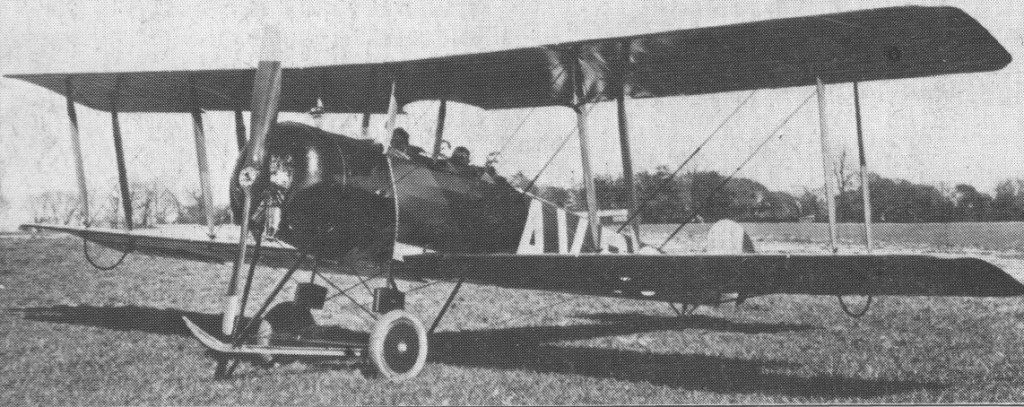
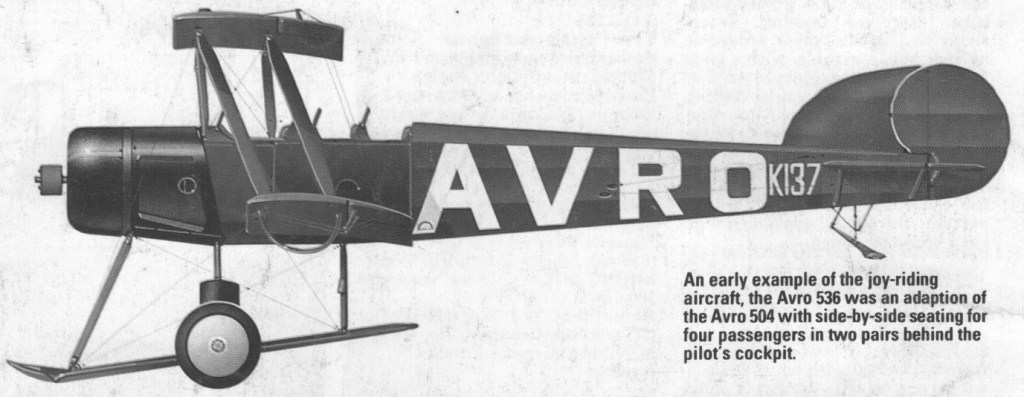
Early post-war pleasure flying was booming and a batch of Avro 504Ks were modified at the company’s Hamble factory. The fuselage was widened 9 in / 22.8 cm to accommodate four passengers in two pairs in the rear cockpit. The first conversion flew at Hamble in April 1919 and was later fitted with floats, the only such floatplane.
In all, 25 Avro 536s were built. 10 at Hamble, 12 at Manchester, and three at Croydon, where Surrey Flying Services undertook assembly.
A considerable amount of joy-riding was undertaken with these open-cockpit aircraft, and one was completed as a two-seater with a long range fuel tank. The last 536s were withdrawn from use at the end of 1930, these being the Surrey Flying Services machines, which had been fitted with 130 hp / 99 kW Clerget engines when Bentley rotaries became unavailable.
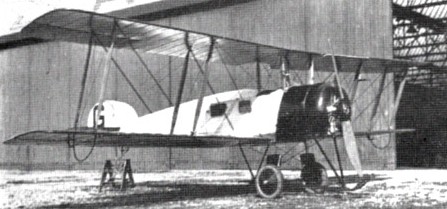
The Last Hamble-built Avro 536 was finished as the Avro 546 four-seat cabin biplane. The pilot was seated outside, I a cockpit above the three-seat cabin. Registered in December 1919, the 546 flew very little and its registration was cancelled 12 months later.
Avro 536 Engine: 1 x 130hp Clerget or 150hp Bentley B.R.1 Wingspan: 11.20 m / 37 ft 9 in Length: 8.97 m / 29 ft 5 in Height: 3.18 m / 10 ft 5 in Wing area: 31.12 sq.m / 334.97 sq ft Take-off weight: 1011 kg / 2229 lb Empty weight: 650 kg / 1433 lb Max. speed: 145 km/h / 90 mph Cruise speed: 113 km/h / 70 mph Ceiling: 3658 m / 12000 ft Range: 306 km / 190 miles Seats: 5
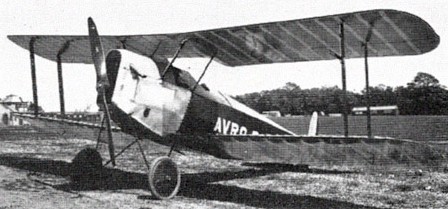
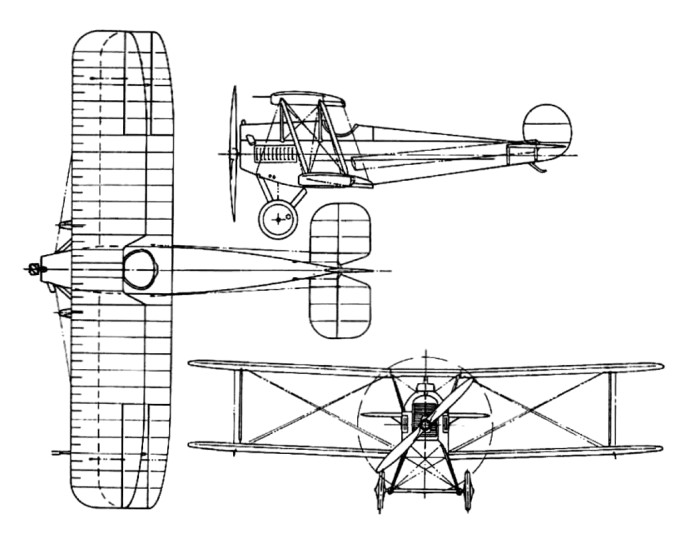
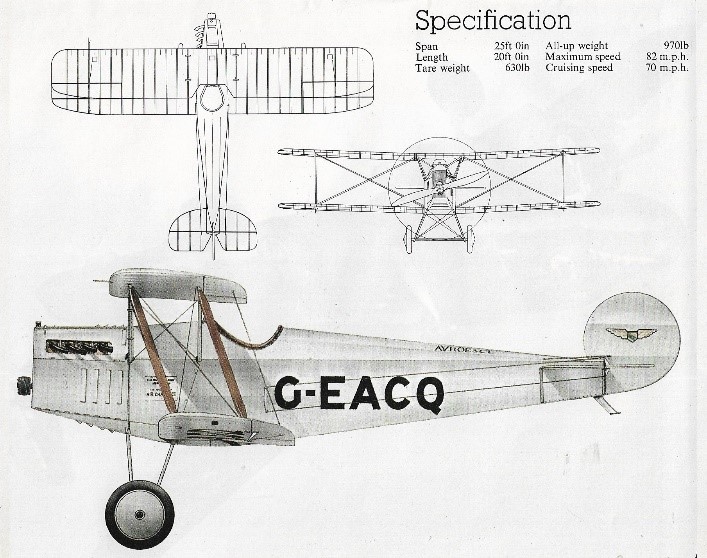
After WW1, A.V.Roe entered the light aircraft field with the Avro 534 Baby, a low-powered lightweight single-seat biplane. At the time, the only suitable engine was a 35 hp / 26 kW Green, which was modified by the makers. Designed around this machine, the Baby first flew on 39 April 1919, Just two minutes after take off it crashed at Hamble, the pilot having inadvertently switched off the ignition.
A second Baby flew on 10 May 1919, powered by the original engine, salvaged from the first aircraft, and this machine proved to have reasonable performance.
Records indicate that about nine Babies were built at Hamble, several achieving fame in notable flights.
Bert Hinkler was awarded the Britannia Trophy for 1 650 mile / 1046 km Croydon to Turin flight in 9 hr 30 min, while the third Baby won the 1920 Aerial Derby. One was sold to Russia, but the longest surviving example was probably the first production aircraft, which went to Australia and remained on that country’s civil register until 1936.
Avro 534B Baby
Variants
Avro 534A Water Baby Twin-float seaplane flown in October 1919. Crashed in September 1921
Avro 534B Version with plywood covered fuselage and shorter span lower wing. Only one built. Crashed in August 1920.
Avro 534C Version with reduced span wings for the 1921 Aerial Derby. Crashed in September 1922.
Avro 534D Special version with modifications, to the order of Colonel E. Villiers, who used it for business trips around Calcutta until 1929.
Avro 543 Two-seat version with forward fuselage lengthened by 2 ft 6 in / 0.76m. later re-engined with 60 hp / 45 kW A.D.C. Cirrus engine and used until 1934.
Avro 554 Photo-survey version mounted on twin floats for the 1921 Shackleton-Rowett South Polr Expedition. Powered by an 80 hp / 60 kW Le Rhone rotary.
Avro 534 Engine: 1 x 35hp / 26 kW Green Wingspan: 7.62 m / 25 ft 0 in Length: 5.33 m / 17 ft 6 in Height: 2.31 m / 7 ft 7 in Wing area: 16.72 sq.m / 179.97 sq ft Take-off weight: 395 kg / 871 lb Empty weight: 280 kg / 617 lb Max. speed: 129 km/h / 80 mph Cruise speed: 113 km/h / 70 mph Service ceiling: 12,000 ft / 3660 m Range: 322 km / 200 miles
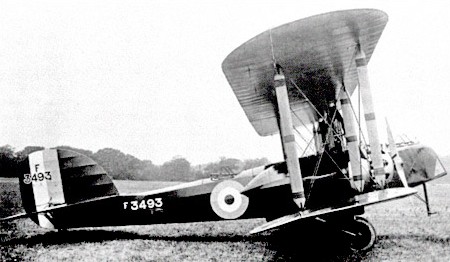
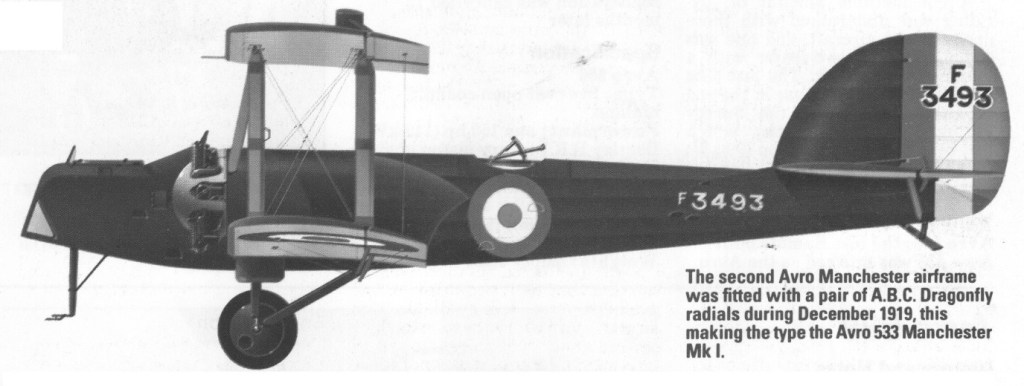
First flown in December 1918, and too late to participate in the war, the Avro 533 Manchester represented a final development of the Avro 523/529 concept. Generally similar to the Avro 529A, with the engines mounted on the lower wing, the design incorporated some refinements including a deeper fuselage, balanced ailerons, and an improved tail unit. The 533 had been designed around the A.B.C. Dragonfly radial engines. When these failed to materialise through development problems, two 300 hp / 224 kW Siddeley Puma were installed, the result being designated Avro 522 Mk.II. Thus, the Mk.II was to fly before the Dragonfly-engined Avro 533 Mk.I.
Both versions flew well in official tests but with the end of the war neither were produced.
A Mk.III was planned with 400 hp / 298 kW Liberty engines, but although the fuselage was completed, the engines were not installed.
Avro 533 Mark I Engine: 2 x 320hp ABC Dragonfly I Wingspan: 18.29 m / 60 ft 0 in Length: 11.28 m / 37 ft 0 in Height: 3.81 m / 13 ft 6 in Wing area: 75.53 sq.m / 813.00 sq ft Take-off weight: 3355 kg / 7397 lb Empty weight: 2219 kg / 4892 lb Max. speed: 209 km/h / 130 mph Climb to 10,000 ft / 3050 m: 14 min 20 sec Ceiling: 5791 m / 19000 ft Endurance: 5 hr 45 min Crew: 3 Armament: 2 x 7.7mm machine-guns, 400kg of bombs
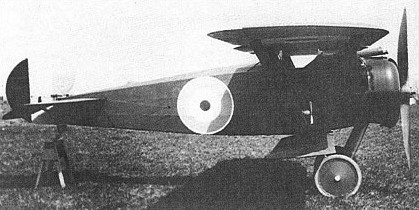
Designed by Roy Chadwick, the Avro 531 Spider was an unsponsored private-venture single-seat fighter. The Spider used a number of Avro 504 components and had a fabric-covered wooden structure with Warren-girder steel-tube interplane struts.
Originally the Spider was powered by a 110hp Le Rhone 9J nine-cylinder rotary engine and flown for the first time in April 1918. Overall performance was not sufficiently in advance of the Sopwith Camel to warrant quantity production. Armament was one fixed synchronised 7.7mm Vickers machine gun, and a 130hp Clerget 9B rotary was later fitted.
The Spider prototype ended its days in the experimental role.
Engine: 130hp Clerget 9B rotary Wingspan: 8.68 m / 29 ft 6 in Length: 6.25 m / 21 ft 6 in Height: 2.38 m / 8 ft 10 in Wing area: 17.55 sq.m / 188.91 sq ft Take-off weight: 688 kg / 1517 lb Empty weight: 437 kg / 963 lb Max. speed: 193 km/h / 120 mph at SL Climb to 5000 ft / 1525 m: 4 min Service ceiling: 19,000 ft / 5970 m Range: 250 mi Armament: 1 x Vickers 0.303 in mg













 All Aero