Beardmore WB.III / SB.3

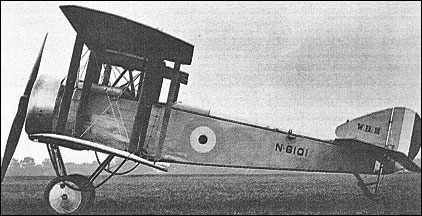
William Beardmore and Co developed their W.B.III as a carrier version of the Sopwith Pup fighter with manually-folding mainplanes and folding main undercarriage members. The William Beardmore and Company firm was already under contract to produce the land-based Sopwith Pup, this under legal license, and developed the WB III for shipboard use by the Royal Naval Air Service during World War 1.

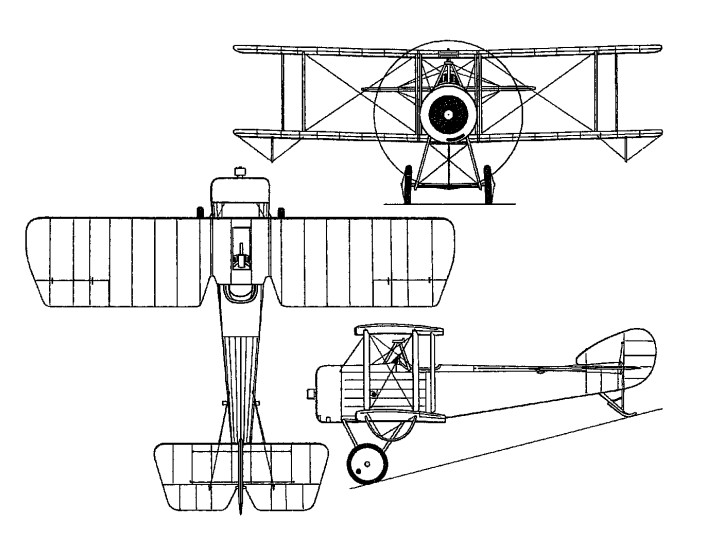
Design of the WB III was conventional for biplane fighter aircraft of the time, keeping up with features as found on the Sopwith Pup. The engine was held in a forward compartment at the front of the slab-sided fuselage. A cylindrical engine cowling was fitted over the front engine facing for a more streamlined approach. The engine, a single nine-cylinder Le Rhone 9C series engine or a seven-cylinder Clerget (each delivering up to 80 horsepower), turned a two-bladed wooden propeller. The biplane wing arrangement featured straight parallel struts unlike the Sopwith Pup’s staggered formation, necessitated by the Navy requirement for manually folding wings (space on aircraft carriers was always at a premium). Additionally, the undercarriage – consisting of two fixed single-wheeled members – could be removed by the ground crew for improved stowage while the tail was supported by a simplistic tail skid. The fuselage tapered off to the empennage to which was affixed a rounded vertical tail fin and applicable horizontal planes.

Performance from the available powerplant allowed for a top speed of up to 103 miles per hour with a service ceiling of up to 12,400 feet and a rate-of-climb equal to 534 feet per minute. Endurance time (essentially the aircraft’s operational range) was listed at 2 hours and 45 minutes. The WB.III maintained a wingspan of 25 feet with a running length of 20 feet, 3 inches. She sat with an 8 foot, 1 inch height. On empty, she weighed in at 890lbs and could take off with a weight of up to 1,290 lbs. Armament was a single fixed, upward-firing .303 Lewis machine gun, firing through a cut-out section of the upper wing assembly.

The prototype WB III (a modified Pup) was accepted by the British military on February 7th, 1917. A contract for 100 production examples soon followed under the official British designation of SB 3.

Armament comprised a single 7.7mm Lewis gun which fired upwards through a cut-out in the upper wing centre section, and the W.B.III could be fitted with either the seven-cylinder Clerget or nine cylinder Le Rhone 9C rotary, both of 80hp. The first 13 production W.B.IIIs had folding undercarriages similar to the prototype and were known as S.B.3Fs, but subsequent W.B.Ills had jettisonable undercarriages (S.B.3D) and flotation equipment.

The initial production models fell under the designation of SB 3F and covered some thirteen examples until supplanted by the revised SB 3D. The SB 3D sported a jettisonable undercarriage as well as emergency flotation equipment in a slightly lengthened fuselage.

The WB III served on only three Royal aircraft carriers, these being the HMS Furious, HMS Nairana and the HMS Pegasus. One S.B.3D was used in an unsuccessful attempt to fly from the forecastle of the battle cruiser HMS Renown. Japan became the only other notable operator of the WB III/SB 3 series.

Beardmore SB 3F
Engine: 1 x Le Rhone 9C OR 1 x Clerget rotary, 80 hp
Length: 20 ft 3 in (6.16m)
Wingspan: 25.00ft (7.62m)
Height: 8 ft 1 in (2.47m)
Wing area: 22.57 sq.m / 242.94 sq ft
Maximum Speed: 103mph (166kmh; 90kts)
Maximum Range: 171miles (275km)
Rate-of-Climb: 534ft/min (163m/min)
Service Ceiling: 12,402ft (3,780m)
Armament: 1 x 7.7mm (0.303 caliber) Lewis machine gun
Accommodation: 1
Empty Weight: 891lbs (404kg)
Maximum Take-Off Weight: 1,290lbs (585kg)
Beardmore WB.II

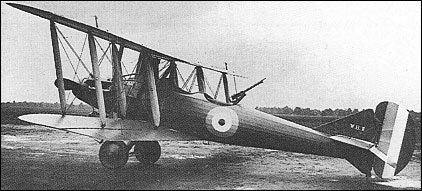
Based on the design of the B.E.2c, the two-seat WB.II fighter was built as a private venture by G Tilghman-Richards of William Beardmore & Co. The W.B.II was powered by a 200hp Hispano-Suiza 8Bd eight-cylinder water-cooled engine and carried an armament of two fixed synchronised 7.7mm Vickers guns and a single 7.7mm Lewis gun on a swivelling Beardmore- Richards mounting. The W.B.II was first flown on 30 August 1917, and performance proved good, but the Hispano-Suiza engine was in short supply and was required for the S.E.5a single-seater. No production of the W.B.II was undertaken, although two civil examples were built in 1920 as the W.B.IIB.

Engine: 200hp Hispano-Suiza 8Bd
Take-off weight: 1202 kg / 2650 lb
Empty weight: 800 kg / 1764 lb
Wingspan: 10.62 m / 34 ft 10 in
Length: 8.18 m / 26 ft 10 in
Height: 3.05 m / 10 ft 0 in
Wing area: 32.88 sq.m / 353.92 sq ft
Max. speed: 193 km/h / 120 mph

Beachey-Curtiss Looper

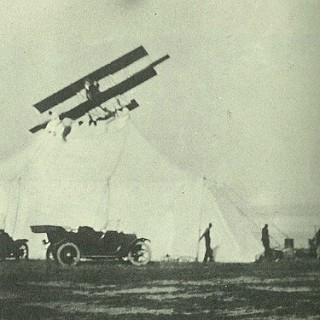
The Looper was built in 1912 and was a special headless version, built for Lincoln Beachey and stressed for aerobatics. On 7th October 1913, that Beachey’s machine fouled the ridgepole of a tent during a test flight and hit two couples who were sitting there. Ruth Hildreth, was killed outright, while her sister, Dorothea, suffered a laceration due to the propeller along with a fractured hip and arm. Their escorts, both US Navy Lieutenants, sustained fewer injuries. Ironically, Beachey was wearing a safety harness and survived the crash relatively unscathed, though he was mortified at what had happened.

Beachey-Curtiss Little Looper

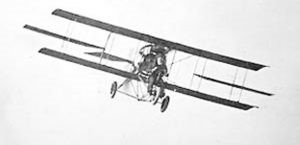
After a brief retirement in 1913, Beachey returned to the air to master the inside loop, a maneuver first mastered by a French aviator. Spurred on by national pride and the spirit of competition, Beachey directed Curtiss to design and build a reinforced airplane able to sustain the forces of a loop. Beachey completed his first loop in November 1913.

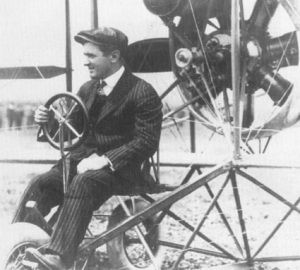
Beachey at the controls

Despite this, Beachey was not satisfied. His airplane was structurally reinforced to stand up to the forces of aerobatics, but its engine would stop running when inverted. In early 1914 technology advanced and Beachey travelled to France to acquire a pair of Gnome rotary engines. This innovative design was composed of seven cylinders arranged in a circle around the propeller shaft. When running, both the 80-hp engine and the propeller whirled around. The Gnome operated equally well upside down as right side up. Beachey directed his crew to install a Gnome engine in his newest airplane, giving rise to his “Little Looper”. On tour throughout the United States, Beachey conducted many flights over the rest of the year, expanding his repertoire and exposing millions of people to aviation.

Beachey’s reputation had swelled across North America as a result of his demonstration flight. Tens of millions of Americans saw Beachey fly the Little Looper through its aerobatic routine, captivating communities with the wonder and promise of aviation from coast to coast. As a “headless” Curtiss-type pusher with no forward-facing horizontal stabilizer, the Little Looper afforded Beachey an exceptional perch exposed at the front of the airplane, with unparalleled visibility and a strong feel for the airstream in any maneuver.

The Hiller Aviation Museum displays the original Little Looper.

Engine: LeRhône, 84-hp
Span: 25 ft 1 in
Length: 18 ft 4 in
Height: 8 ft 0 in
Weight, empty: 750 lbs
Weight, gross: 890 lbs
Max speed: 84 mph
Endurance: 45 minutes

Bates Biplane Glider

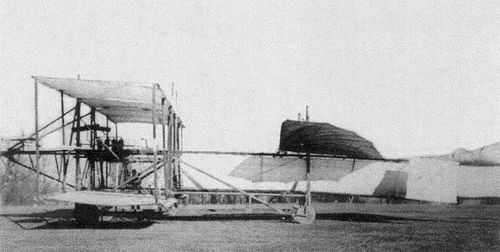
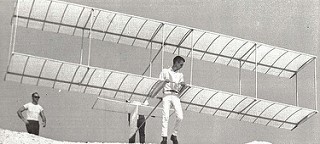
Many “Early Birds” were first airborne in what became known as the Popular Mechanics Glider. Do-it-yourself drawings were published by that magazine in April 1909, from a design by Carl Bates of Chicago. Hundreds of them were built.

The glider, properly registered with the FAA as N2579, was built in 1970 by Robert Mixon and his partner Gary Alfonzo of Miami, Florida. It had a wing span of 20 feet, with a total of 160 square feet of wing area. It made only two flights, both ending with the tail hitting the cliff from which it was launched and the second causing a severely sprained ankle.