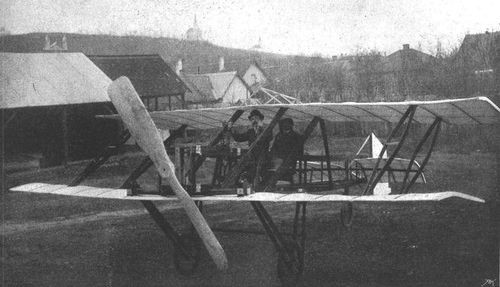
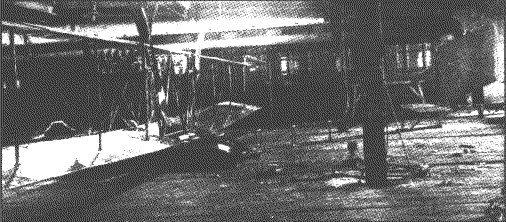
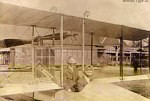
An Austro-hungarian design by Franz Berger, the machine was an early example of negative stagger – the lower wing mounted considerably forward of the top wing. Of wooden construction with the exception of the wing struts which were of aluminium, the photograph was taken before February 19, 1910 in the Hungarian region of the double-monarchy, at Balatonboglár near Lake Balaton (in German: the “Plattensee”) at a time when no engine was fitted. It was however planned to use an Anzani 3-cylinder radial of 35-40 hp.
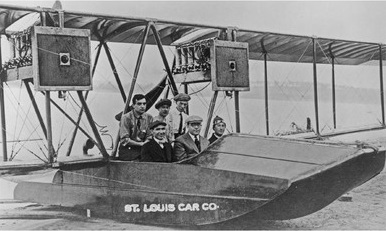
Benoist Type 15 flying boat under construction in St. Louis Car Co. shops, ca. 1915
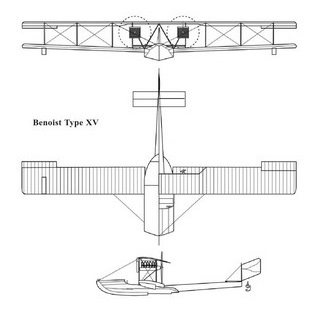
Basically an enlarged Type 14 with a four-bay wing layout and upper and lower wings of equal span. The two direct-drive engines were strut mounted beneath the upper wing.
When the onset of World War I prevented any attempt at a transatlantic flight, Benoist sought to interest the British government in purchasing the aircraft for use in antisubmarine patrol and went so far as to make arrangements to have the type mass-produced at a plant owned by the St. Louis Car (rail) Company. By this time the British were already committed to flying boat contracts with Curtiss, and no orders for the Type 15 were forthcoming.
Benoist hoped to mass-produce the Type 15 for the British Royal Naval Air Services, but the company ceased operations soon after Benoist’s death in 1917.
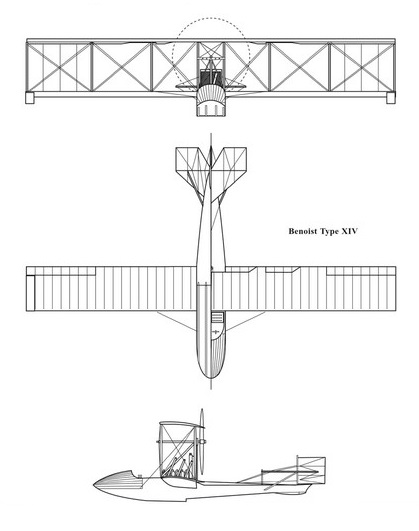
A small biplane flying-boat built in 1914 designed by Thomas W.Benoist and built by Benoist Aircraft Co.
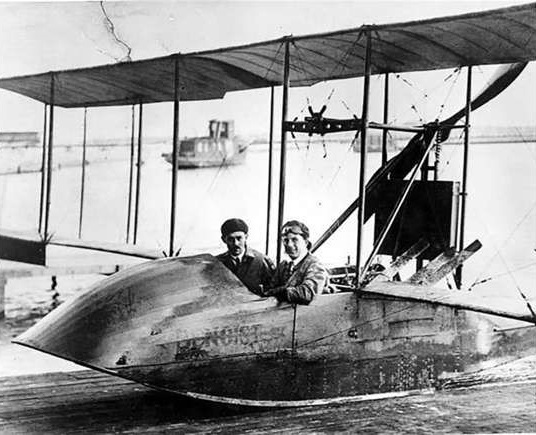
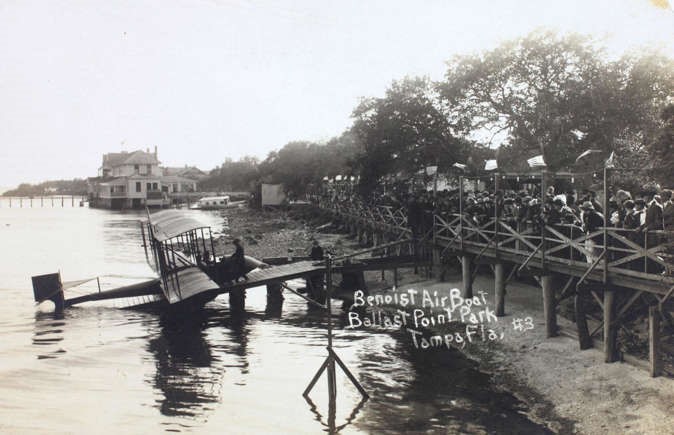
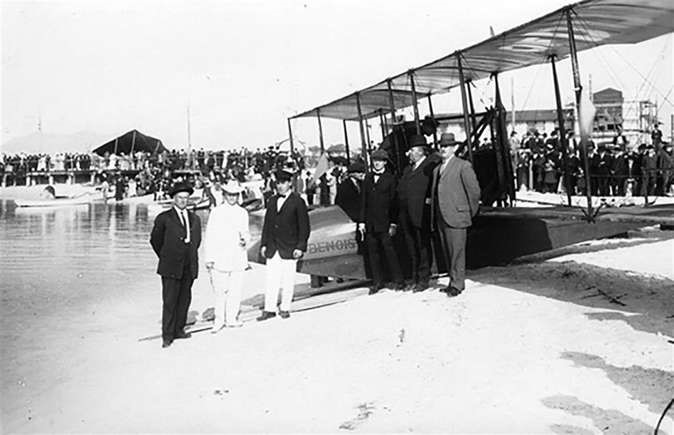
This flying boat conducted the world’s first scheduled airline flight. Designed by Thomas W. Benoist, the Benoist Type XIV first flew from the Florida city of St Petersburg to Tampa in January 1914 and was one of two aircraft belonging to the St Petersburg-Tampa Airboat Line.
In the United States, the St Petersburg-Tampa Airboat Line commenced twice-daily services across Tampa Bay, Florida, using a Benoist flying boat, charging the single passenger US$5 per journey in January 1914.
The aircraft was so small there was space for just one passenger who had to sit next to the pilot, quickly rendering the entire operation an unaffordable venture.
Having carried 1,205 passengers in the space of three months, the airline folded and the Benoist became the plaything of the wealthy. In 1984, a flying replica was built for the 70th anniversary of the flight, which is now on display in the St. Petersburg Museum of History.
Engine: 70 hp Sturtevant or 75 hp Roberts Propeller: pusher Span: 45′ Length: 26′ Range: 175 miles
The 1911 Benoist Headless pusher biplane (land and seaplane) was designed by Thomas W. Benoist and built by Benoist Aircraft Co in St. Louis, USA. They were priced at US$ 3950- land; US$4150- with float.
USA Known originally as the Aeronautic Supply Company, and established at St Louis, Missouri; built in 1914 a small biplane flying-boat known as the Benoist XIV Air-Boat. Power plant comprised a 70 hp Sturtevant or 75 hp Roberts engine driving a pusher propeller.
The company ceased operations soon after Benoist’s death in 1917.
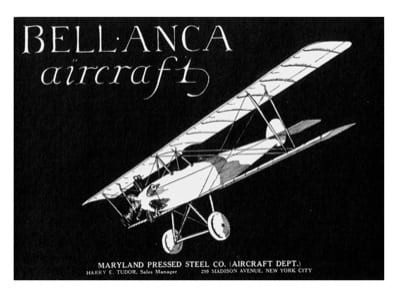
The CE biplane, designed by Guiseppi Bellanca in 1919, was powered by a 35-hp Anzani engine. Two were built, including one by Clarence Chamberlin, who would fly the Atlantic after Lindberg in a later model Bellanca airplane.
Engine: 35-hp Anzani Span: 28 ft Length: 18 ft Empty weight: 470 lb Load: 250 lb Speed: 102 mph.
Bellanca’s first aircraft design was a “pusher” aircraft, somewhat similar to the Wright Flyer. Lacking funds for such an endeavor, he joined with two partners, Enea Bossi, and Paolo Invernizzi. The union of the three produced the first flight of a totally Italian-designed and Italian-built aircraft in December of 1909.
V.H. Bellamy built a full-size replica of an Avro 504K in 1966 at Blackbushe for a film. Registered G-ATXL cn HAC-1, it first flew on 17 August 1966 with an original Gnome engine.
In the end the film was never staged, or at least did not use the 504K, and it was stored until 1970 when it was sold in the USA as N2939.
Engine: Gnome Wingspan: 36 ft 0 in Length: 29 ft 0 in
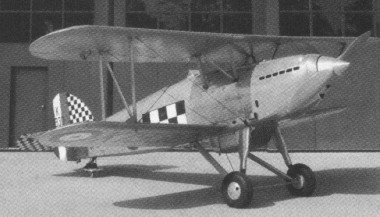
For many years the Fury was ‘extinct’ as a type and so in the early 1980s Viv Bellamy was contracted by the Hon Patrick Lindsay to build a full size Fury replica for him in Cornwall, England. An original Rolls Royce Kestrel was found after much searching in New Zealand (ex Pete Coleman), where it had been fitted to a Hawker Hind. This is a Kestrel V of 640 hp, rather than the Kestrel II of 525 hp the Fury was originally fitted with. After completion, the Fury replica was registered as G-BKBB and painted up as X1930 from 43 Squadron ‘The Fighting Cocks’. Patrick Lindsay was a very ill man, but was able to see the aircraft’s first flight on December 11, 1985 (in the hands of Viv Bellamy) before his death. Cared for by Personal Plane Services at Booker, Buckinghamshire, the aircraft was rarely seen, and rumours of possible show appearances and offers for sale abounded, including a static appearance at Christie’s Auction at IWM Duxford in 1990, where it failed to sell with a reserve of £ 200,000 and less than three hours flying time. Afterwards it was sold to the Belgian Vintage Aircraft Flying Museum. In 1996 it was flown to Belgium and was placed on the Belgian registration as OO-HFU. During an airshow it crashed and was damaged. A rebuild was undertaken in 2001 by Skysport Engineering and a number of test flights were carried out in the UK. The Fury was then based at Old Warden for a short period. In June 2003 Dirk De Slenter flew it back to Belgium and it went in to storage at Kortrijk Wevelgem, it having been decided by the late owner’s family that it was too precious to fly. In 2009 the Fury and its engine was surveyed by a technician for Mr Gerald Yagen and the aircraft was sold from Belgium to Jerry Yagen’s Military Aviation Museum, Virginia Beach, VA, USA, soon after and later shipped to the USA.
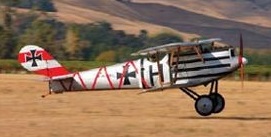
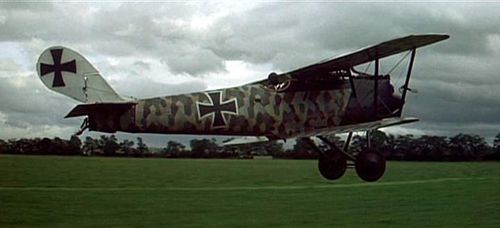
20th Century Fox purchased the film rights of Jack D Hunter’s “The Blue Max” and the film was to be a multi-million dollar production, and the stars were to be the full sized reproductions of World War I fighters constructed for the film- two Pfalz D.III biplanes, two Fokker Dr.I triplanes, two S.E.5a scouts and three Fokker D.VII biplanes.
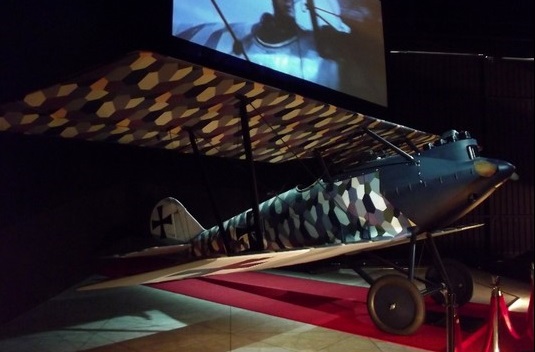
The reproductions had to be built in a hurry to meet the time frame for shooting and were constructed in different locations. One Pfalz D.III reproduction each was constructed by Personal Plane Services (G-ATIF, ZK-FLZ) and the other by the Hampshire Aero Club (reported as G-ATIJ and G-ATIG).
The availability of these aircraft would see them appearing in more movies. “Darling Lili” of 1970 was a vehicle for Rock Hudson and Julie Andrews. A musical comedy, the building of six S.E.5a reproductions added to the Allies squadron. These were based on the Currie Wot airframe and were referred to as Minis due to their not being full size reproductions. Appearances in “You Can’t Win them All”, “Von Richtofen and Brown” (aka “The Red Baron”), and “Zeppelin”, followed. The latter two movies saw fatal crashes and the aircraft were soon after dispersed to private collections.
One of two produced for the movie ‘The Blue Max’ in 1965, c/n PT16 ex EI-ARD, G-ATIJ, N905AC, ZK-JPI, was built by Viv Bellamy of the Hampshire Aero Club in England from drawings by Ray Hillborne. The aircraft was presented in a spurious seven colour lozenge paint scheme for the filming. After spending some time in Ireland, the aircraft was later sold to Frank Ryder and operated from the museum in Alabama. In the mid-1980’s many of the ‘Blue Max’ aircraft were purchased by the ‘Fighting Air Command’ and moved to Hartlee Field near Denton, Tx. At that time the aircraft was was presented in a black fuselage and purple wings and was no longer airworthy. The aircraft was acquired by the Omaka Fighter Collection and imported into New Zealand in September 1999. The collection is managed by the 14-18 Aviation Heritage Trust, which is chaired by Peter Jackson.
Both of the Pfalz replicas and one Fokker D.VII now belong to New Zealand film director Peter Jackson’s 1914–18 Trust, with the Viv Bellamy-designed Pfalz being on display at the Omaka Aviation Heritage Centre in New Zealand. All three aircraft are kept in fully airworthy condition.
Engine: Gipsy Major 10-II Span: 30.11 ft Length: 23.02 ft

 All Aero