The Bleriot-SPAD 33 was first flown on 12 December 1920.
The Bleriot-SPAD 33 was first flown on 12 December 1920.
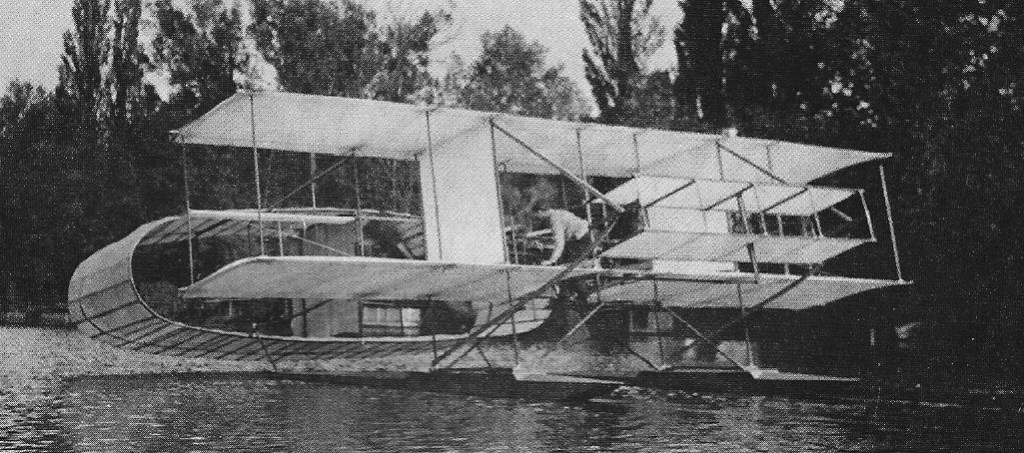
The Bleriot 4 of 1906 failed to fly in test on water and failed in tests on land.
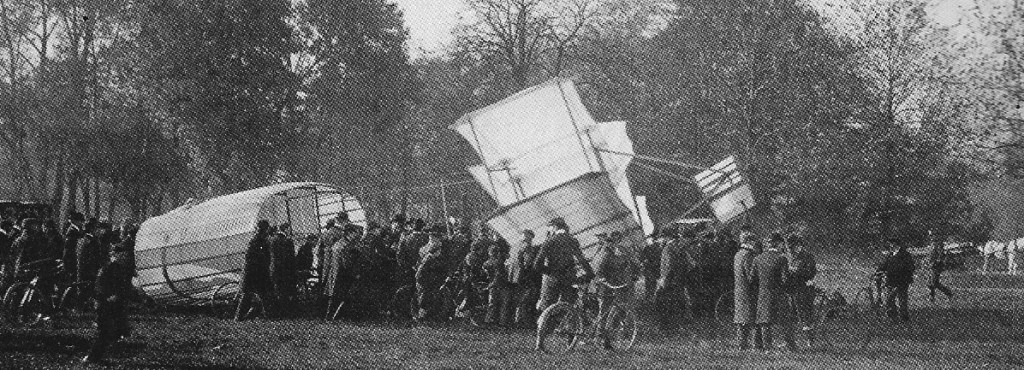
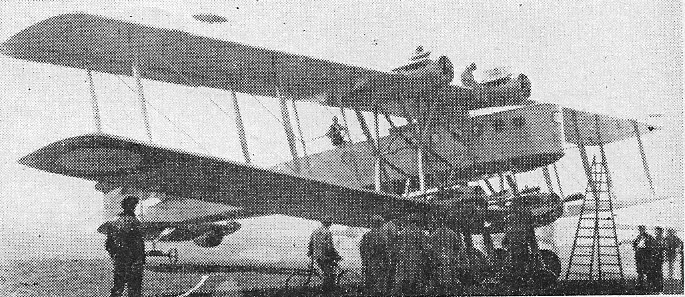
1918 bomber.
The Bleriot 75 was a transport development.
Engines: 4 x 300 hp Hispano-Suiza
Wingspan: 98 ft 6 in
Wing area: 4066 sq.ft
Length: 72 ft 2 in
Loaded weight: 28,000 lb
Max speed: 83 mph
Endurance: 5 hr
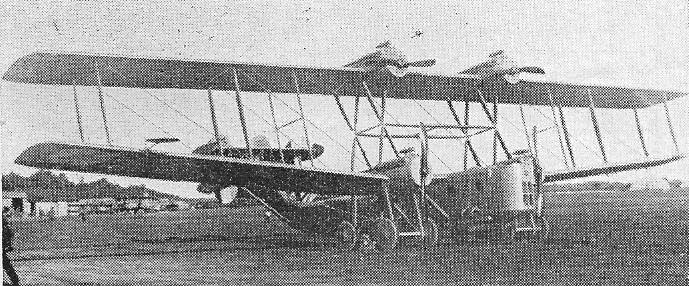
1918 bomber.
Engines: 4 x 300 hp Hispano-Suiza
Wingspan: 98 ft 6 in
Wing area: 4066 sq.ft
Length: 72 ft 2 in
Loaded weight: 28,000 lb
Max speed: 83 mph
Endurance: 5 hr
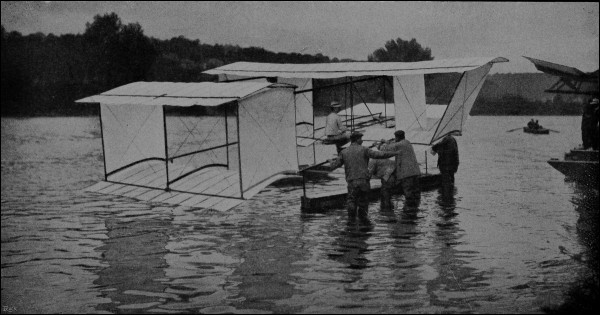
1905 Bleriot III / Blériot-Voisin Cellular Biplane with pontoons was hauled by a motor boat.
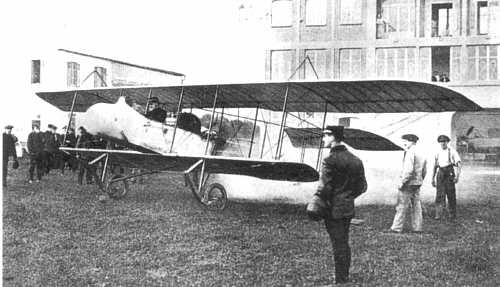
Looking superficially like a Henry Farman pusher biplane, the Type XL of 1913 differed noticeably from the HF by its undercarriage, nacelle and oval rudder. The machine was first presented in May at Salon de Turin, then later exhibited at the Paris Salon, but remained a singular example. It can also be found numbered arabically as the Blériot 40.
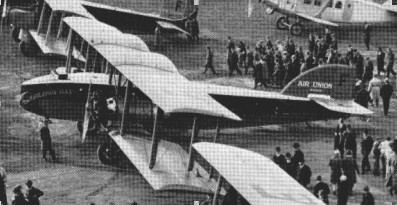
Operated by Air Union circa 1929.
The Bleriot X was another of Louis Bleriot’s concept attempts and followed more the design path of the American Wright brothers featuring a “pusher” type propeller/engine arrangement and biplane wings. Construction of this design was never completed.
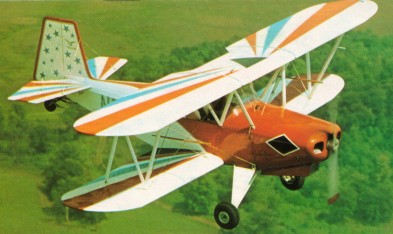
Designed by Dave Blanton, the Wichawk is structurally similar to the Boeing Stearman biplane and is stressed for up to 12g’s positive and six g’s negative. Standard seating is for two in a side-by-side or tandem configuration, which is rather unusual for a sport biplane of its type. Optional tandem or three-place seating is also available. Designed to take the Continental O-470-11 engine of 225 hp, the 180-hp Lycoming is most often used, and can be adapted to house various horizontally opposed or radial engines. The wings make use of wooden spars with light alloy ribs, while the fuselage is constructed from welded steel tubes.
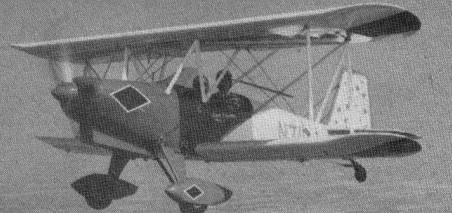
Engine: Lycoming O-360, 180 hp.
HP range: 160-300.
Length: 19 ft.
Wing span: 24 ft.
Wing area: 180 sq.ft.
Weight empty: 1281 lbs.
Gross: 2400 lbs.
Fuel cap: 40 USG.
Speed max: 140 mph.
Cruise: 127 mph.
Range: 500 sm.
Stall: 56 mph.
ROC: 1700 fpm.
Take-off dist: 150 ft.
Landing dist: 400 ft.
Service ceiling: 18,000 ft.
Seats: 2/3.
Landing gear: tail wheel.
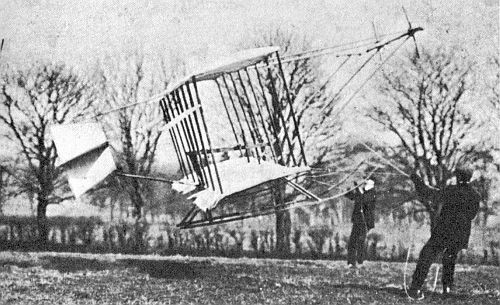
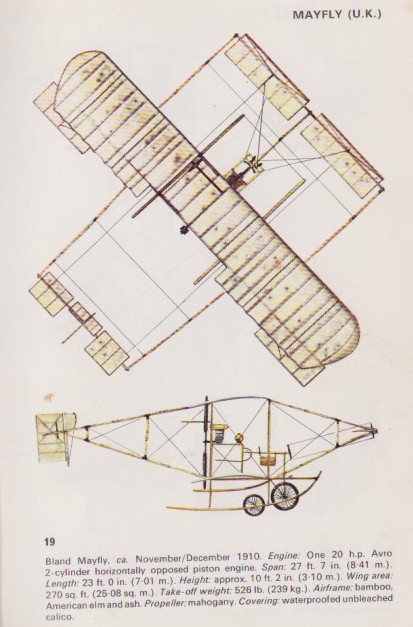
In the summer of 1910 A. V. Roe and Company declared its willingness to build aeroplanes to other people’s designs. Bolts, fittings and bracing wires were supplied to Miss Lilian Bland who built and flew the Mayfly biplane of her own design at Carnamony, Belfast. The first “Mayfly” of Lilian Bland was tested as a glider, probably during February 1910. It was built after the 1909 Blackpool meet and was an amalgam of the Farman and Wright types seen there. Its span was 8.40 m and constructed in less than three months.
Likely the first woman to build as well as fly her own aeroplane, Bland and S.Givvvany developed it empirically, testing and modifying it as a kite and glider before putting a 20 hp engine in it. This aircraft was fitted with one of the few examples of the 20 h.p. two cylinder, horizontally opposed, air cooled Avro engines. It was never given an Avro designation.
Lilian Bland couldn’t sell her constantly modified “Mayfly” and gave it to the Aero Club of Dublin before marrying and leaving for Canada.
Span: 27’7″
Length: 23′
 All Aero