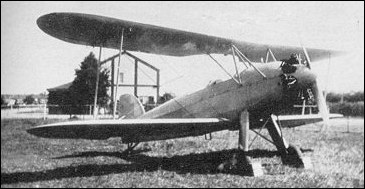
A small biplane trainer, a mixed-construction aircraft that was rejected by the Luftwaffe.
Powered by a Siemens Sh14, Hamburger Fluzeugbau produced 6 of these aircraft all used by the Fleigerubungsstelle, the last of which,D-EKME, was still flying at the end of 1940.
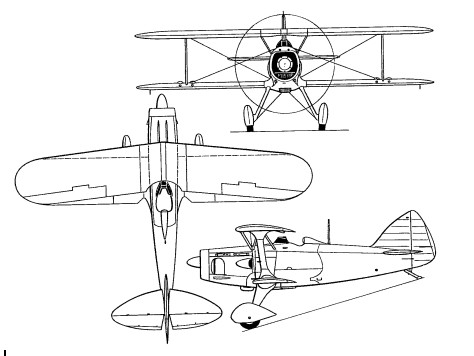
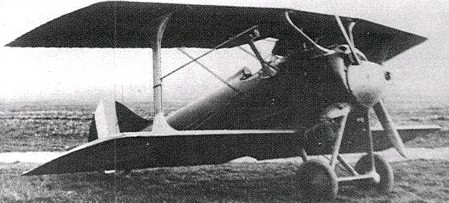
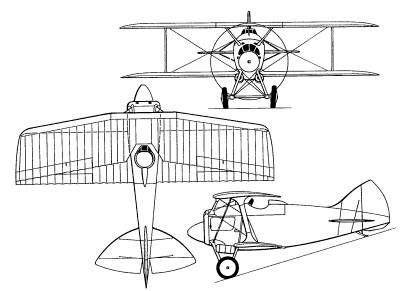
The last fighter design of Andre Herbemont to bear the SPAD designation, and intended to participate in the 1934 fighter competition, the Bleriot SPAD 710 was a single-seat, single-bay biplane of all-metal construction with a duralumin monocoque fuselage and an 860hp Hispano- Suiza 12Ycrs 12-cylinder Vee liquid-cooled engine. It had a proposed armament of one engine-mounted 20mm cannon, four wing-mounted 7.5mm machine guns and one aft-firing 7.5mm gun in the rear fuselage. The Bleriot SPAD 710 embodied inward-retracting main undercarriage members, a completely enclosed cockpit with aft-sliding canopy and a V-type or “butterfly” tail assembly. The initial flight took place in April 1937, and, on 8 June, 300km/h was exceeded in level flight with the undercarriage extended. A week later, on 15 June, tail flutter developed at an altitude of only 200m and the aircraft crashed, killing the pilot, Louis Massotte. Further development was then abandoned.
Wingspan: 8.84 m / 29 ft 0 in Length: 6.50 m / 21 ft 4 in Height: 3.20 m / 11 ft 6 in Wing area: 22.0 sq.m / 236.81 sq ft Max. speed: 470 km/h / 292 mph
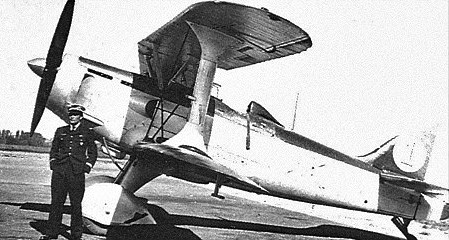
To meet the requirements of the French 1930 fighter programme, Andre Herbemont evolved the Bleriot SPAD 510. The Type 510, which was ordered as a single prototype to participate in the programme, was of all metal construction with a duralumin monocoque rear fuselage, and fabric-covered wings and tail assembly. Powered by a Hispano-Suiza 12Xbrs 12-cylinder Vee liquid-cooled engine rated at 690hp 4000m, the Bleriot SPAD 510 was flown for the first time on 6 January 1933.
After protracted evaluation, during which the centre fuselage was lengthened by 40cm to rectify a shortcoming in longitudinal stability and the vertical tail surfaces were enlarged to improve yaw characteristics, the type was ordered into production in August 1935. The first of 60 production examples were delivered early in the following year, the final two aircraft being accepted with the HS 12Xcrs engine and a 20mm Hispano-Suiza motor cannon. The standard armament comprised four wing-mounted MAC 1934 7.5mm guns. The Type 510 proved to be the last fighter biplane to be ordered for the Armee de l’Air.
S.510 Engine: 1 x 690hp Hispano-Suiza 12Xbrs Take-off weight: 1677 kg / 3697 lb Empty weight: 1250 kg / 2756 lb Wingspan: 8.84 m / 29 ft 0 in Length: 7.46 m / 25 ft 6 in Height: 3.41 m / 11 ft 2 in Wing area: 22.00 sq.m / 236.81 sq ft Max. speed: 372 km/h / 231 mph Cruise speed: 324 km/h / 201 mph Ceiling: 10500 m / 34450 ft Rate of climb: 890 m/min / 2900 ft/min Range: 875 km / 544 miles Crew: 1 Armament: 4 x 7.5mm
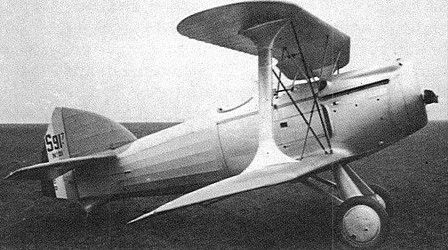
Despite the Type 91 Jockey being abandoned, Andre Herbemont persisted with the development of the Type 91 series fighters and, in October 1930, designed a new version. This, while retaining a fuselage similar to that of the Type 91-4, employed an entirely new wing arrangement of inverted sesquiplane configuration. Ailerons were fitted to the lower wing only, this having a span of 8.65m compared with the 7.00m of the upper wing. Designated Bleriot SPAD 91-7 and powered by a 500hp Hispano-Suiza 12Mc 12-cylinder Vee water-cooled engine, the new model was flown for the first time on 23 December 1931. On 2 June 1932, it established a 500km closed-circuit record of 308.78km/h. It was subsequently fitted with a supercharged Hispano- Suiza 12Xbrs engine as the Type 91-8, a variable-pitch Ratier propeller being adopted and a max speed of 360 km/h being reportedly achieved. The prototype was first flown in its Type 91-8 form on 20 August 1932. In December 1932 it was leased to Hispano-Suiza as a test-bed for the company’s engine-mounted 20mm cannon, which was fitted, together with a large-diameter Levasseur fixed-pitch propeller, the designation then being changed to Type 91-9.
91-7 Engine: 500hp Hispano-Suiza 12Mc 12-cylinder Vee Take-off weight: 1458 kg / 3214 lb Empty weight: 1093 kg / 2410 lb Wingspan: 8.65 m / 28 ft 5 in Length: 6.30 m / 21 ft 8 in Height: 2.87 m / 9 ft 5 in Wing area: 17.80 sq.m / 191.60 sq ft Max. speed: 295 km/h / 183 mph
91-8 Engine: Hispano- Suiza 12Xbrs Prop: variable-pitch Ratier Wingspan: 8.65 m / 28 ft 5 in Height: 2.87 m / 9 ft 5 in Wing area: 17.80 sq.m / 191.60 sq ft
91-9 Engine: Hispano- Suiza 12Xbrs Prop: Levasseur fixed-pitch Wingspan: 8.65 m / 28 ft 5 in Height: 2.87 m / 9 ft 5 in Wing area: 17.80 sq.m / 191.60 sq ft
The Bleriot SPAD 91 was originally designed to the requirements of the 1926 lightweight fighter specification which called for an armament of two machine guns and a range of 400km. An all-metal fabric-covered single-seat single-bay biplane with wings of equal span and chord, the first prototype, referred to as the Type 91 Leger (Light), was powered by a 500hp Hispano-Suiza HS 12Hb 12-cylinder water-cooled engine with radiators mounted on the main undercarriage legs. Flown for the first time on 23 August 1927, the Type 91 Leger was followed by a second prototype, the Type 91-1, which differed primarily in having a frontal radiator in place of the twin leg-mounted radiators. This second prototype was subsequently fitted with a 500hp HS 12Gb 12-cylinder engine of W configuration as the Type 91-2, flying in this form on 31 August 1928. After demonstrations in Romania and Greece, it was again re-engined as the Type 91-3 with a 420hp Gnome-Rhone Jupiter 9As nine-cylinder air-cooled radial. Early in 1931 it received a 480hp Gnome-Rhone Jupiter 9Ae as the Type 91-5, but was destroyed on 10 May after six hours flying in the latter form. The original Type 91 Leger had meanwhile been fitted with a 500hp HS 12Mb engine and, with various minor modifications, became the Type 91-4, which first flew on 4 July 1930. Rounded wingtips were then applied, the fuselage was lengthened and the tailplane was lowered to the base of the fuselage, flight testing being resumed on 10 November 1931 as the Type 91-6. The tailplane was later restored to its original position, but both the 1926 and subsequent lightweight, or “Jockey”, fighter programmes had meanwhile been abandoned and none of the competing designs had been ordered into production.
Type 91 Leger (Light) Engine: 500hp Hispano-Suiza HS 12Hb 12-cylinder
Type 91-1 Engine: 500hp Hispano-Suiza HS 12Hb 12-cylinder Take-off weight: 1465 kg / 3230 lb Empty weight: 1161 kg / 2560 lb Wingspan: 8.65 m / 28 ft 5 in Length: 6.52 m / 21 ft 5 in Height: 2.94 m / 10 ft 8 in Wing area: 20.00 sq.m / 215.28 sq ft Max. speed: 278 km/h / 173 mph
Type 91-2 Engine: 500hp HS 12Gb 12-cylinder engine
Type 91-3 Engine: 420hp Gnome-Rhone Jupiter 9As nine-cylinder
The Type 71 was, like the Type 41, a single-seat derivative of the 1918 SPAD S.XX two-seater, but was intended specifically to participate in the Spanish Concurso de aviones which was to result in the selection of combat aircraft for the Aeronautica Militar Espanola from competing indigenous and foreign types. A staggered single-bay biplane with a sweptback upper wing and unswept lower wing, the Bleriot SPAD 71 was powered by a 300hp Hispano-Suiza HS 8Fb eight-cylinder water-cooled engine, carried an armament of twin 7.7mm MAC (Vickers) machine guns and was flown to Spain for evaluation in January 1923. In the fighter contest it was beaten by the Nieuport 29 and no further development was undertaken.
S.71 Engine: 1 x 300hp Hispano-Suiza 8Fb Take-off weight: 1306 kg / 2879 lb Empty weight: 867 kg / 1911 lb Wingspan: 8.72 m / 29 ft 7 in Length: 7.30 m / 24 ft 11 in Height: 2.80 m / 9 ft 2 in Wing area: 30.00 sq.m / 322.92 sq ft Max. speed: 237 km/h / 147 mph Cruise speed: 207 km/h / 129 mph Ceiling: 6900 m / 22650 ft Crew: 1 Armament: 2 x 7.7mm
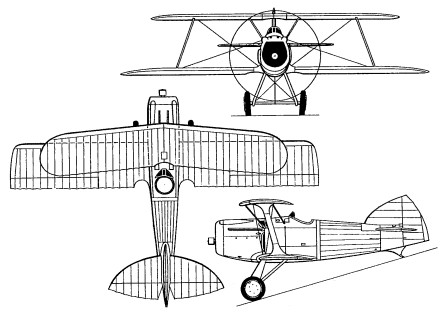
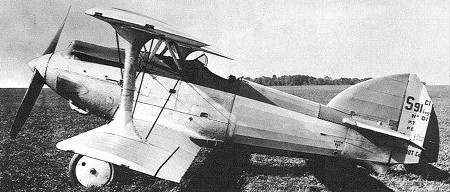
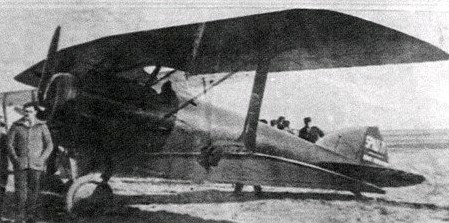
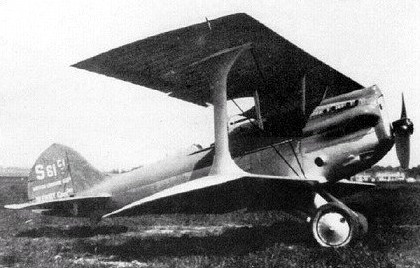
Developed in parallel with the Type 51, the Bleriot SPAD 61 was flown before the 51, the prototype being tested first on 6 November 1923. A single-bay staggered biplane with fabric-covered metal wings and a wooden monocoque fuselage, it was powered by a 12-cylinder W-type Lorraine-Dietrich LO 12Ew engine of 450hp. Production orders were placed on behalf of both Poland (250) and Romania (100), for the Type 61-2, which appeared in 1925, armed with two synchronised 7.7mm MAC (Vickers) machine guns. A further 30 Bleriot SPAD 61-2s were built under licence in Poland from 1927 by CWL (Centralne Warsztaty Lotnicze) and its successor PZL (Panstwowe Zaklady Lotnicze). Variants that progressed no further than the prototype stage included the Type 61-3 which reverted to the metal wing structure of the original Type 61-1 (the production Type 61-2 having a wooden wing), and had four 7.7mm Darne machine guns and increased fuel tankage. First flown on 9 May 1925, it was intended to participate in the 1925 fighter trials. Re-engined with a 480hp Lorraine- Dietrich LO 12Ee, it flew on 6 June 1925 as the Type 61-4. Three examples of the Type 61-5 were built, powered by the 450hp Hispano-Suiza HS 12Gb engine. The first of these was flown on 13 May 1925, and one was supplied to Turkey. The second Type 61-5 flew on 9 September 1927 as the Type 61-8 after being re-engined with a 500hp HS 12Hb engine, and the final fighter derivative was the Type 61SES built for Polish evaluation. This differed from earlier models in being a sesquiplane with a swept upper wing. The Type 61SES was flown on 1 May 1926, but proved to have inferior characteristics to those of the standard Type 61-2.
S.61-2 Engine: 1 x 450hp Lorraine 12 Eb Take-off weight: 1565 kg / 3450 lb Empty weight: 1055 kg / 2326 lb Wingspan: 9.61 m / 32 ft 6 in Length: 6.78 m / 22 ft 3 in Height: 2.80 m / 9 ft 2 in Wing area: 29.30 sq.m / 315.38 sq ft Max. speed: 238 km/h / 148 mph Cruise speed: 220 km/h / 137 mph Ceiling: 7500 m / 24600 ft Range: 400 km / 249 miles Crew: 1 Armament: 2 x 7.7mm
On 24 December 1925, the Societe Bleriot-Aeronautique received a French government order for three prototypes of a two-seat fighter powered by a 420hp Gnome-Rhone Jupiter 9Ab nine-cylinder radial engine. Designated Bleriot SPAD 60, the fighter was a single-bay biplane of mixed construction with sweptback upper wing and unswept lower wing, armament comprising two fixed forward-firing 7.7mm machine guns in the upper wing and two weapons of similar calibre on a ring mounting in the rear cockpit. The first prototype was flown on 26 June 1926, but as a result of stability problems development was abandoned in favour of the Bleriot SPAD 70.
S.60 Engine: 1 x 420hp Gnome & Rhone Jupiter Take-off weight: 1803 kg / 3975 lb Empty weight: 1224 kg / 2698 lb Wingspan: 11.30 m / 37 ft 1 in Length: 6.88 m / 23 ft 7 in Height: 3.21 m / 11 ft 6 in Wing area: 36.60 sq.m / 393.96 sq ft Max. speed: 209 km/h / 130 mph Cruise speed: 185 km/h / 115 mph Rate of climb: 256 m/min / 850 ft/min Crew: 2 Armament: 4 x 7.7mm
Designed by Andre Herbemont and of generally similar configuration to the Type 41, the Bleriot SPAD 51 had fabric-covered metal wings and a wooden monocoque fuselage, power being provided by a 420hp Gnome- Rhone Jupiter nine-cylinder radial. The first prototype, the Type 51-1, was flown on 16 June 1924, a second modified prototype, the Type 51-2, following on 18 March 1925. Powered by a Jupiter IV and carrying an armament of two 7.7mm MAC (Vickers) guns in the upper wing, the Bleriot SPAD 51-2 was ordered for the Polish air arm, the Lotnictwo Wojskowe, 50 being delivered during 1925-26. Another prototype, the Type 51-3, with an improved propeller, flew on 7 September 1926. This offered a 12km/h speed superiority and improved ceiling over the 51-2. On 30 August 1928 the Type 51-4 final derivative with a special 600hp version of the Jupiter first flew. Of ten production Type 51-4s were completed, one being sold to Turkey and another to the Soviet Union, these having provision for two fuselage-mounted Vickers and two wing-mounted Darne machine-guns, and a 420hp Jupiter 9Ab.
S.51-2 Engine: 1 x 420hp Gnome & Rhone 9Ab Jupiter Take-off weight: 1360 kg 2998 lb Empty weight: 990 kg / 2183 lb Wingspan: 9.47 m / 31 ft 1 in Length: 6.45 m / 21 ft 2 in Height: 3.10 m / 10 ft 2 in Wing area: 24.27 sq.m / 261.24 sq ft Max. speed: 245 km/h / 152 mph Cruise speed: 225 km/h / 140 mph Ceiling: 8850 m / 29050 ft Rate of climb: 444 m/min / 1450 ft/min Armament: 2 x 7.7mm Crew: 1
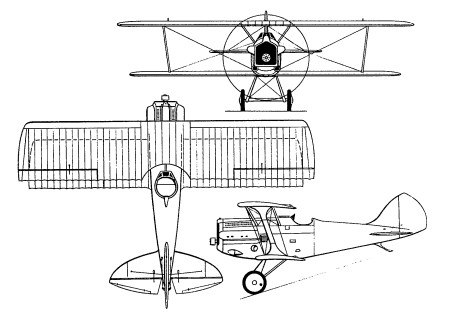
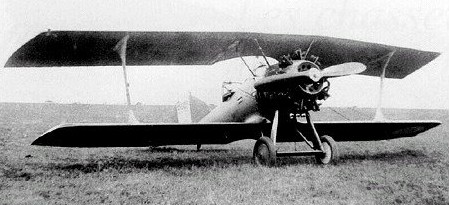
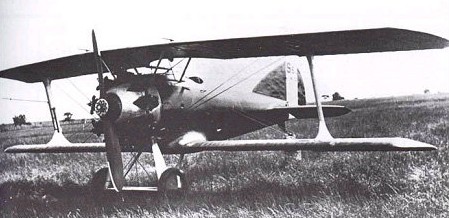
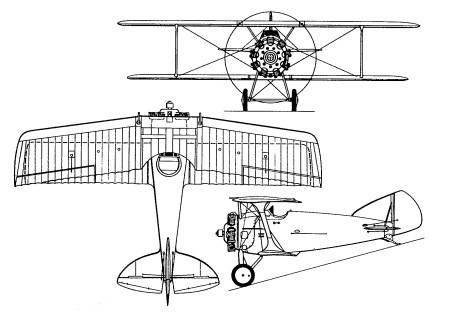
The first fighter in the SPAD line to receive the Bleriot SPAD designation was the Bleriot SPAD 41, designed by Andre Herbemont and essentially a single-seat derivative of the SPAD S.XX two-seater of 1918. Powered by a 300hp Hispano-Suiza HS 8Fb eight-cylinder water-cooled engine with two individual Lamblin radiators in place of the familiar circular frontal radiator, the Bleriot SPAD 41 was a staggered single-bay biplane with a sweptback upper wing and unswept lower wing. It featured a wooden monocoque fuselage. The prototype first flew at Buc on 17 July 1922, but official evaluation revealed an inadequate service ceiling and no production was ordered, the aircraft subsequently being modified for racing.
S.41 CREW 1 Engine: 1 x 300hp Hispano-Suiza 8Fb Take-off weight: 1307 kg / 2881 lb Empty weight: 887 kg / 1956 lb Wingspan: 8.68 m / 29 ft 6 in Length: 6.65 m / 22 ft 10 in Height: 2.76 m / 9 ft 1 in Wing area: 26.40 sq.m / 284.17 sq ft Max. speed: 238 km/h / 148 mph Cruise speed: 205 km/h / 127 mph Ceiling: 6850 m / 22450 ft Armament: 2 x 7.7mm


 All Aero