The Breda B.1 of 1920 was an enclosed-cabin airliner conversion of surplus Caproni Ca.5 bomber. A twin-engined twin-boomed biplane six passenger airliner with a 25m wingspan the fuselage was rebuilt for passengers and two engines.
Biplane
Breda A.14 / Ba.14
The Breda A.14 is a 1928 trimotor biplane bomber, with a 23m Warren truss wingspan. One prototype was built. Similar to the A.8 but with 3 x 410hp Alfa Romeo Jupiter 9-cyl radials.
The prototype rebuilt as an airliner with an enclosed cabin, as the Ba.14.
Breda A.10
The Breda A.10 2-bay biplane tandem fighter-trainer prototype I-BAUD was registered in 1927, flying in 1928.
The A.10 combined features of the A.9 and A.9 bis. Only one A.10 aircraft was built.
Engine: 1 x 250 hp Isotta-Fraschini V.6
Wingspan: 8.84m / 29.0 ft
Seats: 1
Breda A.9
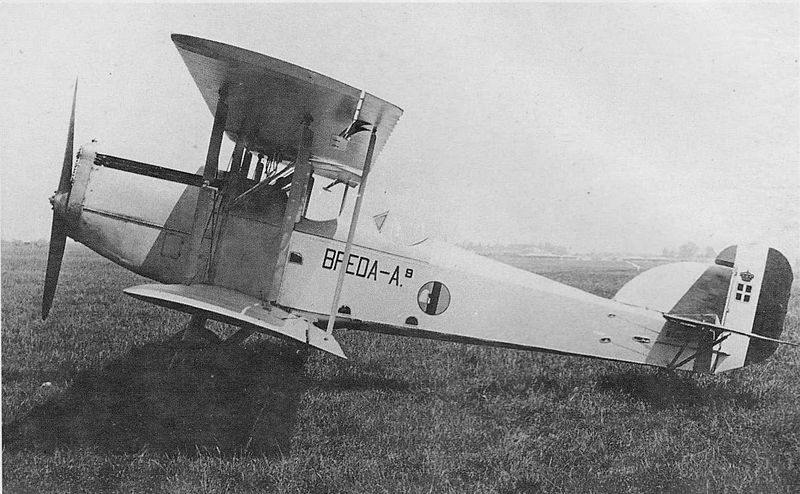
The Breda A.9 was a biplane trainer produced in Italy in 1928 for the Regia Aeronautica. Conventional in design, it featured a single-bay, unstaggered wing cellule and fixed tailskid undercarriage. The student and instructor sat in tandem, open cockpits.
A.9 I-BAZP was registered in 1927, before flying in 1928.
A slightly smaller version, designated A.9-bis was developed for use in Italy’s aeroclubs. The A.9 bis of 1930 was a reduced span (8.72 m) single-seat aerobatics trainer.
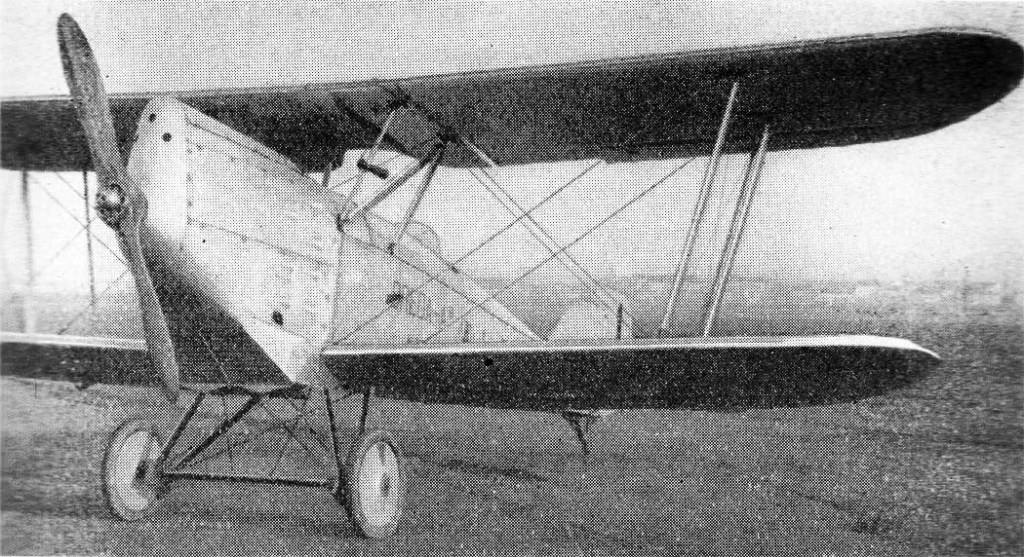
A.9
Engine: 1 x Isotta-Fraschini Asso 250, 250 hp / 190 kW
Propeller: 2-bladed fixed pitch propeller
Wingspan: 9.32m (30 ft 7 in)
Wing area: 27 m2 (290 sq ft)
Length: 7.95 m (26 ft 1 in)
Height: 2.97 m (9 ft 9 in)
Empty weight: 770 kg (1,698 lb)
Gross weight: 1,050 kg (2,315 lb)
Wing loading: 39 kg/m2 (8.0 lb/sq ft)
Maximum speed: 185 km/h (115 mph; 100 kn)
Cruising speed: 152 km / h
Stall speed: 75 km/h (47 mph; 40 kn)
Range: 800 km (497 mi; 432 nmi)
Endurance: 3 hours
Service ceiling: 6,000 m (20,000 ft)
Power/mass: 0.196 kW/kg (0.119 hp/lb)
Seats: 2
No built: 36
A.9 bis
Engine: 1 x Isotta-Fraschini Asso 250, 250 hp / 190 kW
Wingspan: 8.72 m
Empty weight: 720 kg
MAUW: 940 kg
Seats: 2
Breda A.8
A 1927 biplane night bomber, 23m span (Warren truss), 1 prototype. The A.8 was derived from A.4 but with engines now mounted on lower wings
A.8: As first flown, 2 x 400 hp Lorraine-Dietrich 12Db V-12 engines
A.8: As modified, 2 x 500 hp Isotta-Fraschini Asso V-12 engines
Breda A.4
1927 2-bay biplane tandem 2-seat light a/c / trainer
A.4: light aircraft in wheeled landplane config., 1 x 130 hp Colombo 110D
A.4 HS: Hispano-Suiza engined version, 1 x 180 hp HS-8Ab V-8
A.4 Idro: twin-float seaplane config. with enlarged vertical tail fin
Breda A.3
A 1924 biplane night bomber, one prototype was built with Warren truss.
First flown with 4 x 200 hp SPA 6A inline 6-cylinder engines, later modified with 2 x 400 hp Lorraine-Dietrich 12Db V-12 engines.
Wingspan: 23m
Breda A.1
A 1924 4-bay biplane light aircraft derived from the SAML A-3 (in turn, derived from licenced Aviatik designs).
Società Anonima Meccanica Lombarda took on Aviatik’s designer, Robert Wild
Engine: 1 x 140 hp Colombo 110D
Wingspan: 10.20m
Brauner and Smith Biplane
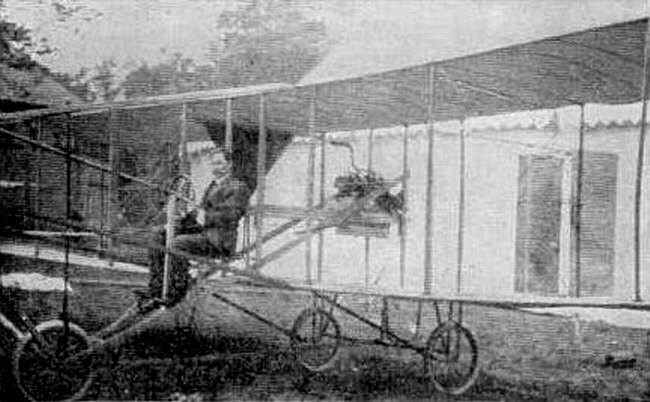
The 1909 Brauner and Smith biplane was designed and built by Pincus Brauner and A. J. Smith, who were members of Aeronautic Society of New York, Morris Park. Their biplane was the second aircraft of the Society to fly. Both Brauner and Smith made numerous flights in the machine proving its airworthiness. Later, the aircraft was exhibited at Madison Square Garden. Eventually Brauner, while attempting to reach a greater height, raised his front control too acutely, and fell backwards, almost totally destroying the machine, but he escaped unhurt.
Brandenburg G.1
 All Aero