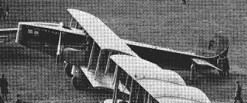
The Breguet 280T was operated by Air Union circa 1929.
The Breguet 280T was operated by Air Union circa 1929.
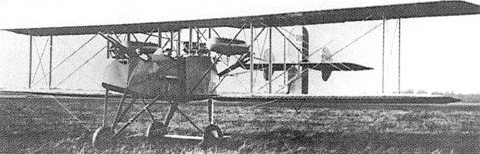
Developed during 1914 when French military planners began to express a preference for pusher- over tractor-configured aircraft, leading Breguet to cease further development of its original Type IV design and pursue military contracts with an aircraft of the preferred layout. The Bre.4 evolved indirectly from the BU3 two-seat twin-boom pusher biplane of late 1914 as a smaller and lighter development of its bomber derivative, the BUM (B=Breguet, U=Salmson engine and M=Michelin-built), the BUC (the letter “C” signifying Chasse) was intended primarily as a bomber escort.
The Type IV was a two-bay, equal-span, unstaggered biplane that seated the pilot and observer in tandem open cockpits in a nacelle that also carried the pusher engine at its rear, and the tricycle undercarriage. As the prototype neared completion, the Breguet factory at Douai was threatened by the advancing German Army, and the machine and its builders were evacuated to Villacoublay where construction and testing were completed. At this point, André and Édouard Michelin approached the French government with an offer to sponsor the construction of 100 bombers for the Army, and were awarded a licence to the Breguet design.
This was put into production as the BUM (B for pusher-driven, U for Canton-Unné-powered, M for Michelin), and later revised to the BLM as the definitive Renault-powered version.
With the installation of a 220hp Renault 12Fb 12-cylinder water-cooled engine in place of the Salmson, prototype trials were performed in June 1915, a few additional aircraft being built under the designation BLC.
Soon after the BUM had entered service, the French Army requested that an escort fighter version be developed to protect the bombers from interception. Breguet responded with a lightened design armed with a 37 mm (1.46 in) Hotchkiss cannon on a flexible mounting in the forward cockpit of the fuselage nacelle intended to pick off enemy fighters before they closed to within range of their machine guns. This entered production as the BUC (C for chasse, or pursuit) in its original 200hp Salmson Canton-Unné 14-cylinder radial powered version and BLC in its Renault version. Few of these escort fighters were built, as their performance and utility were discovered to be lacking, and the doctrine of the cannon-armed escort fighter was soon abandoned in favour of countering fighters with other similar fighters. A number of BUCs were also built for Britain’s RNAS using British engines.
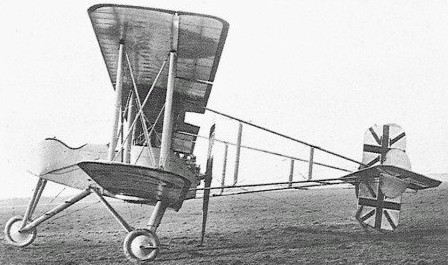
The performance of both the BUC and BLC versions of the Breguet de Chasse was unspectacular and, with fewer than 20 delivered, they were declared obsolete by the Aviation Militaire before the end of 1916. During that year, a 17 essentially similar aircraft were supplied to the Royal Naval Air Service. These differed from the BUC/BLC primarily in having the 225hp Sunbeam Mohawk 12-cylinder engine, armament being a single 7.7mm Lewis machine gun (which was an alternative weapon to the Hotchkiss on French machines). The RNAS was disappointed with the performance of the Breguet de Chasse, which proved unsuitable for employment in the fighting role, and the service withdrew the type from its first-line inventory in June 1916.
BLC
Take-off weight: 1535 kg / 3384 lb
Empty weight: 1160 kg / 2557 lb
Wingspan: 16.40 m / 54 ft 10 in
Length: 9.50 m / 31 ft 2 in
Height: 3.70 m / 12 ft 2 in
Wing area: 54.0 sq.m / 581.25 sq ft
Max. speed: 138 km/h / 86 mph
Variants:
Type IV (BU3)
Breguet prototype.
BUM (BrM2B.2)
Michelin-built, Canton-Unné-powered bomber version.
BLM (BrM4B.2)
Michelin-built, Renault-powered bomber version.
BUC
Michelin-built, Canton-Unné-powered escort fighter version.
BLC
Michelin-built, Renault-powered escort fighter version.
Breguet de Chasse
Version of BLC for RNAS, powered by Sunbeam Mohawk or Rolls-Royce Falcon engine.
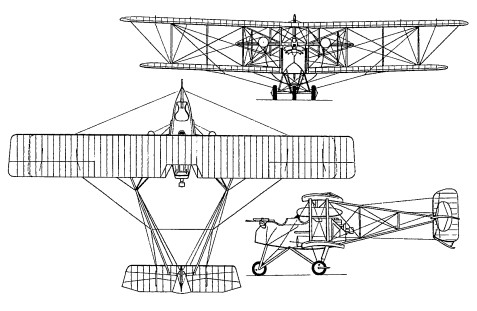
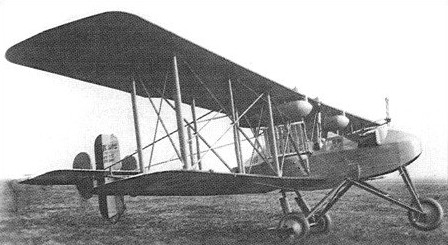
The Type 6 (Bre 6 Ca2) two-seat escort fighter of 1916 was a 225hp Salmson A9 water-cooled nine-cylinder radial engined counterpart of the Renault-powered Type 5, and resulted from a fear that Renault engine production would prove inadequate to meet demands. The Type 5 airframe was modified to take the Salmson engine mounted immediately above the rear undercarriage legs and driving the propeller by means of an extension shaft, the power plant being entirely enclosed. Armament of the Type 6 fighter normally consisted of a short-barrel 37mm Hotchkiss cannon in the forward fuselage. Performance, weights and dimensions were essentially similar to those of the Type 5.
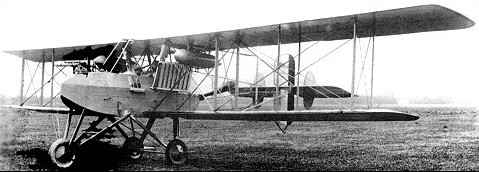
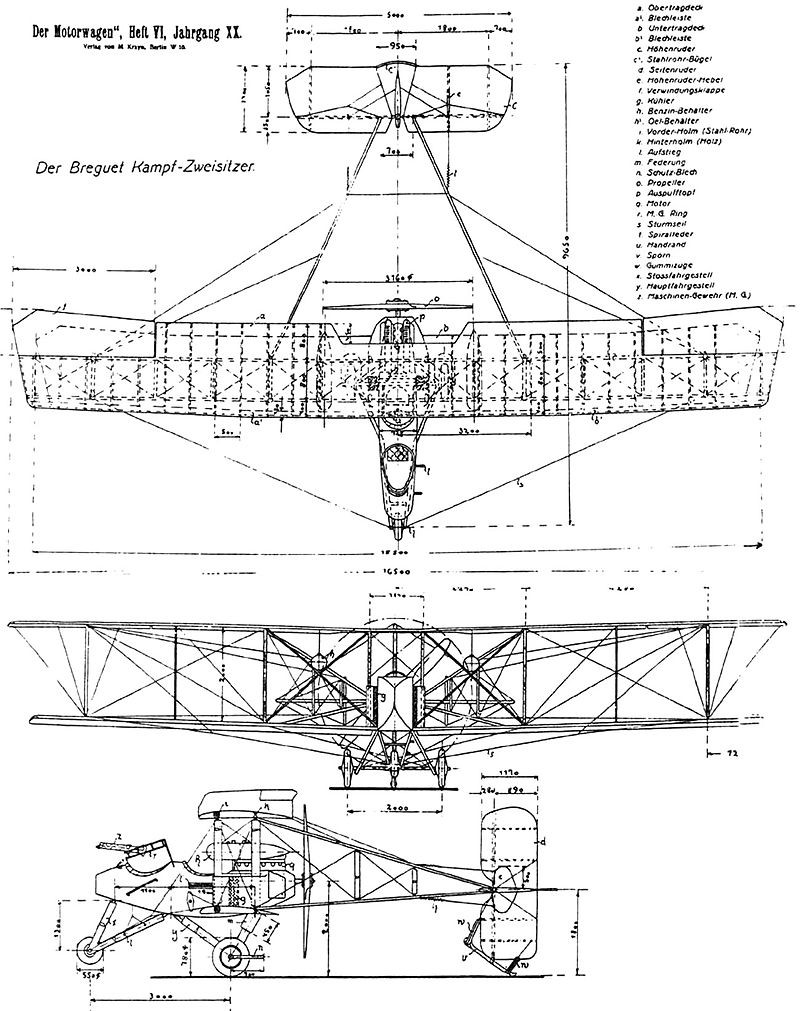
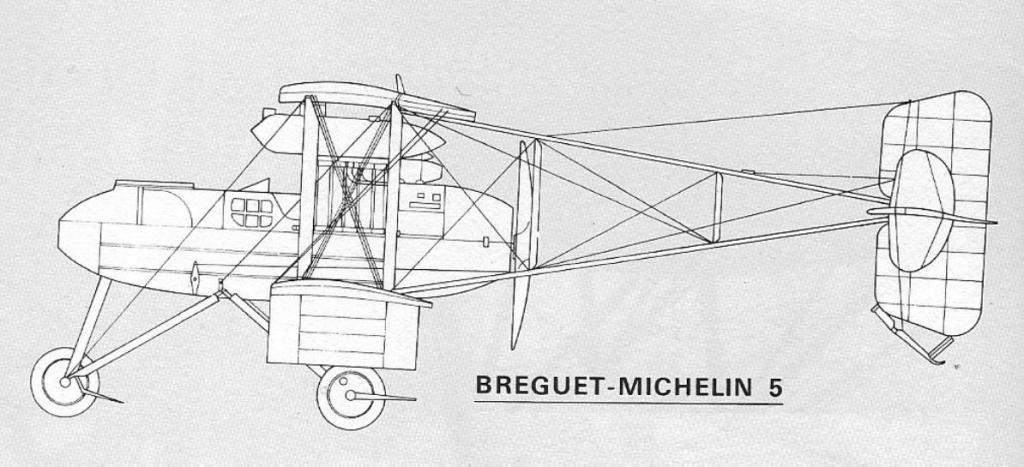
The relative success of the use of cannon in the Breguet BU.3 led the Breguet company to install it in their latest aircraft, the Breguet 5. This was a three-bay, unequal span biplane powered by a 225-hp Renault 12Fb engine. The tail section was the same as that of the Breguet BU.3, with four tail booms extending from the upper and lower wings. The Breguet Br.M5 series of biplane bomber was developed from the Breguet Br.M4 late in 1915 and was regarded by the Aviation Militaire as a two-seat escort fighter or reconnaissance-fighter.
The Br.M5 was operated by a crew of two with the pilot seated in the middle of the aircraft and the gunner/observer to the front. The engine sat behind the crew area – directly behind the pilot and was a pusher driving a two-blade propeller. Design was with a bathtub-like fuselage, a static tricycle landing gear array and framework and cables leading out to the empennage.
The RNAS purchased 59 Breguet 5s from the Breguet factory and ordered an additional 3 from Graham-White Aviation Company (as Grahame-White Type XIX / G.W.19), but only 10 were ever built in Britain. Twenty-five of the Breguet 5s built in France had the 250-hp Rolls-Royce engine installed, the remaining models were powered by the 225-hp Renault engine.
In action, the Br.M5 was fielded primarily as a night bomber and used by both the French and English forces from 1916-1917 though it first appeared in the summer of 1915. The Type 5 fighter, or Bre 5 Ca2, never equipped a complete escadrille, a few aircraft of this type being issued to each of the units operating the Bre 5 B2 bomber version, for which it was expected to act as escort. Armament comprised a 37mm Hotchkiss cannon on a flexible mounting in the forward cockpit and a rear-firing 7.7mm Lewis gun on an elevated mounting over the leading edge of the upper wing. Eleven Type 5 fighters were operational with the Aviation Militaire by 1 February 1916, but the type was generally unpopular.
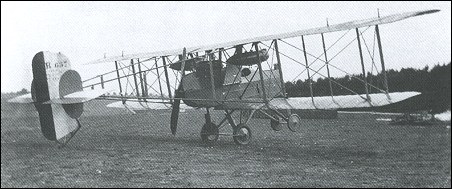
Breguet Br.M5
Engine: 1 x Renault 12Fb, 220hp or 1 x Rolls-Royce Eagle, 250hp.
Wingspan: 17.50 m / 57 ft 5 in
Length: 9.90 m / 33 ft 6 in
Height: 3.90 m / 12 ft 8 in
Wing area: 57.70 sq.m / 621.08 sq ft
Take-off weight: 1890 kg / 4167 lb
Empty weight: 1350 kg / 2976 lb
Max. speed: 133 km/h / 83 mph
Service Ceiling: 11,483ft (3,500m; 2.2miles)
Armament:
1 x 7.7mm Lewis machine gun or 1 x 37mm cannon in forward observer/gunner position.
Accommodation: 2
Hardpoints: 2
Breguet-Michelin 5
Engine: Renault, 220 hp
Wingspan: 57 ft 8 in
Length: 26 ft 1 in
Max weight: 4235 lb
Speed: 86 mph at SL
Endurance: 5 hr
Armament: 1 x mg, 1 x 37 mm cannon
Bombload: 660 lb
Crew: 2
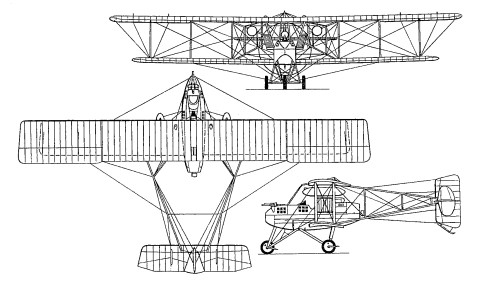
A 1922 modification to the original Tebaldi-Zari fighter prototype.
Modifications were a long span/narrow chord upper wing, different stagger, and removable lower wings.
Engine: Hispano-Suiza HS 42 V-8, 1300 hp
Armament: 2 x 7.7mm Vickers
The 1919 Breda M.1 was an enclosed-cabin airliner conversion of surplus Ca.44 bomber, aka Ca.57.
A twin-engined, twin-boomed biplane 8 passenger airliner, with a 23.40m span.
The 1942 Ba.205 biplane aerobatic trainer was proposed with an all-metal fuselage and forward-mounted cockpits.
Two prototypes (MM.472 & MM.473) were built with fabric/steel-tube fuselage, and the front cockpit covered.
The design was eliminated from competition in January 1943.
Engine: IF Beta RC.10, 280 hp
Wingspan: 9.90m
The Ba.28 training biplane was similar to the Ba.25 except that power was provided by a 380 hp / 290kW Piaggio Stella VIIZ (Gnome-Rhone K-7) radial engine.
Built in both single- and two-seat configurations, the Ba.28 had ailerons on both wings, a cowl, spinner, and larger Ba.25 I-style rudder.
The Ba.28 idro twin float version was exported to Norway.
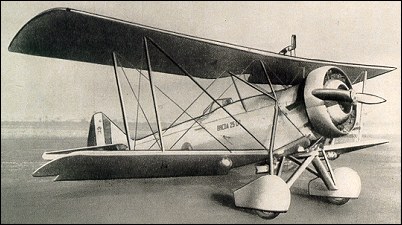
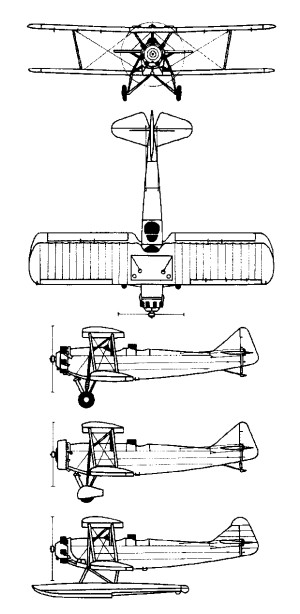
Evolved from the Ba.19A, the Ba.25 training biplane was powered by a Lynx or Castor engine. The Ba.25 was operated by the Regia Aeronautica as a landplane and as a twin-float seaplane.
Ba.25 Prototype
Wingspan: 10m
Wing chord: 719 mm
Seats: 1
Ba.25/D2
Engine: 1 x Alfa Romeo D-2 C.30, 250 hp / 175kW
Take-Off Weight: 1038 kg / 2288 lb
Loaded Weight: 790 kg / 1742 lb
Wingspan: 9.8 m / 32 ft 2 in
Length: 7.8 m / 25 ft 7 in
Height: 2.8 m / 9 ft 2 in
Wing Area: 25.0 sq.m / 269.10 sq ft
Cruise Speed: 195 km/h / 121 mph
Ceiling: 7500 m / 24600 ft
Range W/Max.Fuel: 500 km / 311 miles
Crew: 2
Ba.25/Lynx
Prod. version,
Engine: 215 hp Alfa Romeo Lynx
Seats: 2
Ba.25/Mezzo-Asso
Engine: 250 hp Isotta Fraschini Asso 200
Ba.25 Ridotto
Aerobatic vers. with reduced wingspan
Ba.25 I
Twin-float seaplane, enlarged rudder
42 built
Ba.25 bis
1932 improved vers.
A 1930 aerobatic biplane, single- and 2-seaters, 9 m span.
Forty-one production aircraft were built.
Variants:
Ba.19: Prototype, 1 x 200 hp Armstrong-Siddeley Lynx radial
Ba.19: Production vers. (early) 1 x 240 hp Walter Castor radial
Ba.19: Production vers. (late) 1 x 215 hp Alfa Romeo Lynx
23 built
Ba.19 bis: Improved vers. 1- and 2-seaters, 215 hp AR Lynx
18 built
Ba.19 ter: 2-seat vers, 1 x 260 hp AS Cheetah IIA radial
1 built
 All Aero