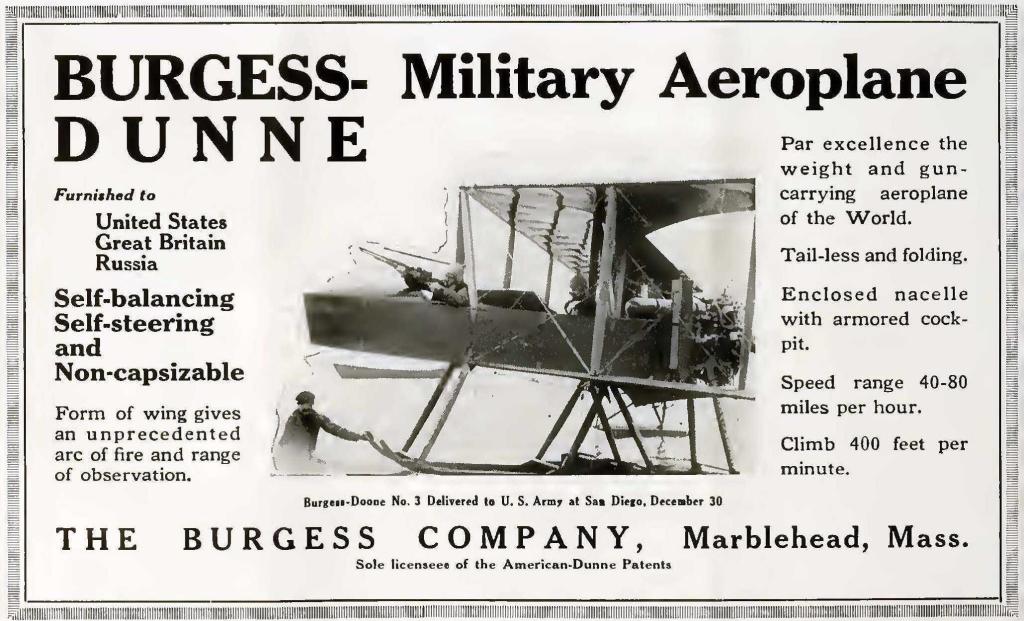
Burgess Military Aeroplane

A hybrid of Farman and Wright machines, it was completed after the Harvard-Boston Aero Meet in 1910, first tried at the end of 1910, and flown into 1911. Passenger flights were undertaken until it crashed in April 1911. Its power plant was a 60 hp Hendee V-8, while a proposed 50 hp Gnôme was never fitted.
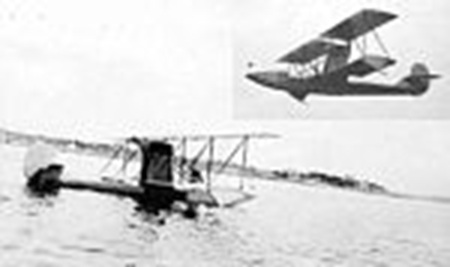
The Burgess K was flown in April 1913 with a 70 hp Renault pusher engine. The two-bay biplane wings had inverted V-struts with a single tube metal spar, and wooden hull.
The single example built, purchased by the Navy, was taken into service as the D-1 (later AB-6) and was destroyed in a crash in early 1914.
Burgess K
Engine: 70 hp Renault
Span: upper 40’9″ lower 35’5″
Length: 30’9″
Seats: 2


Canada’s first military aircraft was this 1914 seaplane, one of several built in America to the designs of J.W.Dunne.

The 1910 Burgess D pusher biplane was designed and built by W.Burgess.
Span: 36′
Length: 41′
The 1910 Burgess B pusher biplane was designed and built by W.Burgess.
Span: 27′
Length: 26′
The 1910 Burgess A pusher biplane, also know as Herring-Burgess, was designed and built by W.Burgess (fuselage, wings, gear) and A.Herring (controls, engine and props). It suffered many changes.
Span: 26’9″ or 27′ or 33’4″
Length: 33′ or 26′ or 28’9″
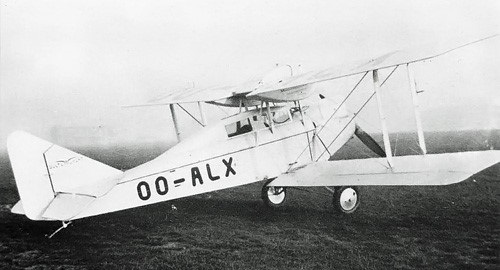
The RB.30 was a two-seat biplane powered by a de Havilland Gipsy I 85 hp engine.
Nine aircraft were built in 1931, and three more in 1932.
In addition to the Gipsy I engine, the RB.30 also used 65 hp Walter motors, a Cirrus Hermes II (105 hp) and a 40 hp Salmson.
In February 1932, one of the RB.30 (OO-ALX) was converted for the Brussels – Congo flight. The aircraft received a closed cockpit and an additional fuel tank located on the upper wing. Having departed from Brussels on February 3, RB.30 was unable to reach the final destination of the flight, as it crashed in the French Alps. The OO-ALX registration was cancelled on January 26th, 1933.
RB.30
Engine: Cirrus Hermes II, 105 hp
Wingspan: 9.10 m
Length: 7.20 m
Empty weight: 450 kg
Maximum speed: 155 km / h
Cruising speed135 km / h
Seats: 2
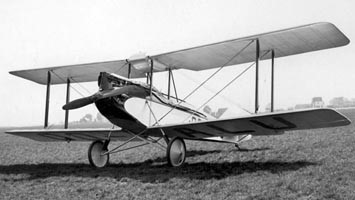
Since 1929, the Belgian engineer René Bulté has changed the numbering of his projects, now the year of manufacture was added to the author’s initials. As a result, the second Bülte model was named RB.29.
It was a two-seat strut-braced high-wing aircraft powered by a 100 hp Hispano-Suiza six-cylinder engine.
In total, Avions Bulté & Cie has built three similar machines OO-AKC, -AKD, -AKE. The second aircraft was powered by a five-cylinder Renard engine of the same power, and the third was powered by an 85-horsepower four-cylinder ADC Cirrus III engine.
All RB.29 vehicles did not fly for long – in early 1930, one of them was crashed while trying to set a new speed record, and the other two were later destroyed in a hangar fire.
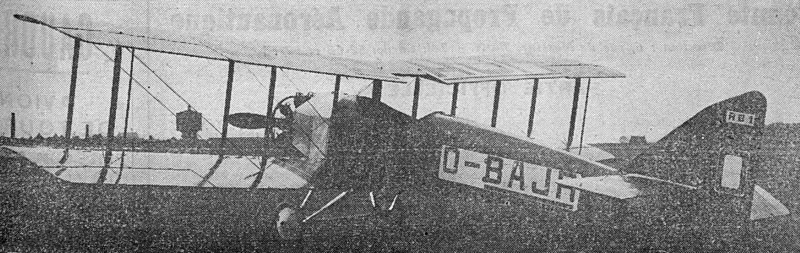
Until June 1928 Renée Bulté had been head of design with Ateliers de Construction Aéronautique de Zeebruges, usually known as ZACCO and one of the pioneers of all-metal aircraft manufacture. He left them to found his own company, Avions Bulté & Cie. Its first product, the RB.1 tandem seat training aircraft, flew towards the end of the year.
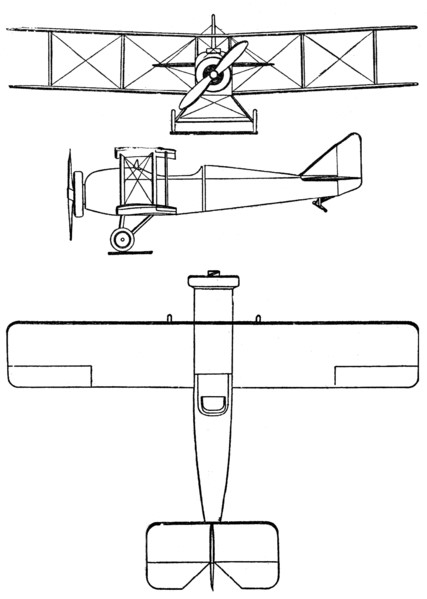
The RB.1 was a simple, conventional, two-bay biplane with thin-section, equal span wings mounted without stagger. One feature of the design was the interchangeability of components; as an example, the wing panels were identical. Such interchangeability reduced the stocks of spares required. The lower wings were attached to the lower fuselage structure and the upper ones to a fuselage-wide centre section held well above the fuselage by four upright cabane struts from the upper fuselage. Both upper and lower wing-sets were mounted with 3° of dihedral and were braced together with two pairs of identical, parallel interplane struts on each side, assisted by the usual wire cross-bracing. Both had short, broad-chord ailerons which reached the wingtips and were externally interconnected. Structurally, each wing was built around two spruce spars and had plywood-covered leading edges.
The trainer was powered by an 89 kW (120 hp) Anzani 6 six-cylinder radial engine in the nose, fitted with a narrow-chord ring cowling. Immediately behind the engine the fuselage was five-sided, rectangular below but sloping on top, and was covered with aluminium sheets back to the wing leading edge. This region contained both fuel and oil tanks. Behind it, the fuselage was formed around four wooden longerons, ash to the rear of the cockpit and spruce further aft. The ash-framed part had three-ply covered sides and a thin aluminium underside and the rear fuselage was canvas covered, including domed rear decking.
Normally the instructor and student sat one behind the other in a long, single, open cockpit, equipped with dual control. The front seat was under the wing but the rear one was behind the trailing edge, which had a rectangular cut-out for better upward vision. Alternatively, the seats could be arranged tightly side-by-side, though with slight stagger, which allowed single controls to be shared and eased communication.
The RB.1’s empennage was conventional, with a broad-chord, rectangular plan tailplane mounted on top of the fuselage and carrying elevators with a large central cut-out for rudder movement. Its triangular fin mounted a parallelogram profile rudder which reached down to the keel.
It had conventional, fixed landing gear, with its mainwheels on a single axle and a wide track of about 2 m (79 in). The axle was joined through rubber cord shock absorbers to a fixed pair of transverse steel tubes supported by a pair of steel V-struts mounted on the lower fuselage longerons. Its tailskid was externally mounted on a little steel tube pyramid, with a knee-type rubber cord shock absorber.
The Bulté RB.1 first flew towards the end of 1928, though the exact date is not known. Five appeared on the Belgian civil aircraft register between 1929 and 1931.
One took part in the Tour du France des Avions de Tourisme around France in May 1931 and another in the Auvergne rally in July that year.
In the UK sales efforts were handled by Sealandair but no examples were registered.
Engine: 1 × Anzani 6, 89 kW (120 hp)
Propeller: 2-blade
Wingspan: 10.88 m (35 ft 8 in)
Wing area: 32.90 m2 (354.1 sq ft)
Length: 7.84 m (25 ft 9 in)
Height: 2.71 m (8 ft 11 in)
Aspect ratio: 6.88
Empty weight: 560 kg (1,235 lb)
Gross weight: 840 kg (1,852 lb)
Wing loading: 25.5 kg/m2 (5.2 lb/sq ft)
Maximum speed: 125 km/h (78 mph, 67 kn) at SL
Stall speed: 55 km/h (34 mph, 30 kn)
Range: 600 km (370 mi, 320 nmi)
Absolute ceiling: 4,200 m (13,800 ft)
Seats: 2
 All Aero