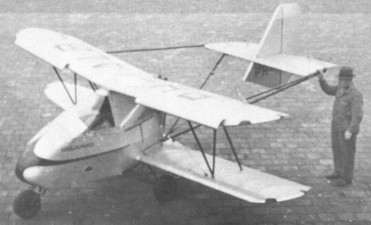
The Scheldemusch, a single seat sports aircraft with a six metre wing span and an empty weight of 185kg. Its price was Dfl. 2,500, and its operating costs, including depreciation, maintenance etc., amounted to Dfl. 9per hour. This small aircraft was designed in 1935 by the former Pander designer, Mr Slot, for the Royal Company De Schelde. The Scheldemusch was the first production light aircraft with a steerable nosewheel.
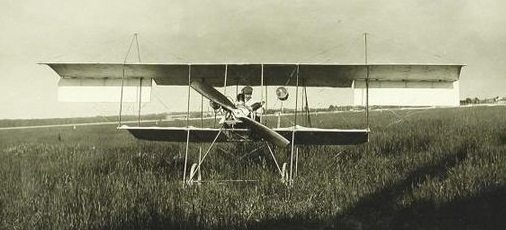
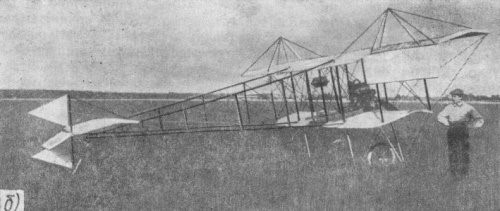
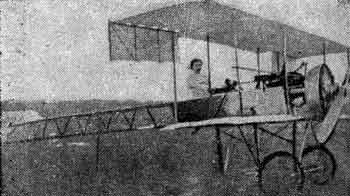
Georgiy Konstantinovich Demkin’s [Георгий Константинович Демкин] second design, it is stated that he held a shed at the Gatchina airfield near St. Petersburg. Only a few “short, straight flights” were achieved with this sesquiplane fitted with a 3-cylinder 25 hp Anzani.
The upper wing carried ailerons. Struts had oval cross section. Despite low engine power, short straight flights were performed during summer 1911.
Engine: 1 x Anzani, 25hp Wing span upper: 8.0 m / 26’3″ Wing span lower: 4.6 m / 15’1″ Wing area: 17.0 sq m (11.2 upper, 5.8 lower) Power loading: 13 kgs/hp
Lucien and Paul Demazel (son and father) ran a flying school at Issy-les-Moulineaux, in Paris, France, and built at least two different types of flying machines two Caudron copies built in 1912.
The 1920 de Marcay Sport-Farman was a two-seater biplane with a span of 23 ft and weighing 450 lb. The landing speed was 16 mph and top speed 87 mph. It could take-off in 30 yds with two POB, and 10 yds with one.
The De Marcey ‘Sport Biplane’ was powered with a 60 hp Le Rhone and wingspan of 18 ft. The motor was neatly cowled and the propeller was fitted with a large spinner and a streamlined monocoque fuselage, Top speed was 118 mph with a landing speed of 28 mph.
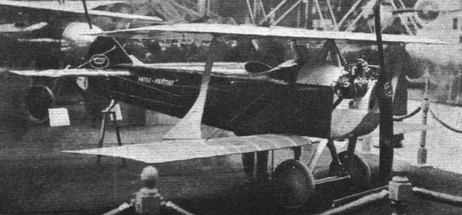
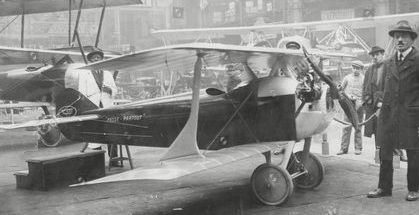
The de Marçay Passe-Partout (lit. '”de Marçay Master-Key”‘) was a small, low-powered single-seat sport and touring aircraft built by SAECA Edmond de Marçay (Société Anonyme d’Etudes et de Construction Aéronautique Edmond de Marçay) in France just after World War I.
The Passe-Partout was the smallest and lightest de Marçay aircraft of the three on display at the Paris Aero Salon of 1919. It had a very low power engine, the same 10 hp (7.5 kW) ABC 8 hp adapted flat-twin motorcycle engine that powered the English Electric Wren. Flight magazine doubted its practicality with this engine.
It was a single bay biplane with a single interplane strut on each side defining a bay braced with a single flying wire and a single landing wire. Both wings were two spar structures; there was marked forward stagger but no dihedral The interplane struts were slender at the top but smoothly widened towards their feet, linking the upper rear spar to both lower wing spars. The narrow upper joint provided a fixed point about which control wires could warp the trailing edge. Short cabane struts from the fuselage supported the centre of the upper wing.
The Passe-Partout had a monocoque fuselage of rounded rectangular cross-section. Its engine was mounted, with cylinders exposed, in the upper nose. The pilot’s open cockpit placed him just aft of the upper trailing edge but over the lower wing because of the stagger. At the rear a plywood covered tailplane was mounted high on the fuselage and fitted with fabric covered elevators. Both the fin and rounded rudder were also ply covered. Its fixed landing gear was of the conventional tailskid type with mainwheels on a single axle rubber rubber sprung from a frame consisting of two V-form struts from the lower fuselage with a single cross-member.
The Passe-Partout hadn’t yet flown when it appeared at the Paris Salon in December 1919 but it had flown by the following May. Marçay continued to advertise it until at least October 1920 but Flight’s doubts about its practicality seem to have been justified for in May 1928, when the de Marçay company ceased to exist, Les Ailes noted that the Passe-Partout had undertaken only a few, inconclusive trials and further, that de Marçay himself saw it more of a curiosity than a practical aircraft.
Powerplant: 1 × ABC 8 hp, 7.5 kW (10 hp) Propeller: 2-blade Wingspan: 4.04 m (13 ft 3 in) Wing area: 8.50 m2 (91.5 sq ft) Length: 3.797 m (12 ft 5.5 in) Height: 1.37 m (4 ft 6 in) Empty weight: 104 kg (230 lb) Gross weight: 189 kg (417 lb) Endurance: 2 hr Maximum speed: 109 km/h (68 mph, 59 kn) Service ceiling: 1,000 m (3,300 ft) Crew: one
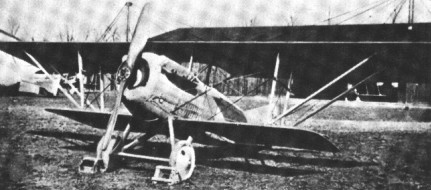
An experimental single-seat scout, the de Marcay Type C utilised a SPAD 13 fuselage, built in 1919.
The initial design was based on the use of an eight-cylinder Liberty engine, but the difficulties experienced with this engine led to revision of the design to take a 300 hp Hispano-Suiza 8Fb eight-cylinder water-cooled engine as the de Marcay 2 Cl. An unequal-span staggered single-seat biplane with horn-balanced ailerons on the upper wing only and an armament of two synchronised 7,7-mm Vickers machine guns.
The Type C achieved 157 mph at Villacoublay flown by Lt. Lebeau. Although the fastest fighter participating in the 1919 Service Aéronautique contest held at Villacoublay, no production order was placed for the de Marcay 2 Cl and only one prototype was completed.
Engine: 300 hp Hispano-Suiza 8Fb eight-cylinder Max speed, 156 mph (252 km/h) at sea level, 144 mph (232 km/h) at 9,840 ft (3000 m). Time to 16,405 ft (5000 m), 16.27 min. Span, 30 ft 4 1/8 in (9,25 m). Length 21 ft 8.6 in (6,62 m). Wing area, 269.1 sq ft (25,00 sq.m).
To celebrate the 45-years jubilee of the Student Aeronautical Study Association ‘Leonardi da Vinci’ of the Technical University of Delft, the members decided it would be a nice project to build an ‘exact’ replica of the Lambach HL-2. However, it never was the intention to make a 100% exact replica since this was almost impossible for practical and for flight-safety reasons.
To realize the construction the SSVOBB, or Stichting Studenten Vliegtuigontwikkeling, -Bouw en Beheer (Foundation Aircraft development, construction and Maintenance) was founded in 1990.
Driving person behind this project was Mr. Hans Blaauw. The project was started around 1989 with the formation of a construction team of dedicated volunteers. The team found out that the chief constructor of the Lambach HL-2, Ir. Wim de Koo was still alive and fully prepared to assist with the project. As a great help a set of original works drawings was discovered at the Aviodome museum at Schiphol airport. In fact, the finding of these drawings was the main reasons this quite unknown aircraft was chosen as a project!
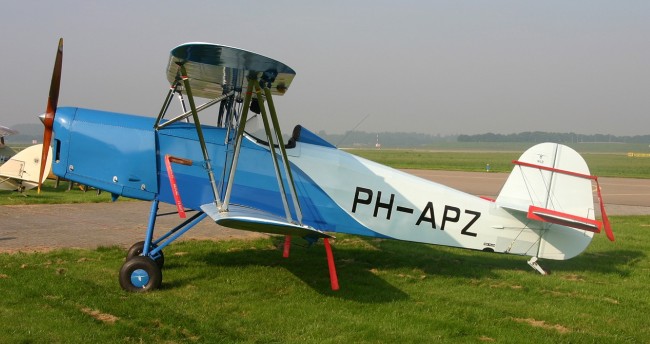
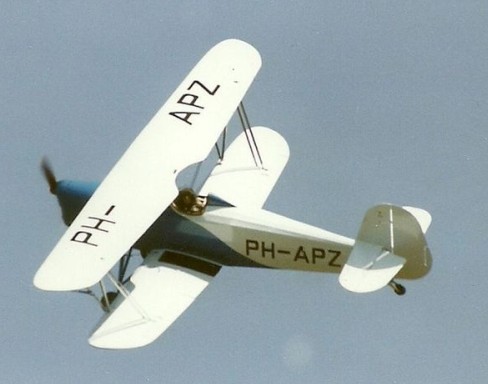
Over more than five years so much work was done to complete the construction that it was more than enough to fill a book. In fact a book on this project WAS written by Bas Nijenhuis, Ferdinant Spek and Piet Moeleker and published in 1996. The original HL-2 had a typical construction of that period with a welded steel tube fuselage covered with fabric, light-alloy engine cover plates and a wooden wing with fabric covered control surfaces. The team had to ‘rediscover’ many construction techniques as originally used in the Thirties and of course modern materials were used where appropriate. As a novelty, the new GLARE-composite material was used, amongst others for the engine firewall. This was the first time this new material was used in an aircraft. After five years the HL-2 replica was ready to make its first flight. This took place on Monday 18 September 1995 at Gilze-Rijen airbase. Pilot on this occasion was Charels Bertels. Over the next few months more test flights were made until the testing programme was completed on 28 December 1995 with the 25th flight. The replica carried the original registration of the original, PH-APZ.
It was the intention to use the plane for airshow displays but unfortunately its Certificate of Airworthiness was withdrawn when fatigue cracks were found in the wing strut supports. The plane was located at various places over the years. Over 1995-1999 is was located at Gilze Rijen Airbase. Over 1999-2000 it was placed in the display hall of the old Aviodrome museum at Schiphol airport. From 2000 to 2005 it was stored at Midden-Zeeland airfield and over the period 2005-2008 it was located at Hoogeveen airfield. In September 2008 it was removed to Lelystad Airport in the exhibit hall of the Aviodrome Theme Park Museum. SSVOBB is still active with the Lambach HL-2 replica and they hope to solve the technical/structural problems to make the plane airworthy again. Last activities took place on 6 July 2010 when a group of SSVOBB volunteers, headed by Halbe Mulder, started the engine again to do some vibration measurements. Basically the engine was regularly started over the years, but since its last move to the Aviodrome there were some problems with one of the magnetos and the original planning of SSVOBB to do the vibration test was quite hampered by these problems.
Lambach HL.II Replica C/N 20002 Registration: PH-APZ Engine: De Havilland Gipsy Major Mk. 1 Serial number: 95121 A 444646 Fuel: AVGAS 100 LL Propellor: Poncelet Two-bladed, wooden fixed pitch Wing Span: 8.00 m Length: 6.70 m Height: 2.40 m Empty Weight: 468 kg Max. Take-off Weight: 620 kg Stall Speed: 43 KIAS Cruise Speed (VA): 110 KIAS Max. Speed (VNE): 145 KIAS Max. G-load: -2.9 / +5.8 Operating Ceiling: 6000 ft MSL Min. take-off distance: 200 m Min landing distance: 300 m Seats: 1
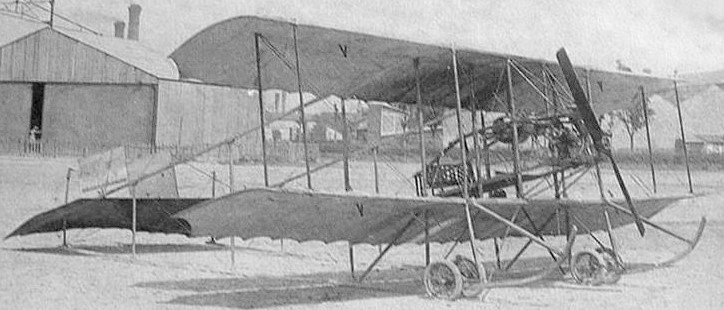
The Delest 1912 Biplane was constructed by Juan Alberto Delest during 1912–13 at Villa Lugano, a section of greater Buenos Aires where the first airfield in Argentina was established. The machine was possibly named “Porteno”.
The Deleray Aircraft Works D-5 Sport Plane of 1920 was a single-seat open cockpit biplane powered with a 15hp motorcycle engine. The lower wing slightly shorter. It could be practically any motorcycle motor of 12 hp or more. The slab-sided early ultralight was advertised as “complete set of 18 large plans” for $6.00.
Wingspan: 17 ft Max speed: 65 mph Stall: 35 mph Seats: 1
 All Aero