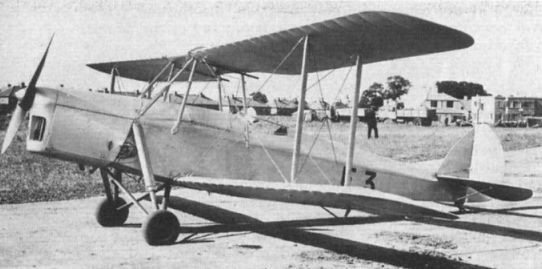
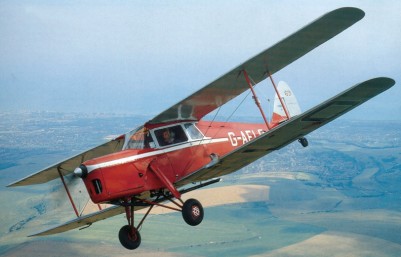
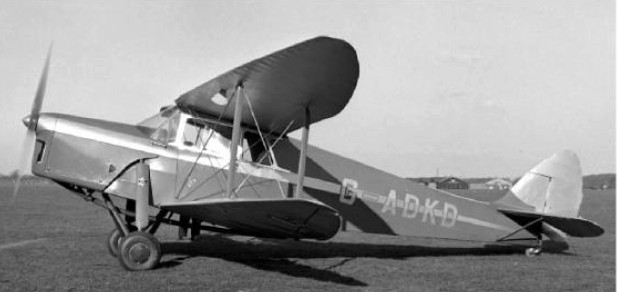
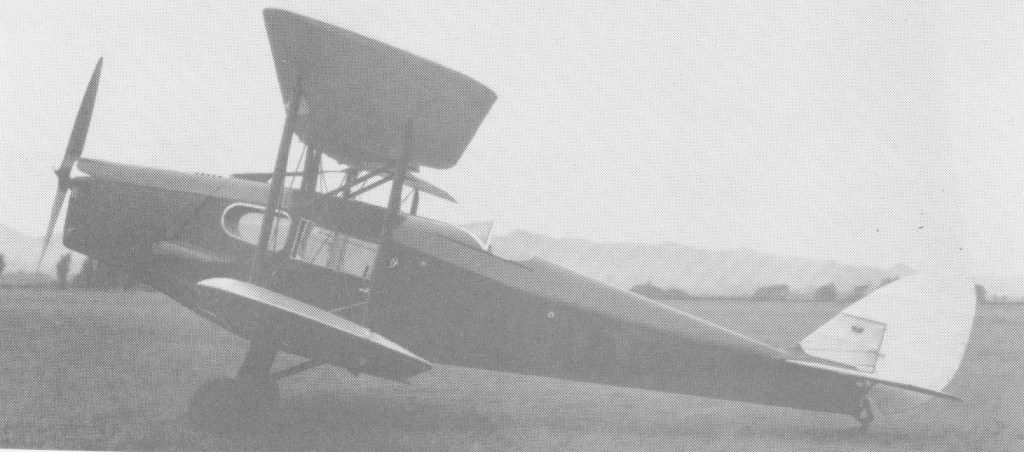
The de Havilland T.K.1 was a two-seat biplane and the first design built by students of the de Havilland Technical School. The T.K.1 was built by students under the direction of Marcus Langley at Stag Lane Aerodrome in 1934.
It was based on converting the de Havilland Swallow Moth monoplane to a biplane. It was a conventional two-seat biplane powered by a 120 hp (90Kw) de Havilland Gipsy III and first flown in June 1934.
It was flown by Geoffrey de Havilland to 5th place in the 1934 Kings Cup Race with a speed of 124.4 mph. It was sold onto a private owner in 1936 who flew it for a short time as a single-seater before it was scrapped.
Engine: 1 × de Havilland Gipsy III, 120 hp (90 kW) Wingspan: 27 ft 0 in (8.23 m) Length: 24 ft 0 in (7.32 m) Empty weight: 950 lb (431 kg) Gross weight: 1450 lb (658 kg) Maximum speed: 118 mph (189 km/h) Cruise speed: 100 mph (160 km/h) Crew: 2
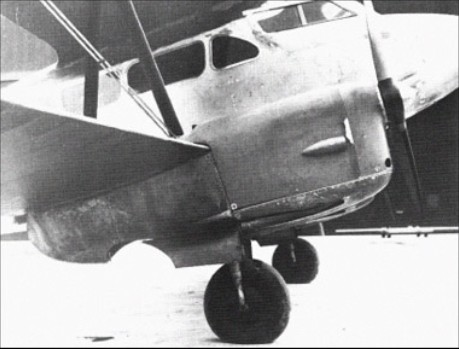
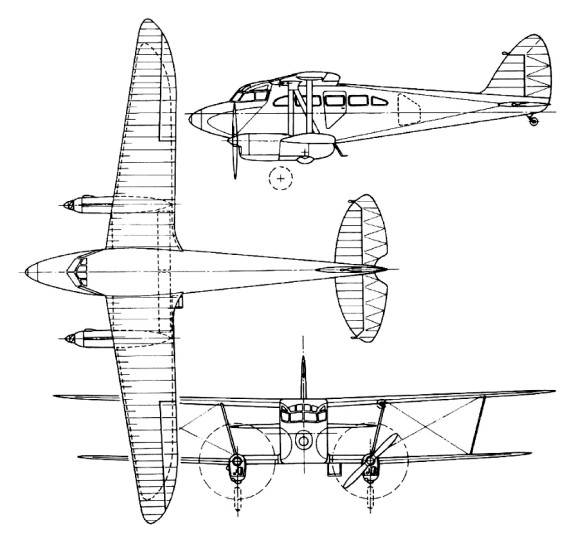
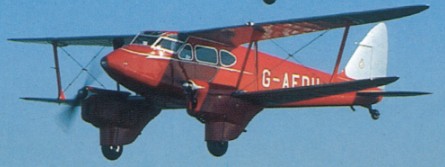
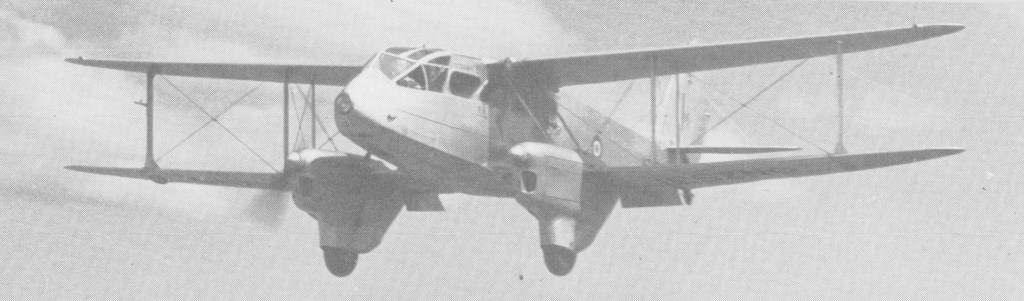
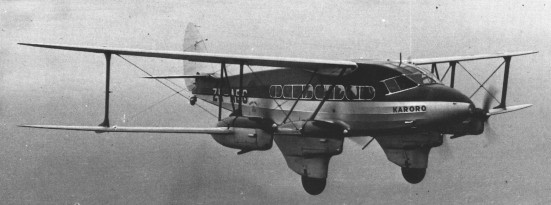
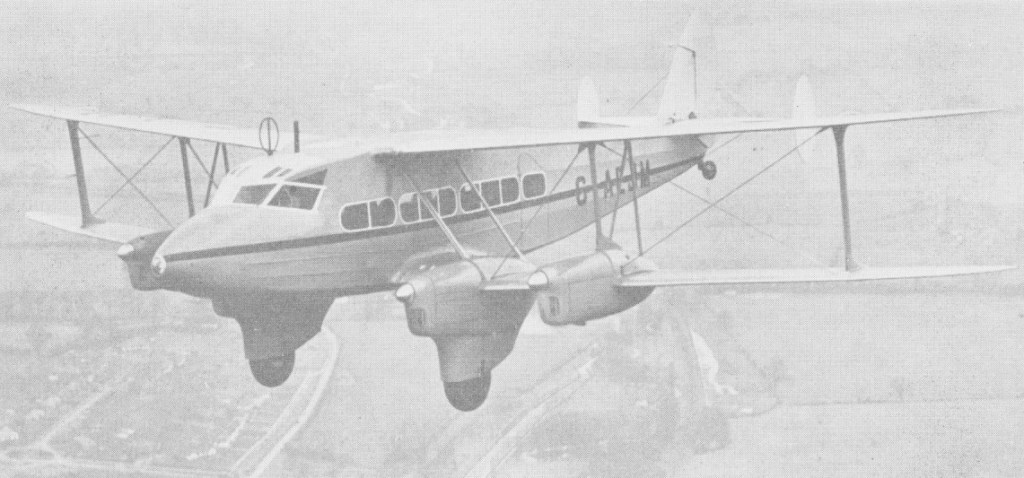
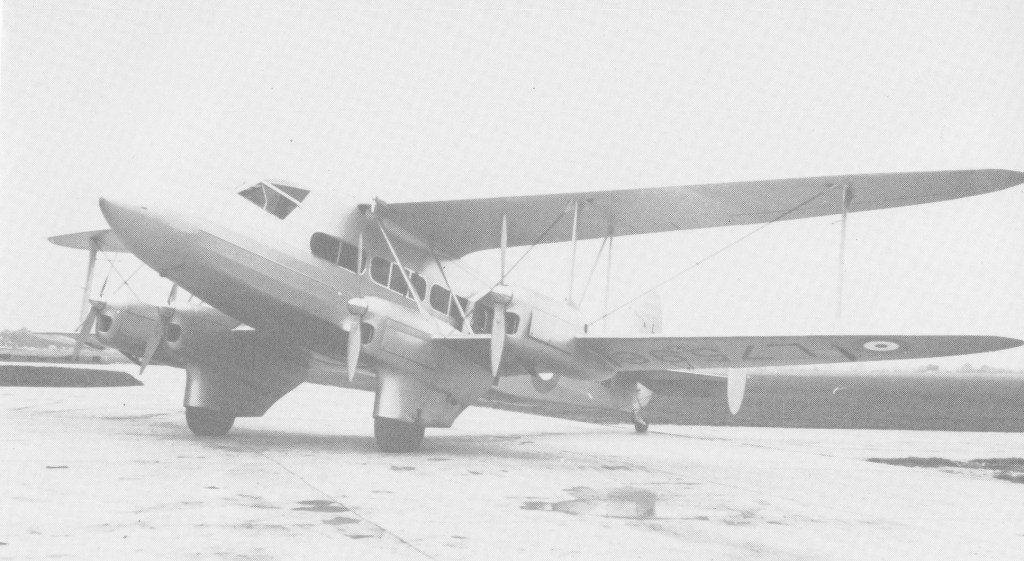
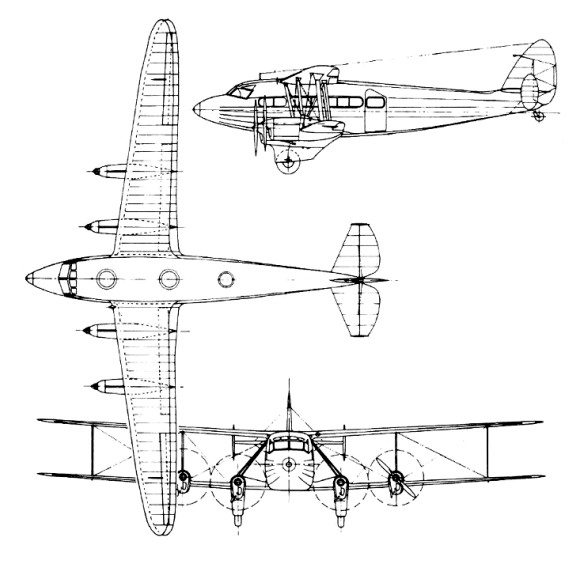
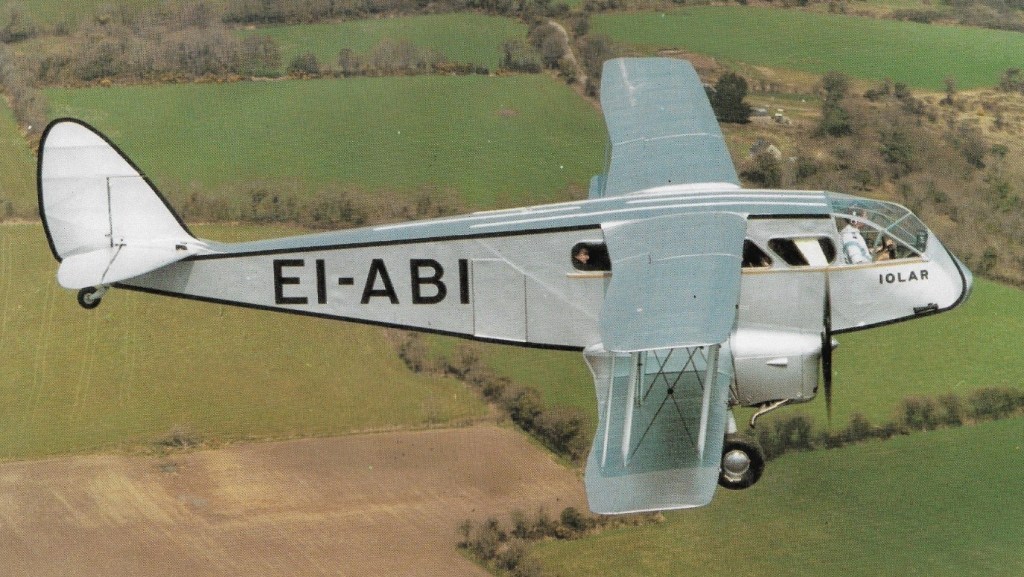
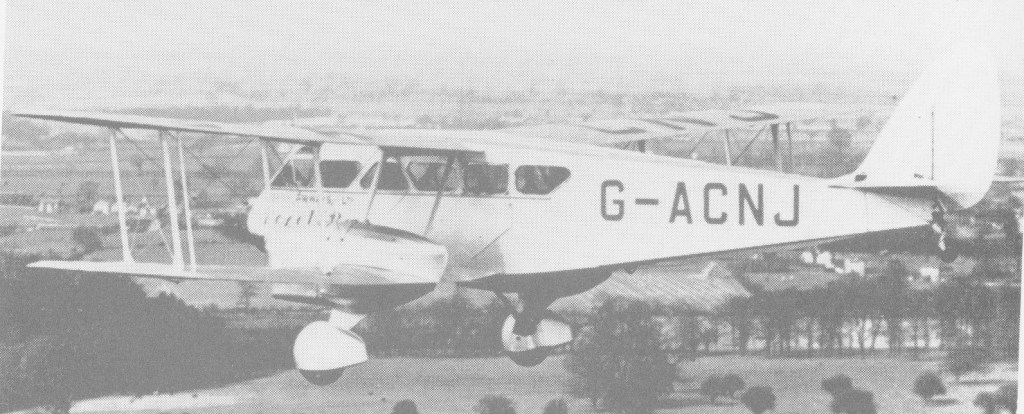
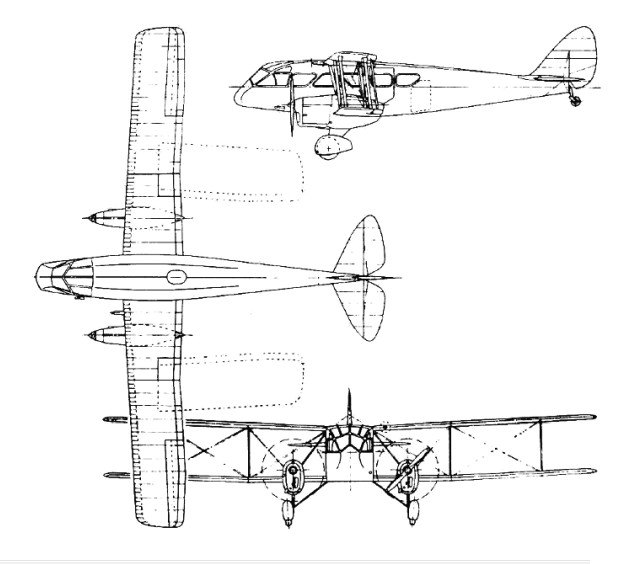
Similar to the D.H.89 Dragon Rapide, the de Havilland D.H.90 Dragonfly has a pre-formed plywood monocoque shell strengthened with spruce stringers. The lower wing centre section was strengthened, making possible deletion of the nacelle/wing root bracing struts and inner bay rigging wires, and so providing easy access to the cabin, with its accommodation for a pilot and four passengers. Powered by two de Havilland Gipsy Major engines, the prototype made its first flight at Hatfield on 12 August 1935 and the first D.H.90A production aircraft, with Gipsy Major II engines, flew in February 1936. Production totalled 66.
Military purchasers included Canada, Denmark and Sweden.
D.H.90 Dragonfly Engines: 2 x de Havilland Gipsy Major inline, 97kW, 130 hp Max take-off weight: 1814 kg / 3999 lb Empty weight: 1134 kg / 2500 lb Wingspan: 13.11 m / 43 ft 0 in Length: 9.65 m / 31 ft 8 in Height: 2.79 m / 9 ft 2 in Wing area: 23.78 sq.m / 255.97 sq ft Wing loading: 15.58 lb/sq.ft / 76.00 kg/sq.m Max. speed: 125 kts / 232 km/h / 144 mph Cruise speed: 109 kts / 201 km/h / 125 mph Service Ceiling: 5515 m / 18100 ft Range: 543 nm / 1006 km / 625 miles
In 1930, the owner of a London bus company, Edward Hillman, opened air services from London to the seaside. He used an aircraft especially designed for him, the de Havilland Dragon, carrying eight passengers.
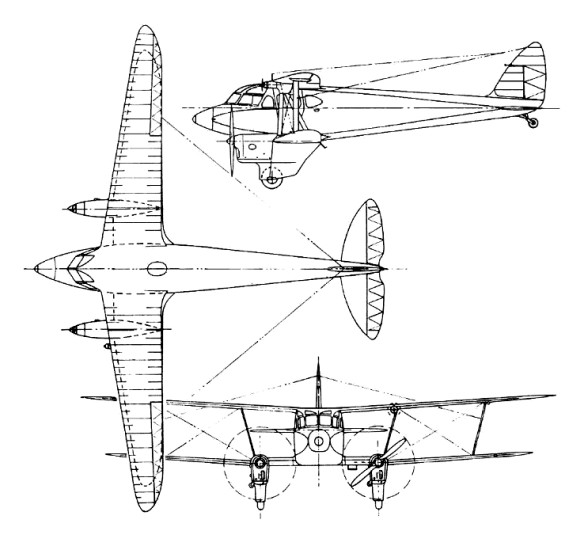
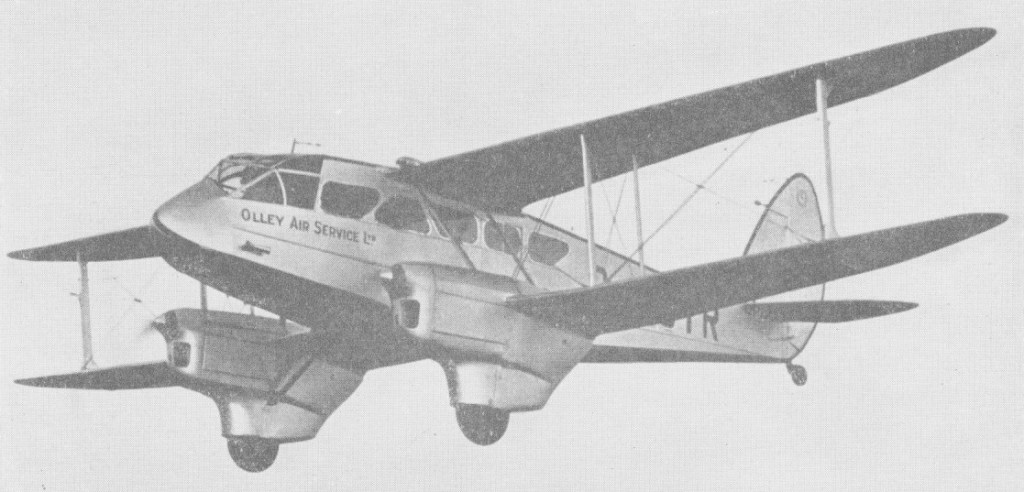
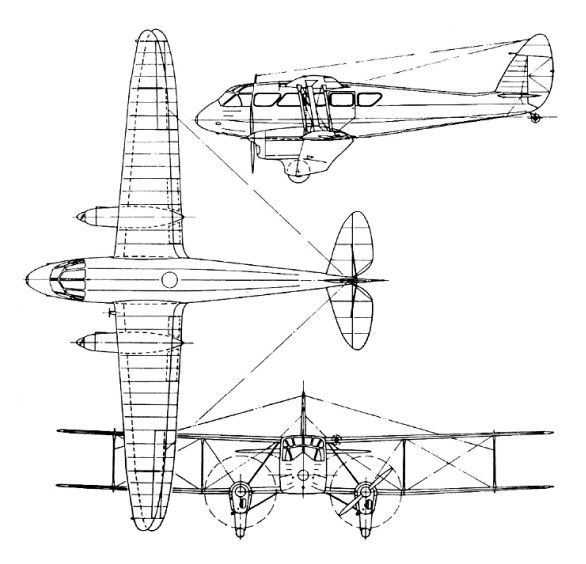
The Dragon Rapide was a direct development of the Dragon, employing the same structure but having tapered wings, 149kW Gipsy Six engines and a faired-in undercarriage. Known originally as the Dragon Six, it was first (E-4, later CH287) was flown on 17 April 1934 at Hatfield, put in production in 1934, and remained in production for more than ten years.
Construction consisted of a boxlike structured fuselage with plywood panelling on the inside and fabric covering on the outside. Wings had wooden spars and fabric covering.
In 1935, a military Dragon Rapide lost to the Anson as the RAF’s future Coastal Command reconnaissance machine. In 1938, the first RAF Dragon Rapide was delivered for communications duties, and eventually it became a mass production wireless (radio) trainer as well as a utility transport. It received the RAF name Dominie in 1941. Total production for the RAF and Fleet Air Arm was 521, the last being delivered in 1946.
The 48 ft spruce and fabric wings have ailerons on all four and split trailing-edge flaps are on the bottom wings between the engines and fuselage.
It remained in production until 1945 and a total of 738 were built. After the war the Rapide served for several years as interim equipment of BEA, Iraqi Airways, Jersey Airways, KLM and other airlines until more modern equipment became available.
Fine pitch props were often fitted to enable an extra 200 lb payload and better short field and climb performance. The DH Rapide were slightly slower than the original flapless DH.89s. The DH89A was produced in 1935 to Capt Fresson’s requirements (of Highland Airways, Inverness) and incorporated landing flaps, a landing light in the nose, and cabin heating.
In addition many military models were exported, some (for Iraq and Spain) being of the DH 89M armed variant. Typical armament was three machine guns (one fixed, and manually aimed dorsal and ventral) and a bombload of up to 127 kg (280 lb).
A number of Dragon Rapides were also operated on Fairchild-produced floats by Canadian airlines, produced in Canada by de Havilland’s Toronto-based company.
RNZAF Dominie
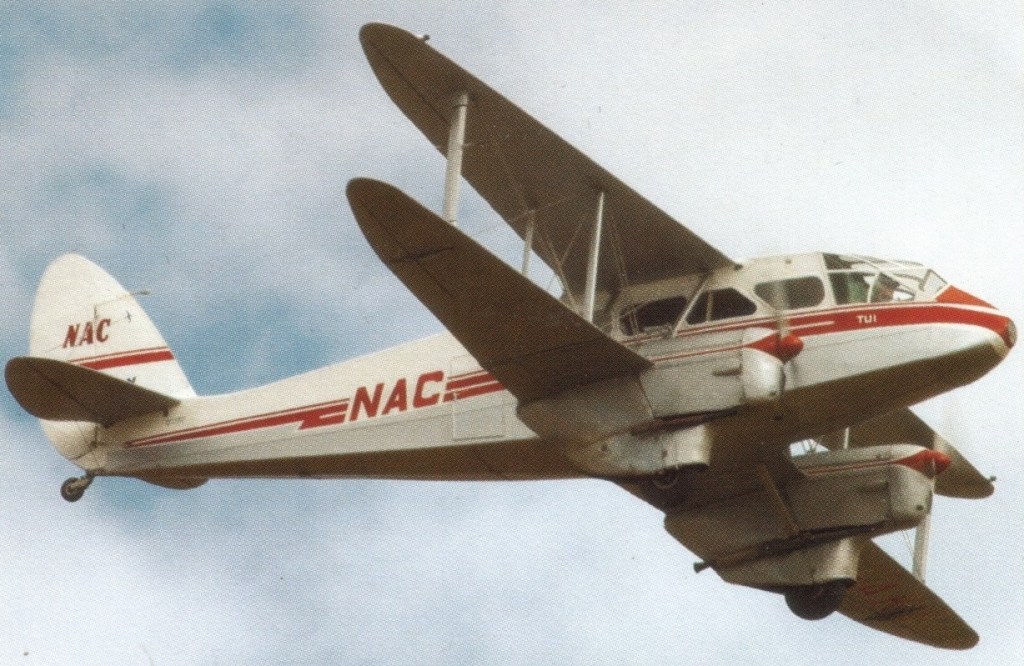
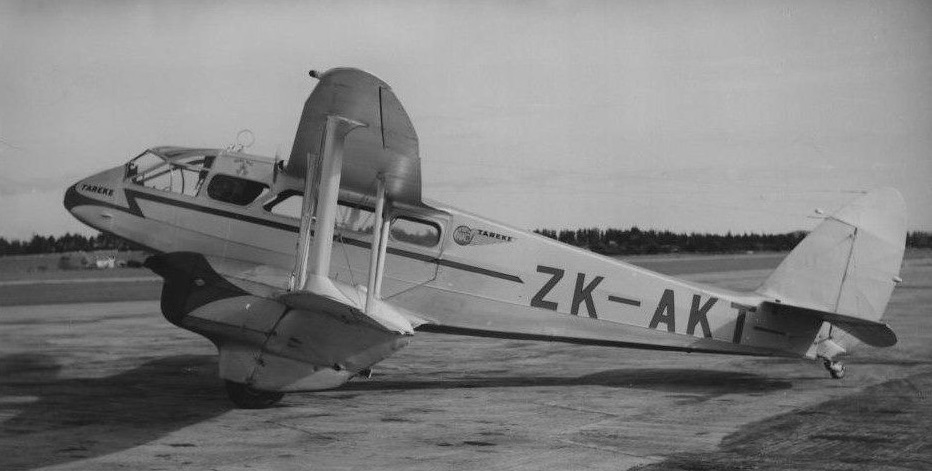
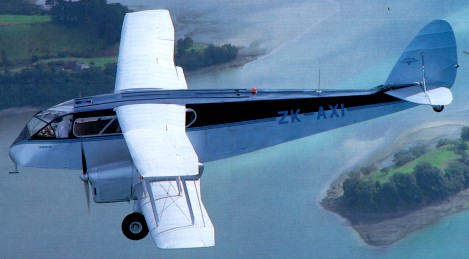
One example of the DH89A Dragon Rapide was owned by the NZ National Airways Corp (ZK-AHS Mokai) 1948-57 and five were impressed from civil airlines by the RNZAF 1939-45 and used as patrol and navigation aircraft. Fourteen DH89B Dominie served with the RNZAF for training and reconnaissance during 1943-53. The NZ National Airways Corp operated six DH89B 1947-64 (ZK-AKS Teoteo; ZK-ALB Tikaka; ZK-AKU Tawaka; ZK-AKT Tareke; ZK-ALC Tiora; ZK-AKY Tui).
DH.89B ZK-AKT
The Breda Ba.44 was a 1934 licence-built DH.89 Dragon Rapide. The prototype (MM.267) had 2 x 155 hp Colombo S.63 inline 6-cylinder engines mounted on lower, revised wing plan. Production Ba.44 were powered by 2 x 200 hp DH Gipsy Six in lowered position.
DH.89 Rapide Engines: 2 x de Havilland Gipsy Six, 205 hp. Prop: 2 blade metal. Wing span: 48 ft 0 in (14.63 m). Length: 34 ft 6 in (10.51 m). Height: 10 ft 6 in. Wing area: 336.0 sq.ft. (31.22 m). Gross weight: 5,550 lb (2:517 kg). Empty wt. 3,230 lb. Fuel capacity 76 ImpG. Maximum speed: 135 kts / 253 km/h (157 mph). Typical cruising speed: 132 mph (212 km/h) at 2.000 ft (610 m). Initial climb rate 867 fpm. Service ceiling: 19029 ft / 5800 m Takeoff run 870 ft. Landing roll 510 ft. Typical range: 578 miles (930 km). Seats: 8 Price new: £3500
DH89A Dragon Rapide Engines: 2 x DH Gipsy Six, 200 hp Wingspan: 48 ft / 14.63 m Length: 34 ft 6 in / 10.51m Max speed: 157 mph / 253 kph Crew: 1 Passengers: 5
D.H.89A Mk 4 Engines: 2 x de Havilland Gipsy Queen 2, 149kW/ 200 hp Max take-off weight: 2722 kg / 6001 lb Empty weight: 1465 kg / 3230 lb Wingspan: 14.63 m / 47 ft 12 in Length: 10.52 m / 34 ft 6 in Height: 3.12 m / 10 ft 3 in Wing area: 31.21 sq.m / 335.94 sq ft Max. speed: 241 km/h / 150 mph Cruise speed: 225 km/h / 140 mph Ceiling: 4875 m / 16000 ft Range: 837 km / 520 miles
DH.89B Dominie Engine: 2 x DH Gipsy Queen III, 200 hp. Wingspan: 48 ft / 14.63 m Length: 34 ft 6 in / 10.51m Max speed: 157 mph / 253 kph Crew: 1 Cruise: 132 mph. Pax cap: 8.
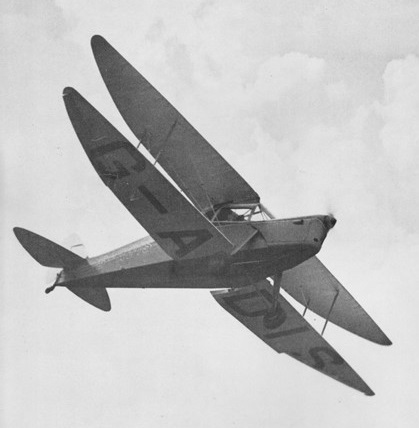
Structurally similar to the D.H.86, the D.H.87 Hornet Moth design philosophy was commercial rather than aerodynamic, and biplane wings could be manufactured far more economically than the more complicated box spars of monoplanes. An enclosed side-by-side two-seater, it had tapered wings and a spruce/plywood box fuselage with external longerons, stringers and fabric covering.
The prototype G-ACTA, first flown at Hatfield on 9 May 1934, was joined in a year-long test programme by two similar aircraft, preparing for production deliveries which began in August 1935 under the designation D.H.87A.
More than 60 aircraft were manufactured to this standard with wings of increased taper and span (9.93m), but in 1936 another set of wings was introduced, first fitted retrospectively to the second production Hornet Moth. These wings, virtually without taper and with almost square tips, were made available to existing owners on a trade-in basis and were fitted to almost 100 new aircraft designated D.H.87B. Following development of a floatplane version by de Havilland Aircraft of Canada Ltd, four examples were acquired by the Air Ministry in 1937 for evaluation as seaplane trainers at the Marine Aircraft Experimental Establishment at Felixstowe, Suffolk. Hornet Moth production, including the prototype, totalled 165 aircraft.
D.H.87B Engine: 1 x de Havilland Gipsy Major inline, 97kW Max take-off weight: 885 kg / 1951 lb Empty weight: 563 kg / 1241 lb Wingspan: 9.73 m / 31 ft 11 in Length: 7.61 m / 24 ft 12 in Height: 2.01 m / 6 ft 7 in Wing area: 20.44 sq.m / 220.01 sq ft Max. speed: 200 km/h / 124 mph Cruise speed: 169 km/h / 105 mph Ceiling: 4510 m / 14800 ft Range: 998 km / 620 miles
Designed and built in response to an Australian government requirement for a multi-engined aircraft to be used by QANTAS for service across the Timor Sea, between Singapore and Australia, the de Havilland D.H.86 was awarded its Certificate of Airworthiness on 30 January 1934, only four months after a start of work on the project. The aircraft was of wooden construction with fabric covering, and powered by four de Havilland Gipsy Six engines.
The first flight was made on 14 January 1934 at Stag Lane, in the hands of Hubert Broad, and certification trials were conducted at Martiesham. The prototype and two identical aircraft were equipped for single-pilot operation. The latter were used by Railway Air Services from 21 August 1934 on a new Croydon-Birmingham- Manchester-Belfast-Glasgow route. A second crew member (navigator/ wireless operator) was carried, accommodated behind the pilot.
DH86B “Zulu shield”
QANTAS and Imperial Airways required that two pilots should be seated side-by-side, and in August 1934 the prototype re-emerged from the Stag Lane factory with a longer and wider nose to provide the necessary accommodation. The first of 29 production examples was one of four flown by Holyman Airways in Australia, and other operators comprised QANTAS (six), Imperial Airways (five), Jersey Airways (six), Misr Airwork, Egypt (four), Hillman’s Airways (three) and Wrightways (one).
A total of 62 DH express airliners were built. Some at Stag Lane, the later ones at Hadfield. Four were single pilot and 28 were two pilot DH86s. Twenty were DH86As, improved with some strengthening following some incidents. Ten built were DH86Bs with the “Zulu shield” additional vertical tail surfaces, giving greater stability.
DH86A
Three DH86A were impressed from Union Airways by the Royal New Zealand Air Force, equipped as bombers, and operated 1939-44. One (ZK-AHW) was in service with the New Zealand National Airways Corp 1947-48.
DH 86A Engines: 4 x DH Gipsy-Six Series 1 Wingspan: 64 ft 6 in / 19.66 m Length: 46 ft 2 in / 14.07 m Max speed: 166 mph / 267 kph Crew: 2 Passengers: 12
D.H.86B Engines: 4 x de Havilland Gipsy Six inline, 149kW / 200 hp Take-off weight: 4649 kg / 10249 lb Empty weight: 2943 kg / 6488 lb Wingspan: 19.66 m / 64 ft 6 in Length: 14.05 m / 46 ft 1 in Height: 3.96 m / 12 ft 12 in Wing area: 59.55 sq.m / 640.99 sq ft Max. speed: 267 km/h / 166 mph Cruise speed: 229 km/h / 142 mph Ceiling: 5305 m / 17400 ft ROC: 925 fpm. Range: 1287 km / 800 miles Fuel consumption @ cruise: 40 gal/hr total Pax cap: 12 Crew: 2
Edward Hillman, of Hillman Saloon Coaches and Airways Ltd, approached the de Havilland Aircraft Company in 1932 with a view to providing a twin-engine airliner to carry eight passengers. He had been using single-engine four-passenger Fox Moths with some success and wanted the equivalent of two of those combined into one, still with the economy of a single pilot for a proposed service from southern England to Paris.
Chief designer Arthur Hagg had a light bomber being developed for the Iraqi Air Force able to carry four 200 lb bombs, a pilot, a navigator/bomb aimer and a wireless operator/air gunner, plus an assortment of Lewis guns for self defence. With its simple plywood box structure fuselage offering plenty of room inside, two Gipsy Major engines and typically de Havilland folding biplane wings and tail shape it would convert easily into a civil airliner, so Hillman ordered an immediate four DH84s off the drawing board. The slab-sided plywood box used successfully in the Fox Moth was adopted for the fuselage of the new design, a two-bay biplane with wings that could be folded outboard of the two de Havilland Gipsy Major engines. The pilot was provided with a separate compartment in the extreme nose and the main cabin could seat six passengers. The prototype made its maiden flight on 24 November 1932, at Stag Lane, Edgware. It was later delivered to Hillman’s Airways at Maylands, Essex, together with three examples of the production Dragon 1, which facilitated inauguration of the Paris route in April 1933.
British production totalled 115 aircraft built at Stag Lane and, from 1934, at Hatfield.
The 63rd aircraft was the first of an improved version, as the Dragon 2, with the glasshouse cabin windows replaced by individual framed transparencies, and with main landing gear fairings. The D.H.84M was a militarised version with a dorsal gun ring and a fin fillet; supplied to Denmark, Iraq and Portugal Dragon production stopped in 1937, but all the tooling and jigs, along with those for the DH94 Moth Minor, were shipped to Australia early in the war. So between September 1942 and May 1943, eighty-seven Australian Dragons came off the assembly line and flew. They were based on the English Mark 1 model, with its continuous cabin win¬dows, but had a steel diagonal brace tube behind the pilot instead of the normal bulkhead separating cockpit and cabin. Produced as navigation trainers for the Royal Australian Air Force, the first of these flying on 29 September 1942.
DH 84 Dragon II
Two Dragon II were impressed by the RNZAF 1939-45 for communications and radio training.
D.H.84 Dragon I Engines: 2 x de Havilland Gipsy Major I inline, 97kW, 130 hp Take-off weight: 2041 kg / 4500 lb Empty weight: 1060 kg / 2337 lb Wingspan: 14.43 m / 47 ft 4 in Length: 10.52 m / 34 ft 6 in Height: 3.3 m / 10 ft 10 in Wing area: 34.93 sq.m / 375.98 sq ft Wing loading: 11.89 lb/sq.ft / 58.0 kg/sq.m Max. speed: 117 kts / 216 km/h / 134 mph Cruise speed: 99 kts / 183 km/h / 114 mph Service Ceiling: 4420 m / 14500 ft Range: 474 nm / 877 km / 545 miles Best SE speed: 75 mph. Vmca: 57 mph. Crew: 1 Passenger cap; 8 Price 1932: £2500
DH 84 Dragon II Wingspan: 47 ft / 14.33 m Length: 34 ft 6 in / 10.52 m Max speed: 128 mph / 206 kph Crew: 1-2 Passengers: 4-10
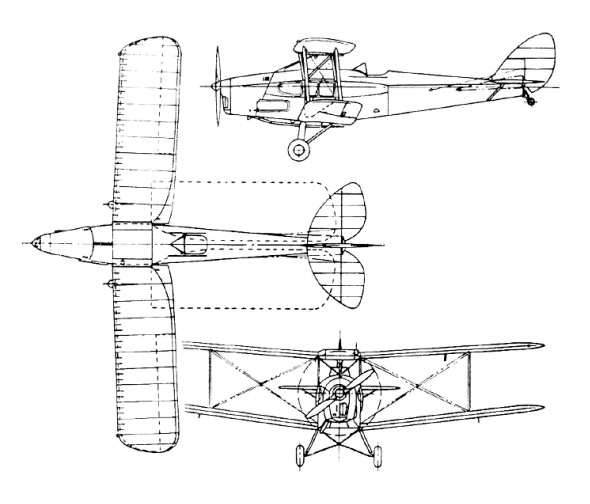
The Fox Moth opened an entirely new market for the company yet did not require the creation of a completely new design. Designer A.E. Hagg utilised existing wings, tail group, undercarriage and most of the firewall-forward section from the Tiger Moth, already in production at Hatfield. The Fox Moth was given a new fabric-covered fuselage of spruce and plywood fuselage, locating the pilot in an open cockpit behind an enclosed cabin which accommodated up to four passengers.
The original engine used in the D.H.83 was the 89kW / 120hp de Havilland Gipsy Ill which was the first of the four cylinder Gipsy engines to be inverted, placing the cylinders to the underside of the crankcase to improve visibility over the nose compared with the ‘upright’ arrangement used on earlier Gipsy engines. The slightly improved Gipsy IIIa later appeared, subsequently to be produced in thousands as the Gipsy Major of 130 hp.
First flown at Stag Lane on 29 January 1932, the prototype Fox Moth (c/n 4000) G-ABUO was shipped to Canada where it was registered CF-API and was evaluated on both skis and floats with Canadian Airways Ltd. Determined to be a suitably rugged contender for the bush-plane market, a further seven sets of D.H.83 components were shipped to Canada for erection at the DHC Downsview facility. That first machine stayed active throughout the 1930s and the war era to eventually be withdrawn and scrapped in 1950.
The second production aircraft G-ABUT (c/n 4002), was flown to victory by WL.Hope in the King’s Cup Race in July 1932. Only slightly modified, the aircraft averaged 124.13 mph on 130hp.
The first multiple purchase customer for the D.H.83 was Edward Hillman, owner of a large fleet of buses who had also been operating a small flying service using Puss Moths. On seeing that he could carry four passengers instead of two on the same engine, Hillman immediately recognised an opportunity and ordered three Fox Moths.
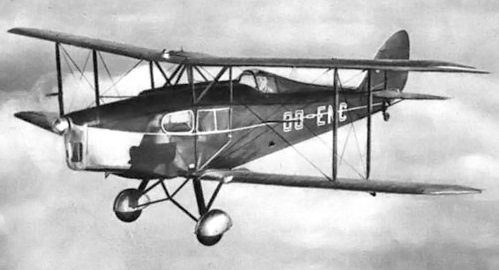
De Havilland DH.83 Fox Moth OO-ENC (c/n 4033), based at Deurne airfield, was bought from the Prince of Wales by Mr Guy Hansez, Member of the Antwerpen Aviation Club and arrived in Belgium on January 11th, 1934. On March 24th, 1934 the pilot started an African flight Antwerpen – Leopoldville. In less than 5 days the African city was reached after a trip via the Sahara, Niger and Gabon. In 1936 the plane was sold to a New Zeeland owner. After many different owners and jobs, the plane was acquired by Vintage Wings of Canada and flying registered as C-FYPM.
Other multiple users were the Scottish Motor Traction Co. Ltd. which operated eight D.H.83s and Midland and Scottish Air Ferries which used four. In the Southern Hemisphere the Fox Moth found favour in rugged areas of Australia, New Zealand and New Guinea. A total of 24 appeared on the Australian register of which a large number served with flying doctor and bush aid services, including numerous examples that served in New Guinea (now PNG). In New Zealand, Bert Mercer’s Air Travel (NZ) Ltd was the countrys first commercial airline and pioneered services on the rugged and remote west coast of the South Island using Fox Moths.
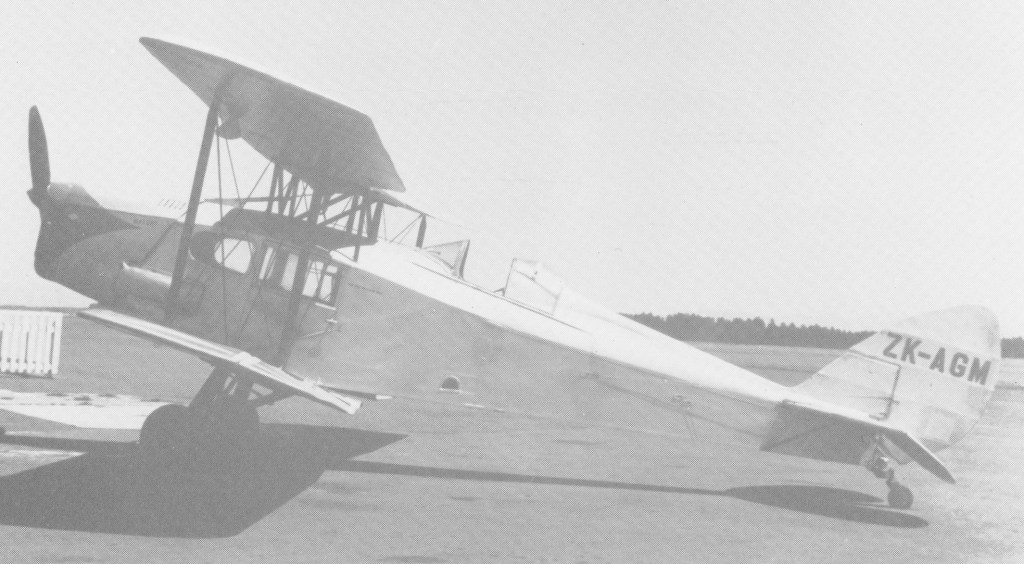
In New Zealand, one was impressed into the RNZAF during 1943-48, and three were owned by National Airways Corp during 1948-56 (ZK-AEK Mohua, ZK-AGM Matahi, ZK-ASP Mimiro).
Production of the D.H.83 reached a total of 98 aircraft completed in England, plus two examples in Australia and one copy in Japan. That machine was modelled after several original examples sold to that country, but it was fitted with a Gasuden Jimpu 3 radial engine of 150 hp. The aircraft went by the name of Gasuden KR- 1 and was christened ‘Chidorigo’ (Plover). As far as is known, just this one example was built, but it is not recorded as part of acknowledged D.H.83 production.
Post WW2, the de Havilland Canada plant at Downsyiew spooled up to produce the Fox Moth biplane again to fill a need for utility aircraft suitable for bush flying in remote parts of the country.
Utilising the major flying components of the de Havilland Canada D.H.82C Tiger Moth of which 1,523 were produced during WW-II, the post war Fox Moths were quickly and efficiently produced. They featured the uprated 145hp Gipsy Major 10 and a new bubble canopy design specific to this model. 53 were delivered before production ceased completely to make way for the DHC-1 Chipmunk that was beginning to take over production at the plant.
Another example of the D.H.83C (there were no D.H.83A or D.H.83B variants) was completed by Leavens Bros Ltd in 1948.
D.H.83 Engine: 1 x de Havilland Gipsy Major, 97kW / 130 hp Take-off weight: 939 kg / 2070 lb Empty weight: 499 kg / 1100 lb Wingspan: 9.41 m / 30 ft 10 in Length: 7.47 m / 24 ft 6 in Height: 2.68 m / 8 ft 10 in Wing area: 24.25 sq.m / 261.02 sq ft Max. speed: 182 km/h / 113 mph Cruise speed: 154 km/h / 96 mph Ceiling: 3870 m / 12700 ft Range: 579 km / 360 miles Crew: 1 Passengers: 4
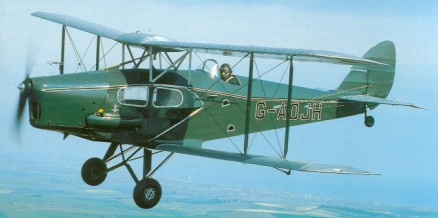
As a result of interest being shown in de Havilland’s D,H.60M “Metal Moth” as a cheap introduction to combative military operations, de Havilland built in November 1930 what they described as a “D.H.T. (Training) Moth”. Essentially a D.H.60M with a de Havilland Gipsy II engine with an inverted fuel system, aircraft No 1672 was complete by December 5. Compared with the earliest civil versions the D.H.60T was strengthened to allow it to operate at a higher all-up weight, and it could also carry four 9-kg (20-lb) practice bombs under the fuselage.
Following review, the company decided that it could be further improved; developed to Specification 15/31, anchorage of the front and rear lift wires was repositioned, allowing unhindered access onto the walkway and the root-ends of the upper mainplanes were cut away to improve the upward view.
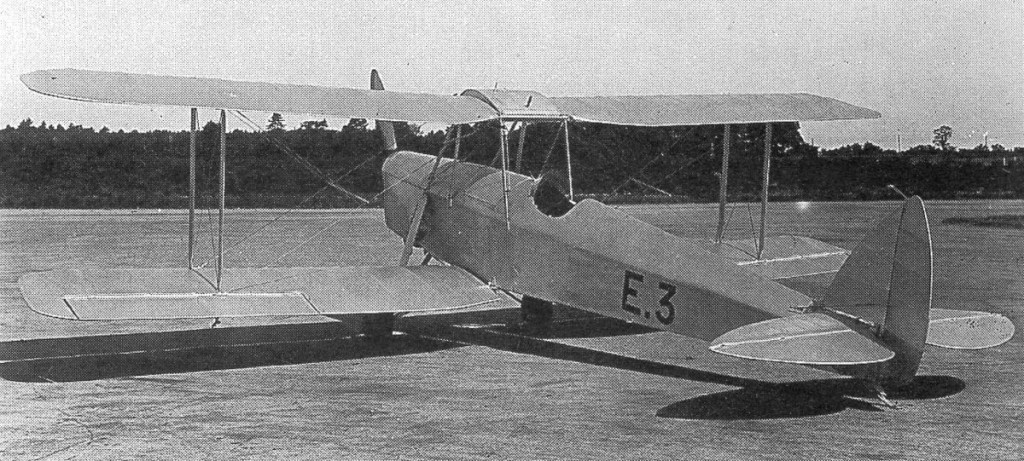
Designated as a D.H.60T Moth Trainer and registered G-ABKU on April 1, 1931, it was despatched to the Aeroplane & Armament Experimental Establishment (A&AEE) at Martlesham Heath under de Havilland’s test marks E.3, but was dismantled in July and “reduced to redundant stock”.
Working with another airframe, the de Havilland team’s new task to comply with the Air Ministry’s requirements was to rearrange the geometry of the cabane structure. The forward shift of the centre section tank proved to be 18in measured at the wing root, and the trial installation was scrutinised by Geoffrey de Havilland and test pilot Hubert Broad, who was not totally convinced, with the result that the centre section was moved forward by a further 4in.
The change in geometry solved the cockpit accessibility, but the aircraft was now seriously out of balance.
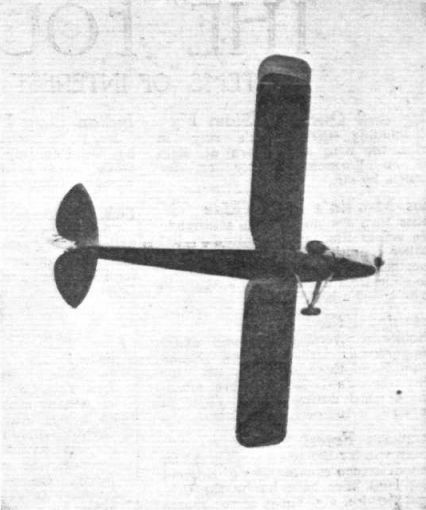
The simplest and cheapest option was to sweep back all four wings, the degree determined after moving the interplane struts 9in forward of their original location, but it proved not to be sufficient. Further sweepback was added to the top wings alone until the centre of gravity (cg) conditions were considered to be satisfied. This precluded the ability to fold the wings, not a drawback for military operators but a major selling feature of all other Moths.
On July 10, 1931, the aircraft was identified as a “D.H. Training Moth T1” fitted with a Gipsy II engine. It is probable that the core of the T1 Moth was the former G-ABIKS, which, as E.4, was flown by Jack Tyler on July 21. E.4 never qualified for a C of A before it too was declared redundant and dismantled.
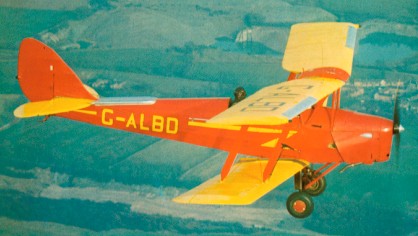
To comply with another Air Ministry requirement, a prospective training aeroplane had to be given a name, one beginning with “T” (for Trainer), and de Havilland chose Tiger Moth.
The decision to “invert” the Gipsy II engine was taken in 1929, the resultant Gipsy III offering the same horsepower but a much improved forward view and higher thrust-line. The first Trainer with the revised swept wings and a Gipsy III to be designated D.H.60T Tiger Moth was No 1726, registered G-ABNI on June 25, 1931.
Sales Director Francis St Barbe was still concerned about prospects in Canada, and in August G-ABNI was despatched to Toronto. The second D.H.60T Tiger Moth, G-ABNJ, was delivered by Hubert Broad to Martlesham Heath on August 18 as E.5, and the general impression was favourable. In the opinion of test pilots, landing in a crosswind put the into wind wingtip perilously close to the ground and when taxying across uneven territory, any down-aileron could make contact with the surface. At de Havilland’s factory, a third D.H.60T, G-ABPH, was re-rigged to accept 40deg 30sec of dihedral on the lower wings only, an increase of 1deg 45sec over the setting of the top mainplanes, solving the problems and the type was cleared in September as a prospective military trainer. Adding sweep to the constant chord wing changed the relationship between the angle of the ribs and the airflow, resulting in a less efficient section. The company viewed the prospect of modifying their jigs with some alarm. The RAF 15 (modified) wing profile had been carefully chosen but the company decided to make no immediate change to the design of the wing and never did.
Eight aircraft were manufactured to the D.H.60T Tiger Moth specification. Following the delivery of G-ABNI to Canada, Hubert Broad flew G-ABNJ to Stockholm in December, where in appalling weather he demonstrated the open cockpit biplane over several days. It remained in Sweden, and was sold to the Flygvapen (Swedish air force) under the designation Sk 11. It was an important sale which led to further orders and licensed manufacture in Sweden. Tiger Moth G-ABPH was sold to de Havilland’s Portuguese agent and the remaining five aircraft were all sold to China.
The design department decided that sufficient major alterations had been embodied in the basic D.H.60 for a new Type Number to be applied to the Tiger Moth. This was not a hasty decision; a change usually signalled the need for a new Type Record to be established, a time consuming and expensive exercise. The next number was D.H.82, and interested parties were advised the price of the new aircraft was £1,045.
The Air Ministry awarded a contract for a prototype D.H.82, c/n 1733, against a unique specification, 15/31. Painted silver, it was flown by Hubert Broad under B Conditions as E.6 (later registered G-ABRC) on October 26, 1931. An order had already been placed for a further 35 aircraft to specification 23/31, essentially the same as the build standard of No 1733.
The D.H.82 Tiger Moth prototype, G-ABRC, first flown by Hubert Broad under B Conditions as 11 on October 26,1931. The aircraft survived until 1956 when it was broken up and burnt at Croydon. All Tiger Moths ordered by the Air Ministry were fitted with Handley Page automatic slats on delivery as part of the standard specification. The advertised cost of supplying and fitting slats early in 1932 was £18 with a further ten guineas required for a slot-locking device operable from the cockpit. An additional sum of £38 11s 6d was paid to Handley Page as a royalty on each set fitted.
The first six of the RAF’s D.H.82 Tiger Moths, K2567-K2572, were scheduled for delivery to No 3 Flying Training School (FTS) at Grantham on November 9, 1931, but owing to poor visibility the flight was postponed. Conditions improved sufficiently the following day and, leaving at 0945hr, the flight took 65min.
In December 1932 K2578 arrived at Martlesham Heath to begin flutter trials, with the result that mass balance weights were recommended for the ailerons. In February 1933, K2570 joined the programme to investigate the inverted envelope and K2583 began trials on November 13, which resulted in a recommendation for mass balancing of the rudder.
The improved Gipsy III engine was initially designated Gipsy IIIA, but the military connection was considered vital, and the name Gipsy Major was adopted for full production in 1932.
Unprecedented for aero-engines of the period, the Gipsy Major 1 was introduced into service with an overhaul life of 450hr, a 50 per cent increase over the Gipsy 1 of 1927. By July 1933, it had risen to 750 hr and by August 1937 to the magic 1,000, but that was not the end.
At the all-up weight of 1,8251b, maximum speeds were 109 m.p.h. at sea level reducing to 99 m.p.h. at 10,000ft, with a cruising speed of 93 m.p.h. and petrol consumption of six gallons per hour. With a fuel capacity of 18 gal, range was 279 miles. The new engine improved performance with a reduction by 17yd to achieve a take-off run of 156yd from a standing start to lift-off.
For an aircraft designed primarily for circuit training, a service ceiling of 13,600ft might have seemed fairly academic, or an absolute value of 18,100ft, but de Havilland’s main thrust early in 1933 was to promote the Tiger Moth as a multi-role military trainer in which bomb-aiming and photographic reconnaissance from such altitudes would have been normal operational practice.
The opportunity was taken in the summer of 1932 to refine the airframe, The front fuselage side frames were redesigned and the fabric-covered hoop-and-stringer arrangement of the rear top decking was replaced with a single spruce and ply construction. New compression legs from Dowty replaced rubber blocks with coil springs. Further changes were made to the top wings to introduce a standard maximum aerobatic weight of 1,7501b. Space for an extra gallon was designed into the centre section fuel tank by rounding out the leading edge. First to take advantage of all the improvements was c/n 3148, supplied to the Ministry of War in Madrid at the end of 1932.
The first Tiger Moth which incorporated all the airframe improvements and with a Gipsy Major engine was c/n 3175. Registered G-ACDA on February 6, 1933, this machine is acknowledged as the first definitive D.H.82A, one of a batch of ten for No 1 Elementary & Reserve Flying Training School (ERFTS).
Two, with twin floats supplied by Short Brothers, were built to Specification T.6/33 for RAF evaluation at Rochester and Felixstowe.
Aware of the need for economy in March 1934, the Air Ministry announced an order for 50 D.H.82A Tiger Moths, listed as Tiger Moth Mk IIs, to be delivered less engines to RAF Kenley between November 1934 and the following February, to Specification T.26/33. The aircraft were serialled K4242-K4291 and allocation was throughout the RAF, not as trainers, but to serve with squadrons and station flights, communications units, practice flights, and an army co-operation unit. Tiger Moth IIs had hoods which could be positioned over the rear cockpit for instrument flying instruction.
Others were supplied to the Bristol Aeroplane Company, the de Havilland School of Flying, Brooklands Aviation Ltd, Phillips and Powis School of Flying, Reid and Sigrist Ltd, Airwork Ltd and Scottish Aviation Ltd for the Elementary and Reserve Flying Schools which these companies operated under the RAF expansion scheme. 44 such schools were in operation in August 1939, although 20 of them closed when hostilities began.
The most radical of all modifications resulted in the first Tiger Moth Fighter, Persian serial 122, unveiled in October 1932. Located in the front cockpit, a 0.30in-calibre machine gun was capable of delivering 900 rounds per minute. It was never clear whether this was a fighter trainer or a true fighting aircraft but the aircraft was deployed around the Persian oilfields at Abadan.
The de Havilland company had resisted a substantial redesign of the Tiger Moth but by the end of 1934 found itself being shepherded in the wake of new RAF requirements. The most obvious was likely to be a more powerful engine, and the Gipsy Six was the natural candidate. Good take-off and climb performance was necessary while speed was of little consequence. The aircraft should have more spacious cockpits, facility for a manoeuvrable observer’s gun to the rear and a synchronised forward firing machine gun.
Early in January 1935, shortly before delivery of the 1,000th Gipsy Major engine, the de Havilland directors were divided on whether a bigger, all-purpose development was preferable to a modified version of the standard Tiger Moth, with the front fuselage adapted to provide more spacious cockpits and other refinements, while retaining the Gipsy Major. Hugh Buckingham reported from Sweden that the Tiger Moth had fallen into disfavour. Instructors believed it was too small and too easy to fly, and cramped cockpits were not compatible with a pilot in a winter flying suit.
Nikolaus von Eltz, de Havilland’s agent in Vienna, raised almost identical criticism. He had been advised by the Austrian air force that the D.H.82 was an old design: no longer were control cables run outside the fuselage and across a non-adjustable tailplane. The aircraft had no mainwheel brakes, nor a tailwheel, and was not very good at aerobatics. In April 1936, St Barbe admitted that had it not been for other major preoccupations the Tiger Moth would have been replaced some time previously. He considered it to be “on its last legs” and at the current price of £1,100, unlikely to attract orders. St Barbe cut the price to £850, a figure at which it could be produced at “no loss”. By the end of 1936, the company was considering a three year plan in which design capacity would be allocated to a replacement, probably from April 1937.
Orders continued in sufficient numbers to maintain the line, which was fortuitous as on May 27, 1938, the company was told that it would receive a contract from the Air Ministry for 400 Tiger Moths, the last to be delivered by September 30 the following year. At a required average monthly production rate of 25 aircraft, it would be difficult to fulfill the contract without assistance, so the Air Ministry agreed to allow de Havilland in Toronto to step in as a sub-contractor.
In the interim, the Air Ministry placed an order in May 1938 for 50 and in June confirmed their order for an additional 400. In September, they ordered another 300.
In 1939 the company prepared a scheme for a D.H.82B Tiger Moth incorporating remedies for all the major criticisms. The fuselage was widened by 4in and a larger fin and horn-balanced rudder were designed to provide inherent stability. Elevator trim tabs and horn balances were installed to improve aerodynamic fore-and-aft trim, replacing the previous crude but effective method of spring tensioning. An important airframe upgrade for the D.H.82B was a Hornet Moth style undercarriage with a wider track and the wheels set further forward to permit functional cable operated brakes, augmented by a tailwheel. An increased capacity fuel tank was planned plus an experimental powerplant, the Gipsy Major IIA which produced 160 b.h.p. at 2,500 r.p.m.
On 17 September 1939, just two weeks after war had been declared, TV Flight of the British Expeditionary Force Communications Squadron (later No. 81 Squadron) was despatched to France. Throughout the winter and the following spring, the unit’s Tiger Moths operated in northern France, providing communications facilities until the Dunkirk evacuation, when surviving aircraft were flown back to Britain.
Preparations were also made for the Tiger Moth to be used in an offensive role, to combat the threatened German invasion. Racks designed to carry eight 9kg bombs were fitted under the rear cockpit or, more suitably, beneath the wings. Although some 1,500 sets of racks were made and distributed to the Flying Schools, 350 Tiger Moths were fitted and none were used operationally. Rather earlier, in December 1939, six coastal patrol squadrons were formed, five of them equipped with Tiger Moths. However futile this may seem, it was considered that despite an inability to attack, the sound of any engine might deter a U-boat commander from running on the surface and thus reduce his capacity to attack shipping.
The ‘paraslasher’; a scythe-like blade fitted to a Tiger Moth and intended to cut parachutist’s canopies as they descended to earth. Flight tests proved the idea, but it was not officially adopted.
The Tiger Moth ‘human crop sprayer’ used a tank fitted in the front cockpit with powder dispensers located under the wings. The tank would be filled with ‘Paris Green’, an extremely poisonous insecticide. It was intended that low flying aircraft would dust the German troops as they waded ashore.
In the Far East a small number of Tiger Moths were converted for use as ambulance aircraft, the luggage locker lid being enlarged and a hinged lid cut into the rear fuselage decking, providing a compartment some 1.83m long which could accommodate one casualty.
The outbreak of war saw civil machines impressed for RAF communications and training duties, and larger orders were placed.
Little is known about the D.H.82B Tiger Moth, a designation often erroneously applied to the D.H.82 Queen Bee. One prototype was constructed, c/n 1989, and tested as E.11 in 1939. Improvements were considered worthwhile, but the more pressing need for high-volume production of a proven primary trainer overtook the need for refinement which brought the D.H.82B project to a premature end in 1940.
The DH82B Queen Bee was built using the wooden Gipsy Moth fuselage and Tiger Moth flying surfaces, a wind-driven generator to provide electrical power, and a larger-capacity fuel tank, and was used as radio-controlled drone for gunnery practice. The prototype was flown manually on 5 January 1935, and 380 were possibly built subsequently.
When war was declared on September 3, 1939, some 1,300 Tiger Moths had been built in eight years at Stag Lane and Hatfield, the latter delivering 660 in 1939 alone.
The Air Council promised in October 1939 that de Havilland was to receive a contract for 2,000 Tiger Moths, and reservedly agreed that 1,000 could be sub-contracted to Morris Motors. In order for Hatfield to concentrate on its new Mosquito project the company agreed to an immediate and total transfer of all Tiger Moth production to Morris Motors at its Cowley, Oxford, factory.
Some of Cowley’s first efforts in the form of T7013 were the subject of critical analysis at Hatfield at the beginning of April 1940, which resulted in 67 observations worthy of comment. The Cowley Works’ Superintendent had already caused some dismay among the de Havilland advance party in claiming that the assembly of an aircraft should be treated no differently from that of a motor vehicle. Perhaps the eventual smooth output of 3,210 Tiger Moths from Cowley vindicated this philosophy to some degree.
The first Cowley-built aircraft was T7011, transferred by road to Witney and test flown by Guy Tucker on May 15, 1940. A further 18 aircraft flew from Witney while the aerodrome at Cowley was being improved before Tucker flew T7029, the first from home ground, on June 27.
In a wartime trainer role the Tiger Moth equipped 28 Elementary Flying Training Schools in the UK, 25 in Canada (plus four Wireless Schools), 12 in Australia, four in Rhodesia (plus a Flying Instructors School), seven in South Africa, and two in India. After the war 22 Reserve Flying Schools and 18 University Air Squadrons flew Tiger Moths, most re-equipping with the de Havilland Chipmunk between 1950 and 1953.
With the military training machine in top gear, the requirement for new Tiger Moths diminished from February 1944 and numbers of complete but dismantled aircraft were delivered by road into “purgatory stores” in and around Oxford. The last Tiger Moth constructed at Cowley was PG746, taken on charge on July 24, 1944.
The first aircraft production at Prestwick was 50 DH Queen Bee target drones (unmanned Tiger Moths) assembled in 1943/4 by Scottish Aviation Ltd.
From June to October 1945, many stored aircraft were routed back to Cowley where they were customised, erected, test flown and delivered to RAF Maintenance Units at Aston Down, Colerne, Little Rissington and Llandow, before sale or gift-in-aid to overseas’ air forces.
Postwar, the RAF transferred many for civil and military use to Belgium, France and the Netherlands, but in the UK and elsewhere they became available in quantity on the civil market. In addition to obvious use as trainers, or for sport and pleasure, they found unexpected employment. Many gave valuable service in an agricultural duster/sprayer capacity, a role which proved to be of great importance to New Zealand.
After aerial topdressing trials in 1948, in the first year Tiger Moths dropped about 5080 tonnes / 3000 tons of phosphate fertiliser on about 19,200 hectares / 48,000 acres of New Zealand farmland.
A number were the subject of conversion schemes, usually to provide enclosed accommodation. The most ambitious was that carried out by the British company Jackaroo Aircraft Ltd, which involved widening the fuselage to seat four passengers in side-by-side pairs; open cockpit and enclosed cabin variants were included in the 19 Thruxton Jackaroo conversions completed by the company in the period 1957-9.
The Royal Air Force Museum
Tiger Moth NL985 had been in continuous military service from delivery in August 1944 until withdrawn from flying duties eight years later. Recategorised as an Instructional Airframe, 7015M, the aircraft was withdrawn to Colerne and there restored to operational configuration with a late wartime camouflage finish to become part of the Royal Air Force Exhibition Unit.
Allocated to the new RAF Museum at Hendon, NL985 was moved onto the site in 1972 to permit final building work to continue around them. Unfortunately vandals breached poor security at the site and set fire to the Tiger Moth, which was burned out.
The RAF, the world’s biggest user of the type, now had no Tiger Moth at all and turned to the Royal Navy for assistance. Tiger Moth T6296 had served with the RAF until December 1946 when it was transferred to the Admiralty and retired from flying activity at Yeovilton in September 1973. Painted in RAF brown and green camouflage, T6296 was presented to the Museum to fill the vacant space and in April 1990 was transferred to the Battle of Britain Hall.
Construction –
Mainplanes
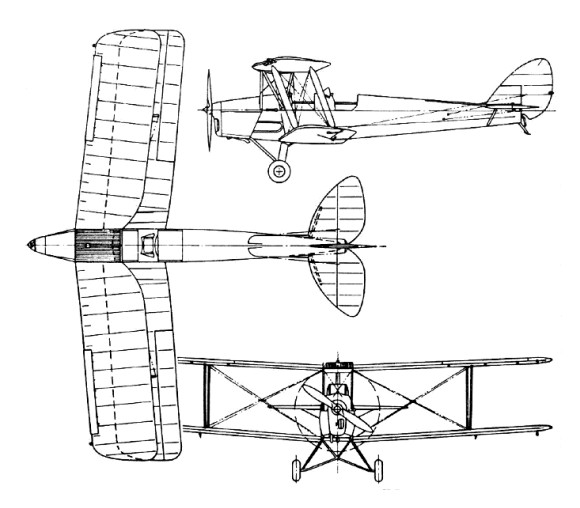
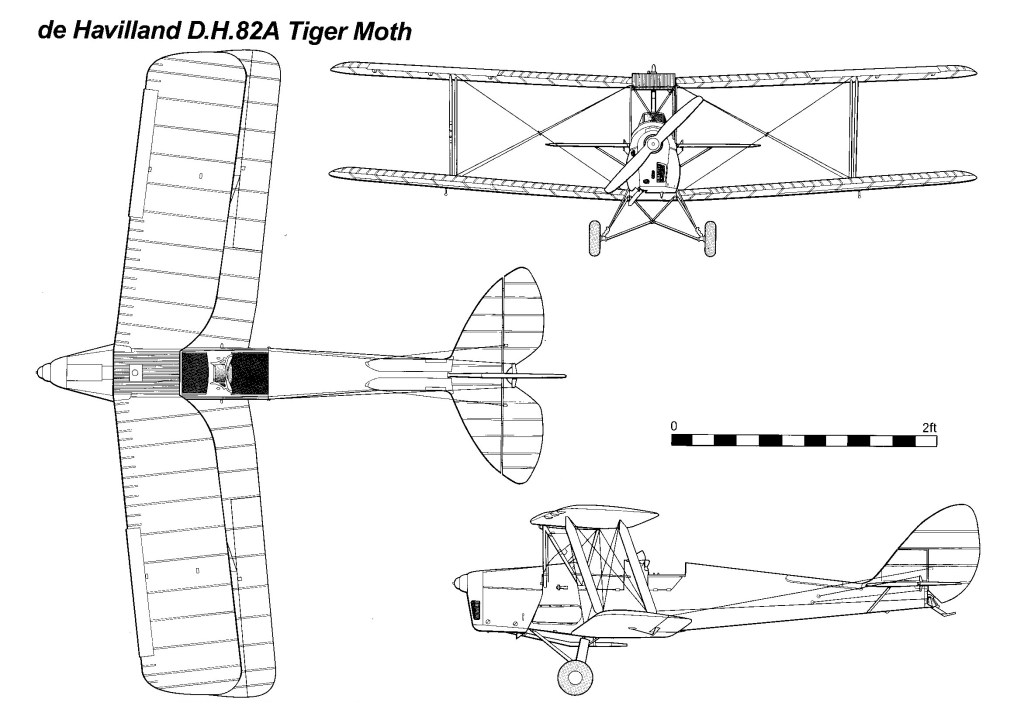
Each plane consists of two heavy I-section spruce spars with leading and trailing edge and ribs of normal wood structure. The tip bends are of light alloy tubing. The planes are internally braced by swaged rod and high-tensile steel wire completing a structure which is unaffected by any slight shrinkage which might take place in the spar. The interplane struts are of spruce with steel end sockets and the drag bracings are duplicated.
Fuselage
Tubing to specification DTD 89A is used for round tubes in the construction of the fuselage, and DTD 113 for square tubes. Lower crossmembers terminating with fittings for root ends of the lower wings are especially constructed parts. The various stiffening plates at the welded joints are mild steel plate to specification S.3.
The front fuselage, which is parallel in plan, is built of two flat sides welded and drilled in a jig, forming easily- replaceable units which are bolted to the crossmembers.
The rear fuselage, from the rear of the pilot’s seat to the sternpost, is a completely rigid welded-up unit, jigbuilt. The four longerons are of square tube; struts, diagonals and crossmembers are of round tube. A small quantity of 1/4in-diameter by 22 s.w.g. steel tubing is also used as stays for the rear fuselage fairing formers.
The engine bay structure consists of two side frames, each made of three square tubes in triangular form, welded flat in a jig at the joints and assembled to the front fuselage by bolted fishplate. A stay tube braces the structure against side loads.
Empennage
The tail follows the normal de Havilland practice and is constructed of wood and fabric-covered. The control surfaces have trailing bends of light-alloy tubing. The tailplane is not adjustable in flight, but longitudinal trim is attained by an adjustable spring loading on the elevator circuit.
Undercarriage
The divided-axle undercarriage’s sprung legs use rubber- in-compression. The top ends are attached to the fuselage lower longeron and the other ends to the wheel ends of the cranked half-axles, which terminate at a tripod fitting under the fuselage. The structure is completed by a forward-raked stay tube from the lower end of the leg casing to the fuselage.
Controls
All control operating gear is housed in a control box running centrally along the cockpit floor, forming a unit which may be easily removed for periodic inspection. The controls in the front cockpit are detachable, the control columns by withdrawing a safety locking pin, and the rudder by removing the connecting rod.
The two control columns connect with a shaft carrying a lever which transmits side movement to the ailerons by cables, and fore-and-aft movement by link tubes to a cross-shaft behind the pilot’s seat, from which cables run to the elevator levers. Rudder cables run direct from the outer end of the rear rudder bar to the levers on the rudder.
Making the Tiger Abroad
Norway proved to be a good customer for de Havilland products and the government-owned aircraft factory at Kjeller, near Oslo, negotiated a licence in February 1932 for production of 17 D.H.82s, for which British-built Gipsy III engines were supplied from Stag Lane. All 17 aircraft were completed by the summer of 1933 and before delivery the Norwegian Government allocated funds for the construction of a further 20 aircraft to be built as D.H.82As, to be known as Woth Majors”. The Norwegian military was a strong proponent of the de Havilland philosophy of a “one-type trainer”. In addition to a machine-gun-equipped operational trainer, the winter exercises in 1934 unveiled D.H.82 No 129 in the role of bomber with a rack of four under-fuselage bombs. In 1940, German forces took control of all Norwegian military aircraft and at least one Tiger Moth was photographed at Kjeller in full Luftwaffe colours. It is believed that some confiscated Danish Tiger Moths, along with others abandoned in France by 81 Sqn in 1940, and four from the Austrian Air Force Air Training School at Parndorf, were flown in German markings until lack of spares grounded them,
Sweden The Swedish agent for de Havilland, Aero Material, placed an order with Stag Lane for delivery of a dozen D.H.82 Tiger Moths in June 1932, to be taken on Swedish air force charge as Type Sk 11. Three additional D.H.82s ordered by the Swedish military were built under licence by Aktiebolaget Svenska Jamvagsverkstadema (ASJIA) at Linkoping and delivered in March 1935. An order for ten D.H.82As, designated Sk 11A, was placed with ASJA for delivery in the summer of 1935, followed by ten more the following year. A number of improvements were designed by ASJA to cater for operations in all seasons. Pickup points for a float chassis were included as standard, and several aircraft were operated as seaplanes.
Portugal Through the efforts of the de Havilland agent in Portugal, Carlos Bleck, the Portuguese Government purchased 23 Tiger Moths in December 1931, followed by 21 D.H.82As in 1933 and 1934. A further eight aircraft were delivered at the beginning of 1938, consigned to Oficinas Gerais de Material Aeronjutico (OGMA), the government aircraft factory at Alverca with whom de Havilland signed a licence agreement. Production at OGMA continued into the early 1940s eventually reaching a total of 91 aircraft.
Canada Following the arrival of D.H.60T Tiger Moth G-ABN1 in June 1931 it was not until August 1935 that de Havilland’s Canadian company took delivery of a second Tiger Moth from England, a fully developed D.H.82A, locally registered as CF-AVG. Officials at the company’s headquarters at Downsview were astonished to find that, like G-ABNI before it, ‘AVG had been built to European standards and a sliding canopy was soon fitted. In this configuration it was widely demonstrated and although the new aircraft met all the criteria laid down by the Royal Canadian Air Force (RCAF), there was no budget to buy a single one.
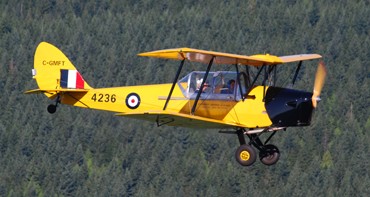
The lobbying of Ottawa and an offer to build the aircraft in Toronto resulted in the issue of specification C/11/36, and a contract for the supply of 28 Tiger Moths was signed on March 12, 1937. The order was for 27 new aircraft re-engineered locally to be known as type D.H.82A (Can) Tiger Moth. The demonstrator, CF-AVG, was included in the sale as the 28th aircraft, but was completely dismantled for use as a working pattern. The first new aircraft, RCAF 239, first flew on December 21, 1937, and was delivered to Trenton on January 18, 1938. de Havilland Aircraft of Canada prewar output included 227 D.H.82As. Having got production of the D.H.82A (Can) under way, the Downsview drawing office sought to add further refinements. A significant improvement was provided by new engine cowlings, the installation of cable-operated Bendix mainwheel brakes and a fully castoring tailwheel with a pneumatic tyre. Skis or floats could be fitted if required. A trim tab was set into the trailing edge of each elevator, capable of precision setting exercised from either cockpit. The improvements to the D.H.82A (Can) continued with the choice of the more powerful Gipsy Major 1C as standard engine and modifications to the canopy which would permit it to be jettisoned. The British Commonwealth Air Training Plan was announced on December 10, 1939, and in February 1940 de Havilland Aircraft of Canada Ltd received a government order to supply 404 Tiger Moths embodying all the modifications and improvements which had been authorised under specification AP/3/39. The new type designation was to be D.H.82C Tiger Moth.
DH82C
The first aircraft built to the specification, C331, was flown by Bruce Douglas on March 12, 1940, and was handed over to the RCAF on April 10. The continuing supply of engines from Stag Lane assured orders for another 428 D.H.82Cs, which were delivered progressively from April to December 1941.
Until the submarine menace in the North Atlantic was finally neutralised the Canadian company realised how dangerous their engine supply situation could become. In the USA they sought, and found, an alternative powerplant – the D-4 Pirate engine designed and built by the Menasco Manufacturing Company of Los Angeles, California, physically similar and with a performance almost identical to the Gipsy Major IC. Air and groundcrew, however, needed to be aware that the propeller rotation was in the opposite direction from the Gipsy Major. The first installation (of a C-4 model) was made for test flying by Bruce Douglas to begin on June 30, 1940. Ten aircraft with Pirate engines ordered for delivery between May and June 1941 were re-designated as D.H.82C2s by de Havilland and as ‘Wenasco Moths” by the RCAF. A second batch which entered service as wireless trainers in the first half of 1941 were designated D.H.82C4 (Menasco Moth II) and appeared ideally suited to the task on account of the engine-driven generator system. The rear cockpit was stripped and fitted with obsolescent wireless equipment. The aircraft were overloaded and underpowered, and all were replaced as soon as practicable. A Gipsy Major-powered wireless trainer designated D.H.82C3 was proposed, but never progressed beyond initial planning.
Some 200 Tiger Moths manufactured under the Mutual Aid Program on behalf of the USA and scheduled for the United States Army Air Force (USAAF) as the PT-24 were never to wear Uncle Sam’s colours. The whole consignment was donated to the Air Training Plan and carried the standard yellow-and -black trainer colours and serials of the RCAF. A further 350 D.H.82C Tiger Moths were delivered to the RCAF commencing on March 3, 1942 From April 1940 until September 1942, the factory at Downsview maintained an average output of 51 Tiger Moths per month, reaching a peak of 75 per month at the end of 1941. In total, 1,549 airframes were completed in addition to the fuselages sent to Hatfield.
Australia The first Tiger Moth received at de Havilland’s works at Mascot Aerodrome near Sydney, VH-UTD, was not registered until May 1935, sold to the Newcastle Aero Club. Alan Murray Jones, the Australian company’s Managing Director, tried to persuade the Royal Australian Air Force (RAAF) to standardise basic training on the versatile D.H.82A, but, against price and delivery, the Avro 643 Cadet was chosen instead However, on November 21, 1938, the Australian Air Board placed an order for 20 Tiger Moths, all to be constructed at Mascot at a total cost of £33,660. The contract allowed fuselages to be imported from England and these were despatched from Hatfield between January and March 1939. Wings and empennage were built at Mascot, where Stag Lane-built engines were installed. Murray Jones made the first test flight of A17-1 from Mascot on May 8, 1939, and the aircraft was delivered into RAAF charge at Richmond eight days later.
An order for a further 350 Tiger Moths was placed on October 10, 1939. All were to be built locally using Gipsy Major engines manufactured in Australia under the terms of a licence held by the Commonwealth Aircraft Corporation (CAC) and, in January 1940, an order for 500 engines was placed with General Motors (Holden’s) Ltd, a major shareholder in CAC. The first of 1,300 Holden’s-built engines were installed in RAAF Tiger Moths at Mascot in December 1940. Delivery of the first Tiger Moth airframe to be wholly constructed in Australia was made on June 21, 1940, when A17-25 was taken on charge at No 2 Air Depot at Richmond. That same month de Havilland was authorised to order raw materials for a further 300 airframes. By December 31, 1940, Mascot had delivered 208 aircraft and production had reached ten Tiger Moths per week. Holden’s was manufacturing engines at the rate of 40 per month. Tiger Moth production at Mascot was continuous from June 1940, reaching a peak of two aircraft per day by March 1941, until August 1942 when the line was halted. Eighteen aircraft originally scheduled for southern Africa were released from May 1942 for use by the USAAF in Australia pending delivery of their own communications types. In September 1944 the Mascot line was re-opened to provide a further 60 Tiger Moths at a cost of about £1,200 each. The new production was authorised in spite of an offer to supply Tiger Moths from the UK, where for some months already, Morris Motors had been delivering aircraft directly into store. By February 1945, 35 of the new Australian aircraft had been delivered, but the remainder of the order was cancelled on the grounds that the aircraft were simply not required.
New Zealand The Tiger Moth soon proved itself ideally suited to New Zealand’s training requirements, and with an established base at Hobsonville offering service and support, the Royal New Zealand Air Force (RNZAF) decided it would standardise all its primary training needs on the type. Alan Butler, chairman of the company, announced on February 7, 1939, that a de Havilland Associated Company was to be established in Wellington and on May 24 construction of a new workshop was commenced at Rongotai aerodrome. At the beginning of August the New Zealand Government ordered 100 Tiger Moths at a total cost of £155,000, the last aircraft to be delivered by February 1941. To initiate the contract it was intended to import batches of partially assembled kits from Hatfield. The first aircraft recognised as having a significant local content, Stage A in a pre-planned six-part programme, was NZ762, taken on charge on July 18, 1940. By the implementation of Stage F, it was intended for the whole aircraft to be a product of the Wellington factory. This happy state was met by NZ811 which was subject to a 30min test flight by Hugh Buckingham on April 19, 1941.
The provisioning programme began to run seriously behind schedule and in an effort to alleviate some of the shortfall, Australia agreed to supply component parts which were integrated into New Zealand production from March 1941, followed by the provision of 20 complete aircraft.
The first RNZAF aircraft consisted of twenty one impressed from eleven aero clubs, and three new aircraft about to be delivered to those civilian organisations. More British built machines were received before the de Havilland factory at Rongotai began production.
A further 36 Tiger Moths were ordered early in 1942 and had been delivered by November. In July 1943 another 36 were ordered but only 27 were delivered. A new contract was drawn up in February 1944 requiring 45 Tiger Moths to be delivered by December 3 of that year but only 18 were supplied. With a run-down in the training programme and a low attrition rate, the final 27 aircraft were cancelled.
This factory produced 345 Tiger Moths for the RNZAF until production ceased in the mid 1940s. In New Zealand 110 were assembled from UK produced parts, 181 were built entirely. A number of modifications, mostly British in origin, were made to the NZ built Tigers. One was an enclosed canopy which appeared in two versions, a sliding model in 1943 for the Air Training Corps and a sideways hinged model in 1944. A fitting for the attachment of a Mk. 1 bomb carrier was made in January 1942, a standard RAF camouflage added in April 1942 and a ten gallon auxiliary fuel system introduced in September 1942 giving a four hour endurance. The “Tiger Bomber” was flown with the pilot in the front cockpit to keep the centre of gravity within limits when the eight 20 or 251b bombs were in position. A drastic nose down pitch followed bomb release. Four Light Bomber squadrons (Nos 41, 42, 43, 44) were formed and one Fighter Bomber squadron (No. 51).
Post World War 2 disposals –
Southern Rhodesia
Canadian-built Fairchild Cornells were supplied to the Rhodesian Air Training Group (RATG) as Tiger Moth replacements from late 1943, and all Tigers with more than 2,000 airframe hours were scrapped; others were taken from open storage and ferried to South Africa.
When news spread that Tiger Moths had been declared surplus in Southern Rhodesia, enquiries began to flow through to the RATG, which on the advice of the Ministry of Aircraft Production in London suggested a minimum price of £500 each, as standing. Sealed offers for the first batch were opened on October 4, 1945, and resulted in 76 firm bids for 45 aircraft from 20 prospective clients, A similar exercise with a second batch of 37 aircraft resulted in 27 contracts. The 100 hand-picked Tiger Moths which arrived back in Rhodesia from South Africa at the end of 1946 were allocated to No 4 FTS at Heany and No 5 FTS at Thornhill. The second batch of 100 Tiger Moths was shipped from Cape Town into the care of the Hindustan Aircraft Company at Bangalore in India on behalf of the Indian Government.
De Havilland manufactured 8,811 DH 82 Tiger Moths between 1931 and 1945. Between 1939 and 1945, de Havilland built 4,005 Tiger Moths in the United Kingdom and 1,747 in Canada.
Disposals in Great Britain In early 1943, Commander Harold Perrin, Secretary of the Royal Aero Club, was advised that no Tiger Moths would be released in quantity until a new RAF trainer was available “In a year or so”. There was even a hint that training aircraft might be imported from the USA. Stocks of Tiger Moths in use or in store, it was admitted, as of March 1, 1945, amounted to 2,273.
In January 1946 the Air Ministry advised that 100 RAF Tiger Moths in store, all lightly damaged, were now available for disposal due to the contraction of repair facilities, The Royal Aero Club purchased all 100 aircraft for £5,000 and handled resale to member organisations.
The entry of de Havilland Canada’s DHC-1 Chipmunk into service released more than 80 Tiger Moths onto the British register in 1951, but there were teething troubles with the new type. Based at Barton, No 2 Reserve Flying School re-equipped with Chipmunks in January 1951 but had converted back to Tiger Moths by the following December, maintaining the type until disbandment in February 1953.
In 1953 RAF storage units were permitted to turn out their residual holdings of Tiger Moths and 380 aircraft were categorised as “Non-Effective Stock”. The majority were offered for sale, and the public was invited to visit Cosford, Hullavington and Lyneham on August 18, 1953, to deposit bids on 222 aircraft.
Australia
The Australian solution to its surplus aircraft situation was quite straightforward: if the aircraft was likely to qualify for a certificate of airworthiness it could be sold but if not, it was scrapped. The first 100 aircraft were offered for sale by public tender by the Commonwealth Disposals Commission in February 1945, and included a variety of types from Tiger Moths to flying boats. They decided that the maximum price for a Tiger should be £500, but administ and structure of the pricing policy was to be generous and flexible.
The last ten RAAF Tiger Moths were not disposed of until January 9, 1957. Each civilian purchaser had to acknowledge that sale of the aircraft was conditional on their immediate availability for military requisition in times of national emergency.
New Zealand
At the time of the Japanese surrender, the Royal New Zealand Air Force (RNZAF) had 232 Tiger Moths on strength. Peacetime RNZAF requirements indicated that about 180 could be declared surplus, and an initial list of 114 aircraft was provided for the War Assets Realisation Board. An additional 15 Tiger Moths were set aside for presentation to flying clubs as compensation for aircraft requisitioned at the beginning of the Second World War.
Surplus stock was offered for tender, with fixed reserve prices ranging from £30 to £330, but when the list closed on December 9, 1946, only 20 aircraft had been sold.
In October 1947 the Minister of Defence was prevailed upon to donate 42 Tiger Moths to the Royal New Zealand Aero Club. Although there was no purchase cost, £20 per aeroplane was charged for assembly and rigging ex-storage, plus 6d per mile air delivery by air force pilots.
The RNZAF was the last of the Commonwealth air forces to operate Tiger Moths in the primary training role. Nine aircraft were sold by tender in 1955 and the final 11 by August 1956.
South Africa
Eight Air Depots (ADs) had been established in South Africa by August 1941, of which No 4 AD at Lyttelton was assigned the reception of Tiger Moths and Miles Masters. Between January and October 1941, 250 new aircraft were imported through Cape Town and a further 120 were imported from Australia.
As a result of the wear of engine parts owing to hot, dry and dusty aerodrome surfaces, aircraft were fitted with air intake filters attached externally to the starboard side cowling. Also, a small wheel was fitted in place of the tailskid.
From February 1946, 100 aircraft were selected by the SAAF for postwar service with the Central Flying School (CIFS) at Dunnottar, from where several were sold in August 1948 at £4 10s each. Some disposed of as scrap later appeared on the civil register. The CFS sold its last aircraft to the SAAF Aero Club in June 1956.
Canada
From 1940 D.H.82C Tiger Moths were operational at 23 Canadian based Elementary Schools in addition to four Wireless Schools. Having taken delivery of 1,520 C models between April 1940 and September 1942, they were mostly replaced by June 1944 by Canadian-built Fairchild PT-26 Cornells.
In 1945 Canada’s War Assets Corporation took administrative charge of each aircraft: all Menasco engined Tiger Moths were scrapped except for a handful, as were others with high hours. The rest were sold off to aero clubs and often to new owners merely for the wheels and tyres and petrol in the tanks.
India
Several of the 208 new production Tiger Moths sent from Great Britain in RAF markings to India during 1943 and 1944 adopted civil registrations on arrival and were operated by flying clubs on behalf of the Government of India. Although some Tiger Moth spares were manufactured in India, plans for production of 239 new Tiger Moths in Bombay were not proceeded with.
Far from being a disposal centre, India became a net importer of Tiger Moths after the war, and there was much administrative tidying to arrange following Independence and Partition on August 15, 1947. Twenty civil aircraft which had been impressed and 41 ex-RAF aircraft were transferred to the Indian Air Force at the end of October.
Seven ex-RAF aircraft were transferred to the Pakistan Air Force in September 1947, and a year later six more were added, all second hand civil aircraft sourced in Great Britain by dealers W. S. Shackleton, an appropriate manner in which to comply with some diplomatic nicety.
DH 82 Engine: 1 x de Havilland Gipsy III, 120 hp Wingspan: 29 ft 4 in / 8.94 m Length: 23 ft 11 in / 7.29 m Height: 8 ft 9.5 in / 2.68 m Wing area: 239 sq.ft Empty weight: 10755 lb MAUW: 1825 lb Max speed: 109 mph / 175 kph Cruise speed: 85 mph Initial climb: 700 fpm Ceiling: 17.000 ft Range: 300 miles
DH82A Engine: Gipsy Major I, 130hp / 97 kW Fuel: Aviation Gasoline 87 Octane Prop: Fixed Pitch 6 ft (1.8 m) diameter Two blades made of laminated timber Wing span: 29 ft 8 in. / 8.94 m Length: 23ft 11in / 7.3m Height: 8 ft 9.5 in / 2.68 m Wing area: 239 sq.ft. / 22.2 sq. m Empty weight: 1,115 lb / 506 kg Maximum Takeoff weight: 1,770 lb / 803 kg Main Fuel Tank Capacity: 19 Imp Gal / 86 Lt / 23 USG Auxiliary Fuel Tank Capacity: 9 Imp Gal / 41 Lt / 11 USGal Maximum Speed: 95 kts / 109 mph / 176 km/h Cruise Speed: 80 kt / 92 mph / 148 km/h Max range: 240 nm. Service ceiling: 14,000 ft. Initial climb: 635 fpm Seats: 2
DH 82C Engine: 1 x de Havilland Gipsy Major IC, 108kW / 145 hp Wingspan: 8.94 m / 29 ft 4 in Length: 7.29 m / 23 ft 11 in Height: 2.69 m / 8 ft 10 in Wing area: 22.2 sq.m / 239 sq.ft Empty weight: 1200 lb MAUW: 1825 lb Max speed: 172 km/h / 107 mph Cruise speed: 145 km/h / 90 mph Initial climb: 750 fpm Ceiling: 4450 m / 14,600 ft Range: 443 km / 275 miles
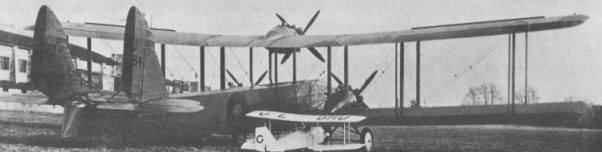
A military prototype bomber built between world wars. The only prototype was first flown on 27 July 1931. No production was undertaken.
Engine: 3 x 595hp Bristol Jupiter XFS Wingspan: 28.96 m / 95 ft 0 in Take-off weight: 9744 kg / 21482 lb Crew: 4 Armament: 2 x 7.7mm machine-guns, 10 x 110kg bombs





 All Aero