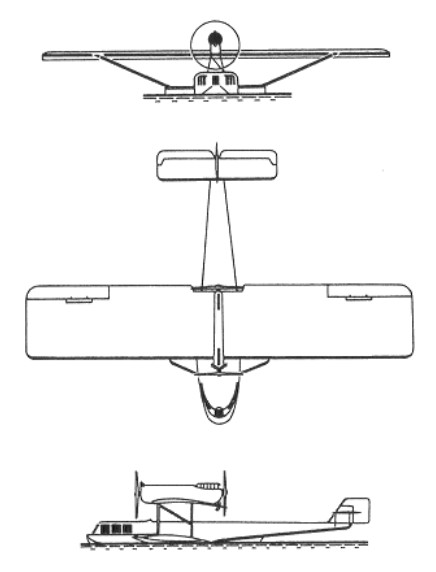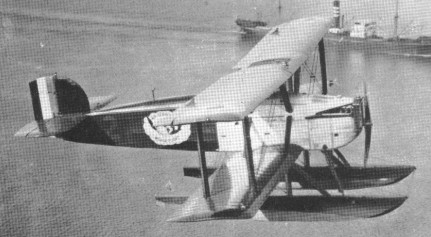
Douglas World Cruiser / DWC

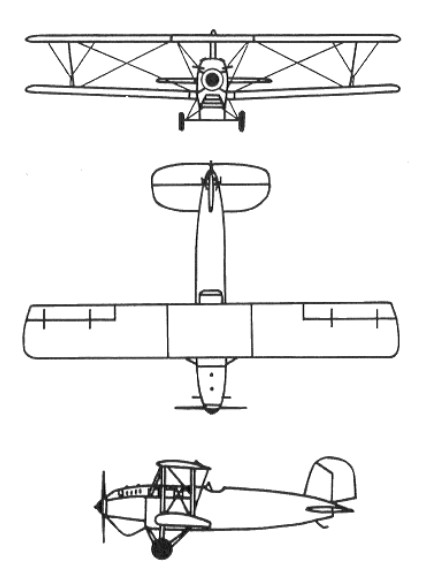
By the mid twenties rivalry between the U.S. Army Air Service and the Navy was at its height, and the Air Service made repeated attempts to keep in the public eye and favour. It pioneered the U.S. Air Mail service at great cost in lives and air¬craft, and made many long distance flights and record attempts. In July 1923, U.S. Army Air Service disclosed that it intended to attempt a global flight the following year. Four specially built two seat Douglas World Cruisers were used for this last achievement, each powered by a 400 hp Liberty engine and with interchangeable wheel and float undercarriages for the over land and over water sectors. As far as structure was concerned, the DWC was identical to the DT-2. The internal equipment, however, was specially designed for the round-the-world attempt and the saving in weight by deletion of the military load (torpedo with release gear, firing sight, etc) was used to increase the range of the aeroplane to 3,540km by fitting extra petrol and oil tanks – totalling 2,437.8 litres.
The all-up weight (floats) was 3,710kg. The improved engine, a 313kW Liberty, offered a weight of less than 0.91kg per hp.
Wings: Sitka Spruce, Cotton Covering
Fuselage: Steel Tube, Sitka Spruce, Cotton Covering
Empennage: Sitka Spruce, Cotton Covering
Cowling: Aluminum
Named after the cities of Seattle, Chicago, Boston and New Orleans, the four aircraft took off from Lake Washington, Seattle, on April 6. 1924 Seattle hit a mountainside in Alaska. After completing much of the journey, Boston force landed in the Atlantic, the other two arrived back at Seattle on September 28, after a 27,534 mile flight over 28 countries. It took 175 days, with a flying time of 371 hours 11 minutes. Throughout the journey the crews prevailed against an endless series of forced landings, repairs, bad weather, and other mishaps that continually threatened the success of the flight.

The crews were; Alva L.Harvey, Leigh Wade, Erik Nelson, Kailua-Kona, John J. Harding, Henry H. Ogden, Frederick L. Martin, Lowell H. Smith, and Leslie P. Arnold.

Douglas World Cruiser Around the World Article

DWC Landplane
Engine: Liberty, 400 hp / 313kW
Wingspan: 15.24 m / 50 ft 0 in
Length: 10.82 m / 35 ft 6 in
Height: 4.14 m / 13 ft 7 in
Wing area 65.68 sq.m / 707 sq. ft
Empty weight 1950 kg / 4,300 lb
Loaded weight 3137 kg / 6,915 lb
Max. speed 166 km/h / 103 m.p.h
Cruise speed: 85 km/h / 53 mph
Ceiling 3050 m / 10,000 ft
Range 3540 km / 2,200 miles.
Crew: 2

DWC Seaplane
Engine: Liberty, 400 hp / 313kW
Wingspan: 15.24 m / 50 ft 0 in
Length: 10.82 m / 35 ft 6 in
Height: 4.14 m / 13 ft 7 in
Wing area 65.68 sq.m / 707 sq. ft
Empty weight 5,100 lb
Loaded weight 7,715 lb
Max. speed 100 m.p.h
Ceiling 7.000 ft
Range 1,650 miles.
Crew: 2
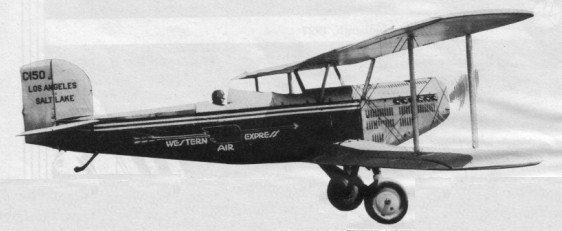
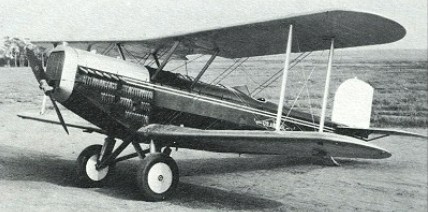
Douglas M-1 / M-2 / M-3 / M-4

M-2

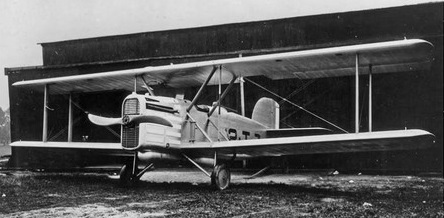
The US Post Office Department had been responsible for US internal air mail routes from 1918 onwards, and by 1925 the various types of DH-4 biplane which had been primary equipment since inception of the service were worn out. A decision was thus made to order a conversion of the Douglas O-2 observation biplane, which had been ordered into quantity production for the US Army.
The Douglas DAM-1 (Douglas Air Mail-One), quickly shortened to M-1, was test flown during the spring of 1925. It had twice the payload of the DH-4, but made use of the same Liberty engine, of which large numbers were in store and readily available. The M-1 was a straightforward conversion of the O-2, with the forward cockpit covered in sheet aluminium to form a reinforced mail compartment with access through two deck hatches, the pilot being located in what was formerly the rear (observer’s) cockpit in the O-2. During tests, extended exhaust piping was installed to keep fumes away from the pilot. The M-1 was adjudged successful, but no production order was received by Douglas.

M-3

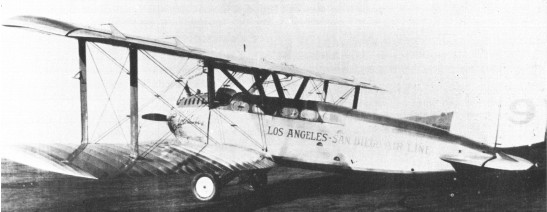
With the introduction of Contract Air Mail (CAM) routes, however, the newly formed Western Air Express Company (later Western Airlines) ordered six Douglas mailplanes. Designated M-2, they differed from the M-1 mainly by replacement of the original tunnel radiator with a frontal type. Provision was also made for quick conversion of the freight section to permit carriage of a passenger in place of mail. A month before Western Air Express inaugurated its Los Angeles-Salt Lake City service in April 1926, the US Post Office ordered 50 of the M-3 version for its major routes. The M-3s differed only in detail from the M-2s, sporting an overall aluminium finish with US Air Mail emblazoned in black on the fuselage sides and on the undersurfaces of the lower wing. Western’s machines had a red and silver paint scheme.
The Douglas Company’s chief engineer, J. H. ‘Dutch’ Kindelberger, then redesigned the M-3 with the aim of doubling its payload. The main change in this new M-4 was an entirely new ‘stretched’ wing which spanned 1.47m more than the 12.09m of the earlier types, and lacked the cut-out in the trailing edge of the upper wing inherited from the US Army O-2s. The Post Office was sufficiently impressed to arrange for 40 of the 50-plane M-3 order to be delivered in M-4 configuration. A single M-4 bought by Western Air Express was designated M-4A by Douglas to differentiate it from the Post Office order. With the leasing of route CAM-3 (Chicago-Dallas) to National Air Transport (NAT) in October 1925, a need arose for more mailplanes. NAT at first used the Curtiss Carrier Pigeon and then, having acquired the important Chicago-New York route, bought at auction all 10 M-3s and eight M-4s from the Post Office when, during July 1926, that department relinquished all its routes to private operators.
The Douglas mailplanes were introduced by NAT on 1 September 1927, and were phased out during 1930 in favour of three-engined Ford tri-motors. In their three years’ service they performed admirably in all weathers and in the most difficult flying conditions. NAT had bought other M-4s from a variety of sources and at one stage had as many as 24 Douglas mailplanes in operation. Among them was a privately owned aircraft which had been confiscated by the US Treasury while illegally smuggling liquor from Cuba to Florida during Prohibition; it became known as the ‘Booze Ship’. NAT M-3s were flown with new long-span wings from the spring of 1928 onwards; for economic reasons these had been designed and constructed by the company’s own engineering department. One M-4 was converted by NAT to take a 391kW Pratt & Whitney Hornet radial engine.
A total of 57 Douglas mailplanes was built, but with the advent of the Ford and other three-engined types they were soon withdrawn from air mail services. A few were sold to private owners but the majority were scrapped.

M-4
Engine: 1 x Liberty 12 V-12 piston engine, 298kW
Max take-off weight: 2223 kg / 4901 lb
Loaded weight: 1544 kg / 3404 lb
Wingspan: 13.56 m / 44 ft 6 in
Length: 8.81 m / 28 ft 11 in
Height: 3.07 m / 10 ft 1 in
Wing area: 38.18 sq.m / 410.97 sq ft
Max. speed: 225 km/h / 140 mph
Cruise speed: 177 km/h / 110 mph
Ceiling: 5030 m / 16500 ft
Range: 1127 km / 700 miles

Douglas T2D / P2D

In July 1925 the US Navy Bureau of Aeronautics ordered three Douglas XT2D-1 twin-engined torpedo-bomber/ general-purpose biplanes. They were required to be suitable for use with wheel or float landing gear, and for operation from aircraft-carriers. Two months earlier a single XTN-1 aircraft, with similar general characteristics, had been ordered from the US Naval Aircraft Factory.
The first XT2D-1 prototype flew on 27 January 1927 as a landplane. Soon afterwards its 373kW Wright P-2 radial engines were replaced by Wright R-1750s and the other two prototypes were similarly re-engined. The three aircraft participated successfully in trials with US Navy Torpedo Squadron VT-2 in spring 1927 and, nine examples of the production T2D-1 were purchased.
The basic configuration of the XT2D-1 prototypes was retained, a large single fin and rudder, wide-track divided landing gear capable of easy conversion to take twin floats, and two-bay equal-span wings with rounded tips. The fuselage of the T2D-1 was 0.90m shorter than that of the XT2D-1 and the engine nacelles were repositioned. A crew of four was carried, the pilot and co-pilot in tandem open cockpits, with gunner/ bomb-aimer in the nose and radio-operator/gunner in the fourth cockpit amidships.
The T2D-1 performed satisfactorily in service, operating from aircraft-carriers (being the first twin-engined aircraft to do so) during the 1928 US Navy fleet exercises. However, its size precluded embarkation of the carrier’s full aircraft complement and, as a result, the type was re-allocated to patrol squadrons. T2D-1s flew subsequently with VP-1 and VP-2 from Pearl Harbor, Hawaii, operating on wheels or twin floats as required until scrapped in 1933.
Variant
P2D-1: in June 1930 the Douglas company received an order for 18 aircraft based on the T2D-1, but intended specifically for over-sea patrol duties; these new P2D-1 aircraft had twin fins and rudders to ensure better flight characteristics, particularly with one engine inoperative, and were powered by 429kW Wright R-1820-E radial engines; deliveries were completed by the end of 1931 and the P2D-1s, almost always in twin-float configuration, flew with VP-3 of the US Navy stationed in the Panama Canal Zone, until withdrawn from first-line service in 1937.

T2D-1
Engine: 2 x Wright R-1750 radial piston engines, 391kW
Take-off weight: 4773 kg / 10523 lb
Empty weight: 2726 kg / 6010 lb
Wingspan: 17.37 m / 56 ft 12 in
Length: 12.80 m / 41 ft 12 in
Height: 4.85 m / 15 ft 11 in
Wing area: 82.31 sq.m / 885.98 sq ft
Max. speed: 201 km/h / 125 mph
Ceiling: 4215 m / 13850 ft
Range: 735 km / 457 miles

Douglas DT / L-W-F DT-2 / Wright SDW-1 / NAF DT-2

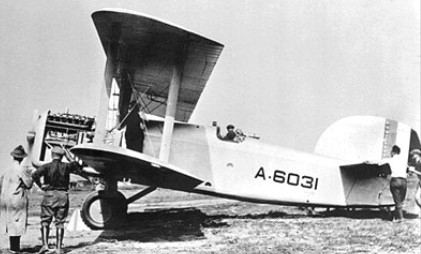
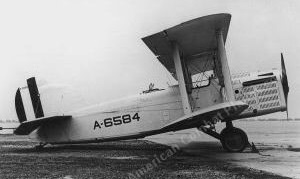
The DT was the first aircraft to be produced in quantity by Douglas aircraft. Based largely on the design of Douglas’s first plane, the Cloudster, the DT was a two-bay biplane featuring a welded, steel tube fuselage, with wings and tail surfaces of built-up wooden construction. It could be rigged as either a landplane or seaplane, and the wings could be folded rearward for stowage.

The 1921 DT-1 was a single-seat 298kW Liberty-powered (with side radiators) torpedo plane. In November 1921, the Navy took delivery of the first of three single seat DT-1s ordered, then after trials concluded in early 1922, directed that the remaining two be completed as two-seaters. Soon afterward, the Navy gave Douglas an order to produce 38 two-seat types as the DT-2 and also contracted L-W-F to build 20 and with NAF to build another six.

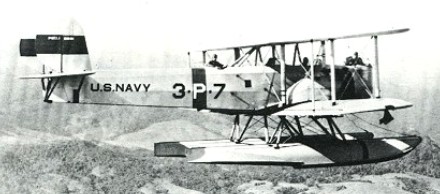
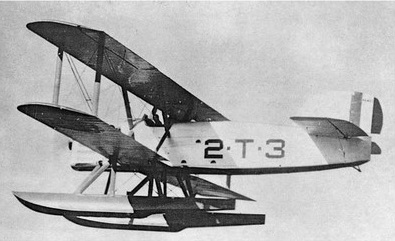
DT-2 2-T-3 of VT-2 early 1920s

The two-seat DT-2, a single-bay biplane was powered with a 335.3kW Liberty engine and nose radiator. The fuselage was of welded steel tubing, braced with tie-rods and provided with stiffening gussets. It was built in three detachable sections: engine section, mid-section and tail section, the first two plated with aluminium and the tail with fabric. The vertical tail surfaces had conventional wooden frames, while the horizontal tail surfaces were of steel tubing. The wings were of standard box-beam and built-up rib construction of wood, fabric-covered. The upper wing was made up of three panels, while the lower had the usual two. The undercarriage had a 3m wide track, although DT-2 could be fitted with two long wooden floats.

DT-2 of 2-T-3 VT-2 1923

As deliveries proceeded, DT-2s began entering operational service in late 1922 with VT-2 in San Diego, California, and during 1923 and 1924, at least six were transferred to the Marine Corps.

A total of about 80 production DT-2-type aircraft were produced in the USA, most as standard DT-2 for the US Navy but including a small number of SDW-1 scouting floatplanes, but excluding five export models delivered to Norway and Peru. The latter had 484.3kW Wright engines and were operated by the small Naval Air Station at Ancon (20 miles from Lima) which was under the command of US Navy officers on loan to the Peruvian government. Seven DT-2 were also built in Norway under licence.

US Navy DT-2 entered service from 1922 and during their four-year career were experimentally flown from the aircraft carrier USS Langley. Several new versions of the DT were developed by fitting new engines into existing DT-2, two NAF DT-2s became DT-4s when they were fitted with 525 hp Wright TA-2 engines, able to carry a bomb load of 748kg. Another modified as a testbed with the installation of a 40 hp Wright P-1 air-cooled radial engine was re-designated DT-6.

L-W-F DT-2

Three L-W-F DT-2s re-built by Dayton-Wright with deeper fuselages to carry more fuel returned to service as SDW long-range scouts. The 1924 Wright SDW-1 was an LWF DT-2 modified as a long-range USN scout with added fuel tanks. An open cockpit biplane, three conversions were made, including A6596. Landing gear was twin pontoons.

All DTs had been withdrawn from Navy and Marine service by the end of 1927.

DT-2
Engine: 1 x Liberty V-12, 336kW
Take-off weight: 2950 kg / 6504 lb
Empty weight: 1695 kg / 3737 lb
Wingspan: 15.24 m / 50 ft 0 in
Length: 10.41 m / 34 ft 2 in
Height: 4.14 m / 13 ft 7 in
Wing area: 65.68 sq.m / 706.97 sq ft
Max. Speed: 163 km/h / 101 mph
Ceiling: 2375 m / 7800 ft
Range: 472 km / 293 miles
Crew: 2
Armament: 1 x 830-kg torpedo

Douglas DT-2 Seaplane
Engine: Liberty 12A, 420 hp
Prop: 2 blade, fixed pitch, wooden
Armament: 1 x .30 mg
Bombload: 1 x 1835 lb torpedo
Max sped: 99 mph at SL
Ceiling: 7400 ft
Combat range: 275 mi
Empty weight: 4528 lb
Loaded weight: 7293 lb
Wingspan: 50 ft 0 in
Length: 37 ft 8 in
Wing area: 707 sq.ft
Seats: 2
Total produced: 67

L-W-F DT-2
Engine: Liberty 12A, 420 hp
Wingspan: 50 ft
Length: 34 ft 2 in
Height: 13 ft 7 in
Wing area: 707 sq.ft
Empty weight: 37 37 lb
Gross weight: 6502 lb
Fuel capacity: 115 Gal
Top speed: 101 mph at SL
Landing speed: 49 mph
Service ceiling: 7800 ft
Climb to 4050 ft: 10 min
Range w/torpedo: 293 miles

Wright SDW-1
Engine: Wright T-3, 585hp
Wingspan: 50’0″
Length: 34’3″
Speed: 105 mph
Ceiling: 3600 ft
Seats: 2

Douglas Cloudster

Douglas dropped anchor in Santa Monica with Davis’ money and began work on the Cloudster, an airplane that contained some innovative uses of streamlining, then a new design construction. The Navy gave him an order for three of the airplanes, but it wasn’t until Los Angeles Times publisher Harry Chandler rounded up some local financial support that Douglas was able to get going. A single example of a Liberty-powered biplane was built for an attempt at a non-stop flight across the USA.

Engine: 1 x Liberty, 295kW
Max take-off weight: 4354 kg / 9599 lb
Empty weight: 2177 kg / 4799 lb
Wingspan: 17.0 m / 55 ft 9 in
Length: 11.2 m / 36 ft 9 in
Height: 3.7 m / 12 ft 2 in
Max. speed: 193 km/h / 120 mph
Cruise speed: 137 km/h / 85 mph
Range w/max.fuel: 4345 km / 2700 miles
Crew: 2

Dottori 1909 biplane         

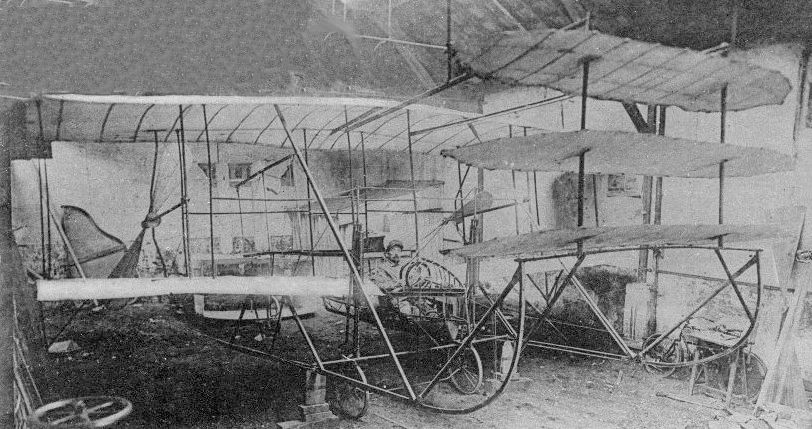
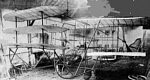
This somewhat complicated twin-propeller pusher with a span of 12 m and a length of 11 m was designed by Charles-Albert Dottori, who was granted a French patent for “Appareil de direction et de stabilisation pour aéroplanes” on April 16th, 1909. The machine was tested on the ground at Port-Aviation by Edmond Jean Eugène Pouvarel, who had built its 50 hp engine. It was destroyed by fire on the night of December 18th, 1909, before making any flights.

Span: 39’4″
Length: 36’1″

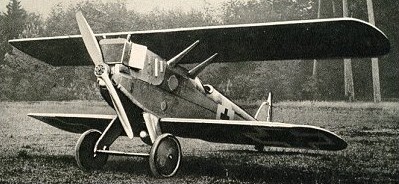
Dornier D-1

1918

Engine: 1 x BMW IIIa, 136kW
Take-off weight: 885 kg / 1951 lb
Empty weight: 160 kg / 353 lb
Wingspan: 7.8 m / 25 ft 7 in
Length: 6.4 m / 20 ft 12 in
Height: 2.6 m / 8 ft 6 in
Wing area: 18.6 sq.m / 200.21 sq ft
Max. Speed: 200 km/h / 124 mph
Cruise speed: 80 km/h / 50 mph
Ceiling: 8100 m / 26600 ft
Armament: 2 machine-guns
Crew: 1

Dornier GsII Wal

The two improved GsIIs under construction at Seemoos fell foul of the Allied Commission and were destroyed in 1919. Dornier commissioned the firm’s Italian subsidiary to continue development and construction of the forbidden type. The GsII, the famous Wal, which flew in 1922, was built under license in Japan, Netherlands, and Spain and would evolve through the 1920s and into the 1930s. Between the first production Wal of 1923 and the military type of 1932, the airplane’s wingspan increased greatly, its engine power more than doubled, and its loaded weight rose from 8820 to 22000 pounds. It was used for civilian mail service and long range reconnaissance, and the commercial and military models differed little.

Engine: 2 x MB IVa, 190kW
Take-off weight: 4315 kg / 9513 lb
Empty weight: 1200 kg / 2646 lb
Wingspan: 21.0 m / 68 ft 11 in
Length: 15.3 m / 50 ft 2 in
Height: 4.7 m / 15 ft 5 in
Wing area: 80.0 sq.m / 861.11 sq ft
Max. Speed: 170 km/h / 106 mph
Cruise speed: 140 km/h / 87 mph
Ceiling: 4250 m / 13950 ft
Range w/max.fuel: 600 km / 373 miles
Crew: 2
Passengers: 6

Dornier GsI

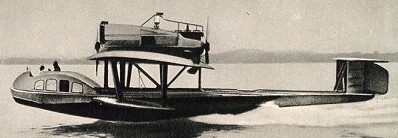
After the armistice, Dornier built a six passenger flying boat, the GsI, with the inher¬ently stable broad beam hull and sponsons that characterized his later boats. First flown in July 1919 the GsI went to Switzerland for test flights, it returned to Fredrichshafen on the 10/12/1919. From there it went on a sales tour to the Netherlands on the 3rd March 1920. The craft was a success, but after a demonstration in the Netherlands, the Allies demanded its destruction because the Control Commission had forbidden that category of aircraft. The GsI was scuttled at Kiel-Holtenaeu on the 25 th April 1920 to prevent it falling into the hands of the Allied Inspection Commission.

Dormoy 1919 biplane

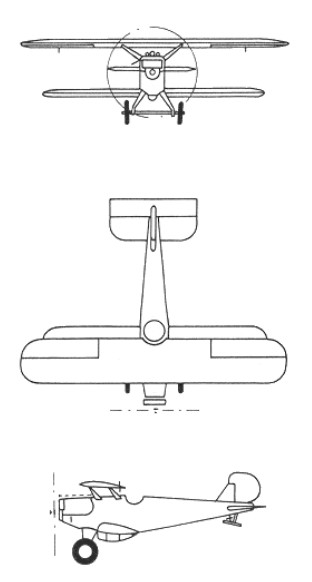
Designed by Etienne Dormoy in 1919 as a single place open cockpit biplane experiment in ultralights. A basic framework with wings and a pilot’s seat behind the 18hp Henderson motor. The idea was carried over into Dormoy Bathtub.

Flown successfully at Selfridge Field, Detroit, only the one was built, sometimes listed as a Packard Motor Co product but actually spare-time project by Dormoy and his co-workers while employed there.