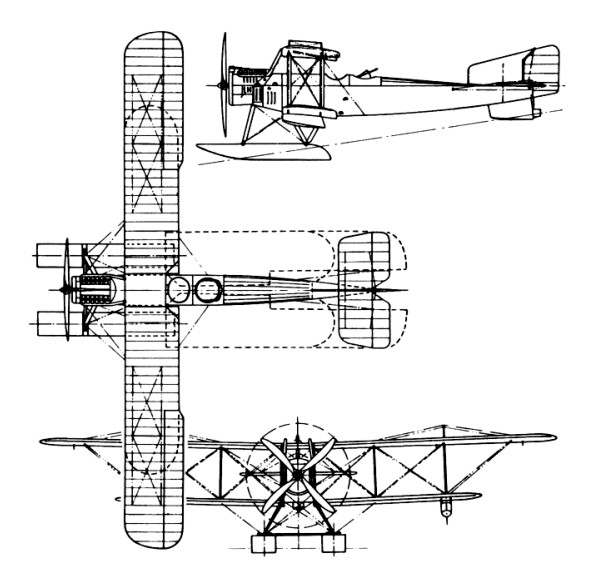
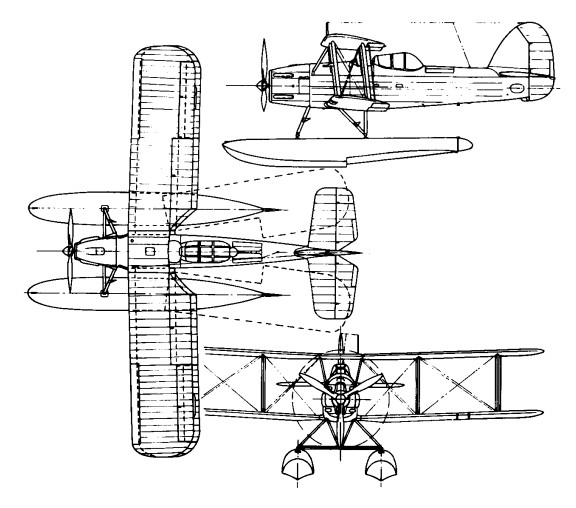
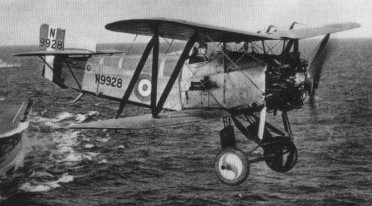
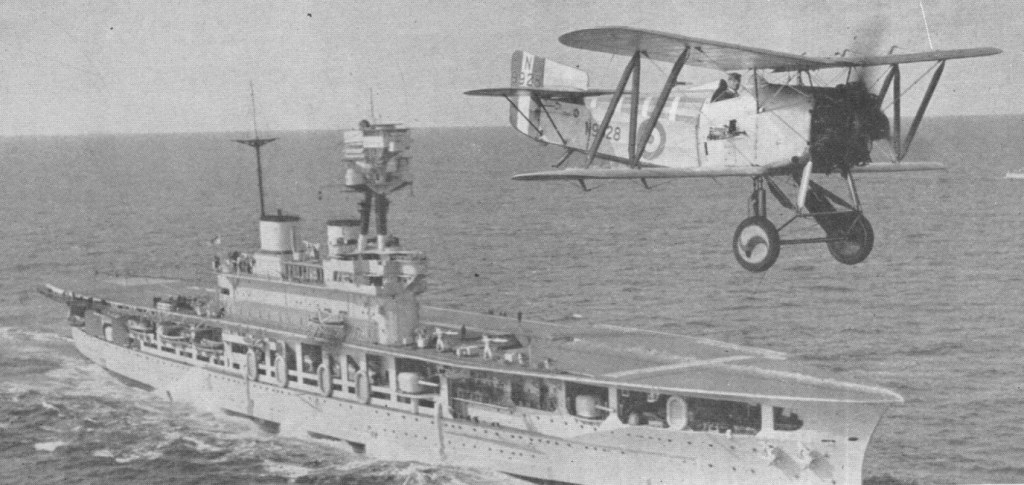
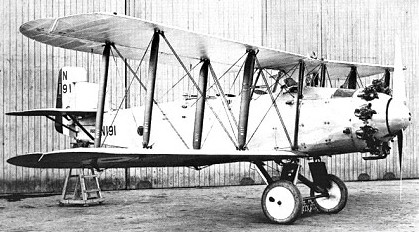
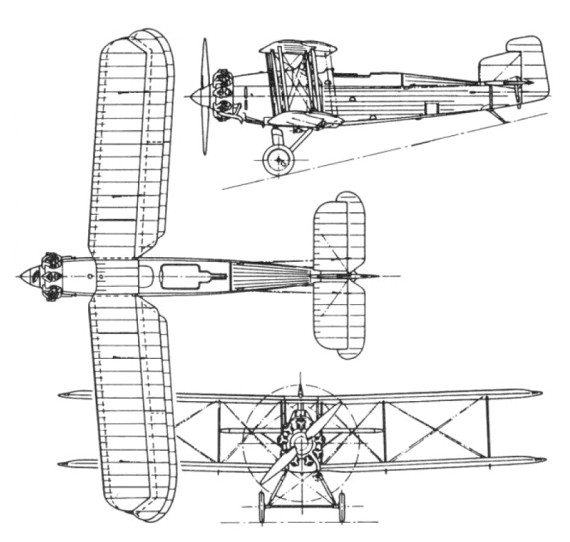
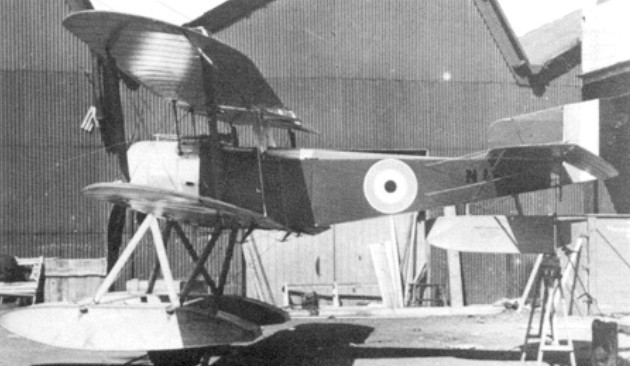
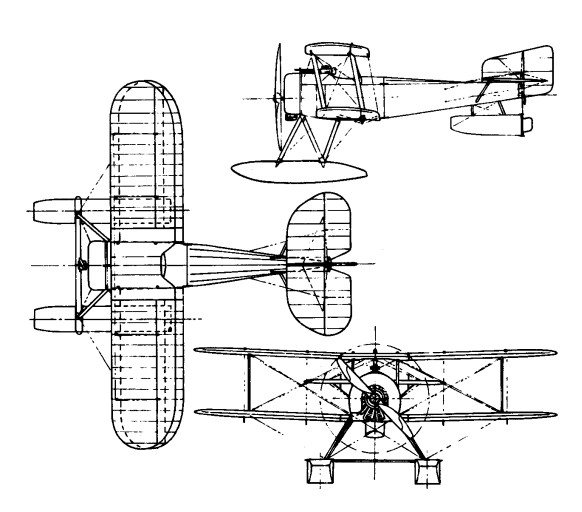
The Fairey Campania two-seat seaplane got its name from the ex-Cunard ocean liner Campania which the Admiralty had converted into a seaplane carrier during the winter of 1914-15. Production aircraft, powered by a 186.3kW Sunbeam Maori II or 186.3-257kW Rolls-Royce Eagle engine, entered service in 1917 and eventually operated as armed-reconnaissance aircraft from the carriers Campania, Nairana and Pegasus and from coastal bases until the Armistice, thereafter also seeing action in Russia. A total of about 60 Campanias were built from the contracts placed with Fairey (for 50 aircraft in two batches), Barclay Curie and Company (for 50) and Frederick Sage and Company/Sunbeam Motor Car Company (for 70).
Engine; 1 x Sunbeam “Maori II”, 190kW Max take-off weight; 2420 kg / 5335 lb Empty weight; 1660 kg / 3660 lb Wingspan; 18.8 m / 61 ft 8 in Length; 13.1 m / 42 ft 12 in Height; 4.6 m / 15 ft 1 in Wing area; 58.3 sq.m / 627.54 sq ft Max. speed; 137 km/h / 85 mph Ceiling; 1520 m / 5000 ft Range w/max.fuel; 450 km / 280 miles Armament; 1 machine-guns, 2 x 30kg bombs Crew; 2
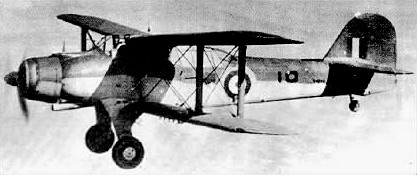
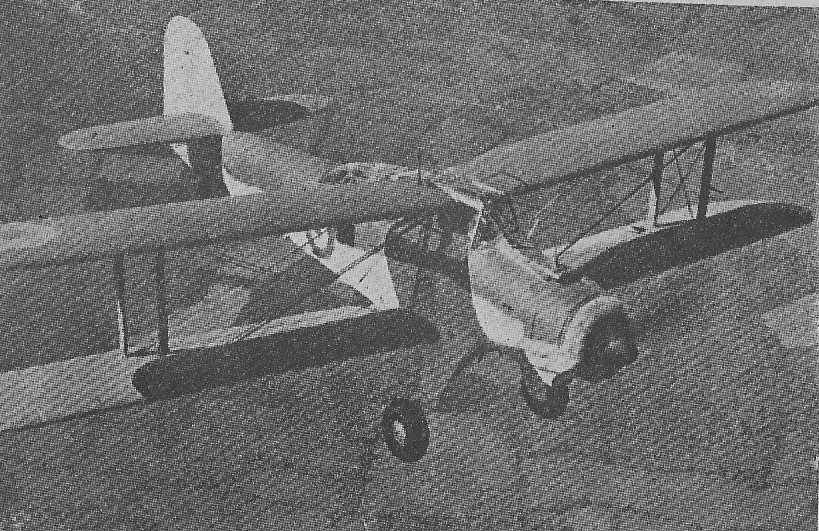
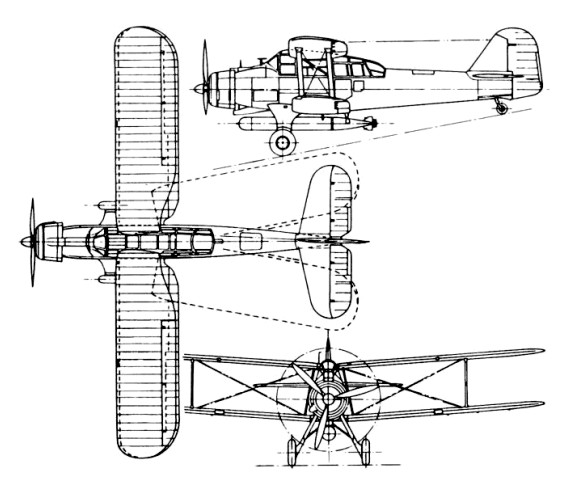
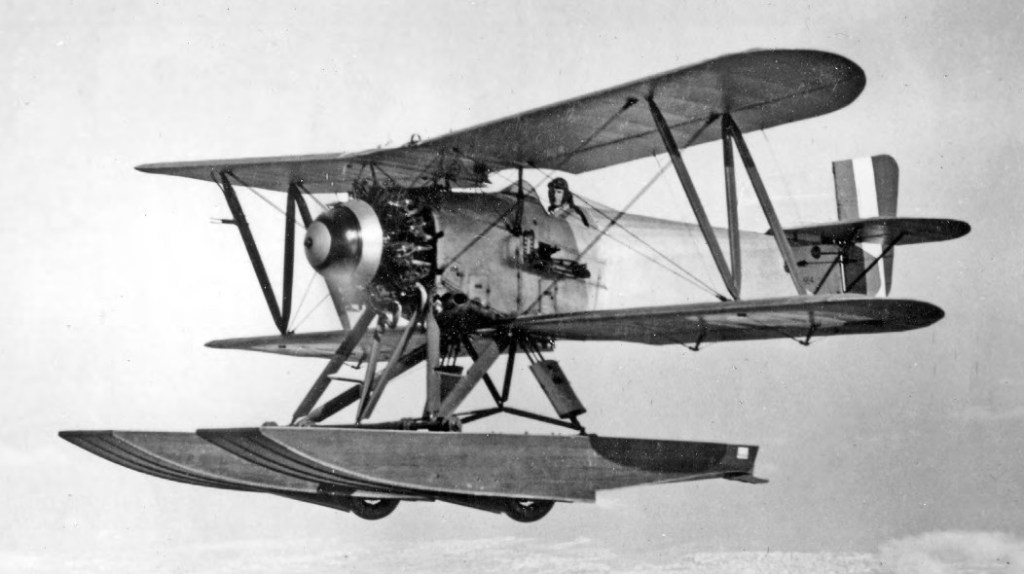
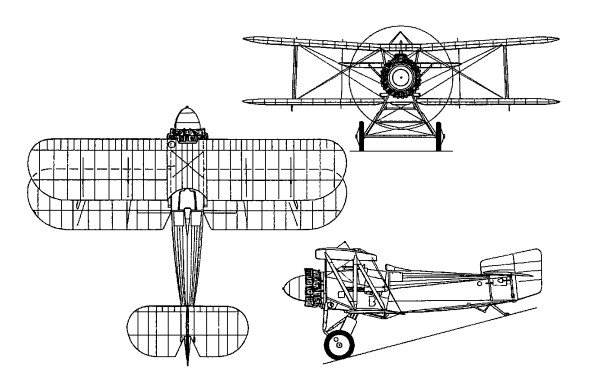
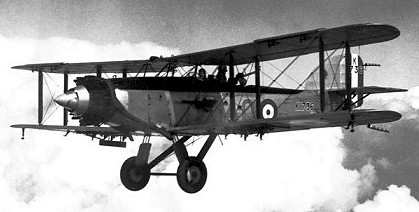
The Albacore torpedo-bombing biplane was first flown in prototype form on 12 December 1938. During the spring of 1940 the first production aircraft entered FAA service and for the remainder of that year were flown mainly on coastal patrol, spotter-reconnaissance, minelaying and night-bombing duties. In 1941 the Albacores went to sea in HMS Formidable and other carriers and from then were active on convoy protection duties in the Baltic and in anti-submarine and other roles in the Mediterranean and elsewhere. The Albacore was removed from FAA service in late 1943, having never performed its intended role as a Swordfish replacement. It had a more powerful 794kW Bristol Taurus or 842kW Taurus XII 14-cylinder sleeve-valve air-cooled radial engine in the NACA cowling with leading-edge exhaust collector and trailing-edge controllable gills, enclosed cockpits for the crew of two or three, one forward-firing 7.7mm Browning and two rear-mounted 7.7mm Vickers guns on a Fairey high-speed mounting, and hydraulically operated flaps. The last Albacores in operational service were those ex-FAA aircraft taken over by the RCAF and used during the Allied advance into Europe from mid-1944. Production totalled 803 aircraft.
Engine; 1 x Bristol Taurus XII, 843kW / 1115 hp Max take-off weight; 4745 kg / 10461 lb Empty weight; 3289 kg / 7251 lb Wingspan; 15.24 m / 50 ft 0 in Length; 12.14 m / 39 ft 10 in Height; 4.32 m / 14 ft 2 in Wing area; 57.88 sq.m / 623.01 sq ft Wing loading: 16.81 lb/sq.ft / 82.00 kg/sq.m Max. speed; 259 km/h / 161 mph Cruise speed; 101 kts / 187 km/h / 116 mph Ceiling; 6310 m / 20700 ft Range; 808 nm / 1497 km / 930 miles Armament; 3 x 7.7mm machine-guns, 1 x 730kg torpedo, 6 x 113kg or 4 x 227kg bombs Crew; 3
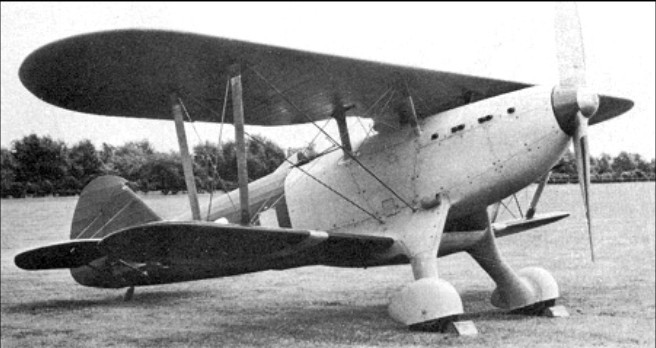
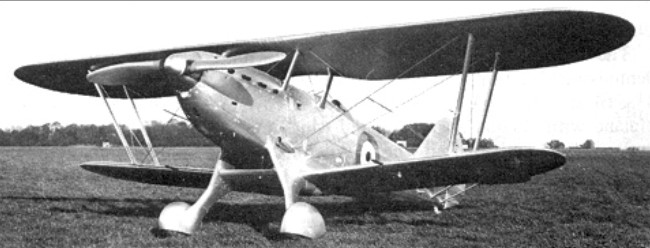
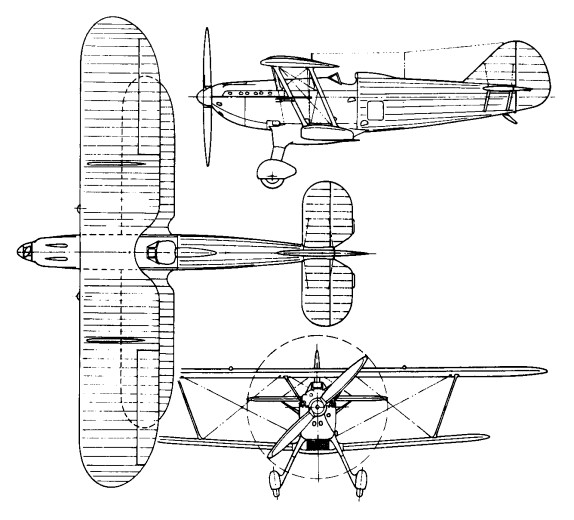
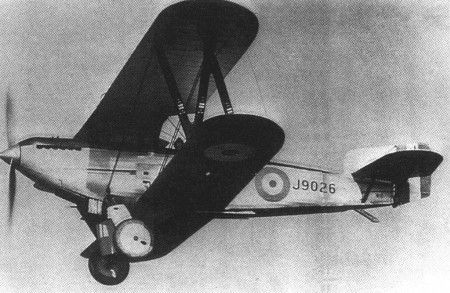
The fighter-biplane Fantome of 1935 was a private-venture. The name Feroce was conferred later. An entrant for the Belgian fighter competition to find a successor for the Fairey “Firefly II” It had provision for a French Hispano-Suiza 12crs moteur canon with an Oerlikon 20mm gun firing through the airscrew hub and 4 rifle-bore Browning guns as made in Belguim by the Fabrique National. One aircraft only was supplied to the Royal Air Force for evaluation. The prototype in Belgium crashed on trials close to their monarch King Leopold. It did not go into production.
Wingspan : 34.514 ft / 10.52 m Max take off weight : 4542.3 lb / 2060.0 kg Max. speed : 235 kts / 435 km/h Landing speed : 52 kts / 96 km/h Cruising speed : 189 kts / 350 km/h Service ceiling : 36089 ft / 11000 m Endurance : 2 h Crew : 1 Armament : 1x MG 20mm Oerlikon, 4x MG Browning, 4x 10kg-Bomb.
Fighter aircraft, United Kingdom, 1936 Derived from the Fairey Fox Mk VI. Could be converted easily to double seat mode and was then similar to the Fox VI.
Engine : Hispano Suiza 12 Y drs, 848 hp Max. speed : 202 kts / 375 kph Service ceiling : 37730 ft / 11500 m Crew : 1 Armament : 4x MG
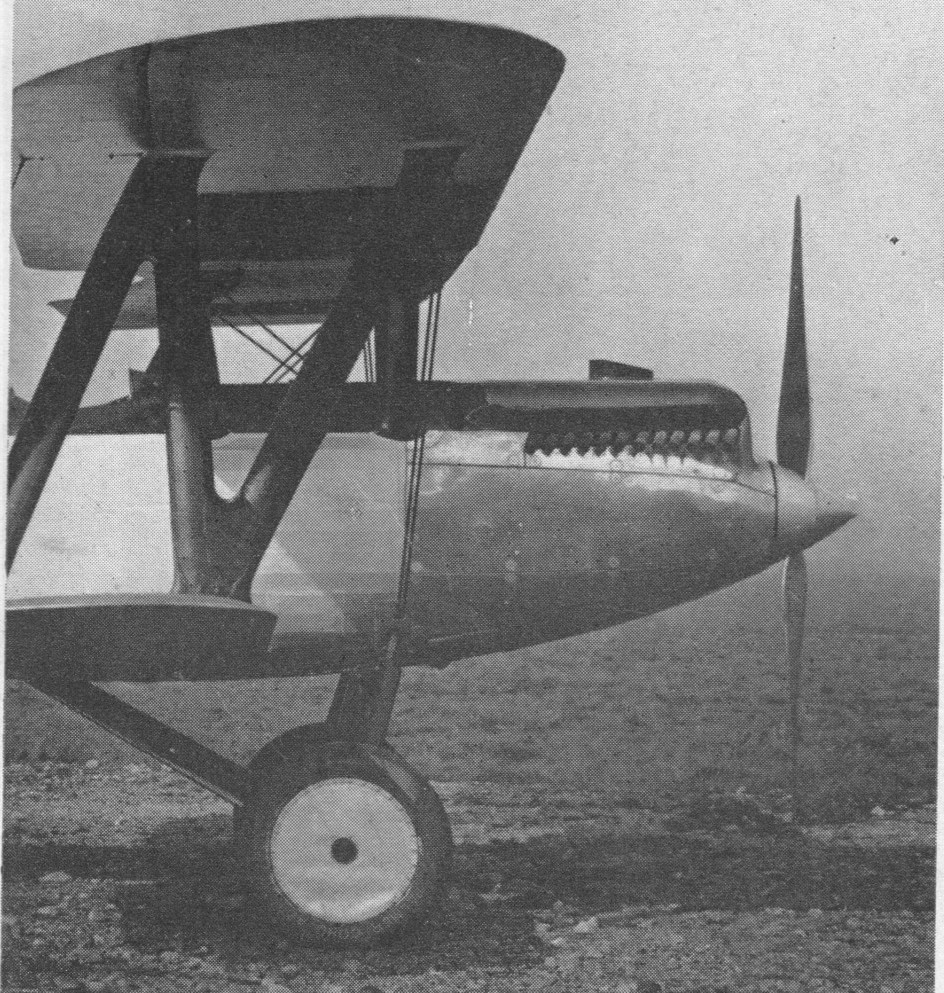
Richard Fairey realised that the Curtiss D-12 engine, in combination with a Curtiss-Reed propeller, was a most significant factor in this American success in the 1923 Schneider Trophy Contest.
The engine was the world’s first wet-sleeve monobloc aero-engine, and it was of small frontal area. The propeller was of comparatively small diameter with forged duralumin blades of thin aerofoil section. It could be rotated at high speed – the blade tips approaching the speed of sound – without any serious loss of efficiency. So fast was the rotational speed that there was no need for a reduction gear between engine and propeller. No reduction gear, small-diameter lightweight propeller blades and a shorter landing gear, all produced weight savings that were vitally important to a high-performance aircraft.
Fairey Fox Reed propellor
Fairey began negotiating for the licence rights to import and/or build this power plant in Britain, and acquired an engine and propeller for the development of a fast day bomber for the RAF.
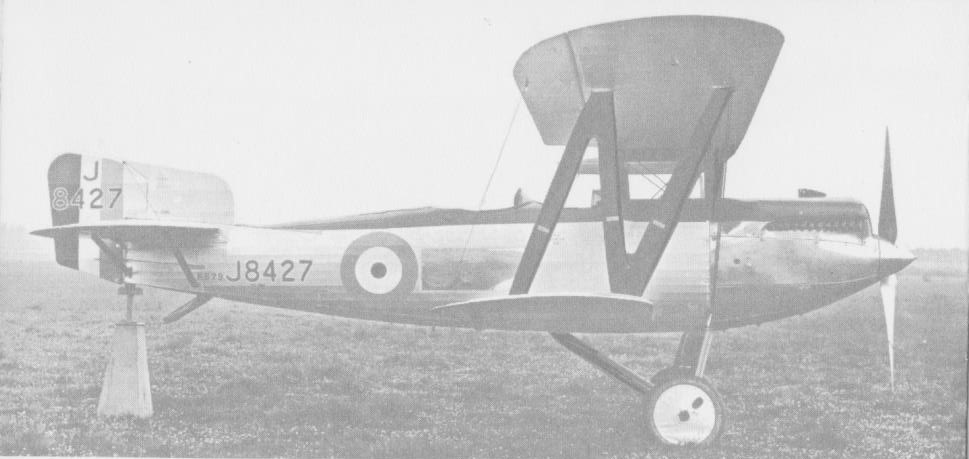
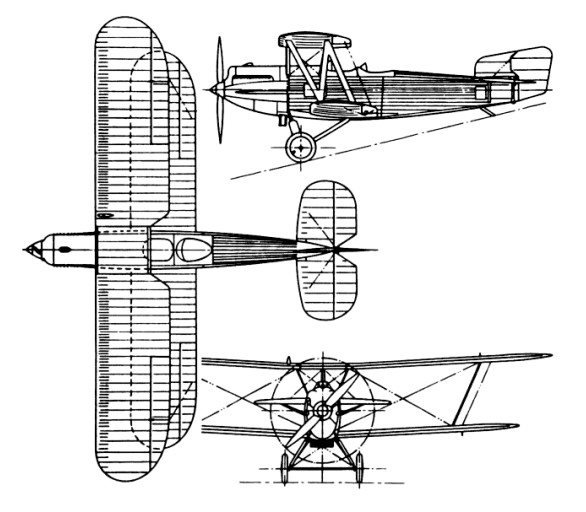
A prototype single-bay biplane with unequal-span staggered wings was built as a private venture. Landing gear, tail unit and fuselage were typical Fairey design but the fuselagewas much slimmer than usual. Notable were the considerable efforts made to produce a structure as free from drag as then possible. Even the mounting for the gunner’s defensive Lewis gun was of Fairey design, to eliminate the drag induced by the normal Scarff ring.
The prototype was first flown on 3 January 1925 named Fox. Demonstrated in October of that year to Air Chief Marshal Sir Hugh Trenchard, its performance was so impressive that a complete squadron of aircraft was ordered into production. Strict budgets of that time (which became tighter as the 1930s approached) limited procurement to 28 aircraft. When issued to No 12 Squadron (in August 1926) they proved to be some 80km/h faster than the Fairey Fawns which they superseded. At a later period some of these aircraft were re-engined with the Rolls-Royce Kestrel and redesignated Fox IAS, remaining operational until 1931.
The British Fox was built under the Fairey Aviation Company sister name in Belgium, Avions Fairey. Avions Fairey was set up in Belgium as an offshoot of the Fairey Aviation Company of Britain. The production facility was initially created for the local production of the Fairey Firefly, to which the facilities were later used for production of the Fairey Fox aircraft.
The Seafox was a light two-seat (the rear cockpit enclosed) reconnaissance catapult seaplane, remembered for the action against the Admiral Graf Spee during the Battle of the River Plate in December 1939, having flown from the Royal Navy cruiser HMS Ajax. A total of 64 Seafox biplanes were built for the FAA, each powered by a 294kW Napier-Halford Rapier VI 16-cylinder air-cooled engine.
Later models were adapted for service by the Belgium air force with total production amounted to 176 examples.
Fox Engine; 1 x Rolls-Royce “Kestrel IIS”, 405kW Max take-off weight; 2140-2300 kg / 4718 – 5071 lb Empty weight; 1450 kg / 3197 lb Wingspan; 11.6 m / 38 ft 1 in Length; 9.9 m / 32 ft 6 in Height; 3.3 m / 10 ft 10 in Wing area; 34.0 sq.m / 365.97 sq ft Max. speed; 304 km/h / 189 mph Ceiling; 9500 m / 31150 ft Armament; 3 machine-guns, 250 kg of bombs Crew; 2
Fairey Fox Mk. VI Engine : Hispano Suiza HS 73-12 Yrds, 848 hp Length : 32.152 ft / 9.8 m Height: 10.499 ft / 3.2 m Wingspan : 38.484 ft / 11.73 m Wing area : 370.282 sq.ft / 34.4 sq.m Max take off weight : 5402.3 lb / 2450.0 kg Weight empty : 3947.0 lb / 1790.0 kg Max. weight carried : 1455.3 lb / 660.0 kg Max. speed : 164 kts / 304 km/h Initial climb rate : 2165.35 ft/min / 11.0 m/s Service ceiling : 22966 ft / 7000 m Wing load : 14.56 lb/sq.ft / 71.0 kg/sq.m Range : 324 nm / 600 km Endurance : 3 h Crew : 2 Armament: 2 x 7.62mm FN-Browning machine gun 1 x 7.62mm FN-Browning machine gun in rear cockpit position
Fairey Sea Fox Length : 35 ft 10 in / 10.81 m Height : 12 ft 2 in / 3.68 m Wingspan : 40 ft / 12.19 m Wing area : 434.004 sq.ft / 40.32 sq.m Max take off weight : 5419.9 lb / 2458.0 kg Weight empty : 3805.8 lb / 1726.0 kg Max. speed : 108 kt / 200 km/h Cruising speed : 92 kt / 171 km/h Service ceiling : 2957 m / 9700 ft Wing load : 12.51 lb/sq.ft / 61.0 kg/sq.m Range : 382 nm / 708 km / 440 miles Engine : Napier Rapier VI, 390 hp Crew : 2 Armament : 1x cal.303 MG (7,7mm), 160kg of bombs
The Specification 21/26, issued by the Air Ministry’s Directorate of Technical Development (DTD) on September 30, 1926, called for a “Single Seater Fighter Ship¬-plane for use from HM ships,” fitted with a land undercarriage which could be replaced by floats, and vice versa, within half an hour. The aircraft, which was to have an all metal structure but could be fabric covered, was to be suitable for launch from a catapult and for taking off from and alighting on the deck of an aircraft carrier. It was to have a good degree of positive stability about all axes in both configurations, and tail incidence had to be adjustable in flight to enable the aircraft to fly horizontally at all speeds without attention from the pilot. It was to be “highly controllable” at all speeds, and especially close to stalling speed, with no tendency to ‘hunt’ in a steep dive. Control had to be adequate to stop an incipient spin when the machine was stalled. A high degree of manoeuvrability in the air and on the ground or water was desired, and it had to respond quickly to the controls while not being tiring to fly. The ailerons were to have the minimum of yawing effect. As a seaplane, the machine was to have good static stability in the water, and when under tow or running under its own power it was to be stable about all axes at all speeds. The engines specified were the air cooled Bristol Mercury radial of 550hp at 2,000rpm or the water cooled Rolls Royce Falcon X of 480hp at 2,300rpm. The installation had to allow for rapid and easy removal of the engine. The cowling, which also had to be easily removable, had to be finished “to prevent the reflection of light which might betray the presence of the aircraft to the enemy or dazzle the pilot”. A metal propeller was specified. There was to be tankage for 74 gallons of fuel, plus an easily removed 20 gallon auxiliary tank and a gravity tank of sufficient capacity to allow half an hour’s flight at full power at ground level. An 11 gallon oil tank was to be provided if the Mercury engine was used, or an 81/2 gallon oil tank and a 21/2 gallon reserve water tank for the Falcon. Alternative exhaust systems for day or night flying were required, and were to be easily changed. The night flying system had to provide adequate silencing and flame damping, while the daytime system was to be “of minimum weight”. Additional equipment to be carried during the acceptance flights weighed 5581b and included a Vickers 0.5in gun and 300 rounds, a Vickers 0.303in gun and 600 rounds, a rocket launching (R/L) tube and six bombs, and flotation gear. A second 0.303in gun with 600 rounds was to be provided for if the 0.5in gun was not available in time. Minimum performance requirements with this load, using the Mercury, called for a horizontal speed of 132kt (152mph) at 10,000ft and a service ceiling of 23,000ft. With the Falcon X the figures were 127kt (146mph) at 10,000ft and 22,000ft. The length of run to take¬off was not to exceed 47ft in a relative wind of 28kt (32mph), and the aircraft was to become airborne at a speed of 55mph when catapulted in still air. The suitability for launching from a catapult or alighting on the deck of an aircraft carrier was “of first importance”, and the aircraft had to be capable of taking off from a turret or cruiser platform. For fighting, the pilot was to have the best possible view in all directions, and a good view forward and downwards was required for carrier landings. A clear, unobstructed view forward over the machine’s centreline was needed to enable him to sight the fixed guns, the installation of which was to dispense with blast tubes. There was also to be provision for the fitting of a G.3 aerial camera as near to the sights as practicable, and standard clips were to be fitted to allow the new “light carrier” to be installed to carry four 20 lb bombs, sufficient clearance being provided to enable the bombs to be released in a very steep dive. Despite the emphasis placed on the machine’s naval use, it was stressed that: “The aircraft is to be designed primarily as a landplane fighter and qualities required for this work are not to be sacrificed in order to improve its characteristics when equipped with the float alighting gear”. A padded head support was to be provided to prevent injury to the pilot during catapult launch acceleration. A limit of 35ft was put on the wing span, the overall length was restricted to 23ft, the height was not to exceed 14ft 9in. Quick and easy removal and erection of the wings was specified, with the ability to remove the wing structure completely in ten minutes and replace it in fifteen minutes. The contractor was required to provide a full size mock up of his proposed aircraft before constructional work was begun, to enable the Director of Technical Development to examine and approve the layout. This mock up had to include “all parts and components which are likely to interfere with the all round view of the pilot”, and was to show the internal arrangement of the cockpit. Scale model floats for official water tank tests were also to be provided, along with specimens of ribs, a section of wing, and a length of spar. Tendering for this demanding specification were Armstrong Whitworth, which offered the AW XVI; Fairey, with the Flycatcher II; Gloster, which tendered the Gnatsnapper; Hawker, which offered the Hoopoe; Vickers, with a modified version of its Type 141 Scout; and George Pamall & Co, which had its head office at the Coliseum Works, Park Row, Bristol, and its aerodrome at Yate, in Gloucestershire. The prototype flew for the first lime in 1922, and 192 were delivered to the Fleet Air Arm as Britain’s standard carrier-based fighters until replaced by the Nimrod.
Flycatcher and HMS Eagle
Construction was composite with wooden fabric-covered wings and a fuselage of wood and metal with fabric covering. A single-bay biplane wings, well-staggered, with pronounced dihedral on the upper wing (plus Fairey’s Patent Camber Gear) and a fuselage which appeared to curve upwards to the tail unit. The Flycatcher was the first aircraft required by the Air Ministry to undertake a terminal velocity dive at the maximum speed to which its 400 hp Jaguar IV engine would thrust it.
Hendon 1924
The aircraft of 403 Flight took part in operations against Chinese Pirates in the mid twenties. Flycatchers remained in service from 1923 until declared obsolete in 1935. They had the distinction of serving on board all British aircraft carriers of that period. In addition, they operated as landplane fighters from a short 18.3m take-off platform mounted above the gun turrets of capital ships. Their trailing-edge flaps and drooped ailerons provided a steep path of descent which was ideal for carrier landing. One Flycatcher was fitted experimentally with hydraulic brakes which permitted a very short landing run. This was the first FAA aircraft to have such brakes, but they did not then become standard equipment. Once on deck, they did not have the benefit of folding wings to simplify shipboard stowage. Instead they were designed to be dismantled easily into sections which did not exceed 4.11m in length. The training, skill and enthusiasm of deck handling crews made possible such feats as a record of six aircraft landed and stowed in their hangars in only 4 minutes 20 seconds. Landing was carried out on the main deck.
Replica: Westward Airways Fairey Flycatcher
Flycatcher Engine: 1 x Armstrong Siddeley Jaguar III or IV, 400hp Wingspan: 8.84 m / 29 ft 0 in Length: 7.01 m / 23 ft 0 in Height: 3.66 m / 12 ft 0 in Loaded weight: 3028 lb Max. speed: 133 mph at 5000 ft Range at max speed: 263 miles at 10,000ft Armament: 2 x 7.7mm machine-guns, 4 x 9kg bombs
Flycatcher I Wingspan: 8.84 m / 29 ft 0 in Length: 7.01 m / 23 ft 0 in Height: 3.66 m / 12 ft 0 in Wing area: 26.76 sq.m / 288.04 sq ft Engine: 1 x Armstrong Siddeley Jaguar III, 298kW Max take-off weight: 1372 kg / 3025 lb Empty weight: 924 kg / 2037 lb Max. speed: 216 km/h / 134 mph Ceiling: 5790 m / 19000 ft Range at 110 mph: 500 km / 311 miles Armament: 2 x 7.7mm machine-guns, 4 x 9kg bombs
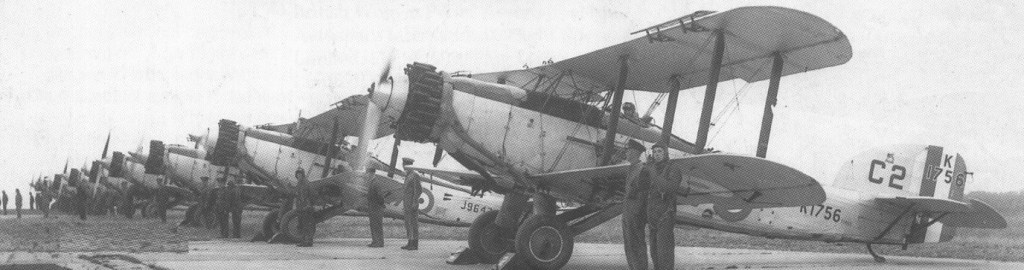
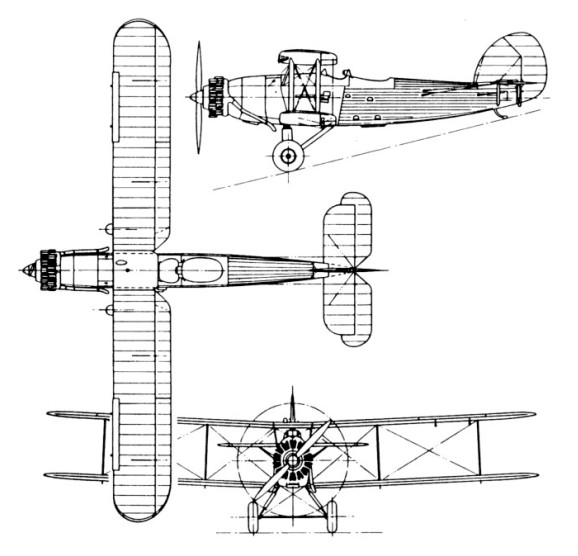
A medium-range day bomber with a forward-firing Vickers machine-gun mounted on the left side of the fuselage and a rear-mounted Lewis gun, the Gordon could carry up to 209kg of bombs. A development of the IIIF Mk V, the Gordon was almost identical to the Fairey IIIF, except for having a 391kW Armstrong Siddeley Panther IIA radial air-cooled engine in place of the Napier Lion water-cooled engine.
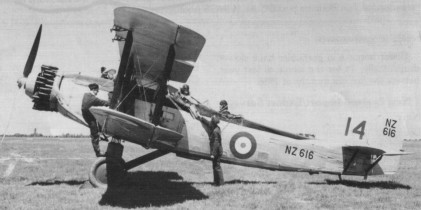
The prototype first flew in 1930 and a total of 163 were built for the RAF, including a small number of trainers. Compared to the IIIF, the Gordon offered a considerable increase in speed, due mainly to the engine and a lighter AUW. In addition to the production Gordon Is, 24 refined Gordon IIs were built for the RAF and about 90 IIIFs were brought up to Gordon standard. They remained operational until 1938. A number were also exported, production examples going to China and Brazil, while RAF types were passed to Egypt and New Zealand.
Gordon I Engine: Armstrong Siddeley Panther IIA, 525 hp / 391kW Wingspan; 13.94 m / 45 ft 9 in Length; 11.20 m / 36 ft 9 in Height; 4.32 m / 14 ft 2 in Wing area: 437.987 sq.ft / 40.69 sq.m Max take-off weight; 2679 kg / 5906 lb Empty weight; 1588 kg / 3501 lb Max. speed: 126 kts / 233 km/h Cruising speed: 96 kts / 177 km/h Service ceiling: 21998 ft / 6705 m Range: 522 nm / 966 km Armament: 2 .303 MG (7,7mm) Bomb load: 460 lb. Seats: 2.
Gordon II Engine: Armstrong Siddeley Panther IIA, 609 hp. Wingspan; 13.94 m / 45 ft 9 in Length; 11.20 m / 36 ft 9 in Height; 4.32 m / 14 ft 2 in Wing area: 437.987 sq.ft / 40.69 sq.m Crew: 2
Engine; 1 x 482hp Bristol Jupiter VI Take-off weight; 1897 kg / 4182 lb Empty weight; 1173 kg / 2586 lb Wingspan; 12.37 m / 40 ft 7 in Length; 8.99 m / 29 ft 6 in Height; 3.12 m / 10 ft 3 in Wing area; 35.30 sq.m / 379.97 sq ft Max. Speed; 217 km/h / 135 mph Crew; 2 Armament; 2 x 7.7mm machine-guns, 200kg of bombs
A total of 286 Sopwith Babies was built of which 195 were produced by Blackburn – and sometimes known as Blackburn Babies – 105 of the latter being fitted with the 130hp Clerget engine, and, of these, 40 were fitted (initially) to carry the Ranken dart and no gun armament. A more extensive modification of the Sopwith float fighter was the Fairey Hamble Baby.
The Fairey Hamble Baby had refinements such as full span flaps designed by Richard Fairey. A total of 180 were built.
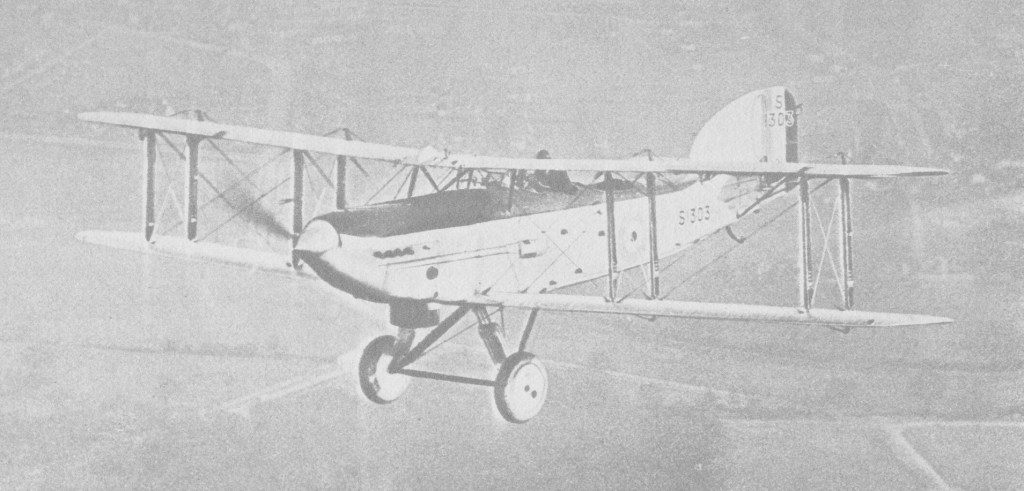
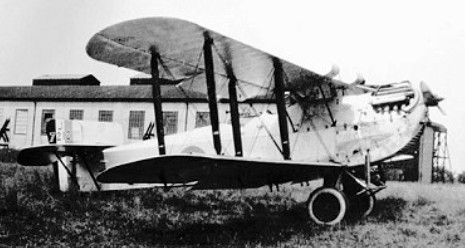
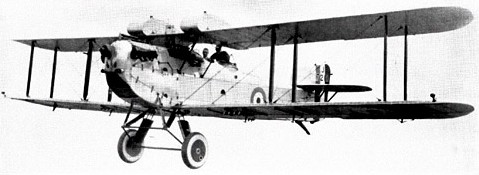
Developed from the Fairey Pintail amphibian of 1920, the Fawn was the first post 1918 designed light day bomber and reconnaissance aircraft to see RAF service. Intended as an army co-operation vehicle to replace the de Havilland 9A, the Fawn prototype, J6907, first flew in March 1923. After various modifications, including a longer fuselage, the design went into limited production, and the first production example appeared in January 1924, designated Fawn Mk II. This version entered RAF service, and eventually equipped Nos 11, 12, 100, 503 and 602 Squadrons.
Production amounted to 75 aircraft, made up of five prototype/pre-production aircraft, 50 350kW Napier Lion II-engined Fawn Mk IIs and 20 turbo-¬supercharged Lion VI engined Mk IIIs. The Mk III did not reach squadron use. Several were fitted with external side ladders and used for parachute dropping exercises and demonstrations at Henlow; while machines of 12 and 100 Squadrons participated in the 1925 and 1926 RAF air displays at Hendon, demonstrating ‘wing drill’.
Fawn III Engine; 1 x 470hp Napier Lion VI Span: 15.21 m (49ft 11 in) Length: 9.78 m (32ft l in) Height: 3.63 m (11 ft 11 in) Wing area: 51.10 sq.m / 550.04 sq ft Max take-off weight: 2649 kg / 5840 lb Empty weight: 1580 kg / 3483 lb Maximum speed: 183 km/h (114 mph) at 3048 m (10000 ft) Climb to 3048 m (10000 ft): 17 min 24 sec Service ceiling: 4220m (13850ft) Range: 1047 km / 651 miles Armament: 1 Vickers mg forward; 1 or 2 Lewis. mg rear cockpit External bombload to 209 kg (460 lb)
Fairey Fawn Mk. III Engine : Napier Lion II, 469 hp Length : 32.087 ft / 9.78 m Wingspan : 49.902 ft / 15.21 m Max take off weight : 5834.4 lb / 2646.0 kg Max. speed : 99 kts / 183 km/h Range : 564 nm / 1045 km Crew : 1+1 Armament : 2x MG 7.7mm, 209kg Bomb. ext.