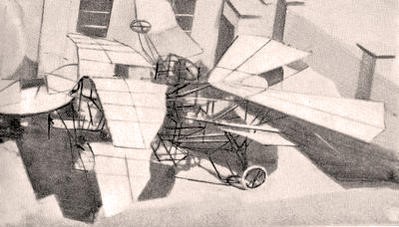
Italian ornithopter, designed by Dr. Fuseri, a pharmacist living in the small town of Fossano in the province of Piemonte, and built by Franz Miller, one of Italy’s first aeronautical engineers, as a contractor. In 1908 the firm “Società anonima italiana per l’esperimento dell’ortoelicottero Fuseri” was formed in Fossano and construction of the aircraft was initiated in 1909 by the factory of Miller in Torino where it was never flown and unlikely to have ever been tried. This sort of machine (VTOL) is along the lines of the somewhat later machines of deCazes where it is named a Hélicoplane, just as the Fuseri Ortoelicottero, a mix of helicopter (vertical take-off and landing) and aeroplane.
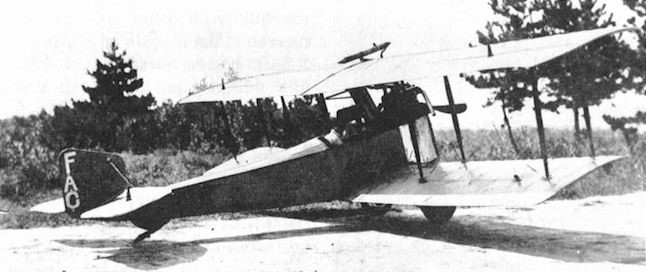
To help Fukunaga establish a flying school of his own, ltoh released the Emi 2 Aeroplane to him and took it to Osaka. Using numerous fields in trying to find a suitable place for his flying school, the aeroplane was frequently damaged and repaired. Eventually Fukunaga settled on the dry river bed of Tenryu River in Kakezuka-cho, Iwata-gun, Shizuoka Prefecture, near his family’s place of origin, where he established in November 1919 what was at first the Fukunaga Aeroplane Research Studio. Because of the many repairs and modifications, his aeroplane was so unlike the original Emi 2 Aeroplane that he renamed it the Tenryu 3 Aeroplane, a name he applied in retrospect to the two previous aircraft and continued to use, numerically sequenced, to those that followed.
The Tenryu 3 was used to provide flying training for his younger brothers, Shiro and Goro, followed by other students who were merely allowed to taxi the aeroplane since the 1911 Gregoire Gyp engine was all but worn out and difficult to adjust.
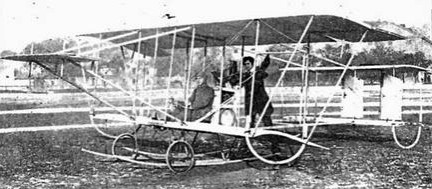
This small biplane of generally Farman-like configuration was built in Pressburg, Austria-Hungary (today Bratislava, Slovakia). The elevators and the ailerons were operated by a lever, while the rudder was operated by a separate lever. It was powered by a German-built 25 hp 3-cylinder engine, driving a propeller of 1.8 m diameter.
Engine: 25 hp Prop diameter: 1.8 m Span: 6.5 m Length: 7.5 m Wing area: 25 sq.m Take-off weight: 250 kg
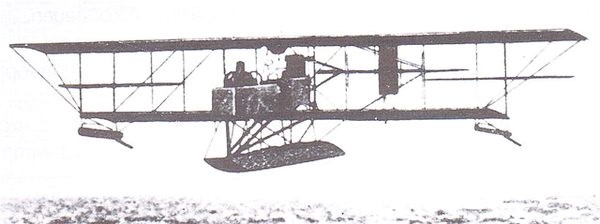
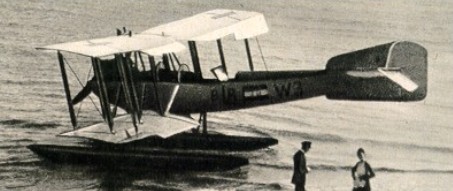
The first form of the first Friedrichshafen model, FF 1, was distinguished by its central float concept, pusher construction, 3-bay wing and old-style ailerons between the wings.
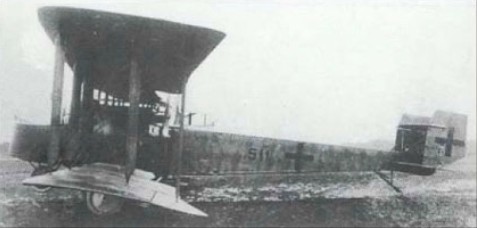
Friedrichshafen’s only other large bomber design was the N.1, a mammoth single-¬engined biplane which was built in 1917. Virtually a scaled up two seater, the N.1 employed markedly sweptback wings and a composite undercarriage. The sole power came from a 260 hp Mercedes D IVa engine in the nose, resulting in the pilot’s cockpit being located almost halfway back along the narrow fuselage, with a consequent hopeless forward view for landing and takeoff.
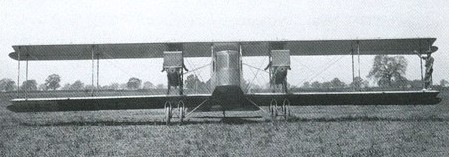
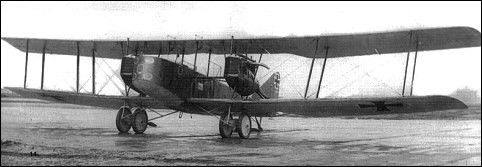
The G.III bomber was a twin 194kW Mercedes D.IVa engined scaled up version of the G.II which saw much operational service from early 1917. Its wings of increased span incorporated three bays outboard of the motors. The undercarriage comprised two pairs of wheels, with a fifth wheel immediately under the nose gunner’s cockpit the latter assisting any heavily loaded takeoff, but mainly preventing a nose over landing on the crude runways of the period. Construction of the G.III was a typical contemporary mixture of wood, plywood and steel tubing, and the three man crew consisted of a pilot and a ‘bombing officer’ in a side by side cockpit, with two cockpits mounting guns in the nose and mid fuselage connected by an internal passageway for the third crew member. Capable of lifting a 1500 kg (3310 lb) bombload, the main weight of bombs was carried externally below the main nacelle, but internal racks, each for five 10 kg (22 1b) bombs, were located either side of the communicating passage aft of the pilot’s cockpit.
G.IIIa
For the final 18 months of the First World War, Friedrichshafen G.IIIs, in company with the better known Gotha G.V bombers, formed the real strength of German heavy bomber units, particularly on the Western Front in France. Used mainly in long¬distance night raids, G.IIIs are known to have attacked such principal targets as Paris, and are believed to have participated in some of the well publicized attacks against Eng-land. During 1917 Friedrichshafen concentrated on the production of the G.III and G.IIIa with many others being built under contract by Daimler and Hansa. An improved variant was the G.IIIa, built under licence by the Daimler works. This differed from the G.III only in minor structural changes to the tail unit and wing tip configuration. It is not known how many G.IIIs and G.IIIas were built in total, but more than 330 were produced by the subcontractors.
Span: 23.7 m (77 ft 9 in). Length: 12.8 m (42 ft). Endurance: 5 hrs. Powerplants: 2 x 260 hp Mercedes D IVa Armament: Bombload up to 1496 kg (3300 lb); 1 Parabellum machine gun in nose; 1 Parabellum machine gun in rear Maximum speed: 135 km/h (84 mph)
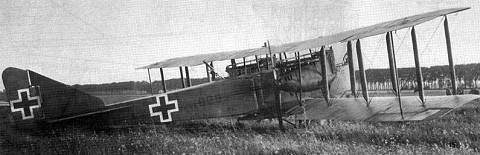
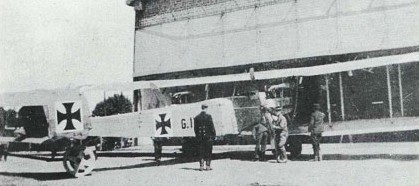
The prototype G.I was developed into the more powerful (149kW Benz Bz.IV) G.II in 1916. With slightly shorter wings and a single fin/rudder tail unit, power came from twin 200 hp Benz Bz IV engines mounted between the wings and driving pusher propellers. Successfully passing its official trials, the G.II went into limited production. Its offensive load of just 450kg and range were not adequate for major attacks on British and other strategic targets.
Span: 20.3 m (66 ft 7.25 in). Length: 11.05 m (36 ft 3 in). Endurance: 5 hrs. Engines: 2 x 200 hp Benz Bz IV. Armament: Bombload up to 1496 kg (3300 lb); 1 Parabellum machine gun in nose; 1 Parabellum machine gun in rear.
The Friedrichshafen G I of 1915 was powered by twin 150 hp Benz Bz III engines driving pusher propel-lers. The G.I carried a three man crew, and pre-dates the debut of the rival Gotha G II by the best part of a year.
Engines: 2 x 150 hp Benz Bz III. Armament: Bombload up to 1496 kg (3300 lb); 1 Parabellum machine gun in nose.