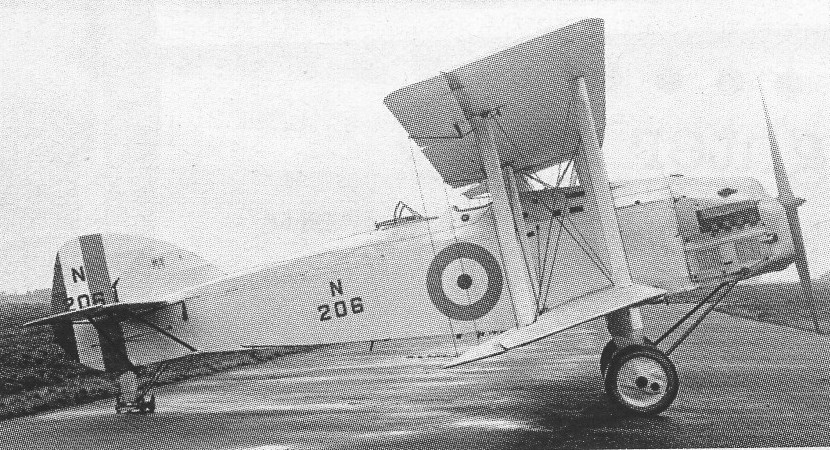
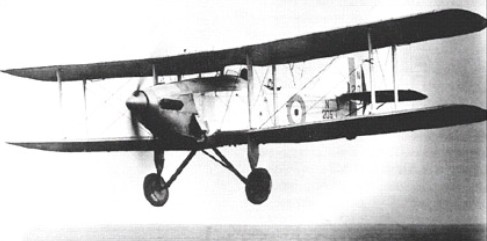
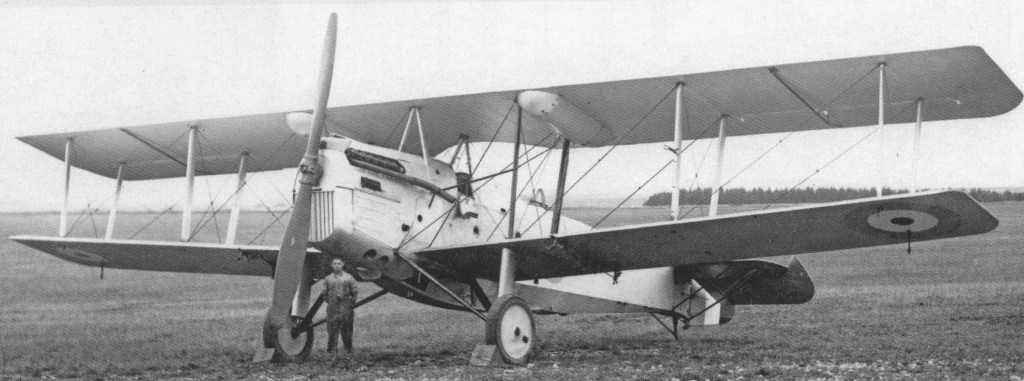
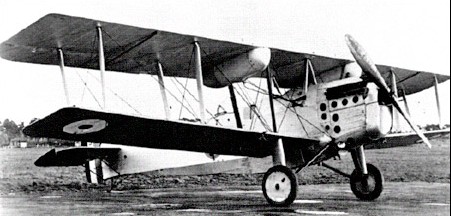
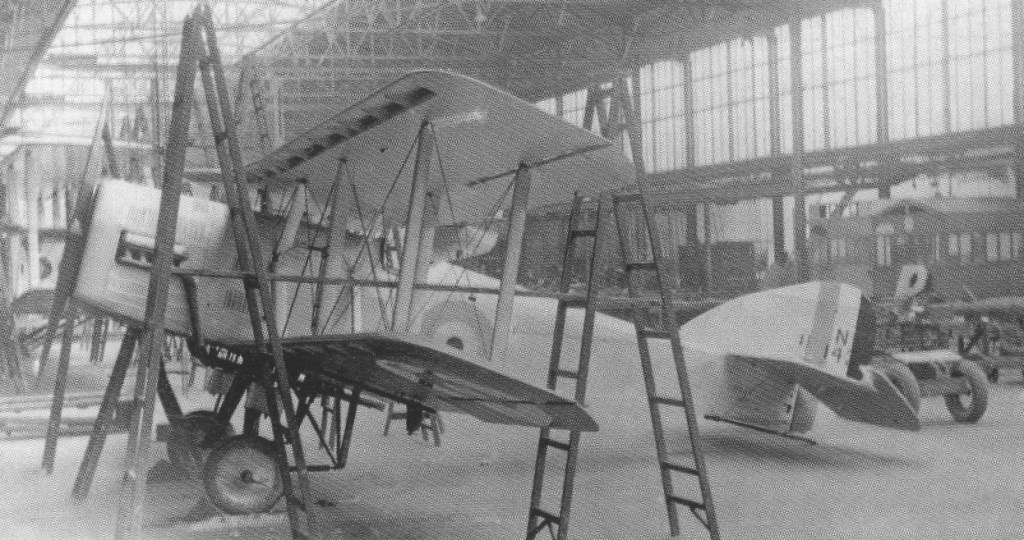
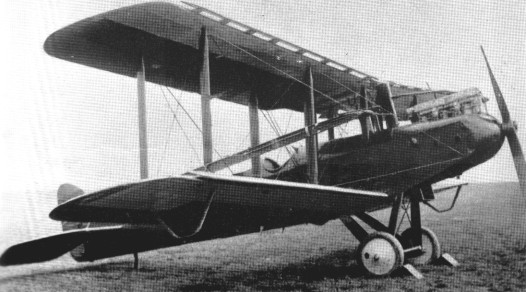
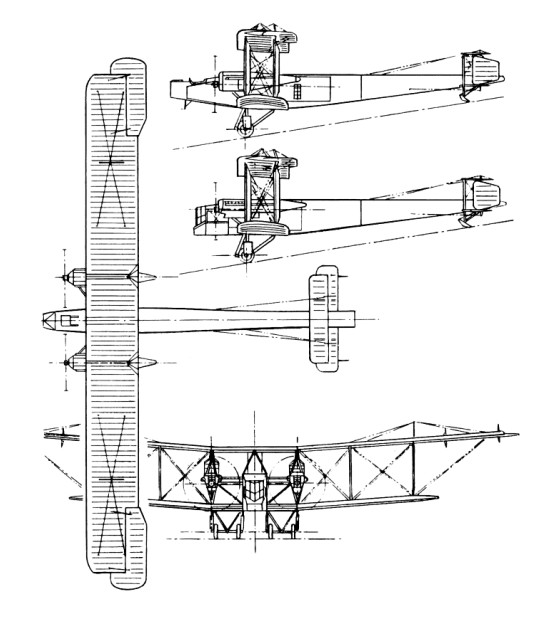
Two prototypes of the HP.31 Harrow were ordered as competition for a two seat fleet torpedo bomber/reconnaissance aircraft to replace the Blackburn Dart under specification 21/23. In their initial form a 470 hp Napier Lion was installed.
As a result of experiments with the second machine, N206, the first, N205, was rebuilt as the Harrow Mk.II, initially with a 630 hp Lion XI and then a slightly more powerful Lion XA. These engines had rear mounted carburettors which allowed an improved nose profile.
Harrow Mk.II
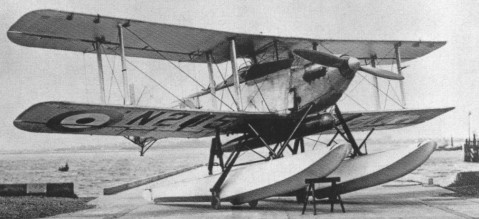
Following trials at Martlesham Heath in landplane configuration, N206 was fitted with floats in March 1928 followed by trials at the Marine Aircraft Experimental Establishment at Felixstowe, and was demonstrated to the Finnish and Argentinian air attaches. It was eventually written off as unfit for RAF service as a seaplane. The competition was won by the Blacburn Ripon in June 1927. Experiments continued towards a revised Harrow.
H.P.31 Mark I Engine: 1 x 470hp Napier Lion V 12 Max take-off weight: 3242 kg / 7147 lb Empty weight: 1998 kg / 4405 lb Wingspan: 13.41 m / 43 ft 12 in Length: 10.29 m / 33 ft 9 in Wing area: 52.30 sq.m / 562.95 sq ft Max. speed: 171 km/h / 106 mph Ceiling: 2652 m / 8700 ft Range: 708 km / 440 miles Armament: 1 x Lewis gun, 1 torpedo or 3 x 235kg bombs
Air ministry specification D of R4B (later revised as 26/23) for a single engined long range bomber led Handley Page to produce the 60 ft span C/7 (HP.28) Handcross, with a Rolls Royce Condor III. The pilot was located high under the cabane, with the prone bomb aimer’s position beneath him. There was a Lewis gun on a scarff ring in the mid-upper position and another in the fuselage underneath and behind the prone position. The pilot had a fixed forward firing Vickers gun. The 550 lb bombload was recessed into the left side for the fuselage belly faring. The first of three built, J7498, first flew on December 6, 1924, but the Hawker Horsley won a production order.
Engine: Rolls Royce Condor III Wing span: 60 ft Crew: 2
Three prototypes, first flown on 6 December 1924. No production.
Engine: 1 x 650hp Rolls-Royce Condor III Max take-off weight: 3405 kg / 7507 lb Empty weight: 2368 kg / 5221 lb Wingspan: 18.29 m / 60 ft 0 in Length: 12.19 m / 39 ft 12 in Wing area: 73.21 sq.m / 788.03 sq ft Max. speed: 193 km/h / 120 mph Ceiling: 5867 m / 19250 ft Range: 805 km / 500 miles Armament: 3 x 7.7mm machine-guns, 1 x 250kg or 2 x 100kg bombs Crew: 2-3
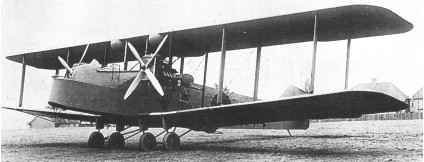
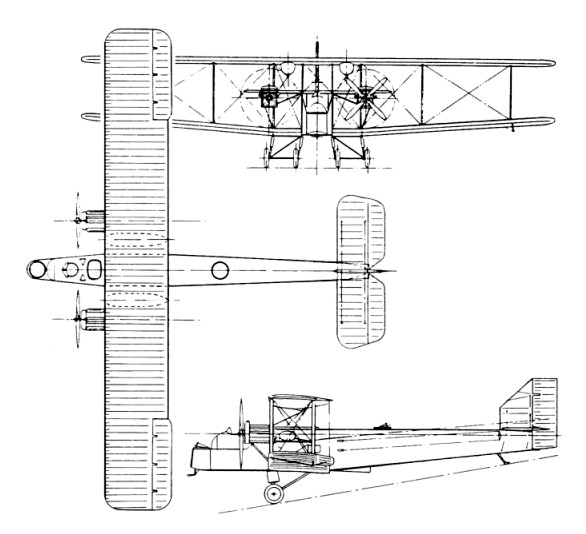
The Hyderabad was a military derivative of the W.8 which first flew in December 1919 as one of the first purpose-designed airliners. The Hyderabad was the company’s response to a 1922 bomber specification, and when it took to the air in October 1923 it was the world’s first large aeroplane with automatic leading-edge slats. Such slats were not incorporated into the Hyderabad Mk I production type, which was also the RAF’s last all-wooden heavy bomber. Delivery of the 38 aircraft was slow, No. 99 Squadron receiving its Hyderabads from December 1925 but No. 10 Squadron re-equipping only from January 1928. Hyderabads were also flown by two Auxiliary Air Force units, Nos 502 and 503 Squadrons. The bomber was withdrawn from first-line service in 1930 and from AAF service in 1933, and the type was declared obsolete in 1934. Three were later converted into Hinaidis.
Handley Page Hyderabad Mk I Engines: 2 x 450hp / 338.5kW Napier Lion IIB or V Wingspan: 22.86 m / 75 ft 0 in Length: 18.03 m / 59 ft 2 in Height: 5.11 m / 16 ft 9 in Wing area: 136.66 sq.m / 1470.99 sq ft Max take-off weight: 6164 kg / 13,590 lb Empty weight: 4045 kg / 8918 lb Max. speed: 94 kts / 175 km/h / 109 mph at sea level Ceiling: 4267 m / 14000 ft Operational Range: 432 nm / 805 km / 500 miles Armament: 3 x 7.7mm (0.303-in) machine-guns, 500kg (1,100 lb) bombs Bomb load: 500kg Crew: 4
In response to specification 3/20 for a single seat deck landing torpedo carrier Handley Page built the HP.19 Hanley. The all wood Hanley had folding wings with full span leading edge slats and a divided undercarriage to fit a torpedo. Three were powered by a 450 hp Napier Lion IIB, the first, N143, first flew on 3 January 1922. Despite extensive modification trying to improve performance, the type did not enter production. Two, one prototype and one new airframe were supplied to Russia.
Wing leading-edge slots, per¬fected by Sir Frederick Handley Page and Dr. G. V. Lachmann in 1919, were first flown on the H.P.17, a modified D.H.9. By controlling airflow over the wing and so enabling aircraft to fly very slowly under perfect control, they ended the danger of the stall-and-spin type of crash.
Following its initial services into Europe with modified O/400 bombers shortly after the first World War, Handley Page Transport operated a series of two and three-engined developments of the bomber, designated W8, W9 and W10.
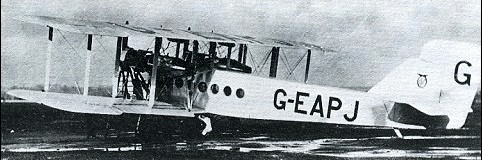
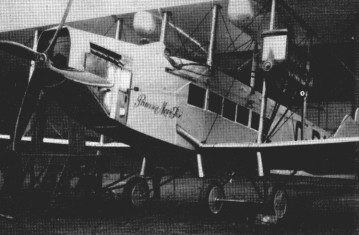
First flown on 2 December 1919 the W.8 had twelve passenger seats in two rows in a glazed cabin, while the pilot and co-pilot sat in an open cockpit in the nose of the fuselage. Powered was 335kW Napier Lion IB engines. The Handley Page W.8B (three of which were originally operated by Handley Page Transport and then from 1924 by Imperial Airways on its London-Paris service) was a refinement of the original W.8. The W.8Bs each had two 268kW Rolls-Royce Eagle VIII engines. The last W.8B was retired in 1932. A trio of W8bs named Princes Mary, Prince George and Prince Henry, started a London Paris service in May 1922.
In addition to the British-operated W.8Bs, one was built and exported to Belgium, where SABCA licence-built three more for Sabena. Handley Page also delivered a single example of the W.8E, with two 171kW Siddeley Puma and one nose-mounted 268kW Rolls-Royce Eagle IX engines. Eight were subsequently licence-built in Belgium. The final new W.8 version, the W.8F Hamilton, was similar to the W.8E and had been designed to be used in the Belgian Congo. Practically a standard W.8B, the nose of the fuselage ahead of the cabin was considerably modified. One of these machines in 1925 completed a flight from Brussels to the Belgian Congo, a distance of 11,000km, piloted by Lt Thieffry, of the Belgian Army, accompanied by Mecanicien De Bruycker. Imperial Airways received only one W.8F
W.8f Hamilton
The HP.24 Hyderabad was a military derivative.
Following its initial services into Europe with modified O/400 bombers shortly after the first World War, Handley Page Transport operated a series of two and three-engined developments of the bomber, designated W8, W9 and W10.
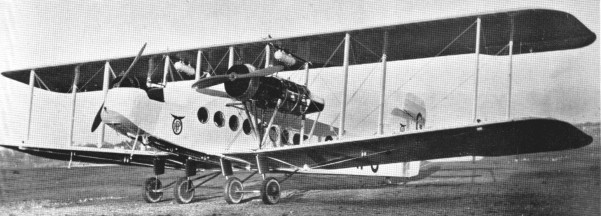
Imperial Airways received one W.9A Hampstead and four W.10s (the last retired in 1933). The Hampstead was powered by three 287kW Siddeley Jaguar and then 335kW Bristol Jupiter VI engines and had a 5.31m long, 1.35m wide and 1.78m high passenger cabin for 14 persons.
The W.10s each had two 335 kW Napier Lion IIB engines and featured a new type of rudder, fitted with a balance of the inset-hinge type, instead of the earlier horn-balance arrangement. The W.10 featured an entirely metallic structure for the engine mountings, replacing the usual wooden bearers.
Imperial Airways received W.10s (the last retired in 1933).
W8b Engines: 2 x Rolls Royce Eagle VIII, 360 hp Props: 10 ft 6 in (3.20 m) 4 blade. Wing span: 75 ft. (22.86 m). Length: 60 ft.1 in (18.31 m). Wing area: 1456 sq ft (135.26sq.m). Gross wt: 12500 lb (5,670 kg). Max speed: 104 mph (167 km/h). Range: approx 500 miles (800 km). Crew: 2. Pax cap: 12.
W.9a Hampstead Engine: 3 x Siddeley Jaguar, 287kW Max take-off weight: 6577 kg / 14500 lb Empty weight: 3794 kg / 8364 lb Wingspan: 24.08 m / 79 ft 0 in Length: 18.39 m / 60 ft 4 in Wing area: 145.30 sq.m / 1563.99 sq ft Max. speed: 183 km/h / 114 mph Ceiling: 4115 m / 13500 ft Range: 644 km / 400 miles
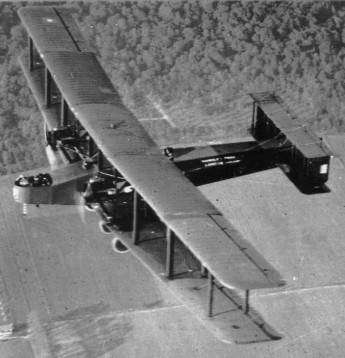
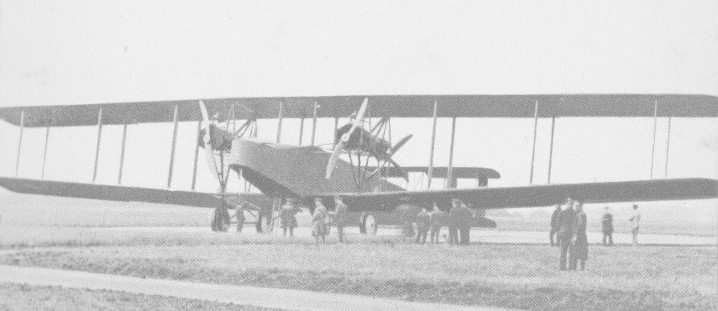
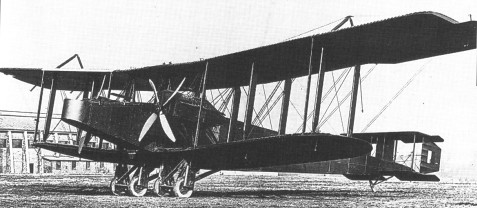
Chief designer George Volkert designed the even bigger four-engined V/1500, but the Armistice was signed before it became operational.
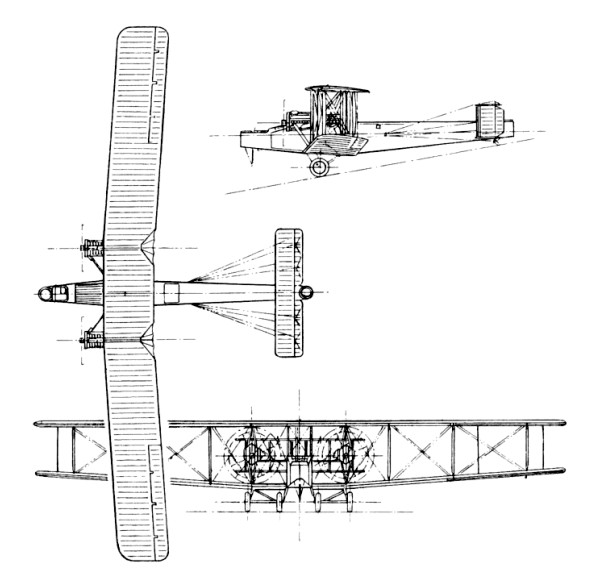
The V/1500 was of conventional construction. The 64ft 4in long fuselage was mainly of silver spruce, with ash cross¬ beams strengthening the bomb bay. The folding wings were also of spruce with cross bracing tie rods and, except for the plywood sheathed nose section contain¬ing the open cockpit, the aeroplane was fabric covered. The four engines installed in tandem pairs in mid gap were 12 cylinder 375 hp geared Rolls Royce Eagle VIIIs. The tractor units turned 13ft 5in ¬diameter two bladed propellers, and the pushers drove four bladers of 10ft 4in diameter.
Ordered as an experimental bomber in the summer of 1917, the V/1500 was envisaged bombing Berlin from bases in England and was designed to carry five tons of crew and disposable load. The Armistice intervened before the weather was sufficiently favourable for the three machines delivered to fly to the German capital. Power for each aircraft was provided by four 279.5kW Rolls-Royce Eagle VIIIs mounted in tandem pairs. To accelerate its introduction to RAF ser¬vice, production was ordered in January 1918, ahead of first flight, although the V/1500 took to the air for the first time on 22 May 1918, only nine months after definitive design had begun. The first prototype did crash in April that year.
At 126 ft it had the longest wingspan of any bomber the RAF would operate, but the type was too late to see service before the war ended. Nevertheless, with an endurance of 17hr it was ideally suited to long range flights, and its four engines, mounted between the upper and lower mainplanes as tractor/pusher pairs, gave it at least some measure of redundancy.
In October 1918, the Independent Force received its first bombers, each planned to drop 7,500 lb of bombs on the German capital. A Flight was formed at Bircham Newton and received its three machines early in November, just prior to the end of hostilities.
255 aircraft were ordered, but only three were operational with No.166 Squadron at the time of World War l’s end, and only about 32 were completed by the parent company, Beardmore in Scotland and Harland and Wolff in Northern Ireland. The first long flight of a V/1500 was from England to India in 1919, which included one stretch of 1,285km over water and another non-stop stage of 1,610km from Cairo to Baghdad. Flown to India by Lt. ‘Jock’ Halley, DFC, AFC, the smallest pilot in the RAF in charge of the biggest aeroplane in the world. With him went Brig.-General McEwan.
In spite of fears that it might not get over the Pathan Hills with a bomb load, Halley bombed Kabul, blowing out the walls of the Emir’s Zenana.
Only three squadrons (Nos 166, 167 and 274) ever received the type, which made some long-distance flights including the bombing of Kabul in 1919 from bases in India. The type disappeared from service in the early 1920s when it was appreciated that the smaller Vimy could undertake the same basic role at lower manpower and operating costs.
In December, 1914, Capt. Murray Sueter had asked Handley Page to produce for the RNAS an aircraft which, with naval forthrightness, he described as “a bloody paralyzer”, a development of the O/100.
Operational experience with the O/100 showed that certain changes were desirable, especially to the fuel system. In the original layout each engine had its own armoured fuel tank contained within the armoured nacelle which housed the engine, restricting the amount of fuel which could be carried. The modified fuel system consisted of two fuselage tanks and two gravity-fed tanks installed in the leading edge of the upper wing’s centre-section. Wind-driven pumps supplied fuel direct to the engines, as well as to the gravity-fed tanks. Removal of the fuel tanks from the nacelles allowed them to be shortened and a new inter-plane strut to be fitted immediately aft of each nacelle.
Other improvements included the provision of a compressed-air engine-starting system, with a crank handle for manual start in the event of pressure loss, and changes to the rear gun position and central fin. In this new configuration this variant of the O/100 was redesignated O/400. An initial contract for 100 of these aircraft was awarded to Handley Page in August 1917.
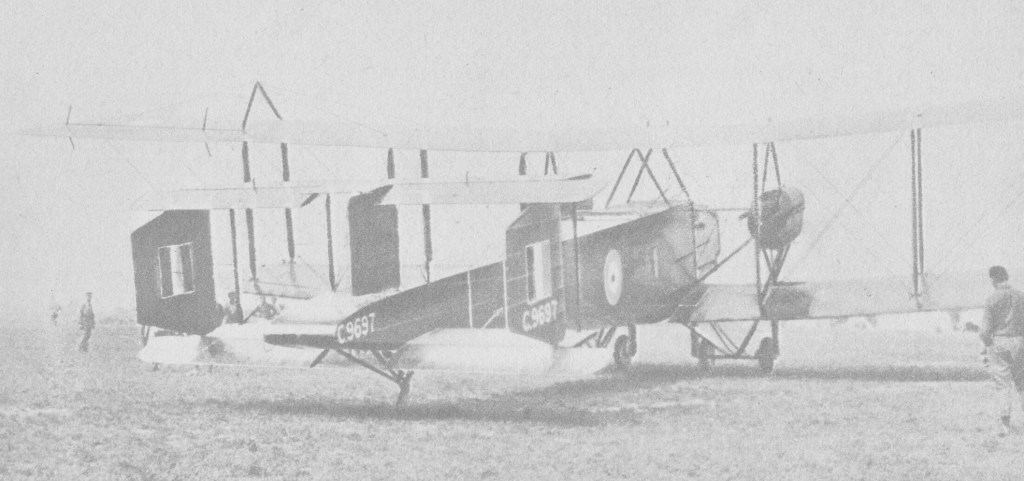
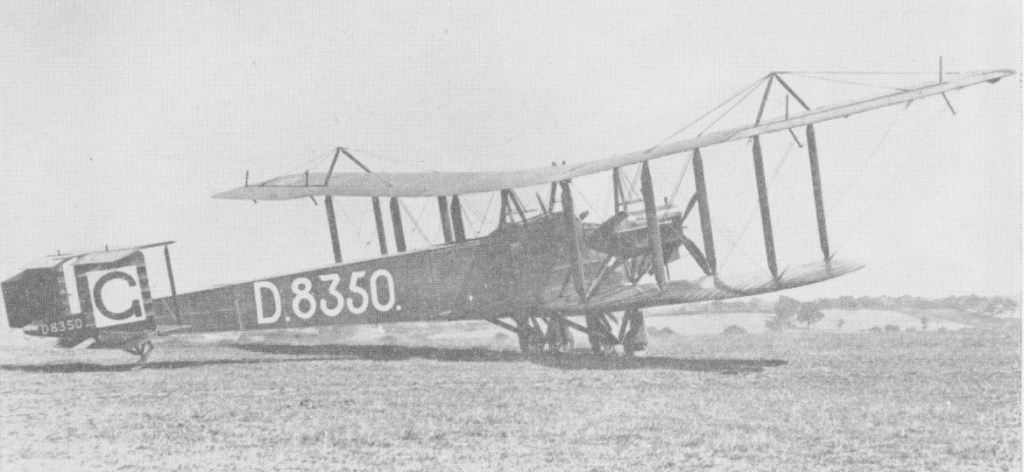
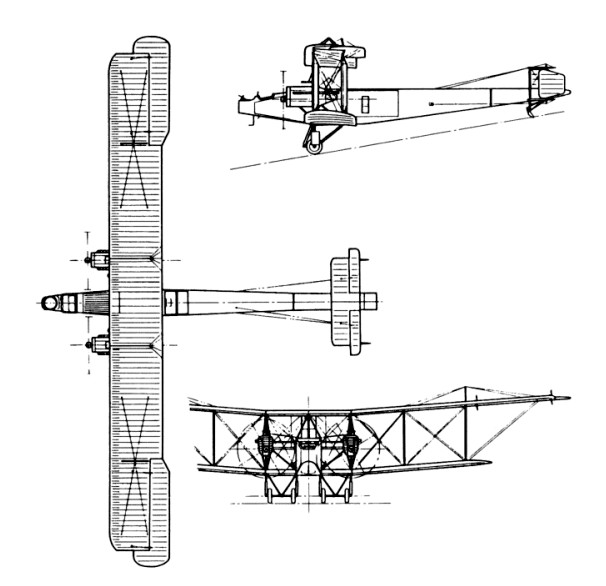
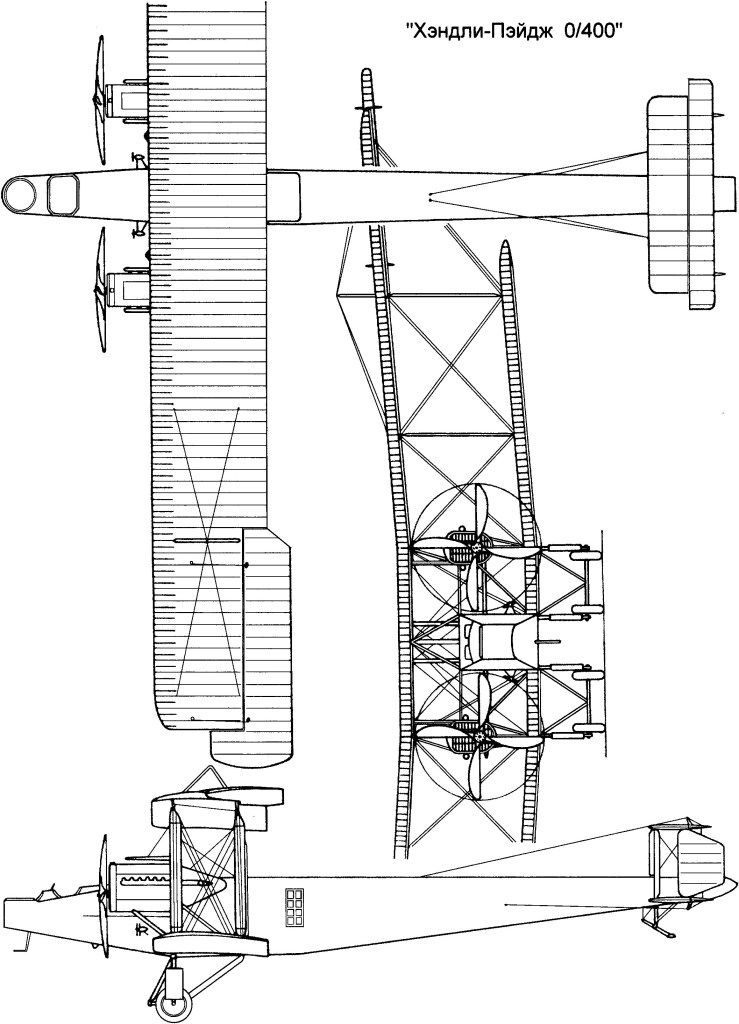
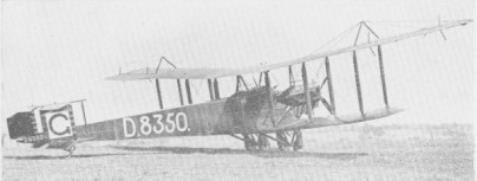
The O/400 was a two-place biplane with two-spar wooden wings, with fabric covering. The wings could be folded for storage. The fabric covered fuselage has a biplane tail-unit, with elevators on the top and bottom tailplanes, a central fixed fin and two outboard rudders. Ailerons were on the top wings only. Twin wheels were on each undercarriage unit.
A total of 284 Imp.Gal of fuel was in two tanks in the fuselage and two in the upper centre-section. Defensive armament consisted of one or two Lewis machine guns in the nose cockpit, one or two in the cockpit aft of the wings, and one firing rearward and downward through a trapdoor in the fuselage. An internal bomb-bay for one 1650-lb bomb or equivalent weight of smaller bombs. A typical load was sixteen 112-lb bombs.
First flying in September 1917, production deliveries of O/400 began in the spring of 1918, but it was not until 9 August 1918 that No 97 Squadron, which was equipped with these aircraft, joined the Independent Force and began operations. As numbers built up it became possible to launch heavier and more frequent raids: on the night of 14-15 September 1918 an attack by 40 Handley Pages was launched against enemy targets. It was also during September that O/400 began to use newly developed 750kg bombs for the first time.
This weapon came into service in 1917 in the form of the O/400 twin engined, heavy bomber. Carrying a bombload of 1800 lbs, and powered by two Rolls Royce Eagle engines, it was the world’s first really effective night bomber.
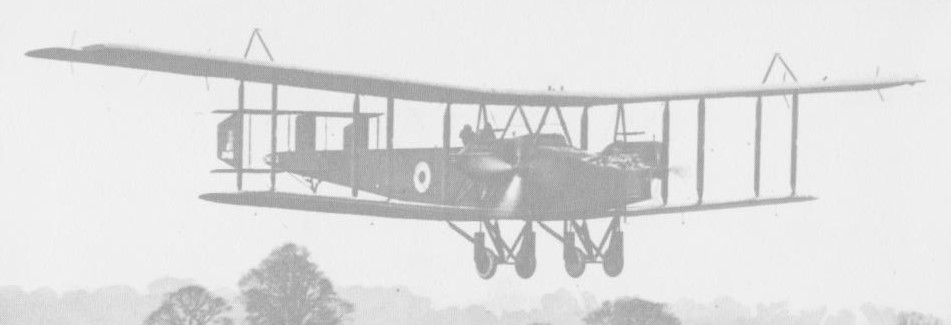
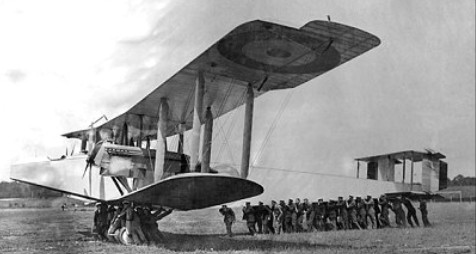
The Handley Page O/400 of 1918 was Britain’s standard heavy bomber of the first World War. A large biplane, with a span of 100 ft (30.5 m) on the upper wing, it was powered by two Rolls Royce Eagles or alternative engines of 250 350 hp each. A crew of three was usually carried, there being an open cockpit seating two side by-side and open gunners’ cockpits in the extreme nose and in the fuselage behind the wings. The guns were mounted on Scarff rings which allowed them to be swivelled through a 360 degree arc, and another gun was mounted in the underside of the fuselage to fire downwards and aft.
The O/400 could carry sixteen 112 1b bombs inside the fuselage, the bomb bay being covered by spring loaded doors which opened under the weight of the bombs as they were released. Other combinations of larger bombs could be carried, up to a single example of the 1,650 1b (750kg) bomb which was the largest used by the RAF in that war. Two more bombs could be carried on external racks under the fuselage. With a gross weight of about 13,500 lb (6,125 kg), the O/400 could reach a speed, flat out, of nearly 100 mph (160 km/h) and had a range of about 600 miles (965 km). Construction was of wood, with fabric covering.
On the Western Front an O/400 was the only aircraft to bomb Essen.
By comparison with the 0/100 the type had more power, detail improvements and the fuel relocated from the two engine nacelles to the fuselage, from where it was pumped to an upper-wing centre section tank for gravity feed to the two inline engines. The type was in service with seven Independent Air Force squadrons (Nos 58, 97, 15, 207, 214, 215 and 216) just before the end of the war, and remained in limited service in the period immediately after the war, until replaced by the de Havilland (Airco) DH10 Amiens and the Vickers Vimy. The O/400 had a slightly longer post-war career in Egypt, where it served with Nos 70 and 216 Squadrons up to 1920.
A total of 700 O/400 were ordered, and about 400 were delivered before the Armistice. In the US 1,500 of these aircraft were ordered from Standard Aircraft Corporation, with power plant comprising two 50hp / 261kW Liberty 12-N engines. Built as components from 1917, of this total only 107 were delivered to Great Britain in 1918 mainly for use as spare parts. Eight were assembled for the the US Army Air Service (AS62445 to 62451, and one other) before signature of the Armistice brought contract cancellation.
A number of British-built O/400 were delivered post-war to China.
Soon after the armistice with Turkey, Major-General Geoffrey Salmond, with Brig.-General A.E. Borton as chief pilot, flew from Palestine to India in an O/400, the first aircraft to make the journey.
On September 2, 1919, Handley Page Transport Ltd, operating from Cricklewood, began flights between London and Paris, and to Brussels and Amsterdam.
Handley Page used converted O/400 bombers on the London-Paris, London-Brussels routes, and converted de Havilland 9s on the London-Amsterdam. The converted DH9s were designated DH.16s. The fuselage of the aircraft was rebuilt as a cabin with room for four passengers. Converted in the same way, the O/400 has room for 12 passengers.
O/400 Engines: 2 x Rolls-Royce Eagle VII, 268kW (360hp). Span: 30.48m (l00ft). Length: 19.16m (62 ft 10.25 in). MTOW: 6360 kg (14,022 lb). Max speed: 97.5 mph at sea level. Height: 22 ft. Operational endurance: 8 hrs. Wing chord: 10 ft. Wing area: 1,648 sq. ft. Weight empty: 8,502 lb Loaded weight: 13,360 lb. Ceiling: 8,500 ft. Armament: 3 to 5 x 7.7-mm (0.303-mg plus up to 907kg (2,000lb) of bombs internally.
Engines: 2 x Rolls-Royce Eagle VIII, 265kW Wingspan: 30.5 m / 100 ft 1 in Wing area: 153.0 sq.m / 1646.88 sq ft Length: 19.6 m / 64 ft 4 in Height: 6.7 m / 21 ft 12 in Max take-off weight: 5466 kg / 12051 lb Empty weight: 3776 kg / 8325 lb Fuel capacity: 284 Imp.Gal Max. Speed: 157 km/h / 98 mph Ceiling: 2600 m / 8550 ft Range w/max.fuel: 1000 km / 621 miles Crew: 2 Passengers: 10-14
Standard Aircraft Corp-Handley-Page O/400 Engines: two 350hp Liberty 12-N Wingspan: 100’0″ Length: 62’10” Useful load: 3704 lb Speed: 96 mph
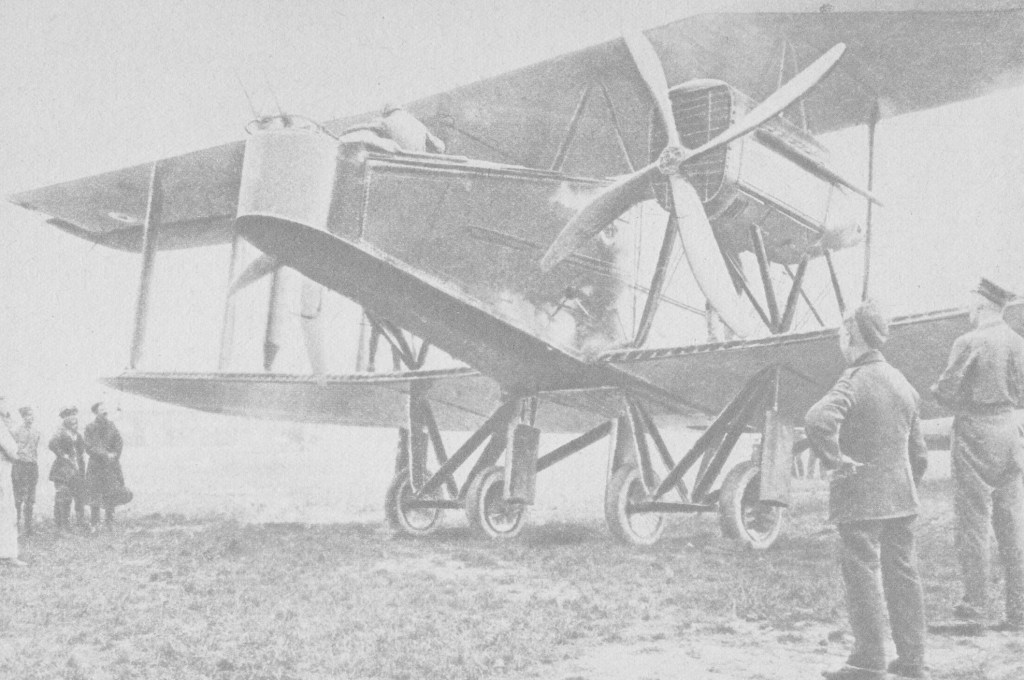
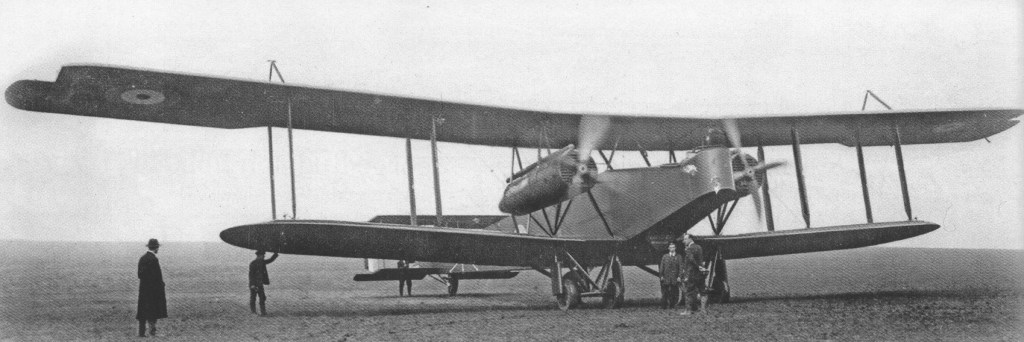
Frederick designed a large biplane to attempt a non-stop transatlantic crossing for the DailyMail’s £10,000 prize, but war intervened. He used his design experience, assisted by the Admiralty, to propose plans for a 100ft-span twin-engined bomber for the Royal Naval Air Service, the O/100 to an Admiralty specification of December 1914. The Royal Naval Air Service Admiralty was thinking in terms of a large twin engined aeroplane able to carry a crew of two and six 112 lb bombs on overwater patrols. Identified originally as the Handley Page Type O, it was later designated O/100, the figure 100 indicating its wing span in feet. When the prototype was completed, it was the largest aeroplane that had then been built in the UK.
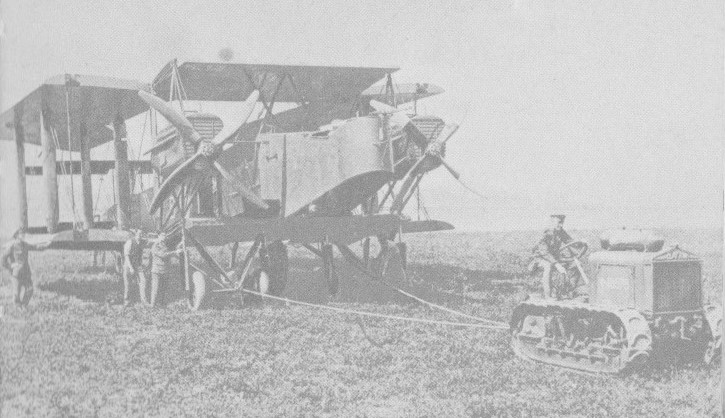
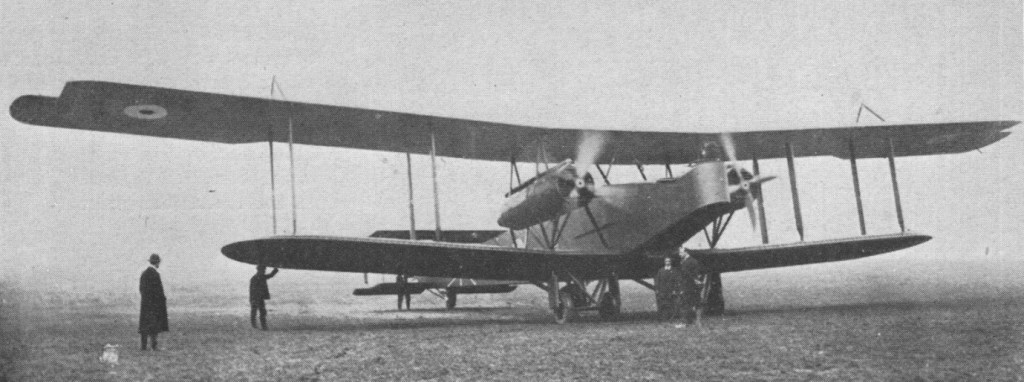
The O/100 was of biplane configuration, with folding unequal-span constant-chord wings that had straight leading and trailing edges; these were mounted on a square-section cross-braced fuselage that terminated in a biplane tail unit. The tailskid landing gear had twin wheels on each main unit and the two 250hp Rolls-Royce Eagle II engines, in armoured nacelles, were mounted between the wings just outboard of the fuselage. Accommodation in the first prototype was in a glazed cockpit enclosure, the floor and sides of the cockpit being protected by armour plate.
Flown for the first time on 18 December 1915, the O/100 was found to be inadequate in performance. The first O/100 with 275 hp RR Eagle engines weighed 14,000 lb empty. Clifford Prodger did the testing. The second prototype had a revised open cockpit for a crew of two (with provision for a gunner’s position forward), the cockpit armour plating and most of that incorporated in the engine nacelles was deleted, and new radiators were introduced for the water-cooled engines. When the machine was first tested in April 1916 there was a marked improvement in performance, to an extent that in early May it was flown with 20 Handley Page employees aboard to a height of just over 2135m. Brackley and Vereker were the first Navy pilots.
Three prototypes were powered with either Sunbeam Cossack motors of 250 hp Rolls-Royces.
Formation of the first ‘Handley Page Squadron’ began in August 1916 and this unit became operational in France in late October or early November; its first recorded bombing attack was made on the night of 16-17 March 1917 against an enemy-held railway junction.
One of the first three sent to France was delivered intact to the Germans when its pilot landed by mistake behind the enemy lines.
Altogether 46 were built and, after an initial period of daylight attacks against German shipping, they became the spearhead of British night bombing forces until succeeded in the last three months of the war by the improved O/400, with 250 hp Eagle IV or 360 hp Eagle VIII engines. Together the two types formed the heavy component of the Independent Force. In addition to their use as night bombers on the Western Front, O/100s also equipped the first bomber squadron of the RAF’s Independent Force following its establishment on 5 June 1918. Forty were delivered to the RNAS at Dunkirk in 1916-17.
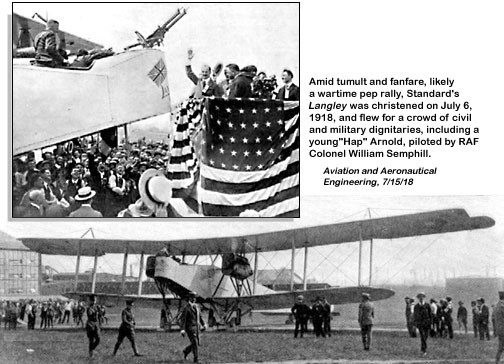
One early O/100 sample component (airframe B9449) was assembled by Standard Aircraft Corp in the US for publicity purposes and dubbed Langley, adorned with crossed British and American flags on the nose and its name on the sides, flew to 3500′ in a half-hour demonstration flight for a crowd of 5,000.
Engine: 2 x Rolls-Royce Eagle II, 250 hp. Max take-off weight: 6356 kg / 14013 lb Empty weight: 3632 kg / 8007 lb Wingspan: 30.48 m / 100 ft 0 in Length: 19.15 m / 62 ft 10 in Height: 6.71 m / 22 ft 0 in Wing area: 153.10 sq.m / 1647.95 sq ft Max. speed: 122 km/h / 76 mph Ceiling: 2652 m / 8700 ft Bombload: sixteen 112 lb. bombs
Engines: 2 x Rolls-Royce Eagle, 275 hp Wingspan upper: 100 ft Wingspan lower: 70 ft Wing area: 1630 sq.ft Wing loading: 8.5 lb/sq.ft Length: 63 ft Height: 22 ft Empty weight: 8480 lb Loaded weight: 14,022 lb Max speed loaded: 79.5 mph Time to 6500 ft: 30 min Service ceiling: 7000 ft Endurance: 8 hr Crew: 3 Armament: 3 or 5 mg Bombload: 1792 lb / 16 x 112 lb or 8 x 250 lb