Back to Ozone Firefly

Back to Ozone Firefly

The Firefly is a hybrid speed wing with performance, but stability that resembles lower aspect ratio speed-wings. The performance is glide performance and handling from the mini-wing category, but stability from the speed-flying category. The Firefly is equipped with an advanced profile which gives high pitch stability and excellent performance, and the low aspect ratio and thick chord adds protection for passive safety and stability. This wing is an excellent choice for pilots who want to experience the thrill of mini-wing piloting without the sacrifice in stability that is inherent in the higher aspect ratio designs which are common in the mini-wing category.


The Firefly 2 was to improve several key characteristics while still retaining the excellent stability and user friendliness of the FF1. Launch has been massively improved and is perfect in still wind and strong wing.
New rods for the leading edge and optimised shaping and new line reduction technologies give improvements in performance with no loss in passive safety.
At Ozone, their main priority for mini-wings and speed-wings is safety. Higher wing loading does not automatically mean higher stability, and they have taken great care to produce a smaller wing that, while fun to fly, still retains a level of passive safety that is suitable for paraglider pilots with beginner-intermediate skill levels and higher. They have taken their time to enter the mini-wing category, due to the desire to only release wings with what they consider to be this reasonable level of ease of use and stability.

Paraglider – Ozone Slalom 19m Motor & Speed Wing


Designed by Dav Dagault with Felix Rodriguez and the Ozone Test Team, the FLX2 is the 2nd generation of competition acro wing. This wing is designed for experienced and competition acro pilots and high wind soaring.
The FLX2 results from a long line of prototypes tested over a period of more than two years. Designed by Dav Dagault with constant feedback from Rodriguez, the goal of the FLX2 is simple – maximum acro with maximum ease, comfort, and precision.
A reworked profile has created the compromise between dynamic pitch (for fast, safe tumbles), and predictable and comfortable behavior in other maneuvers. A partially closed Leading Edge contributes to greater stability while in helicopter and in the tip during all manoeuvres.
Overall, the FLX2 is easy in every manoeuvre, with less effort necessary to achieve the manoeuvres in the cleanest manner. And the FLX2 is durable with an extremely high strength internal construction and the best materials available.

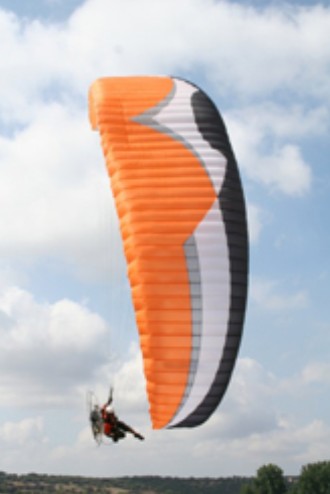
The Viper is a paramotor wing for expert pilots who fly in high level competitions and make advanced XC flights. This wing is an advanced competition glider designed for highly experienced pilots only. The Viper is a paramotor specific wing that has stability at high speed and the high maneuverability and handling of a normal paraglider.
Developed in cooperation with Mathieu Rouanet, World Champion 2005, the high top speed, low sink rate and high efficiency of the Viper gives lower fuel consumption and longer, faster flights. The handling is direct and precise, with clear feedback. Launching is simple due to the benign inflation characteristics.
This Viper is an Open Class wing, and load tested to 1607kg on average, which means 11.5G for the 27 and 14G for the 24.
The Ozone Roadster and Viper both feature a customized Ozone Reflex Profile (OZRP) that has been tuned specifically for powered flight. The OZRP is what gives the Roadster and Viper their stability at high speed and collapse resistance in turbulent air.
This special airfoil design provides constant lift in a wider range of angles of attack. When you apply speed-bar or fly with the glider accelerated at a lower angle of attack, the RP takes effect and provides continuous lift and heightened stability.
Through carefully moderating the shape and amount of curve in the OZRP, a balance that provides increased lift at extreme angles of attack, while still retaining excellent launch characteristics and stall resistance has been achieved.
The Viper is constructed with Porcher Marine Skytex Evolution 45, and comes standard with the Ozone Paramotor Risers which feature double hang points and a reinforced trimming system.
Viper 24
Cells: 59
Flat Area: 24.5 sq.m
Projected Area: 21.0 sq.m
Flat Span: 12.24 m
Projected Span: 9.78 m
Flat Aspect Ratio: 6.11
Projected Aspect Ratio: 4.54
Root chord: 2.50 m
Glider weight: 11.9lb
In flight weight range: 80-115 kg
Recommended weight: 95-105 kg
Load test: Yes
Viper 27
Cells: 59
Flat Area: 27.5 sq.m
Projected Area: 23.6 sq.m
Flat Span: 12.97 m
Projected Span: 10.36 m
Flat Aspect Ratio: 6.11
Projected Aspect Ratio: 4.54
Root chord: 2.65 m
Glider weight: 13lb
In flight weight range: 100-140 kg
Recommended weight: 115-125 kg
Load test: Yes
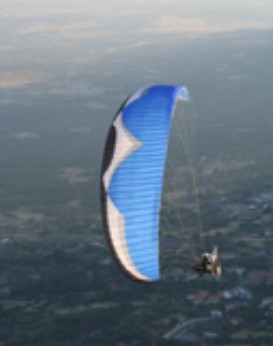
The Roadster was created for a wide range of intermediate paramotor pilots, ranging from XC distance fliers to ground skimmers and adventure pilots. It is a paramotor specific glider, with characteristics similar to the Viper but with an overall much higher ease of use.
The Roadster’s OZRP Technology (Ozone Reflex Profile) means that it is more stable in accelerated flight than a normal free-flight wing.
Special attention was put into the launching characteristics of the Roadster. The inflation is smooth and constant in any wind speed, and the wing comes up directly overhead without shooting in high winds or lagging behind in no wind.
The Roadster can also be flown without a motor. Its sink rate is low enough to soar in light lift, thermal in all conditions, and fly cross country. Although it is designed for pilots who fly a majority (if not exclusively) under power, the Roadster performs excellently unpowered as well.
The Ozone Roadster and Viper both feature a customized Ozone Reflex Profile (OZRP) that has been tuned specifically for powered flight. The OZRP is what gives the Roadster and Viper their stability at high speed and collapse resistance in turbulent air.
This airfoil design provides constant lift in a wider range of angles of attack. When you apply speed-bar or fly with the glider accelerated at a lower angle of attack, the RP takes effect and provides continuous lift and heightened stability.
Through carefully moderating the shape and amount of curve in the OZRP, increased lift at extreme angles of attack, and still retains excellent launch characteristics and stall resistance.
The Roadster is constructed with Porcher Marine Skytex Evolution 45, and comes standard with Ozone Paramotor Risers, which feature double hang points and a reinforced trimming system.
Small
Cells: 45
Projected Aspect Ratio: 3.74
Flat Aspect Ratio: 5.1
Weight Range: 65-105 kg
Medium
Cells: 45
Projected Area: 22.45 sq. m
Flat Area: 26 sq.m
Projected Span: 9.16 sq.m
Flat Span: 11.52 m
Projected Aspect Ratio: 3.74
Flat Aspect Ratio: 5.1
Root Chord: 2.86 m
Glider Weight: 12.5 lb
Weight Range: 80-120 kg
Large
Cells: 45
Projected Aspect Ratio: 3.74
Flat Aspect Ratio: 5.1
Weight Range: 95-140 kg

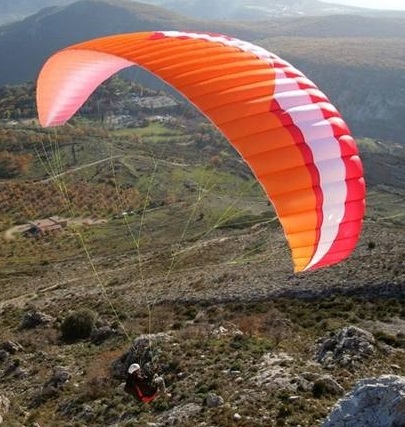
The Mojo has been in the DHV 1 category since its inception, as a solid, stable, and easy glider for beginning paramotor pilots. The Mojo Power, with DULV certification, is for the first phase of paramotoring.
The Mojo Power has long brake travel, but the handling is direct enough for more experienced pilots to appreciate, while still remaining forgiving enough for new beginners. The progressive nature of the Mojo Power’s handling makes for great turning behavior with or without weight-shift. High stability in pitch and roll creates an overall feeling of comfort and safety in flight, however the glider does provide the pilot with feedback, in amounts comfortable and subtle enough for new pilots. The sink rate and handling of the Mojo Power mean that beginning pilots will not outgrow this wing too soon.
The Mojo Power is constructed with Gelvenor cloth on its top surface, and Porcher Sport bottom surface and internal ribs. It comes standard with Ozone Paramotor Risers which feature double hang points, reinforced trimming system, and trimmer lock-off for free flight.
Medium
Cells: 39
Projected Area: 23.63 sq.m
Flat Area: 27.40 sq.m
Projected Span: 9.33 sq.m
Flat Span: 11.73 m
Projected Aspect Ratio: 3.68
Flat Aspect Ratio: 5.02
Root Chord: 2.95 m
Glider Weight: 12 lb
Weight Range: 176-264 lb
DHV: 1
Large
Cells: 39
Projected Area: 25.55 sq.m
Flat Area: 29.70 sq.m
Projected Span: 9.69 sq.m
Flat Span: 12.18 m
Projected Aspect Ratio: 3.68
Flat Aspect Ratio: 5.02
Root Chord: 3.07 m
Glider Weight: 13 lb
Weight Range: 209-297 lb
DHV: 1
Mojo 2 Small
Pilot weight: 65-85kg

Ozone Vib M.L
D.H.V. 1-2 Suitable for Beginner to Intermediate.
Pilot weight range 65-85 kgs plus Ozone recommended allowance of 20kgs for gear, achieves the certified weight range of 85-105 kgs for the glider
44 Cells. Area 23.61 square metres
Speed Bar
DHV1-2
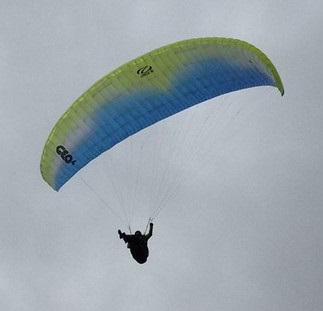
Paraglider circa 2005.
DHV1-2
Ozone Geo 4 L
Pilot weight: 95-115 kg

