1998:
Box 5185
S-102 44 Stockholm
Sweden
The Paramotor chassis design was a variation of Marbella’s PAP.
Circa 1998 the range was imported into the UK by Trekking.
1998:
Box 5185
S-102 44 Stockholm
Sweden
The Paramotor chassis design was a variation of Marbella’s PAP.
Circa 1998 the range was imported into the UK by Trekking.

The F1, F2, F3, and F4 are footlaunched packpacks with an elliptical wing and two blade prop.
Engine: Solo 210
hp range: 14-24
Prop: 2 blade
Wing span: 30 ft
Wing area: 300 sq.ft
Empty weight: 44 lb
Fuel capacity: 2 USG
Cruise: 23 mph
Range: 75 sm
Rate of climb: 500 fpm
Takeoff dist: 0-3 ft
Landing dist: 0 ft
Service ceiling: 15,000 ft
Seats: 1
1998: 1738 Appleview Rd. Pickering, ON, L1V 1T8, Canada.
Paramotor builder

The Wee Mite was a parasol monoplane with a welded steel frame with wooden wings and a fixed landing gear with a tailwheel. Designed by Cecil Noel and built by him and Harold James Le Parmentier it was initial powered by a 30 hp (22 kW) ABC Scorpion engine.
A second-hand ABC Scorpion engine of 30-40 hp coming on the local market made the proposition feasible, and the necessary planning and designing began. Even with his past experience as a pilot-instructor, Mr Noel found that the limitations of the island with regard to take-off and landing made the theoretical side of the business a tricky undertaking, and it was nearly six months before the plans and blueprints were completed.
Early in the summer of 1932 the practical work was commenced, and in this the designer was joined by a small band of enthusiasts. The first job of the work was the creation of the propellor. This was of mahogany, two-bladed, 3ft 4 in pitch, and was manufactured entirely in Guernsey. When fitted to the engine it was tested out on the sandy foreshore mounted on a Ford chassis.
A high wing, semi-cantilever monoplane, V-strutted, a split ‘Oleo’ undercarriage was fitted and open cockpits.
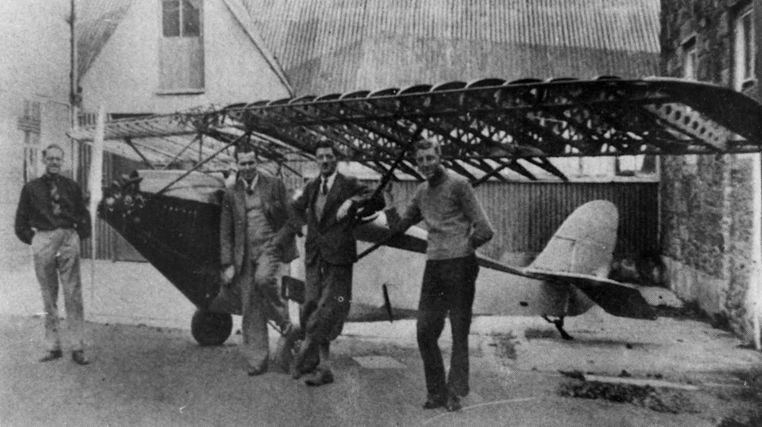
The engine was put aside until the following winter while the fusealge was built to receive it. The engine in position and early one summer morning, Guernsey’s air pioneers smuggled the aircraft through the sleeping streets to the sandy stretch of Vazon Bay.
Here it was put through her speed, control and acceleration tests. As was to be expected, adjustments were necessary, but these were so slight that they served rather to flatter the skill of the designers and builders and the exactitude of their labours.
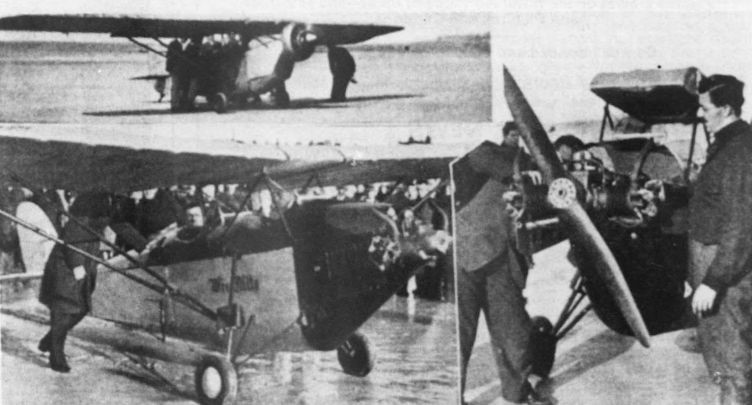
The calulation of the centre of gravity was found to be slightly at fault, having been estimated at from 1½ to 2 inches too far forward, necessitating an alteration of the wing position. This satisfactorily adjusted, the Wee Mite with Mr W C Noel at the controls essayed her first flight. First flown at Vazon Bay, Guernsey on 10 April 1933. Still slightly out of trim though she proved, her initial flutter of a few hundred yards was successful.
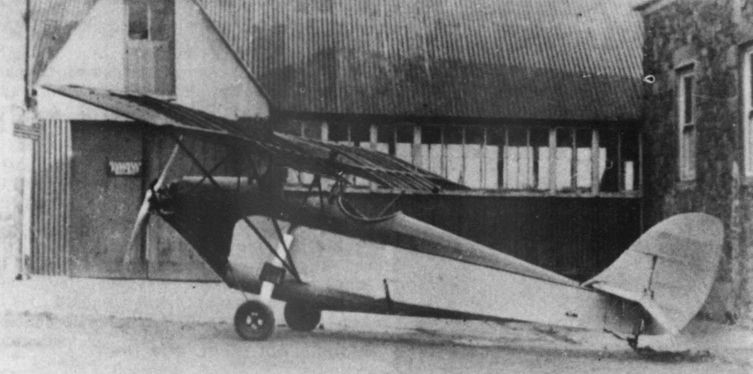
To improve her the engine was geared and she was fitted with a four-bladed metal prop of 6ft pitch, 5 ft 9 in in diameter. The metal prop burst and set up such a tremendous vibration that it crystallised the front part of the metal air-frame, practically ruining the front of the fuselage.
An A D Salmson of 40-50 hp, repairs having been completed, it was installed with a two-bladed wooden propellor and a lengthened fuselage by 18 in (46 cm). this proved ideal for vibration was noticeable less and with the experience gained further teat flights were successfully accomplished, until the ‘Wee Mite’ was ready to be re-christened the ‘We Can,’ to the confusion of all the local doubters.
It was successfully flown around Guernsey in a 50 minute flight on 15 September 1933.

It was registered as G-ACRL to Parmentier on 21 April 1934.
The aircraft crashed on 21 January 1935. Le Parmentier, at the controls, found himself unable to keep it aloft in inclement weather. Gusts of wind were buffeting the beach as he took off, one of which caught the underside of the aircraft and turned it upside down while in flight.
Fortunately, Wee Mite wasn’t very high when at the time, but its aerodynamic properties were completely thrown out and it fell to earth. The propeller and wings were destroyed and, although the engine remained intact, it was beyond practical or economical repair. Its registration was cancelled in spring of 1935.
It was dismantled and stored in March 1936.
In her occupation diaries, Ruth Ozanne recounts how, in March 1941, the owner of a garage in St Peter Port found what was apparently the remains of the plane stowed in the loft.
The Bailiff had no choice but to report the discovery to the German forces, who ordered its destruction so it couldn’t be used either against their own men or to escape the island. A post on the Priaulx Library website recounts the same story.
However, the online history of the Guernsey Aero Club tells a different tale. The club had been established by Wee Mite’s designer, Cecil Noel, and in 1935 it bought an Avro 594 Avian IV, which was damaged in a gale. What was left of it was stowed in the loft of a St Peter Port garage and, when discovered during the occupation, shipped off to Germany.
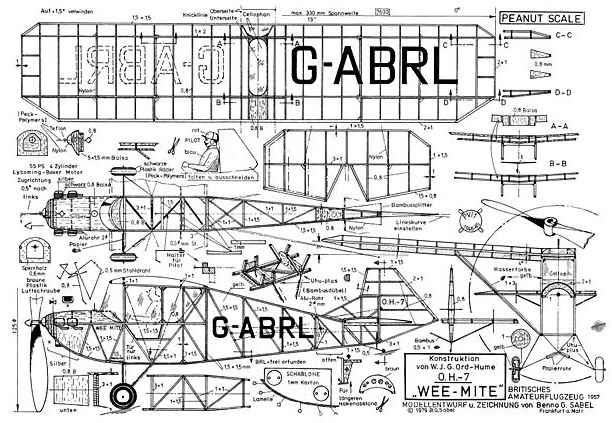
Powerplant: 1 × British Salmson AD.9, 40 hp (30 kW)
Wingspan: 31 ft 0 in (9.45 m)
Wing area: 148 sq ft
Chord: 5 ft
Length: 20 ft 0 in (6.10 m)
Height: 6ft 1½ in
Empty weight: 650 lb (295 kg)
Gross weight: 970 lb (440 kg)
Wing loading: 6.55 per sq ft
Maximum speed: 92 mph (148 km/h, 80 kn)
Cruise speed: 75 mph (121 km/h, 65 kn)
Take-off speed: 38-40 mph
Landing speed: 30-35 mph
Take-off distance: 100-120 yards
Landing distance, 100 yards
Ceiling: 8,000 ft
Tested height: 3,000 ft
Initial rate of climb: 450 ft per min
Crew: one
Capacity: one passenger

An aluminium and fabric powered parachute design. The Paramotor came in in one or two seater backpack unit, or single seat trike. Elliptical parachute, and four blade prop were fitted.
Engine: Paramotor, 25 hp
Height: 4 ft
Length: 4 ft
Wing span: 30 ft
Wing area: 300 sq.ft
Empty weight: 85 lb
Gross weight: 660 lb
Fuel capacity: 2.5 USG
Cruise: 25 mph
Takeoff dist: 2-10 ft
Landing dist: 1-5 ft
Service ceiling: 10,000 ft
Seats: 1-2
Engine: Solo or Zenoah
Speed max: 25 mph
Cruise: 25 mph
Range: 50 sm
ROC: 400 fpm
Take-off dist: 30 ft.
Landing dist: 10 ft
Service ceiling: 10,000 ft
HP range: 15-22
Weight empty: 35 lbs
Gross: 265 lbs
Height: 2 ft
Length: 1.5 ft
Wing span: 10 ft
Wing area: 300 sq.ft
Seats: 1
Landing gear: foot launch
1995: Paramarketing Inc., 9 Audrey Ave, Oyster Bay, NY 11771, USA.
1998: Paramotor Inc, 237 South St. Oyster Bay, NY 11771, USA.
Power pack builder

Mike Campbell-Jones’s auto-stable reflexed profile developments enables the Revolution to have a huge speed range, easy inflation and take off, coupled with resistance to collapses through out the trim range.
The Revolution has a fully adjustable trim range of 27cm, the movements of the trimmer system actuates a number of special features built into the wing, this allows it to change shape much like a bird. So for each trim position the wing has slightly different centralities, these all relate to type of flying required by the pilot.
So from fully reflexed which gives high top speeds with maximum hands off stability and unmatched resistance to collapses, through, to slow speed paraglider mode, which has improved climb and sink rates, easy take offs and light responsive handling.
The Medium size Paramania Revolution (26 Meter) wing, is perfect for Pilots from 155 to 210 pounds plus paramotor. This is a paraglider designed specifically for Paramotor flying, it can be flown as a free flying wing. The Revolution is designed by Paramania and built to the highest standards in Korea by GIN gliders.
Area: 21 sq.m
PPG weight range: 50-130 kg
PG weight range: 50-70 kg
Cells: 50
Trim slow speed: 34 kph
Trim fast speed: 48 kph
Max speed: 60 kph
L/D: 8:1
Sink- min: 1, trim off: 1.5-2, max speed bar: 3
G loading: 8
Area: 24 sq.m
PPG weight range: 60-140 kg
PG weight range: 60-80 kg
Cells: 50
Trim slow speed: 34 kph
Trim fast speed: 48 kph
Max speed: 60 kph
L/D: 8:1
Sink- min: 1, trim off: 1.5-2, max speed bar: 3
G loading: 8
Area: 26 sq.m
PPG weight range: 70-150 kg
PG weight range: 70-90 kg
Cells: 50
Trim slow speed: 34 kph
Trim fast speed: 48 kph
Max speed: 60 kph
L/D: 8:1
Sink- min: 1, trim off: 1.5-2, max speed bar: 3
Afnor cert: Standard
DMSV cert: DMSV-B
G loading: 8
Area: 28 sq.m
PPG weight range: 80-170 kg
PG weight range: 80-110kg
Cells: 50
Trim slow speed: 34 kph
Trim fast speed: 48 kph
Max speed: 60 kph
L/D: 8:1
Sink- min: 1, trim off: 1.5-2, max speed bar: 3
Afnor cert: Standard
DMSV cert: DMSV-B
G loading: 8
Area: 30 sq.m
PPG weight range: 100-220 kg
PG weight range: 100-135 kg
Cells: 50
Trim slow speed: 34 kph
Trim fast speed: 48 kph
Max speed: 60 kph
L/D: 8:1
Sink- min: 1, trim off: 1.5-2, max speed bar: 3
DMSV cert: DMSV-B
G loading: 8

After “countless” prototypes and two years of experimenting, this high performance wing for powered flight came to replace the popular Action and it is introduced as an “all in one wing” for both powered and gliding flight. The Action GT has a wide speed range, with a top speed of 65k/h and high stability thanks to a new “highly sophisticated” reflex aerofoil section, manipulated by a unique semi-ridged trim and intricate D-line gathering system. The Action GT incorporates a centre keel that combined with the lines lay out allow weight shift “without wing distortion whilst giving excellent directional stability and a stiff, controllable structure”, according to Paramania. The keel also re-directs the span wise airflow, reducing drag and further enhancing performance. Another new feature is the inner ribs structure with inclined oval holes for better load distribution and diagonal rib shaping, which gives a “super smooth” top surface. The Action GT from Mike Campbell-Jones offers extremely smooth, precise and efficient handling to “carve your way through the air”. The Action GT was available in 3 sizes that cover the weight range from 65 to 175 kg, and 2 color schemes.


The Cyclone Macro 294cc and 1600cc paragliding motors are water cooled, and have electric starters.
Parajet Cyclone Macro 294cc
Engine: 294cc Rotary.
Engine Weight: 15.4kg
Net price: US$3,500 2010
Parajet Cyclone Macro 1600cc
Engine Type: 1600cc Rotary.
Engine Weight: 12.8kg.
Net price: US$3,055 2010
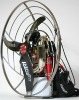
The Volution Macro 1800cc is designed for the long distance Paragliding flyer and heavier pilots. The Macro 1800cc has a 3 hour flight range from its 14 litre fuel tank.
The Volution Compact 1800cc is an all round performance paramotor. A small carbon fibre Scimitar propeller enables easy take-off with little noise.
Volution Macro 1800cc
Engine: 2 Stroke
Starter: Electric
Thrust: 65kg
Propeller: 1.3 metre carbon fibre Scimitar
Endurance: 3 hour
Fuel capacity: 14 litre
Pilot weight range: 65-160kg
Net price: US$2,500 2010
Volution Compact 1800cc
Prop: carbon fibre Scimitar
Pilot weight range: 65-100kg
Net price: US$2,150 2010

