Sportflugzeugbau Göppingen (Sport Aircraft Göppingen)
Sportflugzeugbau Schempp-Hirth
Schempp-Hirth Flugzeugbau Gmbh
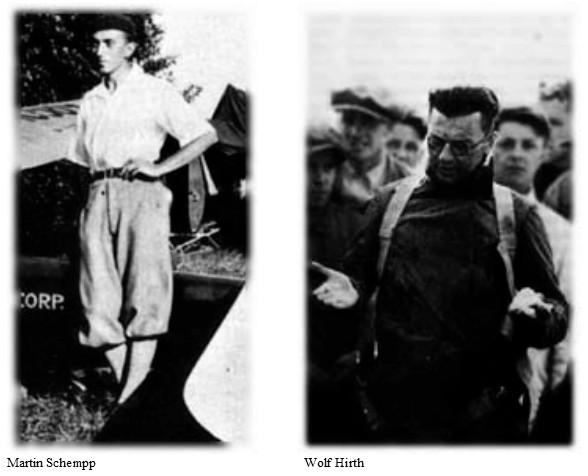
Martin Schempp and Wolf Hirth first met in 1928 and beginning in 1935, the team developed the Minimoa, the first high performance glider to sell more than 100 models. The production of Schempp-Hirth gliders began in the municipal building yard in Göppingen, near Stuttgart, where Martin Schempp founded the Sportflugzeugbau Göppingen (Sport Aircraft Göppingen) company in 1935.
In 1938 the company moved to Kirchheim/Teck and employed more than 300 people during the war time.
The first serial gliders were the aerobatic single seat trainer GÖ-1 ‘Wolf’ from Wolf Hirth and the renown GÖ-3 ‘Minimoa’ as well as the two seat GÖ-4 from Wolfgang Hütter. Occasionally there are single examples which are preserved and maintained as oldtimers which can still be found at airshows.
During the war, the production was forcefully expanded to build parts for, amongst other things, the ME-109, the “Giant” and for the Bachem “Natter”. Alongside the GÖ-4 there were also complete aircraft which were built, like the GÖ-8 and the 13,6m-“Habicht”.
The period after the war till 1955 was bridged with the production of plywood suitcases, leg prosthesis, furniture, weaving looms etc, yet also with fighter jet dummies (F-86) and sound studios for television stations.
The connection to the aviation industry was implemented early on with the production of the Matteson M-1 glider, the production of the powered aircraft GS-6a “Milan” and with works on engine pod and tail section of the “Trumpf” airship D-LEDA.
Licenced production such as “Emeraude” and “Smaragd”, subcontracting for “Kl-107” “, “Do-27”, “Do-28” and subsequently the production of the Standard Austria glider in several versions, ensured the employment of the about 50 employees till 1965.
In 1960s company renamed and built the Milan 656 light tourer, also French Piel Emeraude under licence. During early 1960s production of powered aircraft ceased, licence rights for Emeraude being transferred to Binder Aviatik KG.
Regaining a foothold in the world market was achieved with an own design, the SHK, by Rolf Kunz which was flown into third place in its first attempt at the 1965 World Championships in South Cerny/England.
After that the technology revolution from wood to fiberglass was completed in quick steps – at Schempp-Hirth under the directorship of Klaus Holighaus, who, with the maiden flight of his Cirrus in January 1967, was able to celebrate a successful debut.
Two years later, again in January, he already flew his first “Super Orchid”, the Nimbus-1. With this glider George Moffat won the 1970 World Championships in Marfa/Texas, USA.
With more than 700 produced examples, (of which 200 were produced by Grob), the Standard Cirrus was Schempp-Hirth’s second most successful aircraft in produced units. Further successes followed in 1972 and 1974 when Göran Ax in Yugoslavia and George Moffat in Australia became World Champions in the Open Class flying the Nimbus-2 (the production version of the Nimbus-1).
1974 also marked the maiden flight of the Janus, being the worlds first two seat glider in fiberglass construction. Constantly refined (e.g. 20 m CFK wings) it was only retired from production in 1996 after over 20 years. The last variants were the janus-Ce and janus-CT.
Also in 1974, there was the maiden flight of the single seat motorglider Nimbus-2M. Not only were the first experiences with retractable engines achieved, but also numerous world records were set, from the limited series production.
For the FAI introduced “15 m Racing Class”, Schempp-Hirth delivered the Mini-Nimbus, which came on to the market in many versions and was superseded in 1980 by the Ventus.
A new material had found its way, however, into the Kirchheimer production halls: the carbon fiber. What was included into the Nimbus-2C in a rather inconspicuous manner, proved itself to be the start of, at that time not appreciative of how large, an effective future in the production of high performance gliders. The thin wing profiles of the succeeding developments would not have been possible without the higher strength and stiffness of the carbon fiber.
The lengthening of the lifespan for fiberglass constructed gliders from 3000 to 6000 hours was for example, proven with a Nimbus-2 inner wing.
Serial introduction of carbon fiber was first included on the Nimbus-2C, Mini-Nimbus-C, Janus-C and Janus-CM. the optimal qualities of this new material were only utilized fully later on in the Ventus and Nimbus-3, in the production of the long and thin wings of these models.
Just a few months after its maiden flight, the Nimbus-3 won the 1981 World Championships in Paderborn.
Then the Ventus and Nimbus-3 won the 1983 World Championships in Hobbs/USA and subsequently the Nimbus-3 was also at the front in Rieti in 1985. Together with this, a string of national championships titles for both models and a number of world records for the Nimbus-3 were achieved.
Whilst the production of the single seat Nimbus-3 had to be discontinued after a fire in one of the production halls, this enabled the production of the Racing Class glider Ventus to be increased, allowing the increase in demand for its motorized variant Ventus-bT to be satisfied.
Constant refinement was also the key for the success of the Racing Class glider Ventus which debuted in spring 1986 as the model Ventus-c (on request with wing tip extensions for 17,6 m wingspan). Production of this model was ceased in 1994 after over 600 examples were produced (including self launchers and turbos).
January 1998 saw the delivery of the 4000th built Schempp-Hirth aircraft since the start of the company (including aircraft built under licence).
Today thousands of their gliders are flying around the world. Schempp-Hirth sailplanes include the Ventus A, an advanced 15-meter-class plane with carbon-fiber technology, thin wings, and a low-profile fuselage. The Ventus B is a 15-meter-class craft with a larger cockpit for tall pilots. The Nimbus 2C (open class) has a 20.3- meter wingspan with either carbon or carbon/fiberglass construction. The Janus B has an 18.2-meter wingspan for high-performance tandem two-place flying. The Janus C has a 20-meter span with carbon wings, seating for two, and competition-type performance. The Janus CM, with a 20-meter span, is a two-place motorglider with carbon wings and fully retractable engine. Schempp-Hirth’s newest sailplanes include the Discus, Duo Discus, Ventus and Nimbus, available in a variety of variations, including pure gliders and powered sailplanes.
January 1998 saw the delivery of the 4000th built Schempp-Hirth aircraft since the start of the company (including aircraft built under licence).

2014: Schempp-Hirth Flugzeugbau GmbH
Type Certificate: EASA.A.532