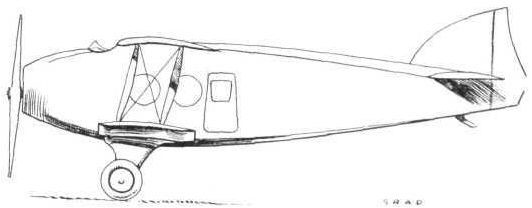
The 1927 S.R.A.P. T.7, also known as the Béchereau S.R.A.P. T.7 or Salmson-Béchereau S.R.A.P. T.7, was a two-bay biplane. Nine were built, powered by a 520 hp Salmson 18CMb radial engine, with a 16.90 m wingspan.
The 1927 S.R.A.P. T.7, also known as the Béchereau S.R.A.P. T.7 or Salmson-Béchereau S.R.A.P. T.7, was a two-bay biplane. Nine were built, powered by a 520 hp Salmson 18CMb radial engine, with a 16.90 m wingspan.
A two-seat monoplane powered by a 500hp Salmson engine.
Established at Billancourt in 1926 to build aircraft to the design of Louis Becherau, formerly with Deperdussin and SPAD. First production design was the C.2, a two-seat monoplane powered by a 500hp Salmson engine.
The Paris-based S.R.A.P. is often listed as the ‘Société pour la Réalisation d’Appareils’. Flight truncated the name as ‘Société pour la Réalisation d’Avions’. However, ‘Prototypes’ seems important as it suggests that S.R.A.P. did not intend to manufacture aircraft designs in series.
In early 1930s licenced to build Netherlands-designed Koolhoven F.K.43 four-seat high-wing monoplane as SAFA F.K.43.
S.I.A.7 and 9 series of two-seat reconnaissance- bomber biplanes, dating from 1917, were designed by Umberto Savoia and Rodolfo Verduzio. Structural weakness attributed to both, and Type 9 was rejected by Italian Army on this account, though accepted by Navy.
S.I.A.7 and 9 series of two-seat reconnaissance- bomber biplanes, dating from 1917, were designed by Umberto Savoia and Rodolfo Verduzio. Structural weakness attributed to both, and Type 9 was rejected by Italian Army on this account, though accepted by Navy.
Had close Fiat links (like Ansaldo and several other Italian companies), and its S.I.A.7 and 9 series of two-seat reconnaissance- bomber biplanes, dating from 1917, were designed by Umberto Savoia and Rodolfo Verduzio. Structural weakness attributed to both, and Type 9 was rejected by Italian Army on this account, though accepted by Navy.
Italy
Forerunner of the Siai-Marchetti organization (see Siai-Marchetti Societa Per Azioni). Founded 1915 by Luigi Cape at Sesto Calende, with a seaplane base on Lake Maggiore. As Idrovolanti Savoia built FBA flying-boats under license. Name “Savoia”had a geographical and historical connotation (House of Savoy), and after the war new flying-boats were known by the name Idrovolanti Savoia, or Savoia. These achieved early distinction, notably in the 1920 Schneider Trophy contest. Names Savoia and Marchetti were linked in 1922, when Alessandro Marchetti became technical director of company renamed Societa Idrovolanti Alta Italia—Savoia-Marchetti. In 1925 the company gained publicity when an S.16ter was flown to Australia and Tokyo and back to Italy by Francesco De Pinedo. Famous types included the twin-hulled S-55 which, though first flown in 1924, is remembered chiefly for General Balbo’s mass-formation flights of 1930 and 1933. Special long-range landplane S-64 broke world’s duration and distance records in June 1930. Initials S. M. for type numbers were not commonly applied until later, and then particularly in association with fast 3-engined civil and military types. Most famous was S.M.79 bomber and torpedo bomber of Second World War. Civil types included the record-breaking S.M.75 of 1939. Last Second World War aircraft was S.M.91 twin-boom fighter-bomber, but S.M.84 bomber served as transport until 1948.
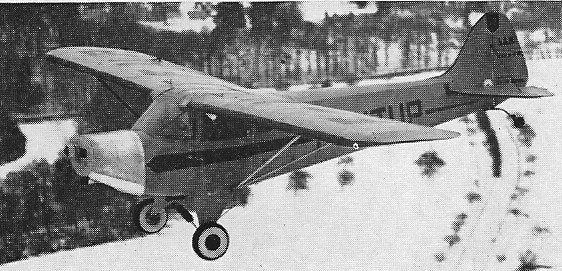
The SAN-101 was the first product of Societe Aeronautique Normande. A tandem two-seat high-wing monoplane powered by a 65 hp Continental C65 engine.
One prototype was built, first flying at the end of 1949.
Engine: 65 hp Continental C65
Wingspan: 38 ft 2.5 in
Length: 24 ft
Max speed: 98 mph
Cruise: 74 mph
Range: 373 mi
Formed 1948. First prototype of the SAN-101 two-seat high-wing monoplane flew 1949. Built other light aircraft, notably Jodel D.150 Mascaret; 4/5-seat Jodel D.140 Mousquetaire; and D.140R, for use as glider tug and in mountainous areas. The products were known as SAN Jodel and attained considerable success, but company went into liquidation early in 1969.

