1980: Box 5070, Raleigh, NC 27607, USA.
Glider and LSA builder
1980: Box 5070, Raleigh, NC 27607, USA.
Glider and LSA builder
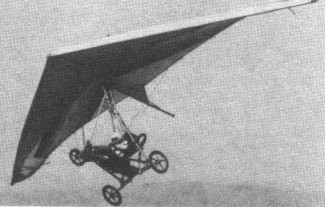
Single seat single engined flex wing aircraft with weight shift control. Rogallo wing with keel pocket. Pilot suspended below wing in trike unit, using bar to control pitch and yaw/roll by altering relative positions of trike unit and wing. Wing braced from above by kingpost and cables, from below by cables; rigid cross tube construction; 60% double ¬surface enclosing cross tube; pre formed ribs. Undercarriage has three wheels in tricycle formation; steel spring suspension on nose¬wheel and bungee suspension on main wheels. Push right go left nosewheel steering indepen¬dent from yaw control. Brakes on main wheels. Aluminium tube trike unit, without pod. Engine mounted below wing driving pusher propeller. Wing has foam insert in leading edges.
Flight Designs Jetwing ATV Article
The Jetwing ATV (All Terrain Vehicle) is an original concept: it is not purely a trike in the conventional sense, because its wheels can be replaced by floats. By removing the wing and fitting the rear of the floats with a triangular tubular structure supporting a large rudder, the Jetwing can be transformed into a speedboat. Using its pusher propeller it can be turned into a go kart by refitting the wheels but leaving the wing off, while also available as an option are skis.
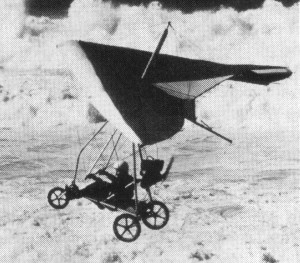
The price of the trike unit was US$3000 in 1982 and bought together with the Demon hang glider wing it costs a total of US$4995. Flight Designs does not recommend the use of any other Rogallo with its trike unit and it is worth noting that its Demon Rogallo is not related to the British wing of the same name, made by Hiway.
The later Jetwing ATVs had a belt reduction drive of 2.2/1 ratio, with a max static thrust of 220 lb (100 kg).
Engine: Kawasaki TA440, 30 hp at 5500 rpm.
Prop¬eller diameter and pitch 36 x 16 inch, 0.91×0.40 m.
No reduction. Power per unit area 0.17hp/sq.ft, 1.8hp/sq.m.
Fuel capacity 5.0 US gal, 4.2 Imp gal, 18.9 litre.
Length overall 12.0 ft, 3.65 m.
Height overall 12.0ft, 3.65m.
Wing span 33.5ft, 10.18m.
Mean chord 5.3ft, 1.60m.
Total wing area 175 sq.ft, 16.27 sq.m.
Wing aspect ratio 6.3/1.
Nosewheel diameter overall 16 inch, 40 cm.
Main wheels diameter overall 20 inch, 50 cm.
Empty weight 216 lb, 98 kg.
Max take off weight 480 lb, 218 kg.
Payload 264 lb, 120 kg.
Max wing loading 2.74 lb/sq.ft, 13.4 kg/sq.m.
Max power loading 16.0 lb/hp, 7.3kg/hp.
Load factors; +4.0, 2.0 ultimate.
Max level speed 47 mph, 76 kph.
Never exceed speed 52 mph, 84kph.
Max cruising speed 37mph, 60kph.
Stalling speed 22 mph, 35 kph.
Max climb rate at sea level 400 ft/min, 2.0 m/s.
Min sink rate 350 ft/min at 23 mph, 1.7 m/s at 37 kph.
Best glide ratio with power off 7/1 at 25 mph, 40 kph.
Take off distance 50 ft, 15 m.
Landing distance 75ft, 23 m.
Service ceiling 10,000ft, 3050 m.
Range at average cruising speed 160 mile, 257 km.
In 1981 Flight Designs Inc was incorporated into Pioneer International Corporation which has been well known for half a century in the aerospace industry as specialising in parachutes.
1982-3: Flight Designs, PO Box 1503, Salinas, California 93902, USA.
Flight Designs was bought out by Pioneer Parachute in 1982.
A 1981 hang glider with cambered aluminum ribs.
It is pretty easy on the handling side and the speed trim is real nice hands off. This glider was really nice to fly on a 15-20 mph day. An easy landing trainer.
It was available in two models: Javelin 168 and Javelin 208.
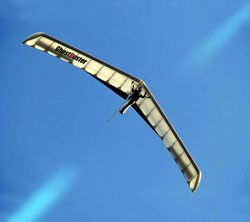
A 1999 hang glide for advanced pilots.
Wing area: 12.6 m²
Wing span: 13 m
Aspect ratio: 13.4
Hang glider weight: 35 kg
Minimum pilot weight: 90 kg
Maximum pilot weight: 150 kg
Minimum speed: 30 km/h
Maximum speed: 110 km/h
Max glide ratio (L/H): 17.60
Max glide ratio speed: 55 km/h
Minimum sink rate: 0.7 m/s
Packed length: 5.9 m
Nose angle: 150°
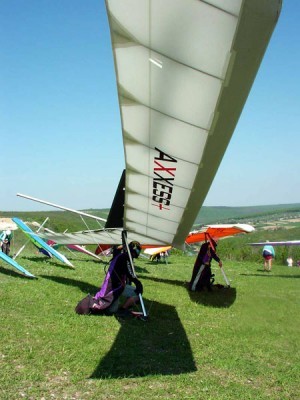
A 2002 rigid wing hang glider for advanced pilots.
The rigid AXXESS is super stable in flight (calm and turbulent) and has a formidable landing facility, with well dimensioned flaps. The assembly with integrated slats is easy. The decoupling of the wings facilitates the transport.
Flight Design no longer produces wings and rigid. But fliegerboehm continues the manufacture of rigid Axxess.
Axxess
Wing area: 13.5 m²
Wing span: 13.1 m
Aspect ratio: 12.7
Hang glider weight: 39 kg
Minimum pilot weight: 90 kg
Maximum pilot weight: 115 kg
Packed length: 6.3 m
Nose angle: 127°
Axxess +
Wing area: 12.6 m²
Wing span: 13.1 m
Aspect ratio: 13.6
Hang glider weight: 39 kg
Minimum pilot weight: 90 kg
Maximum pilot weight: 115 kg
Packed length: 6.3 m
Nose angle: 127°
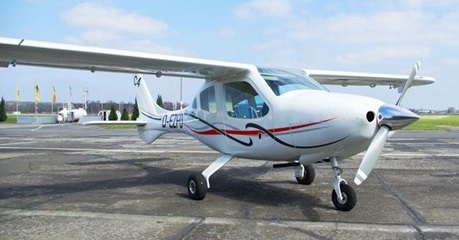
The company’s four-seat C4 project has slowed down its planned U.S. certification schedule to take advantage of anticipated streamlining of the Part 23 process by FAA, so deliveries could slide into 2015.
Flight Design entered receivership in 2016. Work on the C4 had come to a standstill after the company ran into financial difficulty. Production had also slowed to a trickle as the company workforce was trimmed to 10 people in Germany and around 60 in the Ukraine.
Flight Design completed the sale of all major company assets to the German investment group Lift Holding, allowing for the resumption of work on the C4, a Part 23-certified four-seater with a projected selling price of $250,000.
Paraglider circa 1998.
Wing area: 44 sq.m
Certification: Afnor
Pilot weight: 140-195 kg
No. of cells: 70
Wing span: 15.4 m
Aspect ratio: 5.4
Min sink: 1.1 m/s
Max speed: 39 kph
Price (1998) £ 2600
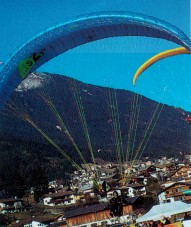
Paraglider new in 1998.
S2 VT 23
Wing area: 23 sq.m
Pilot weight: 60-85 kg
No. of cells: 50
Wing span: 10.9 m
Aspect ratio: 5.2
Min sink: 1.1 m/s
Max speed: 46 kph
Price (1998) 17,390 Fr
S2 VT 26
Wing area: 26.8 sq.m
Certification: Afnor
Pilot weight: 80-105 kg
No. of cells: 50
Wing span: 11.8 m
Aspect ratio: 5.2
Min sink: 1.1 m/s
Max speed: 46 kph
Price (1998) 17,730 Fr
S2 VT 30
Wing area: 30.6 sq.m
Pilot weight: 100-130 kg
No. of cells: 50
Wing span: 12.6 m
Aspect ratio: 5.2
Min sink: 1.1 m/s
Max speed: 46 kph
Price (1998) 18,100 Fr
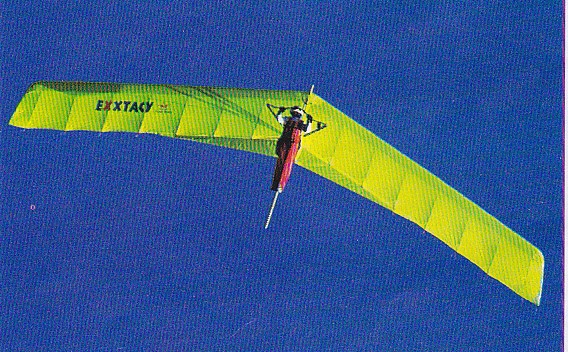
A rigid wing light hang glider from 1996. Very safe to fly, sink rate below 0.8m/s, glide ratio above 16, speed range from 32 to more than 110 km/h.
Handling at take off is typical rigid wing stuff: does not require any assistance in strong winds, as the spoiler will lift up and bring the wings level without any pilot input. Normal cruising speed is about 35km/h in thermals, 50 km/h straight.
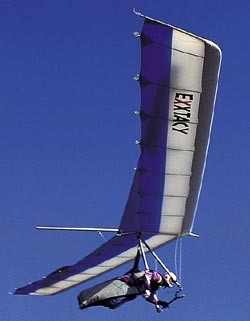
Very light in turns and very stable trajectory at speed hence excellent for aero-towing. In thermals, its stability in roll requires sensitive pilot input to climb well. Not much affected by turbulence, only in pitch. Landing is easier than on a flex wing.
When folded, the weight and bulk can be problematic but splitting the wing in two halves helps.
Flight Design no longer produces wings and rigid. But fliegerboehm continues the manufacture of rigid Exxtacy.
From 1999 the Exxtacy was improved: reduced weight 35kg / 38 kg; length of the large model: 570 cm and the weight of the mini / maxi 100 kg / 160 kg.
Tthere is a biplace model.
Exxtacy 135
Wing area: 13.8 m²
Wing span: 11.4 m
Aspect ratio: 9.4
Hang glider weight: 39 kg
Minimum pilot weight: 90 kg
Maximum pilot weight: 140 kg
Minimum speed: 36 km/h
Max glide ratio (L/H): 17.5
Minimum sink rate: 0.75 m/s
Packed length: 6.2 m
Nose angle: 127°
Exxtacy BI 160
Wing area: 14.8 m²
Wing span: 12.2 m
Aspect ratio: 10.05
Hang glider weight: 39 kg
Minimum pilot weight: 100 kg
Maximum pilot weight: 160 kg
Vne: 100 kph
Minimum speed: 30 km/h
Max glide ratio (L/H): 17.5
Minimum sink rate: 0.75 m/s
Packed length: 6.2 m
Nose angle: 127°
Price (1998) £ 5500

