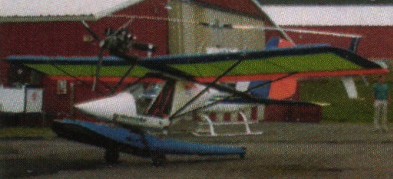
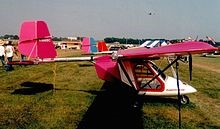
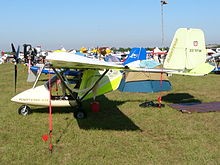
Flightstar designer Tom Peghiny built the first Flightstar in the mid-1980s for the US FAR 103 Ultralight Vehicles category with its maximum 254 lb (115 kg) empty weight requirement. The two-seat Flightstar II soon followed to fill the role of a trainer. The designs quickly became commercial successes and the basic design has been extensively developed over time. By 2007 over 700 single seaters had been sold.
All models are constructed from anodized aluminum tubing assembled with bolts. The fuselage is suspended from a keel tube that also mounts the engine at the front, the tail at the back and the wings. The wings are strut-braced and utilize jury struts. The wings and tail surfaces are covered in pre-sewn Dacron envelopes, which reduces construction time. The wings have full-span ailerons, while the tail features conventional elevators and rudder. The landing gear is a tricycle gear arrangement with bungee suspension on the main wheels. The nosewheel is steerable and mainwheel brakes are an available option. The reported construction time for the single seat models is 100 hours.
The Flightstar II is LSA legal.
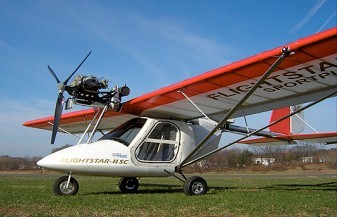
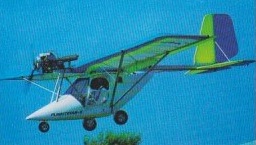
The Flightstar-IISC is the Sport Cabin version of the IISL. The IISC includes all that’s needed to enclose the plane for more comfort and all season flying. The cabin parts include the Fastback rear enclosure, composite cabin fairings, door posts, Lexan roof and zippered sport doors. The IISC was developed with the sport pilot in mind. The large wing allows predictable slow flight handling and quiet low throttle cruising. The IISC features the 54HP dual carb, dual ignition, Rotax 503 with the Flightstar 503 Super Cowl. The optional engines include the 64HP Rotax 582 liquid-cooled twostroke and the 60HP HKS 700E four-stroke engine. The Flightstar II was shown at the ’98 Sun ‘n Fun with an HKS 700 engine.
The Rotax 503 engine installation on a Flightstar II
Standard equipment includes high lift wing with streamlined struts, Flightstar wingfold system, vibration isolated instrument panel, 10 USG rotational molded fuel tank w/sump, full dual control system, chromemoly cage and landing gear, heavy duty stamped dynofocal engine mount, anodized airframe for corrosion protection, and point pilot restraint harnesses.
Optional equipment includes, full instrument package, 4 point harnesses, complete electrical system. in-flight adjustable trim, 3 blade composite propeller, azusa drum brake system, and brs ballistic parachute system. The Flightstar II SC airfoil is the Flightstar FS-II-2 13% thick.
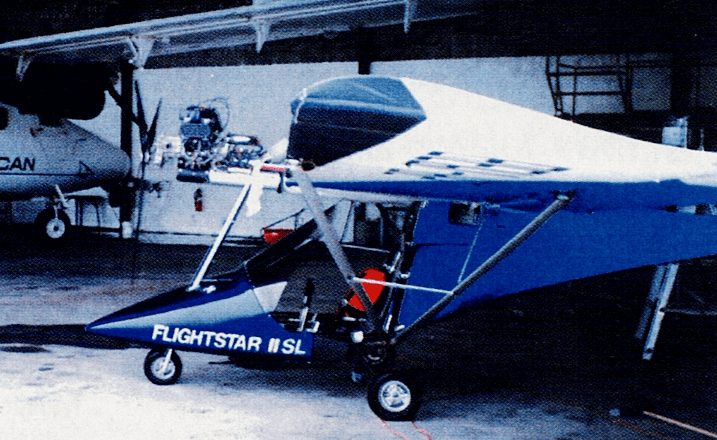
Flightstar IISC
The Flightstar-IISL combines the open air freedom of ultralight type flying and the fun of being side by side with your passenger. With a 120 hour assembly time and the Flightstar wingfold system, the IISL is fitted with full dual controls. The wide stance landing gear for cross wind landings and light wing loading offers easy handling and landings. The airframe is designed for the rigors of flight training and is tested to last. The IISL offers the same standard and optional equipment as the IISC.
The full engine options are the Rotax 503FA (496 C.C. 54HP @ 6800 RPM) with 2.58 TO1 reduction ratio, and the HKS 700E (680 C.C. 60 HP @ 6200 RPM) with 3.47-1 reduction ratio. Propeller options include Tennessee prop. Co. 2-blade, 68” dia, Ivo-prop. 3-blade 68”, and Powerfin F model 70” diameter.
March 1993
The Flightstar II kit, including engine, cost US$15,395 in 1997. The Flightstar II-SL kit, including engine, cost US$13,795 in 1997.
Flightstar IISL
The two seat models all have side-by-side seating and have folding wings. The aircraft were also produced under licence in India by Albatross Flying Systems.
In 2009 the Flightstar single and two-seat, high wing, single engined kit aircraft produced by Flightstar Sportplanes of South Woodstock, Connecticut, rights, tooling and parts inventory were sold to Yuneec International of China when Flightstar Sportplanes’ business was wound up.
In July 2009 a new single seat model was exhibited at EAA AirVenture Oshkosh as the Yuneec e-Spyder electric-powered version.
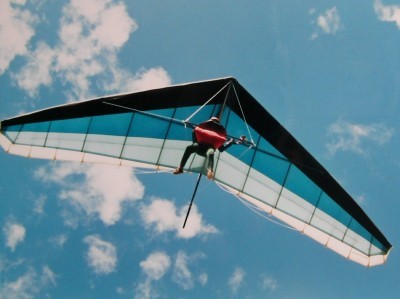
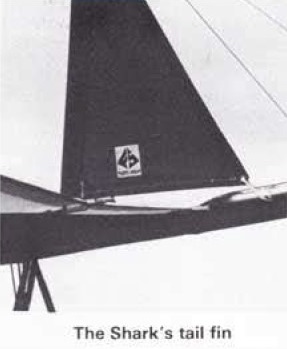
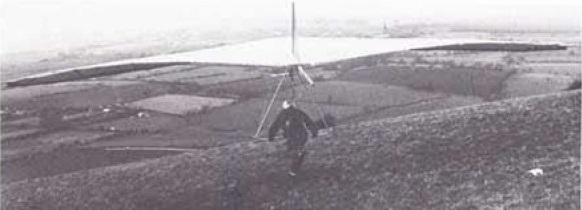
A 1981 hang glider for advanced pilots designed by Warren Bird with help from Bob Martin. The Shark was produced by Flight Sails NZ in New Zealand probably in 1982 and 1983. It had no keel pocket and the double surface was 90%, not sewn on the top surface. The keel was fully enclosed between both surfaces. The king post holds the keel which is not sewn into the top surface. The wing contained 30 battens.
Only a few were made and it was never fully developed. From the first production Shark they were gradually de-tuned from then on to try to improve the handling.
Distributed in England, it cost just over £1000 in 1982.
Performance was good but handling was not. Great in a straight line but really hard to turn. Sometimes it would turn and sometimes it wouldn’t. Turning was improved by upper wing spoilers which also could be used for air brakes.
This was the first Delta to beat the Manta Fledgling when flown by Graeme Bird at the 1981 World Champs in Japan.
Reportedly the Shark made one awesome trike wing in the 80’s. With a British Tri-pacer trike, 330cc motor, Graeme Henderson flew his across Foveaux Strait, New Zealand, in the first crossing by a microlight in 1981.
New Zealand Flight Engineers Ltd was a joint company formed by agricultural operator Barr Brothers and Marine Helicopters Ltd. to maintain own fleets, but also undertook license-assembly of Transavia PL-12 Airtruk agricultural aircraft from 1973. T320 version powered by Continental Tiara engine introduced 1977. Production ended 1980.
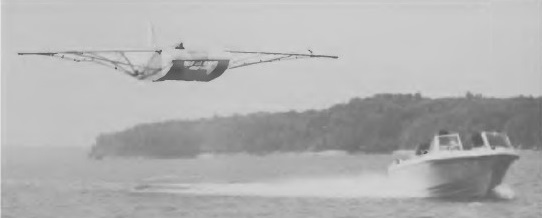
This single- or two-seat homebuilt glider is distinguished by an aerofoil-shaped fuselage and bat-like sailwing type wings, the tail unit being carried on an aluminium boom. It is an unpowered Stage 1 version of an aircraft which, in fully developed powered form, will be known as the Flightsail VII, the Seasprite being of more simplified construction, and it is being marketed as plans to amateur constructors.
The fuselage is a framework of aluminium tubing, the sides and top of which are covered with polyethylene foil, except for the upper part of the nose section, which has a transparent covering of polyester film and Plexiglas. Alternatively, the structure can be covered with aluminium foil for only a minimal weight increase, and this has a much longer life. The underside of the fuselage has catamaran-type twin floats, built of plastics with a plywood covering, enabling the Seasprite to be operated off water if so desired.
The wings are of triangular planform with aluminium tube leading edges and wire trailing edges, the whole being covered in polyethylene. They can be folded rearwards when not in use but are otherwise braced to the fuselage sides. The wing tips pivot about their leading edges to provide roll control. The tail is built as a single fin/tailplane unit pivoting only in the vertical plane for control in pitch.
The pilot sits in an open cockpit in the centre section, to the right of the aluminium boom carrying the tail unit, and his weight is balanced by a counterweight at the port wing tip if a second pilot or passenger is not carried.
One Seasprite has been fitted with twin tail booms preparatory to adding a small pusher engine between them, this being an interim stage, as the Seasprite II, in the development of the Flightsail VII.
Wingspan 34 ft 0 in Length 20 ft 0 in Height 8 ft 0 in Wing area: 166.0 sqft Aspect ratio: 6.96 Empty weight: 165 lb Max weight: 500 lb Lift off speed 30 mph Cruise speed 35 mph Max aero-tow speed: 35 mph Best glide ratio: 6:1 at 50 mph
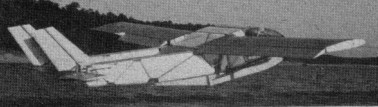
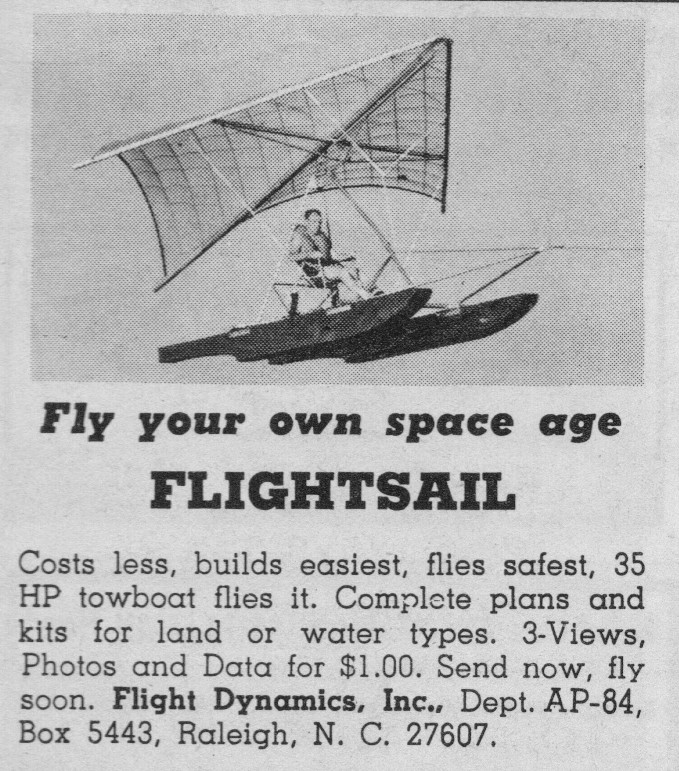
Design begun in 1966 and first first flown in October 1970, the Flightsail VII can either be towed behind a 70-hp ski boat or it can have a 90-hp Continental pylon mounted above the fuselage to fly the Flightsail under its own power. The structure is built from bolted aluminum, foam and epoxy. This two-seater amphi¬bian features twin booms and twin tails.
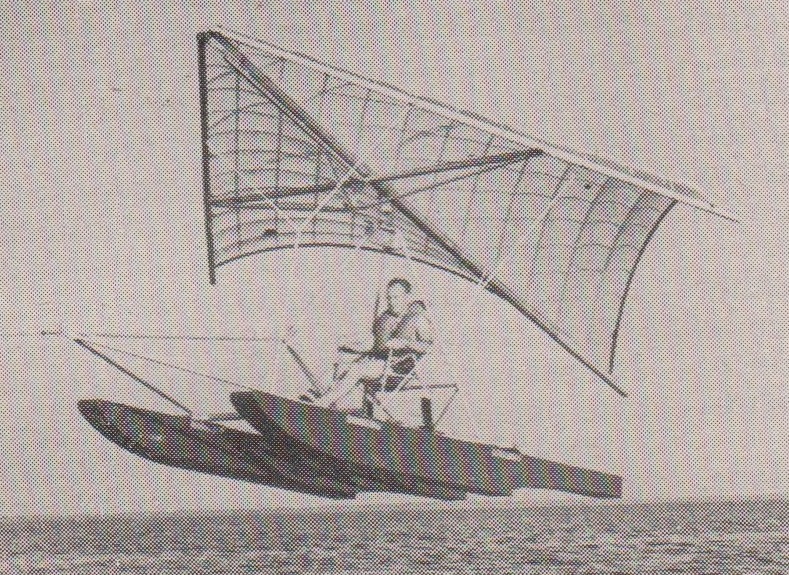
Flight Dynamics Inc, of Raleigh, NC, were promoting in 1963 The Flightsail. An adaptation to sport of the flexible wing developed for the National Aeronautics and Space Administraion. The wing is a polyethylene covering on an airframe of commercial aluminium tubing and angle stock.
Capable of taking off from land or water, Flightsail is controlled in flight by an aircraft-type control stick that regulates the tilt of the wing.
Easily towed aloft by a 40 – 50 hp outboard, flying is best with a breeze of about 5 mph, lift-off being between 25-50 mph ground speed.
In 1963 it was claimed the Flightsail could be built at a total cost of US$250, including wheels and floats.