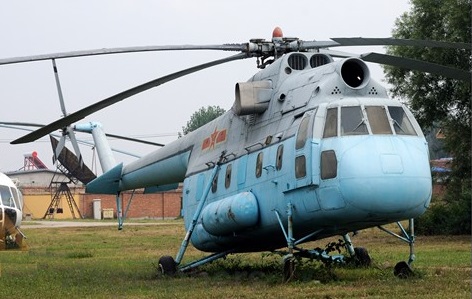
Development of helicopters continued in 1968 with the first flight of the Harbin Z-6. A development of the Z5 (Mi-4) equipped with turbine engines, it was not a success, only 15 were built.
Development of helicopters continued in 1968 with the first flight of the Harbin Z-6. A development of the Z5 (Mi-4) equipped with turbine engines, it was not a success, only 15 were built.

In July 1982 it was reported that the Harbin Aircraft Works had developed a turbine-powered version of the Y-11, with PT6A-110 turboprops. A prototype was reputed to have flown. With a gross weight of 12,125 lb / 5500 kg, the maximum payload is 3748 lb / 1700 kg, and the Y-11T is estimated to have a max speed of 175 mph / 282 kph and a max range of 876 miles / 1410 km.
Developed from the earlier piston-engined Y-11, the twin-PT-6A-powered Y-12 has an enlarged cabin to accommodate up to 17 passengers. A first production batch of 18 aircraft was scheduled for completion by the end of 1986.
The Y-12 prototype first flew in 1982, and there have been three series production versions
Y12 (I)
Initial version with 500 shp PT6A-11 engines, 93” diameter propellers,
leading edge slats, seating for 17 passengers and a MTOW of 5000 kg.
Y12 (II)
Later production version with higher-rated 600 shp PT6A-27 engines, plain leading edge, 98” diameter propellers and MTOW increased to 5300 kg. The UK CAA issued Type Certificate FA49 for this variant in 1990 and examples are in operation in Malaysia and Fiji.
Y12 (IV)
Improved model with sweptback wingtips, redesigned seating for 18-19 passengers and max. weight increased to 5700 kg. The Canadian Aerospace Corporation markets a version of the aircraft under the Twin Panda name as a DHC-6 replacement.
The Sri Lankan Air Force ordered six Y-12 turboprop utility transports from China in 1986, and at least two have been delivered to the Chinese Air Force for aerial survey work.
The Y12 was originally produced by Harbin Aircraft Manufacturing Corporation (HAMC), and under Chinese commercial arrangements is marketed by the China Aviation Technology Import and Export Company (CATIC). HAMC has subsequently been reorganised in 1999 as Hafei Aviation Industry Co. Ltd (HAI), responsible for the Y12 and other sub-contract work.
Federal Aviation Administration Type Certificate: A00006WI applies to the Hafei Aviation Industry Company Limited Y12 IV.
Harbin Y 12 II Turbo Panda
Engines: 2 x PT 6 A 27, 500 shp
Length: 48.885 ft / 14.9 m
Height: 18.373 ft / 5.6 m
Wingspan: 56.43 ft / 17.2 m
Wing area: 369.205 sq.ft / 34.3 sq.m
Max take off weight: 11686.5 lb / 5300.0 kg
Weight empty: 6262.2 lb / 2840.0 kg
Max weight carried: 5424.3 lb / 2460.0 kg
Max speed: 158 kt / 292 km/h
Cruising speed: 135 kt / 250 km/h
Initial climb rate: 1653.54 ft/min / 8.4 m/s
Service ceiling: 22966 ft / 7000 m
Wing loading: 31.78 lb/sq.ft / 155.0 kg/sq.m
Range: 724 nm / 1340 km
Crew: 2
Payload: 17pax
Y-12-II
Engine: 2 x P&WAC PT6A.
Installed pwr: 925 kW.
Span: 17.2 m.
Length: 14.9 m.
Wing area: 34.3 sq.m.
Empty wt: 2840 kg.
MTOW: 5000 kg.
Payload: 1700 kg.
Cruise speed: 330 kph.
Initial ROC: 528 m / min.
Ceiling: 7000 m.
T/O run: 180 m.
Ldg run: 208 m.
Fuel internal: 1600 lt.
Range/payload: 1440 km with 800 kg.
Capacity: 17 pax.
Y12 IV
Engines: 2x Pratt & Whitney Canada PT6A-27
Propellers: 2x Hartzell HC-B3TN-3B/T10173(N)B-3
MCTOW 12,500 lb (5670 kg)
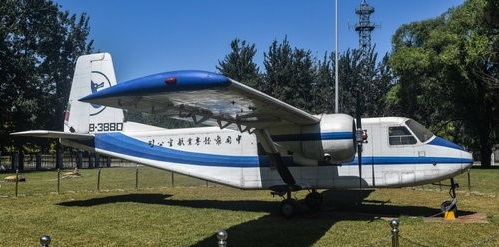
The Y-11 failed to attract export orders while equipped with Chinese radial engines, so it was converted to the Y-12.
In July 1982 it was reported that the Harbin Aircraft Works had developed a turbine-powered version of the Y-11, with PT6A-110 turboprops. A prototype was reputed to have flown. With a gross weight of 12,125 lb / 5500 kg, the maximum payload is 3748 lb / 1700 kg, and the Y-11T is estimated to have a max speed of 175 mph / 282 kph and a max range of 876 miles / 1410 km.
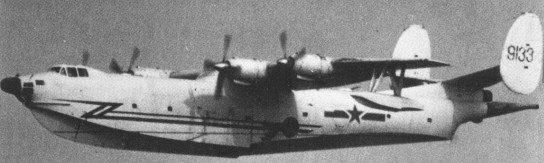
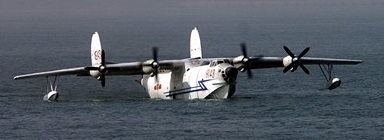
The SH-5 is an indigenous seaplane designed to replace the domestically produced Beriev Be-6s then in PLANAF service. Design work began in 1970, with the new aircraft aimed at performing maritime patrol and search and rescue duties. An entirely new in design, static testing didn’t begin until 1974. The Harbin Shuishang Hongzhaji 5 / PS-5 first flew April 1976, with series production commencing 1984 and 8-9 built to 1987 at Harbin.
The four-turboprop amphibian PS-5 appears to have the wing and powerplant of the Y-8 (An-12) transport and the tailplane and twin fins of the Beriev Be-6, combined with a new fuselage.
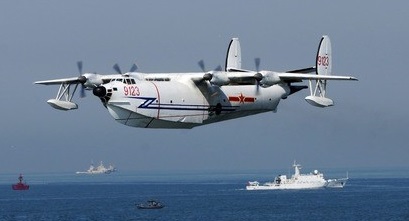
Powered by four 3,150 hp WJ¬-5A-1 (AI-24A) turboprops, PS-5S has 22,045-lb (10-tonne) max payload, includ¬ing four torpedoes or AShMs on underwing racks, or up to 13,227 lb (six tonnes) of depth bombs.
The SH-5 saw active use, and several of the aircraft were upgraded with EW systems. One example was converted for use as an aerial firefighter. In 2009, production of a new variant was announced with deliveries planned for 2014.
Created in 1952 from the Mansyu Hikoki Seizo Kabushiki Kaisha of Manchuria. Began the H-6 bomber program in 1957, initially assembling two Tu-16s from Soviet supplied components, the first flying in September 1959, but in 1961 this program was transferred to Xi’an. Manufactured the H-5 jet bomber from 1966 to the 1980s, based on the Soviet llyushin II-28. Developed and still produces the Y-11 (first flown about 1975) and Y-12 (first flown June 1984) general-purpose transports and Z-9 Haitun twin-turboshaft helicopter as license-produced Eurocopter Dauphin 2. Was pursuing development of a new helicopter in 1999, and is a partner in the Colibri EC 120 B helicopter program . Also produced two prototype (one static) and five production SH-5 anti-submarine amphibians (one civil, tested as a firebomber).
In 1998, the core company of Harbin Aircraft Industry Group (HAIG) was under under AVIC II and occupied a 514 ha (1.270 acre) site, including 350,000 sq.m of workshop space. The workforce in 1998 numbered approximately 18,000.
Harbin partnered with Eurocopter and Singapore Technologies Aerospace in the Eurocopter EC 120 Colibri programme, for which it builds the cabin.
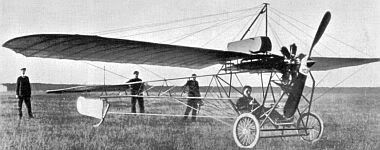
The 1912 Hanuschke Eindecker Model “Populaire II” was a German monoplane distinguished by its completely bare triangular tube fuselage fitted with a 50 hp rotary Gnôme engine.
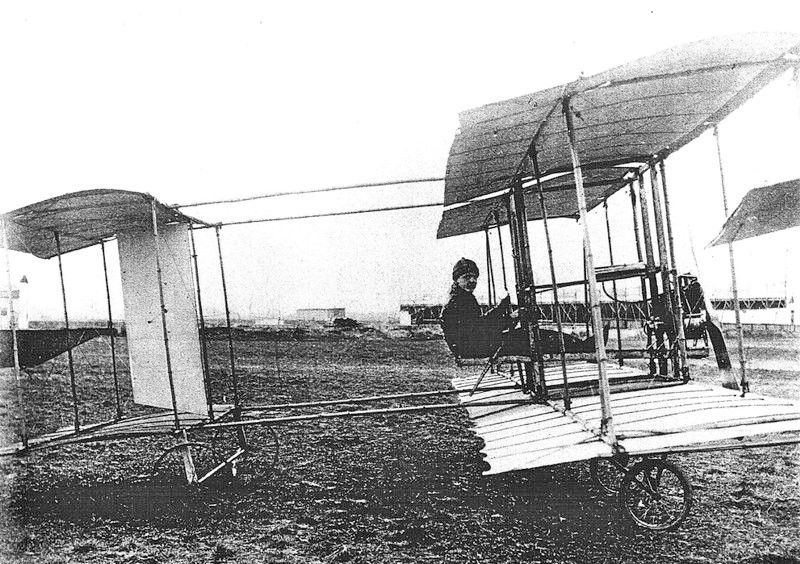
Bruno Hanuschke built his first powered plane, which looked much like his previous glider but powered by a two-cylinders engine. It was built (when as he was 18) in 1910 at Johannisthal, Germany. This biplane made only short hops.
Bruno Hanuschke built a glider with the help of his brother Willi, before 1910.
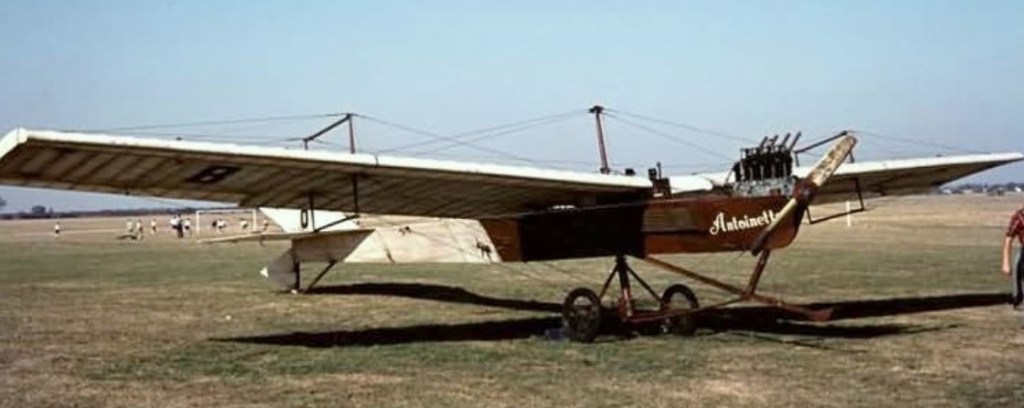
In 1964 Hants & Sussex Aviation was contracted to build three Levavasseur Antoinette IV monoplane replicas of 1910 vintage for the film ‘Those Magnificent Men in Their Flying Machines’. The Antoinette IV movie model closely replicated the slim, graceful monoplane that was very nearly the first aircraft to fly the English Channel, in the hands of Hubert Latham, and won several prizes in early competitions. When the Hants and Sussex Aviation Company from Portsmouth Aerodrome undertook its construction, the company followed the original structural specifications carefully, although an out-of-period de Havilland Gypsy I engine was used.
They were built in wood but the Antoinette’s wing structure proved, however, to be dangerously flexible, and lateral control was very poor, even after the wing bracing was reinforced with extra wires, and the original wing-warping was replaced with “modern” ailerons (hinged on the rear spar rather than from the trailing edge, as in the “real” Antoinette). The final configuration was still considered marginal in terms of stability and lateral control.
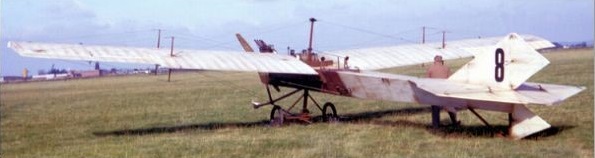
Both of the flying examples (one was static only) are thought to still exist. The first machine was noted in a hanger at Fairoaks in 1972 and the second machine was undergoing a rebuild in Geneva, Switzerland.
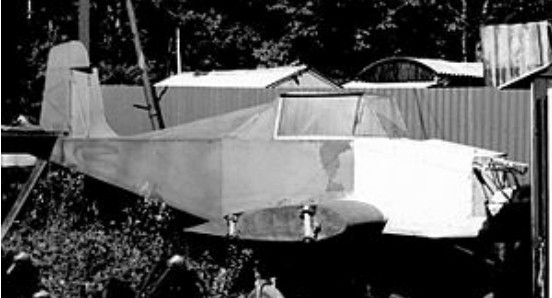
Hants and Sussex Aviation Ltd was an aircraft manufacturer based at Portsmouth Airport, Hampshire, England. It is still in business in the aircraft components industry.
In 1953, HSA designed its first aircraft. This was the H&S Herald. The Herald was a single-seat ultra-light aircraft with a fixed tricycle undercarriage and powered by a 40 h.p. Aeronca-JAP J-99 piston engine.
Aircraft Registration: G-ALYA
Construction Number: HA/AC/001
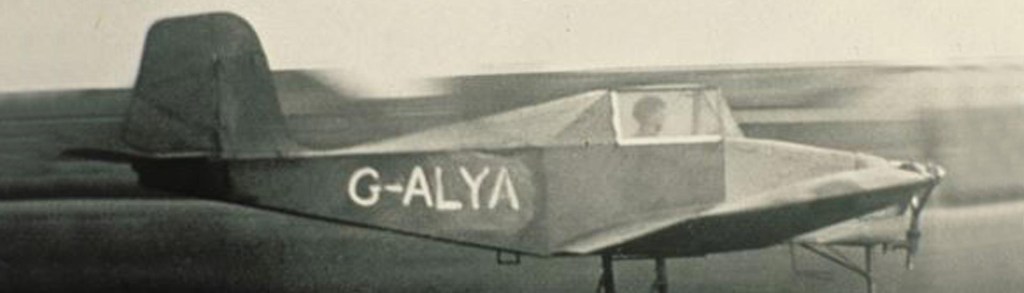
The Herald made flight tests at Portsmouth Airport in 1953, but these revealed that it had a poor performance and the aircraft was grounded and dismantled in 1955.
Powerplant: 1 × Aeronca-JAP J-99, 40 hp (30 kW)
Wingspan: 29 ft 0 in (8.84 m)
Length: 21 ft 6 in (6.55 m)
Empty weight: 580 lb (263 kg)
Gross weight: 900 lb (408 kg)
Maximum speed: 92 mph (148 km/h, 80 kn)
Cruise speed: 82 mph (132 km/h, 71 kn)
Crew: 1

