Hants and Sussex Aviation / HAS

Hants and Sussex Aviation (HSA) was formed in 1946 at Portsmouth Airport, Portsmouth, Hampshire, England, by the Hawes family (A.H.Hawes, W.E.Hawes, A.E.Hawes & F.G.Lewis) and initially worked on component manufacture and repair for military aircraft.

The first Hants and Sussex office was located above the archway of what was then the Bailey family business of builders and estate agents in Bognor Regis. The company’s first workshop was in Fratton, Portsmouth and comprised of an estimated 1,500 square feet. They relocated to the edge of what was then Portsmouth Municipal Airport in 1947 and have been here ever since.

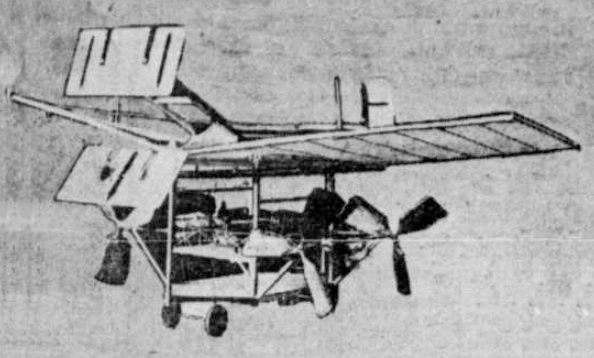
In 1953, HSA designed its first aircraft. This was the H&S Herald. The Herald was a single-seat ultra-light aircraft with a fixed tricycle undercarriage and powered by a 40 h.p. Aeronca-JAP J-99 piston engine. The Herald made flight tests at Portsmouth Airport in 1953, but these revealed that it had a poor performance and the aircraft was grounded and dismantled in 1955.

HSA were contracted in 1965 to build one of the pre-World One flying replica aircraft for the film Those Magnificent Men in their Flying Machines. HSAs aircraft was the Antoinette IV which they powered by a de Havilland Gypsy I engine.

HSA then concentrated on work on the overhaul, modification and repair of aircraft engines and components. In late 1976 the firm advertised its work on the overhaul and repair of Continental piston engines for aircraft. By September 1986 HSA were overhauling and modifying Rolls-Royce Dart and Pratt and Whitney PT-6 turboprop engines. HSA still carry on trading within the aviation support industry in 2008.
Hanson WH-1 Thunderchicken / Sump’n Else

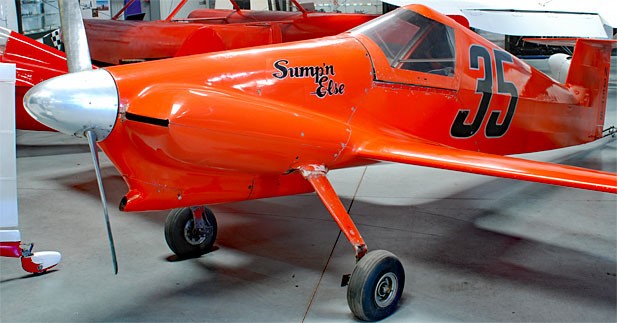
William Hanson’s WH-1 Formula 1 racer N35TS, Race 35, began life with the name of “Thunderchicken.” The fuselage is of welded tubular steel construction, with the cockpit and engine areas covered with sheet aluminum, and the area aft of the cockpit covered with fabric. The tail surfaces were constructed similarly to the aft fuselage. The wings were made of wood spars and ribs with plywood covering.

The aircraft, wearing the name “Thunderchicken,” qualified at the Cleveland Air Races in 1972, flown by Ken Haas. However, due to failure of the windshield, the aircraft failed to place. The same year, Tom Cooney flew finished in fifth place in the Formula 1 Silver Race at Reno, with a speed of 202.74 mph.

The WH-1 was renamed “Sump’n Else,” retaining race number 35, and repainted for the 1974 Reno Air Races, but did not qualify. In 1975, Thomas Summers flew “Sump’n Else” to a third-place finish in the Silver Race at Reno with a speed of 204.69 mph.

Engine: Continental 0-200
Span: 18 ft. 8 in
Length: 18 ft. 3 in
Height: 6 ft. 2 in
Maximum Speed: 225 mph
Crew: 1

Hanson Woodwind

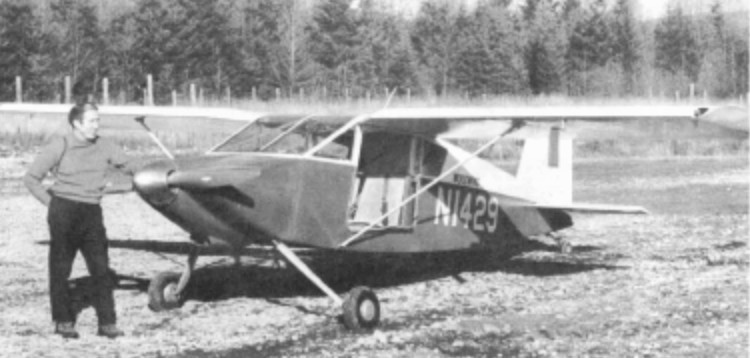
The Hanson Woodwind is an all-wooden homebuilt aircraft with a fiberglass wing designed by Carl Hansen.

The Woodwind is a two seat side-by-side configuration, strut-braced, high-wing aircraft with conventional landing gear and Plexiglas doors. Some construction elements were adapted from the all-wood Bowers Fly Baby. The Woodwind was a homebuilt copy of the Wittman Tailwind using all-wood construction, rather than welded steel tube and aircraft fabric covering for the fuselage. The Wittman design uses plywood covering for its wings, while the Woodwind uses fiberglass. The fuselage sides and tail surfaces are built flat on a table at the same time and covered with aircraft grade plywood. The wings are covered in fiberglass with stainless steel torque tubes for aileron control. The fuel tanks and cowling are also made from fiberglass. The prototype used a moose-hide interior.

The prototype first flew on 20 June 1969. The aircraft was written off in an non-fatal accident on 5 June 1976 after hitting a large rock.

Engine: 1 × Lycoming O-235-C, 100 hp (75 kW)
Propeller: 2-bladed variable-pitch Sensenich “Skyblade”
Capacity: 2
Empty weight: 851 lb (386 kg)
Gross weight: 1,425 lb (646 kg)
Fuel capacity: 32 U.S. gallons (120 L; 27 imp gal)
Maximum speed: 126 kt / 233 km/h (145 mph)
Cruise speed: 122 kt / 225 km/h (140 mph)
Stall speed: 52 kt / 97 km/h (60 mph)

Hansen Baby Bullet

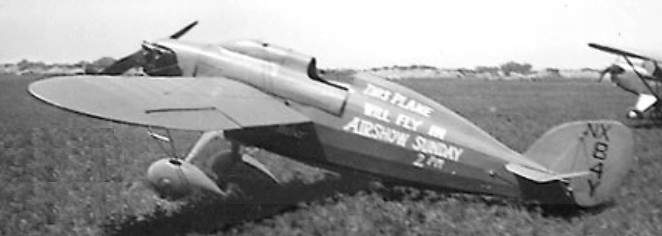
Hansen Special Baby Bullet III NR84Y

Three Hansen racers were built. The first a modified Heath Baby Bullet as Baby Bullet [11351]. The second, from a Heath 115, with 40hp Continental A-40 (span: 16’6″) as Baby Bullet II for 1932 Nationals [NR282W] (piloted by Art Davis and Walt Bagnick). The third as Baby Bullet III for 1934 Nationals [NR84Y] (piloted by Art Davis), and rebuilt in 1947 as Francis-Angell midget racer.

Baby Bullet I
Engine: Wright-Morehouse, 29hp
Wingspan: 20’0″
Seats: 1

Baby Bullet II
Engine: Continental A-40, 40hp
Wingspan: 16’6″
Seats: 1

Baby Bullet III
Seats: 1