1995-7: 2255 Orkla Dr., Golden Valley, MN 55427, USA.
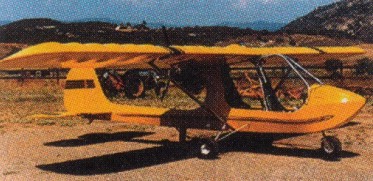
Highlander Aircraft Corp offerd the Highlander two-seat monoplane in kit form, but originally designed in the U.K. by Richard Noble as the ARV Super2, then becoming Island Aircraft ARV-1 Super 2 and Aviation Scotland ARV-1 Super 2. Also certificated in Sweden as the ASL Hagfors Opus 280.
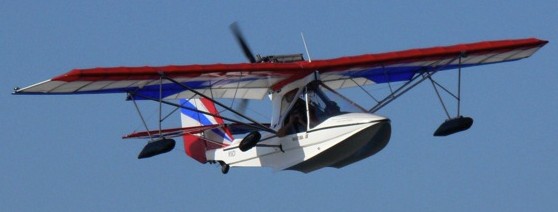
Receiving the “Best New Design” award at Oshkosh 1984 the Buccaneer was a conventional double-surface high-wing, three-axis control ultralight. Powered by a Rotax 277 single-cylinder, it came in three models — open framework, pod, and retractable amphibian. The landing gear was taildragger, or retractable/amphibian, using reinforced fiberglass hull & sponsons. Centre mounted joy stick, rudder pedals, tailwheel steerable through rudder pedals. Later marketed by Keuthan Aviation as the Buccaneer SX and Buccaneer II, and by Arnet Pereyra Inc as the Aventura 1 HP/A and Aventura II A. A modified version, retrofitable to Buccaneers was marketed by Advanced Aeromarine as the Mallard. The Mallard was available as a conversion for existing Buccaneers or as a complete kit. First flown in 1993. Although produced as an amphibious flying boat, the Buccaneer can be converted to a land plane by removing the boat hull and floats.
The Aero Adventure Aventura II Sport is a new model designed to minimize the expense and complexity of buying, building, and flying a two seat Aventura. With a strong 65 H.P. Rotax 582, the complete kit started at only $33,400. This is by far the most inexpensive two place amphibian on the market. Invest 250 hours of assembly time and this plane will be flying you and a friend anywhere. The 100 H.P. 4-Stroke Rotax 912ULS with its 18 gallon fuel tank allows a solid 3 hours of flight with reserve. $44,900 for the complete kit. The Aventura II XLR has a new engine cowling available, a new graphics package, an amazing new panel with AVMAP’s daylight readable GPS, a VSI, mode-C transponder, and more. Electric gear with indicator lights, differential hydraulic brakes, carpeting, headliner, 600-6 Soft Turf Tires, a 100 H.P. Rotax 912 ULS with an Air Box, a custom stainless steel exhaust, a warp drive 3-blade nickel edge prop and a spinner.
The Arnet Pereyra Buccaneer SX first flew in May 1986. The Arnet Pereyra Buccaneer II first flew in March 1984. The Arnet Pereyra Aventura UL and HP first flew in March 1995. The Arnet Pereyra Aventura II first flew in June 1995.
Buccaneer (Land) Empty wt: 228 lbs. Empty weight (De Luxe) 250 lbs. Wing span: 35 ft. Wing area: 147 sq.ft. Aspect ratio 8:1 Length: 17 ft 6 in Fuel cap; 4.5 USG. Construction: Aluminium, Dacron. Engine: Rotax 277 (268cc) 28hp. Max wt: 500 lbs. Stall speed: 20 mph. Max speed: 51 mph. Vne: 75 mph. Climb rate: 600 fpm @ 28 mph. Design limit: +5, -3.5g. Glide ratio: 8-1. Wing loading: 3.4 lbs/sq.ft. Power loading: 17.86 lbs/hp. Pilot weight category 90-225 lbs all models.
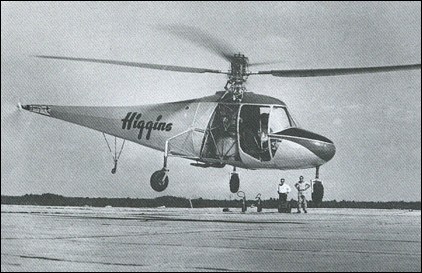
In 1942 an Aircraft Division was formed in Higgins Industries Inc, owned by Andrew Higgins, with the object of manufacturing transport aircraft for the United States Air Force. There was also a Helicopter Division concerned with building and perfecting a helicopter designed by Enea Bossi. This small two-seater helicopter had a main four-bladed rotor, consisting of two two-bladed rotors a few inches apart, and a small two-bladed tail rotor. The latter was fixed to the end of the upward-rising tail so that the tail rotor hub was at approximately the same level as the main rotor. The two-place, side-by-side cabin interior was designed to resemble as closely as possible that of a lightweight aircraft with a wheel control column and a standard panel of flying instruments. The fuselage is entirely covered, has a forward section with metallic skin, while the tail is covered with fabric. There is a small, two-bladed, vertical tail rotor and a fixed tricycle landing gear. The pitch-control and clutch-control levers look much like the gearshift on a car. The rudder pedals resemble brake and clutch pedals of an automobile.
In 1942 an Aircraft Division was formed in Higgins Industries Inc, owned by Andrew Higgins, with the object of manufacturing transport aircraft for the United States Air Force. There was also a Helicopter Division concerned with building and perfecting a helicopter designed by Enea Bossi.
In 1914 Otto Hieronimus manufactured the six-cylinder Hiero E, also known as the Hiero 6 engine which was derived from earlier 4-cylinder engines. The Hiero engine like the Austro-Daimler powered many of Austria’s World War I aircraft. Hiero aircraft engines were designed by Otto Hieronimus, a famous Austrian auto racer of the early 1900s. His initial designs were liquid-cooled inline engines built by the Laurin & Klement Automobile Works of Austria.
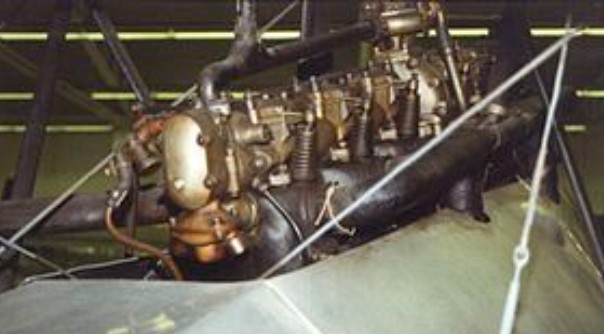
The Hiero E had a 135 mm x 180 mm bore/stroke (15.46L / 943.4cuin) and delivered 200-230 hp. The engine had the typical features of an inline vertical 6-cylinder: aluminum bed, cast iron cylinders, one inlet and one exhaust valve per cylinder controlled by bars and rockers, with the cam-shaft in the bed, and dual ignition by two Bosch magnetos. During World War I, the highly regarded Hiero engines were built under license by Essler, Warschalowski & Company of Vienna and the Breitfeld-Daněk company of Czechoslovakia. A point of recognition of Hiero engines compared with other Central Powers OHC inline’s is that the intake was on the right and the exhaust on the left. After World War I, production was continued by the Avia company and powered a number of their early aircraft.
Variants: Hiero 145hp: 145 hp (108.1 kW) (probably designated Hiero B or Hiero C ) Hiero 185hp: 185 hp (138.0 kW) (probably designated Hiero D) Hiero E: 200 hp (149.1 kW) – 230 hp (171.5 kW)
Hiero E Type: 6-cyl in-line Water-cooled Bore: 135 mm (5.31in) Stroke: 180 mm (7.09in) Displacement: 15,459 cc (943cu in) Designer: Otto Hieronimus Valvetrain: overhead-cam Cooling system: water Power output: 200 – 230 hp (149 – 172 hp)