Hidemasa MXY8 Akikusa

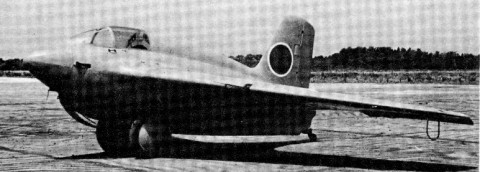
When developing the Mitsubishi J8M1 (Me-163 copy) the Japanese were unfamiliar with the handling characteristics of aircraft lacking a conventional horizontal tail. To provide a means of expediting the training of pilots eventually to be assigned to the rocket-driven fighter, the Scientific Division of the Navy Air Technical Arsenal at Yokosuka had been assigned the task of creating a full-scale wooden glider version of the Shusui. While definitive design work and prototype construction proceeded at Nagoya, Hidemasa Kimura who had been responsible for the Tachikawa-built A-2600 that had created a new international closed-circuit distance record developed the glider which was known as the MXY8 Akikusa (Autumn Grass). This was flown for the first time at the Hyakurigahara airfield, the base of the 312th Naval Air Group which, it had been decided, would be the first recipient of the Shusui. This event took place on 8 December, its pilot being Lt Cdr Toyohiko Inuzuka who had taken the place of Lt Cdr One as the project test pilot after the latter had been taken ill. The Akikusa glider was towed into the air by a Kyushu K10W1 and its handling characteris¬tics received a highly favourable report from Jnuzuka. The second Akikusa was sent to the Army Aerotechnical Research Institute, the Rikugun Kokugijutsu Kenkyujo, at Tachikawa where it was tested by Col Aramaki with similarly successful results.
On 1 December, the completed structural test specimen was inspected and approved by both services, but a week later, on 7 December, the Tokai district, in which Nagoya was situated, was wracked by strong earth tremors and the airframe, which was undergoing loading tests, was overstressed and suffered distortion, On 18 December, the Ohe plant in which the “heavy gliders” were being built suffered a heavy attack from B-29 Superfortresses and it was decided to transfer the salvaged airframes, together with the structural test specimen, to a plant that had been created in a mountain cave at Taura, Yokosuka, although the Ohe plant continued, together with the Nanko plant, to build a number of pre-series Shusui interceptors. Despite these setbacks, the first “heavy glider” Shusui was test flown by Lt Cdr Inuzuka at Hyakürigahara airfield on 8 January 1945, after being towed into the air by a Nakajima B6N1 Tenzan attack bomber.
For the initial flight, the engineless Shusui weighed 2,286 lb (1037 kg) and the Cl was situated at 16.8 per cent of the aerodynamic mean chord, Inuzuka confirming that there was no difference between the handling characteristics of this “heavy glider” and the Akikusa apart from a minor change of trim at take-off. During subsequent flights, some devon vibration was experienced at gliding speeds in excess of 184 mph (296 km/h) but this was eradicated when the gap between the wing and elevon was reduced and the Frise balance near the devon tip shortened. Various problems were encountered in the oil pressure system, but these were quickly resolved and in March all Navy flight testing of the “heavy glider” was to be pronounced satisfactorily completed. The second “heavy glider” was tested by the Navy at the Kashiwa airfield, Chiba, and this was eventually to be tested also by the Army. These tests were not to commence until August, and at an early stage in the trials, the Shusui parted company with its towplane prematurely and crashed in a pine forest, its pilot suffering injuries.

Hicks Kestrel / Merlin

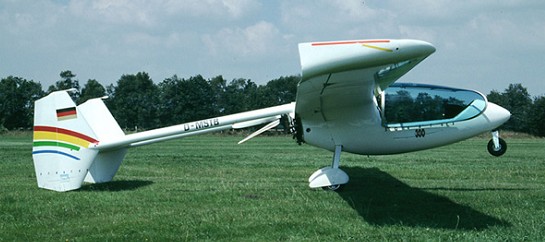
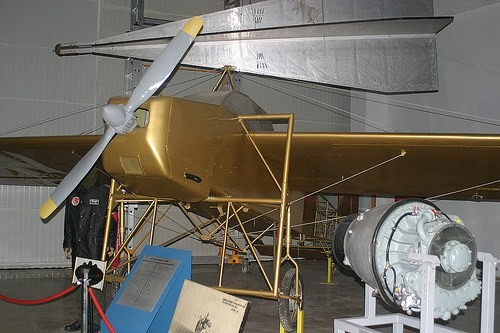
The Hicks Merlin, initially called the Hicks Kestrel, was a single-seat high performance sailplane designed and built by W.E. Hicks at the Newcastle Gliding Club from 1933 to 1936.

A parasol, braced three-piece wing with no air-brakes or flaps. The undercarriage was a main skid and tail skid. It was fitted with an “Automatic Rudder”.

It was first flown on 2 February 1936 at Moat Law, UK.

No B.G.A. CofA was issued. As the fuselage contours were shaped around Eddie Hick’s profile the Merlin was of ‘little use to any other person’.

It was eventually purchased for £1 for the Newcastle Club bonfire and burnt pre-war.

Wingspan: 10.46 m / 34 ft 4 in
Length: 4.50 m / 14 ft 9 in
Wing area: 7.43 sq.m / 80 sq.ft
Aspect ratio: 14.8
Wing section: Gottingen 652
Empty weight: 40.82 kg / 90 lb
AUW: 116.12 kg / 245 lb
Wing loading: 15.63 kg/sq.m / 3.2 lb/sq.ft
Max L/D: 20
Min sink: 0.61 m/sec / 2.0 ft/sec

HIBM Blériot AK-01X / AK-2000X

HIBM AK-2000X (01)

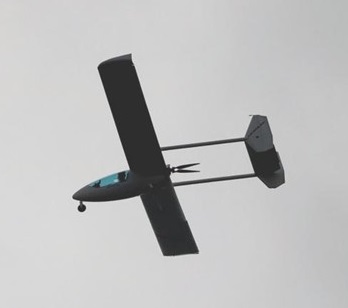
From 8 Febuary to 15 May 1914, four Turkish airmen flew a 2500 km long-haul flight – Istanbul-Damascus-Jerusalem-Cairo-Alexandria, in a Blériot XI. To commemorate this in part tragic, but very successful in the end, flight, the Turkish state television TRT decided to film a recreation.

In 2001 HIBM built two modified, but flyable replicas of the aircraft. Because the replicas corresponded little to the original Blériot XI aircraft, there was some discord. With two Blériot AK-2000X aircraft a re-enactmet of the same route of 1914 was carried out during 15 May -18 June 2001.

Variants:
Blériot AK-01X
One built

Blériot AK-2000X
Two built

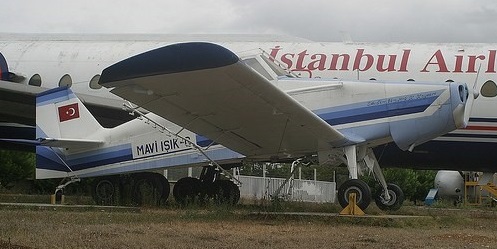
HIBM Mavi Isik

HIBM Mavi Isik G-1 (001)

In 1978 2.HIBM constructed and developed the Mavi Isik 78-XA-1 agricultural aircraft. The maiden flight (TC-TXA) was successfully conducted in February 1979 in Kayseri. The sequent Mavi Isik-B (1980) and Mavi Isik-G-1 (1983) were developed from the prototype. It did not enter series production. Instead, Turkey bought Pezetel M-18A Dromader agricultural / fire-fighting aircraft.

HIBM / Ikmal Hava ve Bakim Merkezi

Turkish aircraft in the true sense began only after the founding of the Republic in 1923. A small delegation was dispatched to Europe to procure aircraft for the new Turkish Air Force. After evaluation it was decided to obtain 16 Bréguet XIV A-2, 39 Caudron C-27 and 32 Caudron C-59 aircraft. These aircraft were dismantled in 1924 and shipped to the Gaziemir / Izmir Air Force Base under French supervision. After the first requirements of the Turkish Air Force, the armed force withdrew from the assembly of planes however, this plan did not last long. When in the course of technical development, the maintenance became more complicated and more complex, the maintenance facilities of these forces were again entrusted with the manufacture of spare parts or installation or modernization of aircraft. So the 1st Air Supply and Maintenance Center emerged (1 Ikmal Hava ve Bakim Merkezi, 1.HIBM) in Eskisehir (1926), the 901 Home Depot and production plant for aircraft (the 901.Hava Araci Ana Depo ve Fabrika Komutanligi, nine hundred and first HAADFK) in Polatlı (1948, 1962 in Ankara) and the 2nd Air Supply and Maintenance Center (2nd Hava Ikmal ve Bakim Merkezi, 2.HIBM) in Kayseri (1950).

Heydecke V16

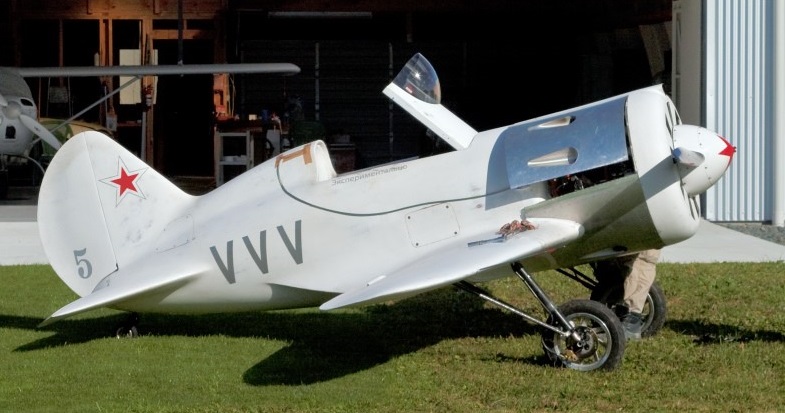
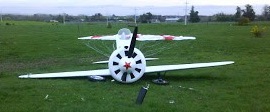
A home built 2/3 scale Polikarpov I-16 replica built by Volker Heydecke of Drury, New Zealand. Volker Heydecke is a mechanical engineer but did not weld a single piece on this airplane. He trusted a licensed airplane welder to do this. The only welded truss-system is the engine mount. There are a few welded brackets made from steel, the undercarriage is bolted. The rest is self supported composite structure (monocoque).

On Saturday, 29 August 2009, around 1730 hrs, the pilot was conducting stalls as part of the test flying regime. On on the second stall, the left wing dropped and the aircraft entered a spin. Standard recovery techniques did not arrest the spin, so the pilot transmitted a distress message and deployed the aircraft ballistic recovery chute. The aircraft sustained damage to the propeller and undercarriage on landing in a farm paddock. The pilot was able to vacate the aircraft with only minor injuries.

Serial: V16001