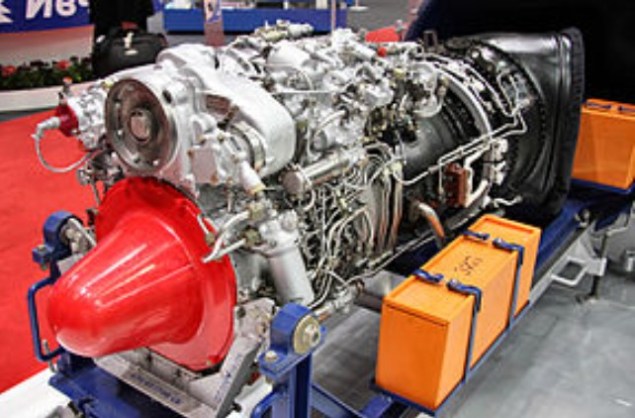
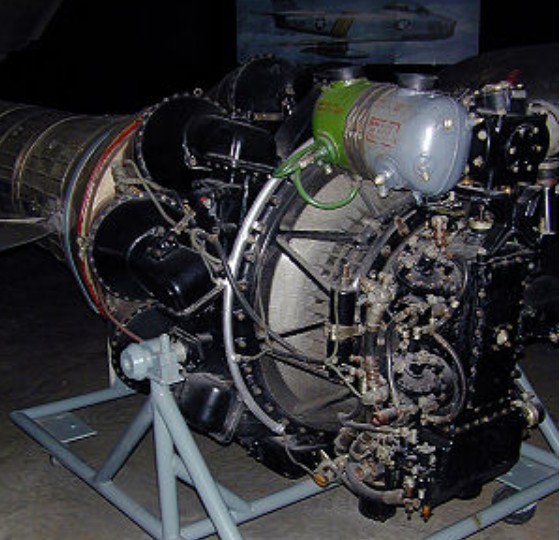
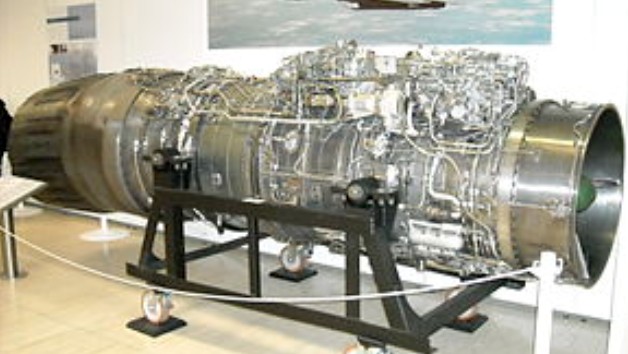
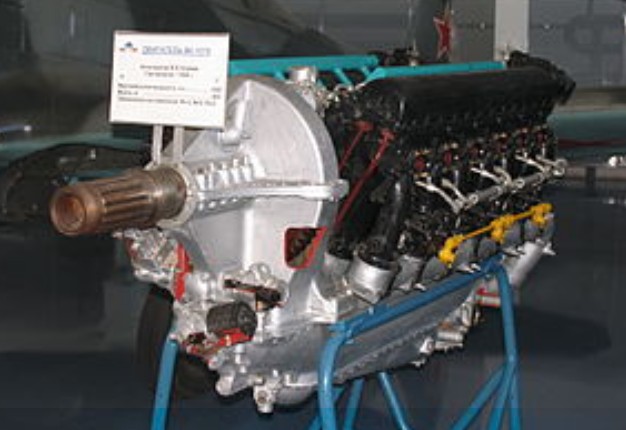
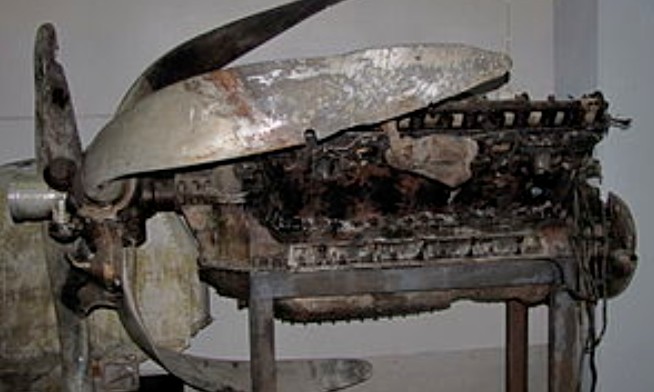
Klimov VK-800

The Klimov VK-2500 is a Russian turboshaft aero-engine, a high power derivative of the Klimov ТV7-117VMA engine also for hot and high.

It differs from the older versions in having an extended overhaul period of the engine hot components, extra gas-dynamic stability at varying duties, engine parameters accuracy and engine control quality, enhanced monitoring depth providing operation of the engine according to its technical condition and better weight characteristics and overall dimensions.

Variants:
VK-2500-01
Has 1750shp (1287kW) maximum continuous performance and a 2400 shp (1764kW) take-off performance

VK-2500-02
Has a 1500shp (1103kW) maximum continuous performance and a 2200 shp (1617kW) take-off performance

VK-2500-03
Has a 1500shp (1103kW) maximum continuous performance and a 2000 shp (1470kW) take-off performance

Applications:
Kamov Ka-50
Kamov Ka-52
Mil Mi-28

Specifications:
VK-2500
Type: Turboshaft
Dry weight: 300kg
Maximum power output: 1287kW (1750shp)
Specific fuel consumption: 0.22 kg/hp/hr

Klimov VK-2500

The Klimov VK-2500 is a Russian turboshaft aero-engine, a high power derivative of the Klimov ТV7-117VMA engine also for hot and high.

It differs from the older versions in having an extended overhaul period of the engine hot components, extra gas-dynamic stability at varying duties, engine parameters accuracy and engine control quality, enhanced monitoring depth providing operation of the engine according to its technical condition and better weight characteristics and overall dimensions.

Variants:
VK-2500-01
Has 1750shp (1287kW) maximum continuous performance and a 2400 shp (1764kW) take-off performance

VK-2500-02
Has a 1500shp (1103kW) maximum continuous performance and a 2200 shp (1617kW) take-off performance

VK-2500-03
Has a 1500shp (1103kW) maximum continuous performance and a 2000 shp (1470kW) take-off performance

Applications:
Kamov Ka-50
Kamov Ka-52
Mil Mi-28

Specifications:
VK-2500
Type: Turboshaft
Length:
Diameter:
Dry weight: 300kg
Compressor:
Maximum power output: 1287kW (1750shp)
Specific fuel consumption: 0.22 kg/hp/hr

Klimov RD-500

The Klimov RD-500 was an unlicensed Soviet copy of the Rolls-Royce Derwent Mk.V turbojet that was sold to the Soviet Union in 1947.

Producing metric drawings and analyzing the materials used in the Derwent went fairly quickly, but finding a substitute for the high-temperature, creep-resistant Nimonic 80 steel alloy was a more difficult challenge. Eventually an alloy that matched Nimonic 80’s high-temperature properties was found in KhN 80T, but it was not creep-resistant. The first Derwent copy, designated as the RD-500 (Reaktivnyy Dvigatel’ — jet engine) after the Factory No. 500 where the engine was first produced, was being tested on 31 December 1947, but problems cropped up quickly. Combustion was uneven and this cracked the combustion chambers. This may have had something to do with the modifications made by the Soviets to the fuel, speed and starter systems. But these problems were resolved by September 1948 when the engine passed its 100-hour State acceptance test.

RD-500 was a close copy of the Derwent with a single-stage centrifugal compressor, nine combustion chambers and a single-stage turbine. It matched the Derwent’s thrust of 15.9 kN (3,506 lbf) and was only 13.7 kg (30 lb) heavier. The main problem with the engine in service was with its turbine blades, 30% of which failed inspection due to recrystallization after casting. The poor creep resistance of the KhN 80T alloy resulted in dangerous elongation of the turbine blades. Up to 40% of the early production RD-500s had to be individually adjusted before delivery and the service life of the engine never approached the 100 hours demonstrated in the acceptance test.

The Soviets had enormous problems building the engines to standard, as demonstrated in the 20,000 man-hours required to build a single engine in 1947. This figure dropped to a more reasonable 7,900 man-hours by November 1948 and declined further still to 4,734 man-hours by 1 March 1949, close to the target of 4,000 man-hours. Production by Factory No. 500 totaled 97 in 1948 and 462 in 1949. Factory No. 16 in Kazan was brought into the program and built 300 engines in 1949. Production was canceled around 1950 in favor of the superior Klimov VK-1 turbojet based on the Rolls-Royce Nene.

The RD-500 was used in a number of early Soviet jet fighters including the Lavochkin La-15, the Yakovlev Yak-25, and the Yakovlev Yak-30, but only the Yakovlev Yak-23 was accepted for service, albeit in small numbers.

Applications:
Lavochkin La-15
Mikoyan-Gurevich KSK test plane
Raduga KS-1 Komet
Yakovlev Yak-23
Yakovlev Yak-25
Yakovlev Yak-30
Yakovlev Yak-1000

Specifications:
RD-500
Type: Turbojet
Length: 2.11 metres (6 ft 11 in)
Diameter: 1.09 metres (3 ft 7 in)
Dry weight: 580.7 kg (1,280 lb)
Compressor: Single-stage centrifugal compressor
Combustors: Nine
Turbine: Single-stage
Maximum thrust: 15.9 kN (3,600 lbf)
Specific fuel consumption: 1.4
Thrust-to-weight ratio: 2.73

Klimov VK-1 / RD-45 / Shenyang PF-1

Klimov VK-1

Immediately after World War II, the Soviet Union manufactured copies of first generation German Junkers 004 and BMW 003 engines, which were advanced designs with poor durability, limited by Germany’s availability of rare metals at wartime. However in 1946, before the Cold War had really begun, the new British Labour government under the Prime Minister, Clement Attlee, keen to improve diplomatic relations with the Soviet Union, authorised Rolls-Royce to export 40 Rolls-Royce Nene centrifugal flow turbojet engines. In 1958 it was discovered during a visit to Beijing by Whitney Straight, then deputy chairman of Rolls-Royce, that this engine had been copied without license to power the MiG-15 ‘Fagot’, first as the RD-45, and after initial problems of metallurgy forced the Soviet engineers to develop a slightly redesigned (and metallurgically closer) copy, the engine had then entered production as the Klimov VK-1 (Rolls-Royce later attempted to claim £207m in license fees, without success).

It was developed by Vladimir Yakovlevich Klimov and first produced by the GAZ 116 works.

The RD-45 was further improved to produce the VK-1, which differed from the Nene in having larger combustion chambers, larger turbine, and revised airflow through the engine. The VK-1F added the afterburner.

The engine featured a centrifugal compressor, requiring a larger-diameter fuselage than aircraft featuring the more progressive axial compressor designs that had already appeared in WWII Germany and Britain. The engine was built under license in China as the WP-5.

Applications:
The VK-1 was used to power MiG-15 ‘Fagot’ and MiG-17 ‘Fresco’ fighters, as well as the Il-28 ‘Beagle’.

Specifications:
VK-1
Type: Turbojet
Length: 2,600 mm (102 in)
Diameter: 1,300 mm (51 in)
Dry weight: 872 kg (1,395 lb)
Compressor: Centrifugal compressor
Maximum thrust: 26.5 kN (5,955 lbf)
Specific fuel consumption: 109.1 kg/(kN·h) (1.07 lb/(lbf·h))
Thrust-to-weight ratio: 41.4 N/kg (4.27:1)

Klimov RD-33 / RD-93 / SMR-95

The Klimov RD-33 is a turbofan engine for a lightweight fighter jet that is the primary engine for the Mikoyan MiG-29. It was developed in OKB-117 led by S. P. Izotov (later OAO Klimov) from 1968 with production starting in 1981. Previous generations of Russian supersonic fighters such as the MiG-21 and MiG-27 used turbojets, but western fighters such as the F-111 and F-4K introduced the use of afterburning turbofans in the 1960s which were more efficient. The RD-33 was the first afterburnering turbofan engine produced by the Klimov company of Russia in the 8,000 to 9,000 kilograms-force (78,000 to 88,000 N; 18,000 to 20,000 lbf) thrust class. It features a modular twin-shaft design with individual parts that can be replaced separately and has a good tolerance to the environment. The RD-33 is simple to maintain and retains good performance in challenging environments.

Variants:
In early 1970s the RD-33 was selected for new light fighter jet, later becoming Mikoyan MiG-29, the other option was Tumansky R-67-300. Years of development has built an extensive engine family. A newly designed thrust vectoring nozzle (TVN) was available. Newer models of the RD-33 family include BARK digital monitoring and control systems. Repair and maintenance of RD-33 engines takes advantage of an information and diagnostics system (IDS).

RD-33
Baseline model developed in 1976 to power the MiG-29.

RD-33B/NB
A model without afterburner for various types of aircraft, such as the Il-102.

RD-93
A variant used to power the JF-17 / FC-1. According to JF-17.com “The most significant difference being the repositioning of the gearbox along the bottom of the engine casing.” The Klimov poster at Zhuhai 2010 airshow gave the thrust of the engine to be up to 98 kN.

SMR-95
A model for upgrading international 2nd and 3rd generation jet fighters. The accessory gearbox is repositioned below the engine, length can be varied depending on the adopted aircraft fuselage. The engine passed bench tests and flight tests on the Super Mirage F-1 and Super Cheetah D-2 aircraft of the South African Air Force and had achieved an improvement in flight performance and combat efficiency by a factor ranging from 1.2 to 3.0.

RD-33 series 3
A revised model with a longer service life used on later or upgraded old variants of the MiG-29 such as MiG-29M and MiG-29SMT. A pair of RD-33 series 3 engine equipped with TVN is currently undergoing flight tests as a component of the MiG-29OVT jet fighter.

RD-33MK
The RD-33MK “Morskaya Osa” (Russian: Морская Оса: “Sea Wasp”) is the latest model developed in 2001. It is intended to power the MiG-29K and MiG-29KUB shipborne fighters, however it has also been adopted for the MiG-35. The RD-33MK develops 7% higher thrust, is digitally controlled FADEC and smokeless unlike earlier RD-33 engines, has increased afterburner thrust to 9,000 kilograms-force (88,000 N; 20,000 lbf) and dry weight 1,145 kilograms (2,524 lb) compared to the baseline model through modern materials used on the cooled blades, although it retains the same length and maximum diameter. Incorporated is an infrared and optical signature visibility reduction systems. Service life has been increased to 4,000 hours. The RD-33MK ensures shipborne fighters unassisted take-off capability, retain performance in hot climate environment and, naturally, a boost in combat efficiency for MiG-29 fighter latest variant.

Specifications:

RD-33
Type: afterburning turbofan
Length: 4,229 mm (166.50 in)
Diameter: 1,000 mm (39.37 in)
Dry weight: 1,055 kg (2,326 lb)
Compressor: 2 spool axial, 4 low pressure stages, 9 high pressure stages
Combustors: annular combustor
Turbine: Single stage high pressure, single stage low pressure
Maximum thrust: 50.0 kN (11,230 lbf) Dry, 81.3 kN (18,285 lbf) Afterburning.
Overall pressure ratio: 21:1
Bypass ratio: 0.49:1
Turbine inlet temperature: 1,407 °C (2,565 °F)
Specific fuel consumption: 75 kg/(kN·h) (0.77 lb/(lbf·h)) dry, 188 kg/(kN·h) (1.85 lb/(lbf·h))
Thrust-to-weight ratio: 4.82:1 (dry), 7.9:1 (afterburning)
Life expectancy: 4,000 hours

RD-93
thrust=49.4 kN Dry, 81.4 – 88.4 kN Afterburning.

Klimov M-120

The Klimov M-120 was a Soviet prototype 18-cylinder liquid-cooled inline aircraft engine designed during the early years of World War II. Testing did not go well and it was cancelled in 1942.

The M-120 was developed by arranging three Klimov M-103A cylinder blocks in an inverted ‘Y’ configuration, driving a common crankshaft. It began development in 1938 and manufacture of five prototypes began in late 1939. The first prototype was completed on 30 October 1939 and began bench tests the next year. Two M-120TKs were flown in a prototype Ilyushin DB-4 bomber in November 1940. It was submitted for its State acceptance trials in August 1941, but the main connecting rod and the supercharger both broke down and the tests were not completed. The project was cancelled in 1942.

Variants:
M-120
1,600 hp (1,193 kW), weight of 850–895 kg (1,874–1,973 lb).
M-120TK
1600 hp, weight of 950 kg (2,094 lb), fitted with turbo-supercharger.
M-120UV
1,800 hp (1,342 kW). Version with a long shaft to the remote reduction gear.
M-120UV-TK
A 1940 project to combine the two variants.

Specifications:
M-120TK
Type: liquid-cooled, 18-cylinder, three-block inline engine
Bore: 148 mm (5.8 in)
Stroke: 170 mm (6.7 in)
Displacement: 54 l (3,295 cu in)
Dry weight: 950 kg (2,090 lb)
Supercharger: single stage, two-speed geared
Cooling system: liquid
Power output: 1,600 hp (1,193 kW)
Compression ratio: 6.6:1

Klimov VK-107

The Klimov VK-107 was a V-12 liquid-cooled piston aircraft engine used by Soviet aircraft during World War II.

The VK-107 was a brand-new design having little in common with its predecessors M-105 and VK-106. To achieve a greater power output, each cylinder now had four valves (two intake and two exhaust), crankshaft and camshafts were completely revised, and a new supercharger design was implemented. Although the engine could have been ready for production as early as 1942, Soviet factories lacked the capacity to produce a brand new design. Thus, less powerful VK-105PF and VK-105PF2 were built instead. However, the appearance of Luftwaffe Messerschmitt Bf 109G with Daimler-Benz DB 605 engine in 1943 created an urgent demand for a more powerful engine. VK-107A was put into production in 1944 and was used on Yak-9U fighters. The engine was not well liked by either pilots or mechanics — it had a life expectancy of only 25 hours and war emergency power was almost never used for fear of decreasing this even more. The engine was also difficult to service, in part because its exhaust headers were on the inside of the cylinder banks, the reverse placement of most V-type liquid-cooled engine designs.

Variants:
VK-107A – production version
VK-107R – version for hybrid piston-motorjet powered Mikoyan-Gurevich I-250 (N) and Sukhoi Su-5 fighters
VK-108 – attempt to further develop VK-107 with 1,380 kW (1,850 hp) on takeoff, used on several Yakovlev Yak-3 prototypes but did not enter production.

Applications:
Mikoyan-Gurevich MiG-7
Petlyakov Pe-2
Yakovlev Yak-3
Yakovlev Yak-9

Specifications:
VK-107A
Type: 12-cylinder supercharged liquid-cooled Vee aircraft piston engine
Bore: 148mm (5.83in)
Stroke: 170mm (6.69in)
Displacement: 35.08 liters (2,140 in³)
Dry weight: 765 kg (1,685 lb)
Valvetrain: Two intake and two exhaust valves per cylinder actuated via an overhead camshaft
Supercharger: Single stage, two-speed, gear-driven centrifugal type supercharger
Cooling system: Liquid-cooled
Power output:
1,230 kW (1,650 hp) at 3,200 rpm for takeoff
1,082 kW (1,450 hp) at 2,800 m (12,500 ft)
Specific power: 35.1 kW/L (0.77 hp/in³)
Compression ratio: 6.75:1
Power-to-weight ratio: 1.61 kW/kg (0.98 hp/lb)

Klimov VK-106

The Klimov M-106 was an experimental liquid-cooled V12 piston aircraft engine intended for Soviet aircraft during World War II.

With the VK-105PF exhausting the potential of the M-105, Klimov prolonged its development into new VK-106 engine from 1941. Since air combat on the Eastern Front took place primarily at low altitudes (under 4,000 m {13,000 ft}), the new engine was built specifically for peak performance at those altitudes with a reduced compression ratio and a single-speed supercharger. Static testing was carried out from 27 October till 9 November 1942. Although reliable and easily installed in M-105-powered aircraft, VK-106 did not enter production because its cooling problems were not solved. Like M-105P, VK-106P could house an autocannon in the “vee” between the cylinder banks. Over 300 engines were built.

Applications:
Yak-1b with M-106

Specifications:
VK-106-1sk
Type: 12-cylinder supercharged liquid-cooled piston aircraft engine
Bore: 148mm (5.83 in)
Stroke: 170mm (6.69 in)
Displacement: 35.08 liters (2,140 in³)
Dry weight: 600 kg (1,320 lb)
Supercharger: Gear-driven single-stage single-speed centrifugal type supercharger
Fuel type: 95-octane rating gasoline
Cooling system: Liquid-cooled
Power output:
1,007 kW (1,350 hp) at 2,600 rpm for takeoff
1,007 kW (1,350 hp) at 2,000 m (6,560 ft)
Specific power: 28.8 kW/L (0.63 hp/in³)
Compression ratio: 6.5:1
Power-to-weight ratio: 1.68 kW/kg (1.02 hp/lb)

Klimov M-103

Klimov M-103 engine recovered from Tupolev SB wreck

The Klimov M-103 is a V12 liquid-cooled piston aircraft engine used by Soviet aircraft during World War II.

The M-103 was a further development of the Klimov M-100 engine that was itself a licensed copy of the French Hispano-Suiza 12Ybrs. It differed from both engines in a number of aspects such as increased compression ratio, increased supercharger ratio, increased rpm’s, strengthened cylinder blocks, a new crankshaft, and flat bottomed cylinders. Developed in 1936 it was ready for testing in October 1936. The first two models failed testing due to cracked cylinder blocks and the engine was resubmitted for testing in 1937. After passing its trials it was cleared for production in 1938 and 11,681 were produced until 1942 at its factory in Rybinsk. The M-103 was followed by the M-105.

Variants:
M-103A – 148mm rather than 150mm bore cylinders.
M-103P – A ShVAK cannon fitted to fire through the engine vee.
M-103SP – A proposed version with two engines married to a common crankshaft.
M-103G – With Glycol rather than water cooling.
M-103A-TK – With an experimental Turbo-Supercharger
M-103U – Improved service life variant.
M-104 – Basically a M-103A with a two speed single stage supercharger for increased performance. 232 built.

Applications:
Bolkhovitinov S
Beriev MBR-7
Polikarpov TsKB-44
Polikarpov VIT-1 & VIT-2
Tupolev SB
Yakovlev Yak-2
Yakovlev Yak-12
Yakovlev Yak-22

Specifications:
M-103A
Type: Twelve-cylinder supercharged liquid-cooled 60° V12 engine
Bore: 148mm (5.826 in)
Stroke: 170mm (6.693 in)
Displacement: 35.101 Liters (2,142.2 cu in)
Length: 1,971 mm (77.6 in)
Width: 764 mm (30.08 in)
Height: 942 mm (37.08 in)
Dry weight: 500 kg (1,101 lb)
Valvetrain: One intake and one sodium-filled exhaust valve per cylinder actuated via a single overhead camshaft per bank.
Supercharger: Gear-driven single-speed centrifugal type compressor. Gear ratio: 11.0:1. Maximum boost for take-off: 1,100 mm Hg (43.30 MP). Maximum boost at altitude: 920 mm Hg (36.22 MP). Critical altitude: 4,000 m (13,123 ft)
Fuel system: Six K-100A Carburettors (License copy of Solex-Hispano 56S2 self-adjusted carburettor)
Fuel type: 90 (minimum grade), 95 or 100 octane.
Cooling system: Liquid-cooled
Reduction gear: 2:3
Power output:
1,000 hp (745 kW) at 2,450 RPM for take-off, boost rated at 1.44 Atm (43.30 MP)
960 hp (715 kW) at 2,400 RPM at 13,123 ft (4,000 m), boost rated at 1.21 Atm (36.22 MP)
500 hp (372 kW) at 2,450 RPM at 30,839 ft (9,400 m)
Specific power: 21.22 kW/L (0.466 hp/in³)
Compression ratio: 6.6:1
Specific fuel consumption: 328 g/(kW•h) (0.54 lb/(hp•h))
Oil consumption: 11 g/(kW•h) (0.28 oz/(hp•h))
Power-to-weight ratio: 1.50 kW/kg (0.916 hp/lb)

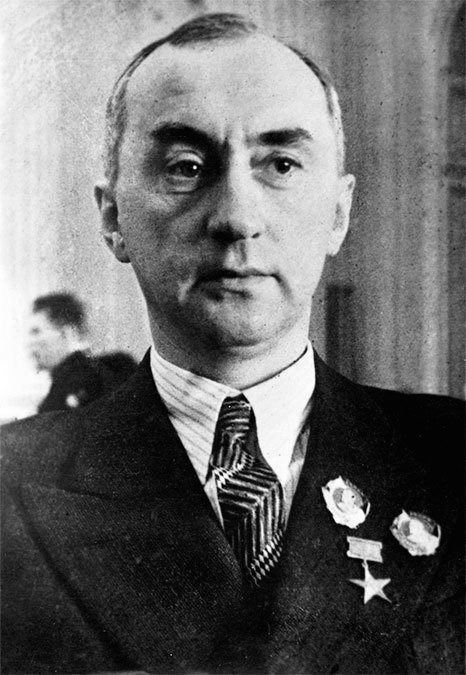
Klimov, Vladimir Yakovlevich

Vladimir Yakovlevich Klimov was born on 23 July 1892 in Moscow and studied at the Technical School Komissarovskom.

In 1918 he graduated from the Faculty of Mechanical Engineering of the Technical State University of Moscow NE Bauman and began his career in October of 1919 in Kolomna factory, an engineering company based in Moscow.

From July 1918 to 1931 he worked interchangeably as chief laboratory engineer, department head, assistant director of the automotive research laboratory of this factory which later became the Soviet Scientific Institute of Engines (NAMI).

After 1931 he became Head of the Department of Technical Control of gasoline engines of the Central Institute of Aviation Engines and at the same time, he worked as a professor at the Moscow Higher Technical School, the Lomonosov Institute and the Military Academy of the Force, Zhukovsky Aerial.

He was also head of the Engine Design Department at the Moscow Aviation Institute.

Vladimir Yakovlevich Klimov participated in the development of the first Soviet air-cooled star-shaped aircraft engines, the M-12, M-23, and others. In 1927 he created the first and most powerful engine of the time (approx. 650 kW (880 horsepower) the M-13 with liquid cooling for cylinders.

In the mid-1930s, it organizes the production of 12-cylinder M-100 engines, whose capacity was 30% more than that of similar foreign engines of the same size, at that time the M-103 series engine for bombers. “SB” designed by AA Tupolev and Arkhangelsk.

In 1935, Vladimir Klimov was appointed Chief Designer of the Rybinsk Engine Plant No. 26.

In August 1941, he worked designing high-power engines for Soviet aircraft destined to defend the USSR during World War II in a factory evacuated to Ufa.

The engines that Klimov had designed in the late 1930s and early 1940s (M-105, VC-105PF, EC-107, EC-108), were installed in Pe-2 dive bombers designed by VM Petlyakov and fighter jets designed by Yakovlev.

In the postwar period Klimov led the design and production of a wide series of jet engines.

During his work and research, Klimov developed and implemented a series of inventions and innovations in aircraft piston engines such as the closed liquid cooling system, the closed system with a special pressure air pump with two speed traction, advanced timing, mixed fuel feed systems in powerful and high-speed engines, and proposed a number of innovative solutions in the construction of the turbojet.

Klimov made a significant contribution to the development of lubrication theory, to the solution of balance piston engine problems, and other aircraft engine problems.

In 1947-1949 he created the first engines with internal centrifugal compressors for jet aircraft.

In 1951, on the basis of the English Nene engine, Klimov created the VK-1F – one of the world’s first turbojet engines equipped with an afterburner.

Vladimir Yakovlevich Klimov was a Deputy of the Supreme Soviet of the USSR from 1946 to 1950.

He reached the degrees of Major General in the USSR Air Engineering Service.

He was also an outstanding academic twice awarded as Hero of Socialist Labor (1940, 1957). Winner of four Stalin Awards (1941, 1943, 1946, 1949).

He died on September 9, 1962. He was buried in the Novodevichy Cemetery in Moscow.

In 2002, the name Klimov was given to a street in the Shevchenko district of Zaporozhye and a park called Academician Klimov already existed there.