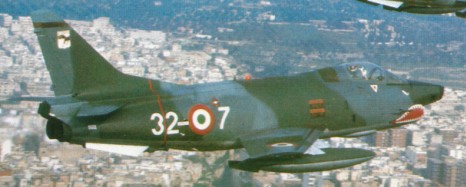
Fiat G.91

G-91Y

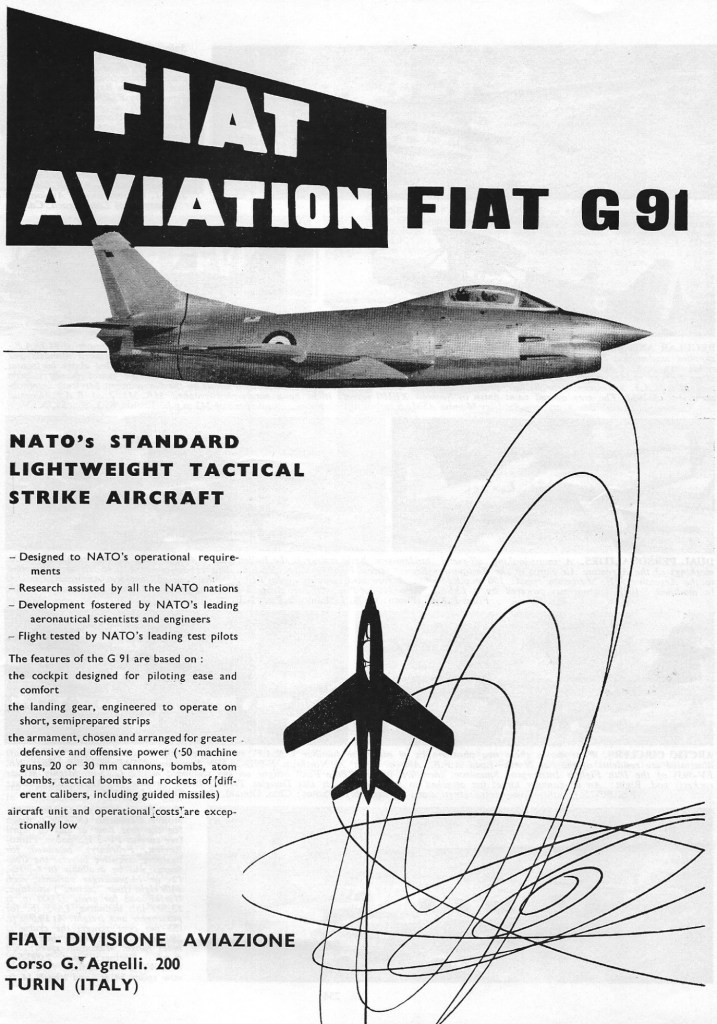
In 1954, NATO publicised the specifications for the project through the Mutual Weapon Development Programme, announcing a competition which would involve major European aerospace industries. The theme of the contest was obviously the design of a fighter intended to undertake close air support, reconnaissance and light interdiction missions, NMBR/1. Empty weight should not exceed 8 000 lbs (3,630 kg) and the fighter should be easily maintained, with high manoeuvrability and reasonable speed at low level. Fundamental to the project was the capability to operate from grass strips, semi-prepared runways and small airfields. The aim of the project was to release close air support fighters from dependence on traditional large air bases which would surely be amongst the first targets to be destroyed in any conflict. The Italian design emerged as the winner from a number of submissions and would be produced by Fiat Aviazione. It was assigned the designation G-91. An order was placed in June 1955 for three prototypes and 27 pre¬production aircraft.

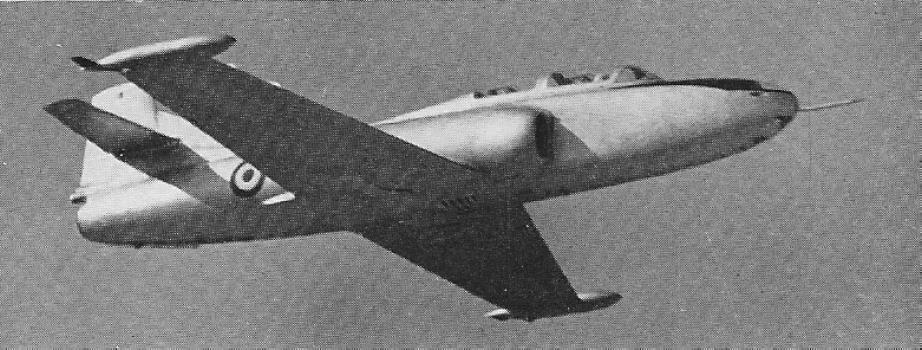
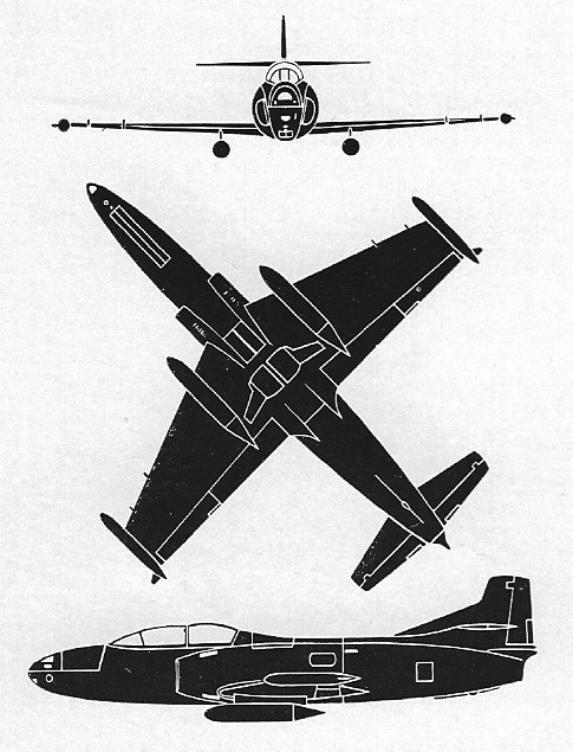
The airframe low-set wings featured a 37 degrees sweepback, and swept-back tail surfaces. Conventional ailerons, elevator, rudder, and slotted flaps are fitted, and variable incidence tailplane. Two air-brakes side-by-side are fitted under the centre-fuselage. The tricycle undercarriage has single wheels on each unit. The main wheels retract inward into the fuselage and the nose wheel retracts rearward. Fuel tanks in the fuselage can be supplemented by underwing tanks.

Designed by Giuseppe Gabrielli, the first prototype flew on August 9, 1956, powered by a 1837 kg (4050 1b) st Bristol Orpheus B Or.1 turbojet. Control problems arose later during a high speed level run, and the structural failure of the tail caused the pilot to eject. After exhaustive tests on the tail unit the second prototype was fitted with a larger tailplane and a small ventral keel; the cockpit was also raised by some 63 mm (2.5 in). Powered by a 2200 kg (4850 1b) st Bristol Orpheus B Or. 3 turbojet, this aircraft flew for the first time in July 1957. It was equipped with one of the basic sets of armament: four 0.50 in (12.7 mm) Colt Browning machine¬guns, two mounted on each side below the cockpit and each having 300 rounds of ammunition. Alternative installations were two 20 mm (0.79 in) or two 30 mm (1.18 in) cannon (one each side), with 200 or 120 rounds respectively. The guns could be supplemented by two underwing packs of 25 51¬mm (2in), 15 70 mm (2.75 in) or six 127 mm (5in) rockets, or two 250 kg (551 lb) bombs.

Construction was conventional and simple. There was an all metal semimonocoque fuselage built in three sections, with an armoured cockpit fitted with a Martin Baker Mk 4 ejection seat. The nosewheel retracted rearward under the cockpit, the main undercarriage inward into a central fuselage bay. A braking parachute was fitted at the base of the rudder. The first of the preproduction G91s was flown in February 20, 1958, and in August of that year the 103O Gruppo Caccia Tattici Leggeri (Light Tactical Fighter Group) of the Italian air force was formed for operational evaluation. After limited squadron service, 16 of the preproduction aircraft were modified in 1964 for use by the Italian aerobatic team, receiving the new designation G91PAN (Pattuglia Acrobatica Nazionale).
July 1958

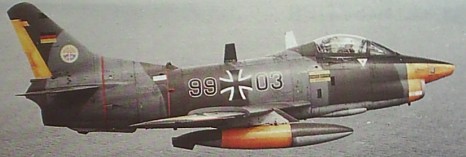
Two basic service versions of the original G91 were developed: the 1959 G91R single seat reconnaissance fighter and the G91T tandem two seat combat trainer/tactical fighter. Both had shortened and revised nose housings for three Vinten aerial cameras for forward and lateral oblique photography. Twenty four G91R/Is and the same number of R/IAs (with improved navigational aids) were delivered to the Aeronautica Militare Italiano, together with 50 G91R/111 fighter bombers. These models all carried the armament of four 0.50 in (12.7 mm) machine guns, as did the 101 G91T/1 trainers also delivered. It was, however, the Federal German Luftwaffe which employed the largest number of G91s, receiving 344 G91R/3s, nearly 300 of which were built in that country by Dornier, Heinkel and Messerschmitt. Fifty Italian built G91R14s and 66 Fiat/Dornier built G91T/3s, all with twin 30 mm (1.18 in) DEFA cannon, also served with the Luftwaffe. The German G91Rs (transferred later to the Portuguese air force) had two additional underwing pylons inboard, each capable of carrying 227 kg (500 lb) of stores.
The initial production variant was the G91R-1 which entered service with the Italian air force at the beginning of the 1960s, this air arm eventually acquiring over 100 similar aircraft. However, it was West Germany which proved to be the major customer, receiving a sizeable batch of Fiat-built G91R-3 aircraft plus a substantial number built under licence by a consortium comprising Dormer, Messerschmitt and Heinkel. The first German-built example of the G91R-3 made its maiden flight from Oberpfaffenhofen during July 1961, and the type entered service with Aufklärungsgeschwader 53 at Leipheim during 1962.

In 1964 West Germany cut down the intended size of its Luftwaffe because of shortages of funds and manpower. They will reduce the nine F-104G Starfighter squadrons to seven, and two Fiat G.91 reconnaissance squadrons instead of four. First line strength will be 380 F-104G’s and 170 G.91’s.

In the event, Germany’s Luftwaffe also operated some 50 or so G91R4 aircraft, originally being earmarked for equal distribution between Greece and Turkey, which eventually rejected them. After a fairly short career with the Luftwaffe, 40 of these aircraft were transferred to Portugal alongside a number of G91 R-3s made redundant when the Luftwaffe re-equipped its light attack units with DassaultBreguet/Dornier Alpha jets in the late 1970s and early 1980s.

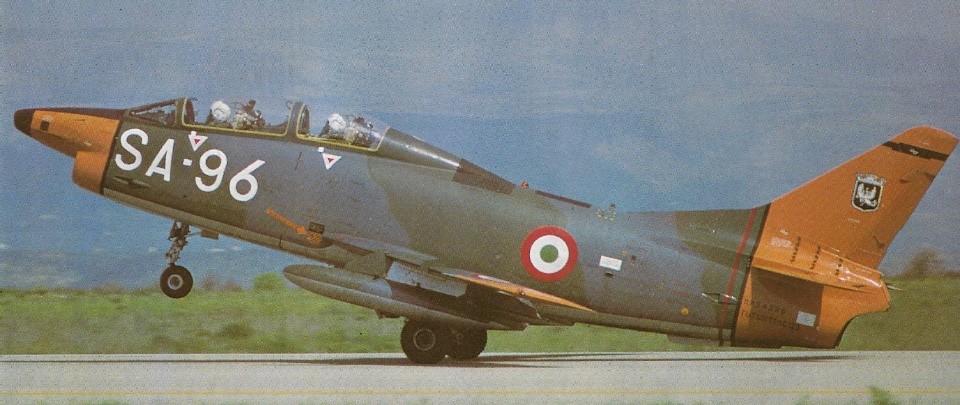
In the spring of 1965 details were announced of the G91Y, a single seat twin jet tactical fighter bomber developed as a follow on type for the AMI. Based on the two seat G91T airframe, it incorporated two 1235/1850 kg (2722/4078 1b) st General Electric J85 GE 13A afterburning jet engines, mounted side by side in the rear fuselage and giving 60% more total thrust. Two prototypes (converted G9ITs) were flown on December 27, 1966, and September 1967, respectively. In July 1968 the first of 20 preproduction G91Ys appeared, and orders for a further 45 followed. Delivery of these was completed by mid 1976, and they are now in service with the 1O and 13O Gruppi in Italy. They have provision for JATO (jet assisted takeoff) units which can halve the distance required for takeoff, and three nose¬mounted cameras are fitted as standard. Armament comprises two 30 mm (1.18 in) DEFA cannon in the nose, and four under¬wing hardpoints for up to 1814 kg (4000 lb) of bombs, rockets or napalm canisters.

Fiat G91 Article

During the 1960s within the ranks of the AMI General Staff (Stato Maggiore), the idea began to emerge of a new type with higher performance than that offered by the G-91R. To avoid protracted development and coincident cost increases, Gabrielli based his design on the same aerodynamic formula as that adopted by the G-91R. Similarly, the requirements specified by the AMI were in part based on those of its predecessor and included high manoeuvrability, high subsonic speed (Mach 0.95) at low level, mechanical simplicity, high operational efficiency and the ability to operate from small fields. Payload and radius of action were greatly increased and a more complex electronic fit was embodied, although this was relatively simple to achieve since the G-91R carried only rudimentary equipment. The new aircraft would be equipped with a navigation and attack system, with a gyroscopic collimator as well as an inertial platform, which at the time constituted a useful electronics fit. Consistent with thinking of the period, no passive or active ECM package was planned. Adoption of a twin-engine formula using two general Electric J85-GE13A turbojets was planned to give the type good flight safety. Nevertheless, the configuration of the air intake system was designed in a way that later caused problems and the loss of some aircraft. The front air intake, shared by both power units, splits into a ‘y’ form near the cockpit and it was this layout which was to be the source of a number of failures.
In comparison with the G-91R, the G-91Y features a 24 per cent increase in empty weight, a 73 per cent improvement in payload, a 63 per cent increase in take-off power and double the fuel load. The J85 provides 1,235 kg of ‘military’ thrust, climbing to 1,850 kg when afterburner is selected. The G-91Y was also designed to accept JATO rockets and can utilise a catapult device for take-off, something that necessitated enlargement and strengthening of certain undercarriage components. Installation of a ventral hook allows the use of arrester barriers.
G-91R

With regard to electronics, besides the normal communications equipment, the G-91Y possesses an inertial platform, a position and homing indicator (PHI), a doppler radar, an air data calculator, a radar altimeter, a radio compass and a gyroscopic calculator. Armament comprises two 30 min DEFA 552 cannon with 125 rounds each. External stores are fixed to four wing pylons, two on each side, with a maximum load 1,815 kg. The Yankee is also equipped for daylight tactical reconnaissance and carries three lateral TA-7M2 cameras and a forward-looking KA-60C camera with a rotating prism for panoramic work. All cameras are housed in the nose section.
The first prototype G-91Y made its maiden flight from Turin-Caselle on 27 December 1966 and was subsequently used to explore the flight envelope. The second prototype was used for weapons trials and electronic system tests and featured modifications to the windscreen as well as the nose contours. It also had a double engine cooling air intake replacing the original, which was located at the base of the dorsal fin.
The flight test programme was rapidly brought to a conclusion and in July 1968 the first production example was flown. Nevertheless, deliveries of the type to operational units only began two years later, as problems concerning the engines had first to be resolved. The first unit to receive the type was the 101st Gruppo of the 8th Stormo, which deployed temporarily to the experimental base at Pratica di Mare for transition to the new aircraft.
For nearly four years, the Gruppo was the only one to operate the G-91Y and it struggled to achieve operational status and overcome the problems that construction of only two prototypes had prevented the manufacturer from solving. Later, in 1974, the 13th Gruppo of the 32nd Stormo began transition to the new type which was at last adjudged to be fully operational.
In total, production of the G-91Y amounted to some 65 aircraft (MM6441-MM6495 and MM6951-MM6960), to which should be added two prototypes (NIM579 and MMS80). The final batch of eight (MM6961-MM6968) was cancelled and the last Yankee was assigned to the 32nd Stornio in 1976.
In addition about 160 examples of the two-seat G91T trainer variant were also completed and this has also seen service with Italy, Portugal and West Germany.
The G-91 was also evaluated by the Schweizerische Flugwaffe (Swiss Air Force) as a possible Venom replacement. In the light of Swiss interest, Aeritalia modified a production example (MM6461, c/n 2023), transforming it into the prototype ‘G-91YS’. These modifications comprised the addition of two underwing pylons capable of launching the AIM-9 Sidewinder and the replacement of the nose cameras by a Swedish-designed laser aiming system. The new nose was slightly elongated and two ventral fins were added to the two already present. Maximum takeoff weight rose from 8,700 kg to 9,000 kg, thereby increasing the take-off run by around 20 per cent. The new version was a finalist in a fly-off competition with the Vought/LTV A-7 Corsair II but negotiations were suspended and no other nation showed interest in buying the Aeritalia fighter.
Principal versions – G91 (initial light attack model), G91R/1 (attack and reconnaissance model), G91R/1A (version with improved navigation system), G91R/1B (strengthened and updated version of the G91R/ 1A), G91R/3 (West German model with two 30¬mm cannon, Doppler navigation and other im¬provements), G91R/4 (G91R/3 variant with the armament of the G91R/1), G91T/1 (Italian two-seat trainer with two 0.5-in/12.7-mm machine guns), and G91T/2 (West German version of the G91T/1).

Gallery

G91R
Engine: 1 x Fiat-built Bristol Siddeley Orpheus 80302, 5000 lb
Wingspan: 28 ft 1 in
Wingarea: 176.7 sq.ft
Length: 33 ft 9 in
Height: 13 ft 1 in
Empty weight: 6700 lb
MTOW: 11,465 lb
Max speed: 668 mph / M0.88 at SL
Max ROC: 6000 fpm

G91R/1
Engine: one 5,000-lb (2,268-kg) thrust Fiat-built Rolls-Royce (Bristol Siddeley) Orpheus Mk 803 turbojet.
Maximum speed 675 mph (1,086 km/h) at 4,920 ft (1,500 m)
Initial climb rate 6,005 ft (1,830 m) per minute
Service ceiling 42,980 ft (13,100 m)
Radius 199 miles (320 km).
Empty weight: 6,834 lb (3,100 kg)
Maximum take-off weight: 12,125 lb (5,500 kg).
Wing span 28 ft 1 in (8.56 m)
Length 33 ft 9.5 in (10.30 m)
Height 13 ft 1.5 in (4.00 m)
Wing area 176.75 sq ft (16.42 sq.m).
Armament: four 0.5-in (12.7-mm) machine guns / 1,500 lb (680 kg) of disposable stores.

FIAT G 91 R3 Gina
Engine: Bristol Siddeley Orpheus 801, 22269 N / 2270 kp
Length: 33.05 ft / 10.06 m
Height: 12.992 ft / 3.96 m
Wingspan: 27.986 ft / 8.53 m
Max take off weight: 12502.4 lb / 5670.0 kg
Max. speed: 580 kts / 1075 km/h
Service ceiling: 42979 ft / 13100 m
Range: 999 nm / 1850 km
Crew: 1
Armament: 4MG 12,7mm 2MK 30mm
Hardpoints: 4

G91T/1
Span: 8.60 m (28 ft 2.5 in)
Length: 11.70 m (38 ft 4.5 in)
Height: 14 ft 7.25 in / 4.45 m
Gross weight: 6050 kg (13338 lb)
Maximum speed: 1030 km/h (640 mph) at 5000 ft / 1525 m
Service ceiling: 40,000 ft / 12190 m

G91Y
Engines: two General Electric J85GE-13A turbojet, 1851 kg (4080-1b) afterburning thrust.
Maximum speed 1110 km/h (690 mph) at SL
Maximum speed 1038 km/h (645 mph) at 30,000 ft / 9145 m
Cruise: 497 mph / 800 kph at 35,000 ft / 10670 m
Initial ROC: 17,000 fpm / 5180 m/min
Time to 42,000 ft / 12200m; 4 min 30 sec
Service ceiling 12500 m (41,000 ft)
Combat radius at sea level 600 km (372 miles)
Ferry range 3500 km (2,175 miles)
Empty weight 3900 kg (8,598 lb)
Maximum take-off 8700 kg (19,180 lb).
Wingspan 9.01 m (29 ft 6½ in)
Length 11.67 m (38 ft 3½ in)
Height 4.43 m (14 ft 6 in)
Wing area 16.42 sq.m (176.74 sq.ft).
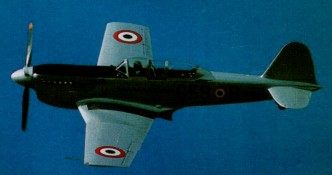
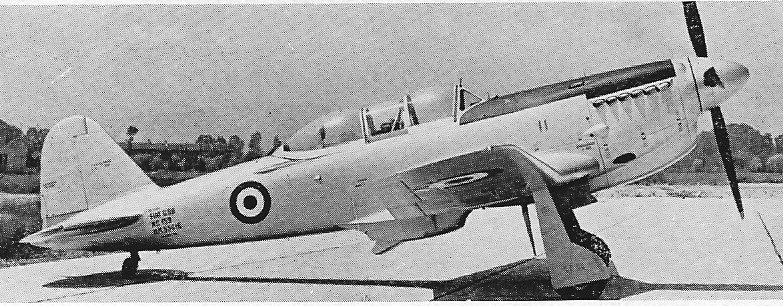
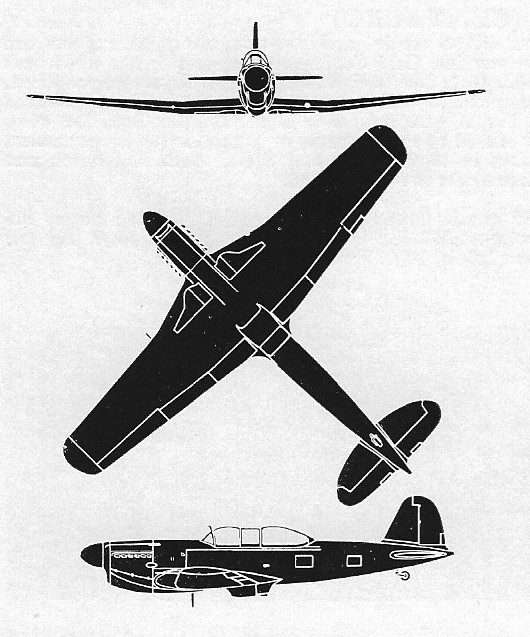
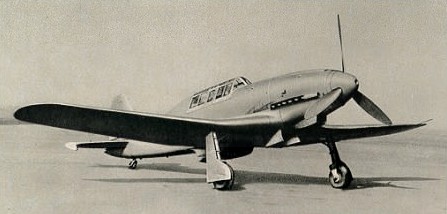
Fiat G.82

The first true jet aircraft built in Italy (discounting the piston¬ engined Caproni Campini N.1) was the prototype Fiat G.80, flown on a 1360 kg (3000 1b) thrust D.H. Goblin turbojet on December 10, 1951. After exhaustive flight development a batch of ten G.80 3B fighter/trainers were built in 1954 and delivered to the Aeronautica Militare Italiana. By this time the same basic tandem seat or single seat design had been developed into the G.82, with modified inlets feeding a fuselage plenum bay housing a Rolls Royce Nene RN.6 21 rated at 2450 kg (5400 lb) thrust. The basic Italian produc¬tion version was the tandem seat G.82 1B with two 12.7 mm (0.5 in) Breda SAFAT machine guns in the nose, and wing racks for two 113 kg (250 1b) bombs or eight 127 mm (5 in) rockets.

Fiat G.82 Article

G.82
Engine: Rolls Royce Nene RN.6 21, 2450 kg
Span: (over tip tanks) 11.6 m (38 ft)
Length: 12.95 m (42 ft 6 in)
Height: 13 ft 4 in
Wing area: 270.6 sq.ft
Empty weight: 9724 lb
Gross weight: 6114 kg (13 480 lb)
Maximum speed: 5578 mph
Cruise: 339 mph at 34,800 ft
ROC: 5510 fpm
Armament: 2 x 12.7mm Browning mg
Seats: 2

G.82-3B
Span: (over tip tanks) 11.6 m (38 ft)
Length: 12.95 m (42 ft 6 in)
Empty weight: 8700 lb
Loaded weight: 12,566 lb
Max speed: 534 mph
Seats: 2

Fiat G.80

The first true jet aircraft built in Italy (discounting the piston¬ engined Caproni Campini N.1) was the prototype Fiat G.80, flown on a 1360 kg (3000 1b) thrust D.H. Goblin turbojet on December 10, 1951. After exhaustive flight development a batch of ten G.80 3B fighter/trainers were built in 1954 and delivered to the Aeronautica Militare Italiana. By this time the same basic tandem seat or single seat design had been developed into the G.82.

Fiat G.59

G.59B

From the wartime G.55 fighter the Fiat company developed the postwar G.55A single seat fighter/trainer and G.55B dual trainer, both with 1310 hp Fiat RA. 1050 (licence built Daimler Benz 605) engine.

In 1948 the engine was switched to the Rolls Royce Merlin T.24 or Mk 500, rated at 1630 hp, the former being fitted to the G.59 1 and 2 and the Mk 500/20 the 3 and 4. The 4 had a lower rear fuselage to match a blister hood. In each case the suffix A denoted a single seater and B a dual two-seat version. Single seat versions could have two 20 mm (0.79 in) Hispano cannon and camera gun, and racks for two 100 kg (220 1b) bombs.

G.59-4

Production G.59s were delivered to Italy and Syria. A proposed family of true fighter derivatives with 2000 hp Packard V¬1650 11 (Merlin) engines was not proceeded with.

Among the customers were Argentina, Egypt and Syria.

Gallery

G.59 4b
Engine: Rolls-Royce Merlin 500/20, 1400 hp
Span: 11.85m (38ft 10.5in).
Wing area: 228 sq.ft
Length: 9.49m(31ft 11 in).
Height: 12 ft 1 in
Empty weight: 6285 lb
Gross weight: 3388 kg (7470 lb)
Maximum speed: 600 kph (373 mph)
Cruise: 286 mph
Range: 780 mi
Seats: 2

G.59-4

Fiat G.55 Centauro

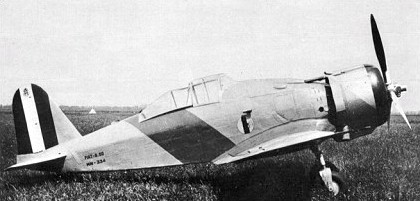
The Centauro (centaur) was a development of the G.50 with a Daimler-Benz DB 605A-1 inline built under licence in Italy. The type evolved from the DB 601-powered G.50V, and the first of three prototypes was flown on 30 April 1942.
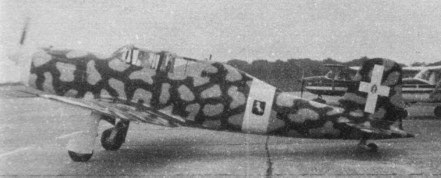
The Fiat G.55 Centauro (centaur) was an all-metal low-wing monoplane single seat fighter designed by Giuseppe Gabrielli, with fully-retractable landing gear and a raised cockpit.
Flight trials confirmed that this was an excellent fighter, but production was slow to start and only a few of the eventual total of 200 aircraft had been delivered before Italy’s armistice with the Allies in September 1943.
The third prototype (MM 493) was the only one to carry armament, comprising one engine mounted cannon and four fuselage mounted machine-guns. It was evaluated under operational conditions from March 1943, but by then the Italian air ministry had already decided on mass production of the G.55.

However, only 16 G.55/0 preproduction and 15 G.55/1 initial production aircraft had been delivered to the Regia Aeronautica by September 1943, production from then being for the Fascist air arm flying alongside the Luftwaffe. Before wartime production ended 274 more were completed and a further 37 were abandoned at an advanced construction stage.
Most G.55s thus fought with the fascist air arm on the German side in northern Italy. Three prototypes and eight pre-production aircraft were followed by about 185 G.55 Series 1 fighters. There were also about 10 examples of the G.55S torpedo strike fighter, but none of the G.55 Serie2 bomber destroyer with five 20-mm cannon. After the war 85 more aircraft were delivered as G.55A single-seat fighter trainers and G.55B two-seat advanced trainers.
Before the armistice of September 1943, G.55s had participated in the defence of Rome with the 353º Squadriglia of the Regia Aeronautica. The postarmistice operations were mainly with the Fascist air arm’s Squadriglia ‘Montefusco’, based at Venezia Reale, then with the three squadriglie which formed the 2º Gruppo Caccia Terrestre, but losses were heavy, as a result mainly of Allied attacks on the airfields. While the war was still in progress, Fiat flew two prototypes of the G.56, which was developed from the G.55 to accept the more powerful Daimler-Benz DB 603A engine. Built during the spring of 1944, they incorporated minor structural changes and had the fuselage mounted machine-guns deleted.
The first prototype survived the war and was used subsequently by Fiat as a test-bed.

G.55 exprimentally fitted with torpedo

FIAT G 55 Centauro
Engine: Fiat RA 1050 RC. 58 Tifone (DB 605 A), 1455 hp
Length: 30.741 ft / 9.37 m
Height: 10.269 ft / 3.13 m
Wingspan: 38.878 ft / 11.85 m
Wing area: 227.228 sqft / 21.11 sq.m
Max take off weight: 8198.2 lb / 3718.0 kg
Weight empty: 5799.2 lb / 2630.0 kg
Max. speed: 340 kts / 630 km/h at 22,965ft
Service ceiling: 41667 ft / 12700 m
Wing load: 36.08 lb/sq.ft / 176.00 kg/sq.m
Range: 648 nm /1200 km
Crew: 1
Armament: 3x MG 151 20mm Mauser, 2x MG 12,7mm Breda-SAFAT, 320 kg (706 lb) Bomb.

G.55A

G.55B

G.55S

Fiat G.50 Freccia / G.51 / G.52

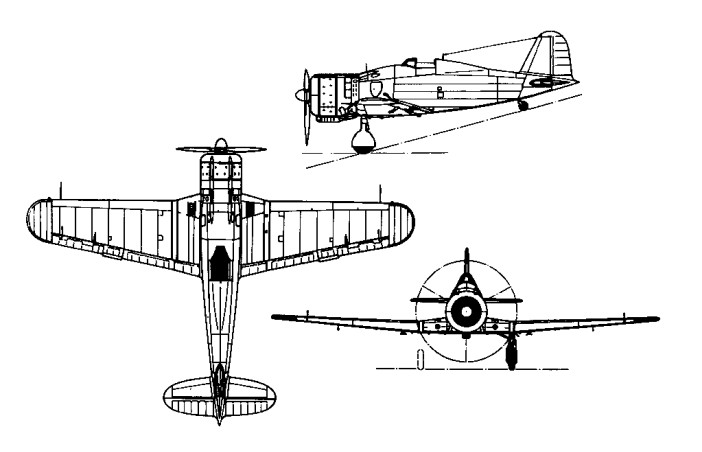
Fiat’s Giuseppe Gabrielli produced his proposals for the G.50 single seat monoplane prototype in 1936, at which time it was the most modern fighter design in Italy. Although a contemporary of the Spitfire and Hurricane, it remained to the end extremely lightly armed. The Freccia (arrow) was the first all-metal monoplane with a retractable undercarriage to be evaluated by the Italian air force; the prototype flew for the first time on February 26, 1937, and proved light to handle, with a high degree of manoeuvrability, but somewhat lacking in both engine and fire power. Its powerplant was the 840 hp Fiat A.74 RC 38 14-cylinder two row radial, fitted with a super¬charger and driving a Fiat built Hamilton three blade variable pitch metal propeller. The armament comprised two 12.7 mm (0.5in) Breda SAFAT machine guns mounted forward of the cockpit in the top of the fuselage, synchronized to fire through the propeller arc. The 150 rounds for each gun could be fired in single shots or in salvo.

Fiat G.50 Freccia / G.51 / G.52 Article

Production was undertaken both by Fiat and CMASA, a subsidiary, and the first 12 were delivered to the Italian expeditionary forces in Spain in January 1939 towards the end of the civil war. Although too late to give a true indication of their potential under battle conditions, it was decided to continue with a further order for 200 aircraft. The first 45 production G.50s had an enclosed cockpit but Italian pilots preferred the open variety and after testing several designs, an open canopy with hinged, transparent side flaps was adopted as standard. Upon Italy’s entry into the Second World War in June 1940, a total of 118 G.50s were in service: 97 with operational units and the other 21 awaiting either delivery or repair. The 51o Stormo CT at Ciampino was composed entirely of G.50s, and G.50s in company with Fiat C.R.32s made up the 52o Stormo in Tuscany; they were used mainly as escorts during the early days of the war.
Fiat G.50s also formed part of the 56o Stormo, based at Maldegern in Belgium, to assist the Luftwaffe during the Battle of Britain, but they achieved no great success in that theatre and most had been returned to Italy by April 1941. Better results were achieved by the 35 G.50s ordered by Finland in late 1939, although deliveries were initially sporadic due to German interference. How¬ever, after the start of the so called ‘continu¬ation war’ in Finland in June 1941, the Finnish G.50s gave excellent service until withdrawn from the front line in May 1944.
A two seat trainer version, also manufactured by CMASA, was pro¬duced. Designated G.50B, it had a second cockpit with dual controls added and the armament installation removed. One hundred and eight were produced, and gave satisfac¬tory service at Regia Aeronautica training units.
The initial production series of 246 aircraft were followed by 421 examples of the G.50bis with greater fuel capacity, improved radio and a modified wing.
The Regia Aeronautica, meanwhile, utilized its G.50s in Greece, the Balkans, the Mediterranean and North Africa before they began to be replaced by the superior G.50bis The prototype of this was flown for the first time on September 9, 1940, and differed from the original aircraft in having improved fuse¬lage contours, increased fuel capacity, more modern radio equipment, an enlarged rudder, and a modified canopy and armour protection for the pilot. A total of 421 G.50bis were built, and served mainly in North Africa (Libya) from late 1940 until December 1941. Nine were supplied to the Croatian air force. Some G.50bis were fitted with underwing racks at this time, to carry small bombs.
The basic G.50B airframe formed the basis of the G.50bis/A two-seat carrierborne fighter with four 12.7-mm (0.5-in) machine-guns. The G.50bis A was an enlarged two seat fighter bomber with better armament and a bigger bombload, plus an arrester hook for service aboard the planned aircraft carriers Aquila and Sparviero. It flew for the first time on October 3, 1942, but after Italy’s surrender all further development ceased and none was produced.
This latter was flown only in prototype form, and other prototypes (G.50ter, G.50V, G.51 and G.52) were developed round imported German engines or their Italian licence-built versions. The basic type was also exported to Croatia and Finland.

FIAT G. 50 Freccia
Length : 25.558 ft / 7.79 m
Height: 9.711 ft / 2.96 m
Wingspan : 35.958 ft / 10.96 m
Wing area : 195.367 sq.ft / 18.15 sq.m
Max take off weight : 5325.1 lb / 2415.0 kg
Weight empty : 4354.9 lb / 1975.0 kg
Max. speed : 255 kts / 472 km/h
Service ceiling : 32267 ft / 9835 m
Wing load : 27.27 lb/sq.ft / 133.0 kg/sq.m
Range : 362 nm / 670 km
Engine : Fiat A. 74 RC.38, 828 hp
Crew : 1
Armament : 2x MG 12,7mm Breda-SAFAT

G-50bis
Engine: l x Fiat A.74 RC 38, 626kW (840 hp).
Span: 10.9m (36 ft 0.75in).
Length: 7.8m (25ft7in).
Normal T/O weight: 2522 kg (5,560 lb).
Max speed: 293 mph at 14,765ft.
Operational range: 420 miles.
Armament: 2 x 12.7-mm (0.5-in) mg plus 300 kg (661 lb) of bombs

G-50B

G-50bis/A

G-50ter

G-50V
Engine: Daimler-Benz DB 601.

G-51

G-52

Fiat G.50 Freccia

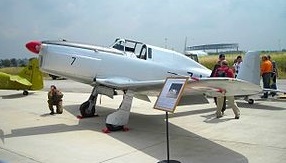
Fiat G.46

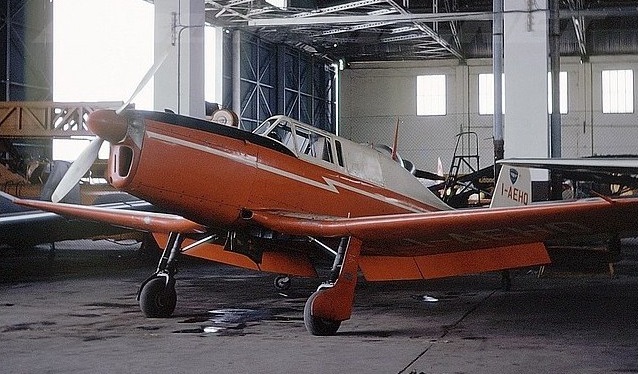
The Fiat G.46 was developed by Giuseppe Gabrielli as a military trainer in Italy shortly after World War II, the all metal G.46 was a conventional, low-wing monoplane with tailwheel undercarriage, the main units of which retracted inwards. The pilot and instructor sat in tandem under a long canopy hinging to the right.

The first prototype G.46 1, powered by a 205 hp (153 kW) Alfa Romeo 115-Ibis engine driving a two blade constant speed propeller, made its maiden flight on 25 June 1947.

Testing revealed excellent flying characteristics and suitability for aerobatics, and the type was ordered into production.

Production versions were the G.46 2 with a 205 hp de Havilland Gipsy Six or 250 hp Gipsy Queen 30, and the 3, 4 and 5 with 225 hp Alfa 115ter.

223 were built: The Italian Air Force operated 141 Fiat G.46 from 1949 until 1960; the Argentine Air Force operated 70 Fiat G.46; the Syrian Air Force operated 12 G-46Bs; and the Austrian Air Force operated five former Italian Air Force G-46Bs.

Austrian Fiat G.46

Gallery

Variants:

G.46-1B
two-seater with Alfa Romeo 115bis engine, one prototype and initial production of 25 for the Italian Air Force.

G.46-2B
two-seater with de Havilland Gipsy Queen engine for the Argentine Air Force, 70 built with an additional 12 for the Syrian Air Force.

G.46-3B
two-seater with Alfa Romeo 115ter engine for the Italian Air Force, 25 built.

G.46-4B
two-seater with Alfa Romeo 115ter engine for the Italian Air Force, 55 built.

G.46-5B
two-seat navigation trainer (prototype only)

G.46-4A
single-seater with Alfa Romeo 115ter engine for the Italian Air Force, 35 built.

Specifications :

G.46 2
Maximum speed: 325 km/h (200 mph)
Gross weight: 1430 kg (3150 lb)

G.46-4B
Engine1 × Alfa Romeo 115-1ter, 168 kW (225 hp)
Length: 8.48 m (27 ft 10 in)
Wingspan: 10.40 m (34 ft 1¼ in)
Height: 2.40 m (7 ft 10 in)
Wing area: 16 m2 (173 ft2)
Empty weight: 1,110 kg (2,442 lb)
Gross weight: 1,410 kg (3,102 lb)
Maximum speed: 311 km/h (194 mph)
Cruising speed: 263 km/h (164 mph)
Range: 900 km (560 miles)
Service ceiling: 5,300 m (17,400 ft)
Rate of climb: 5.8 m/s (1,150 ft/min)
Crew: 2, pilot and instructor

Fiat CR.42 Falco

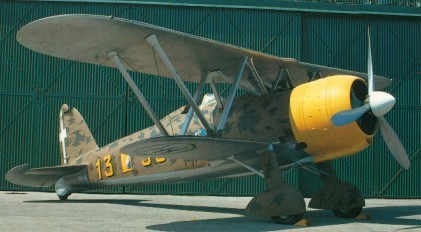
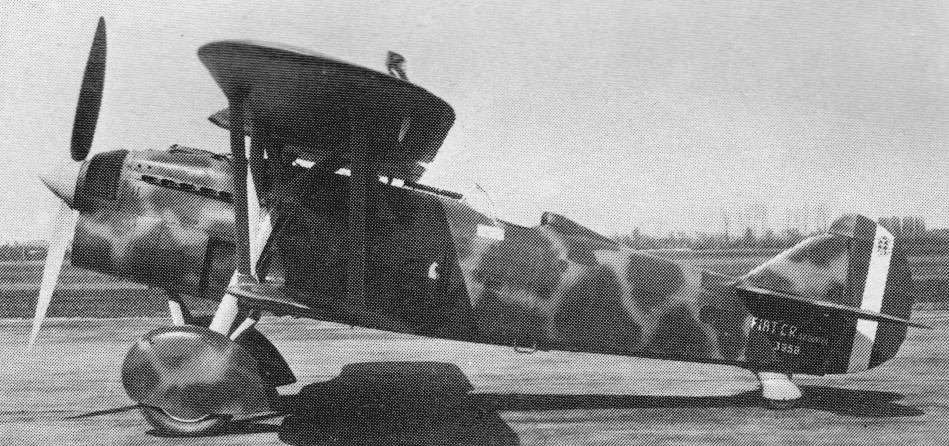
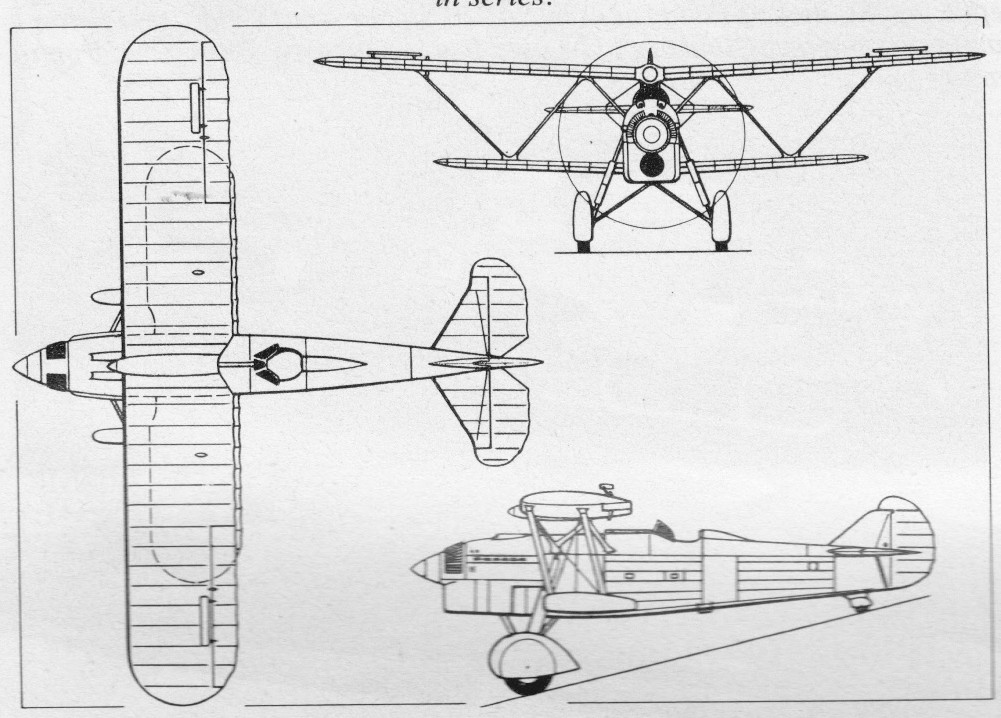
The C.R.42 Falco (Falcon), designed by Celestino Rosatelli, was the last in the family, begun in 1923 with the C.R.20 and 30 series and followed by the C.R.33, 40 and 41 prototypes, to become one of these succes¬ses. It had the distinction of being the last fighter biplane manufactured by any of World War Two’s combatants. It was an unequal span biplane, with an oval section fuselage. Employing the same Warren truss system of interplane struts as the 1933 CR.32, from which it was developed, Celestino Rosatelli’s CR.42 was powered by a 626kW Fiat A74 R1C 38 radial and had a top speed of 441km/h. The fixed two leg undercarriage was fitted with oleo pneumatic shock absorbers and enclosed in streamlined fairings. The tailwheel was retractable on the prototype, but fixed on production aircraft. The CR42 first flew on May 23,1938 and, powered by an 840 hp Fiat A74R.IC. 38 two row radial engine, the prototype proved to be highly manoeuvrable, with a rapid rate of climb and a maximum speed of 441 km/h (274 mph).

Fiat CR.42 Article

It was put into production the same year deliveries to the Regia Aeronautica commenced in April 1939, and when Italy entered the war on June 10, 1940, a total of some 330 were in front line service with Stormi or Gruppi of the Regia Aeronautica in Italy and in North and East Africa. Armament comprised one 7.7 mm (0.303 in) and one 12.7 mm (0.54in) Breda¬SAFAT machine gun, which both fired through the disc of the Fiat 3D41 propeller, and a rounds counter was fitted in the instru¬ment panel. On later production models, the 7.7 mm (0.303 in) gun was replaced by another of 12.7 mm (0.5 in) calibre. For some inexplicable reason, radio equipment was not installed.
Italian C.R.42s drew their first blood on June 13, 1940, attacking air bases at Fayence and Hyeres in southern France; they also escorted Fiat B.R.20s on bombing missions over Toulon harbour during the battle for France. They met opposition from French Dewoitine D 520s and Bloch 152s, but losses were minimal and during the remainder of the campaign they were also used on escort duties with S.M.79 bombers over the Mediterranean and North Africa.
On the strength of the achievement in this theatre, the Italian government decided on a closer collaboration with the Luftwaffe, and created the Corpo Aereo Italiano (Italian Air Corps) to assist mainly in the Battle of Britain. Fifty C.R.42s and 48 Fiat G.50s, together with other Italian fighter, bomber and reconnaissance aircraft, formed the con¬tingent. They were sent to Ursel and Maldeghem in Belgium. Unfortunately, the speedier German Bf 109s found it a hard task to keep formation with the biplanes, and the latter’s lack of radio also hampered activities. Nevertheless, it was decided to send the Falcos into combat against Hurricanes and Spitfires. Their first raid was on Harwich on November 11, 1940. They also participated in action off the Kent coast a few days later, and substantial victory claims were made by the Italians, although RAF records give a different picture. Their inefficiency against superior aircraft, together with the Italian need for more air power in the Mediterranean, instigated the return of the Falcos to Italy in January 1941.
Falcos served extensively in Libya during 1940 41 and were used for attacks on Malta in the same period, as well as acting as escorts to bombers attacking Allied shipping in the Mediterranean. In October 1940, when Greece entered the war, the three squadrons of C.R.42s (together with other Italian aircraft) sent to the area showed marked superiority over the somewhat motley Greek air arm, which was soon defeated. Falco fighter units then combined with Luftwaffe forces to take the island of Crete, and remained in the Aegean theatre until they were replaced by Fiat G.50s in November 1941. After the Italian conquest of Ethiopia, bases there had, initially, little or no trouble in getting new C.R.42s or spares. However, after June 1941, increased Allied activity in North Africa, bad weather conditions and lack of radio equipment in the aircraft, all took their toll. By November 1941, all Falcos from the region had been either evacuated or destroyed.
In the early stages of the desert campaigns in North Africa, during mid 1940 to 1941, C.R.42s were used extensively as fighters, until the advent of more advanced opposition in the form of Hurricanes and Tomahawks. They could not hope to compete against such types and were put to use in the ground attack role. Although improvements and modifications had been made to the original design the C.R.42bis had two additional 12.7 mm (0.5in) guns in underwing fairings (ordered by Sweden as the J 11). Parts of North Africa still covered by the ubiquitous little biplanes included Cyrenaica, where they were fitted with underwing racks for two 100 kg (220 lb) bombs the C.R.42AS (Africa Settentrionale: North Africa) was fitted with a special oil and air sand filter to cope with desert conditions, and a few were armed with two 20 mm (0.79¬in) cannon under the lower wings.
As fighter bombers, Falcos also participated in raids around Tobruk, Alexandria and Mersa Matruh and in the siege of Tripoli. Surviving aircraft from this last battle (some 82 Falcos) went back to Italy and were used in attacks on Allied convoys in the Mediterreanean. They were phased out of this duty in favour of more modern types. In October 1941, a C.R.42CN night fighter unit was formed in Sicily and, although it did not see a great deal of active service there, it was reasonably effective later, in 1942 43, against RAF bombers over the industrial areas of northern Italy.
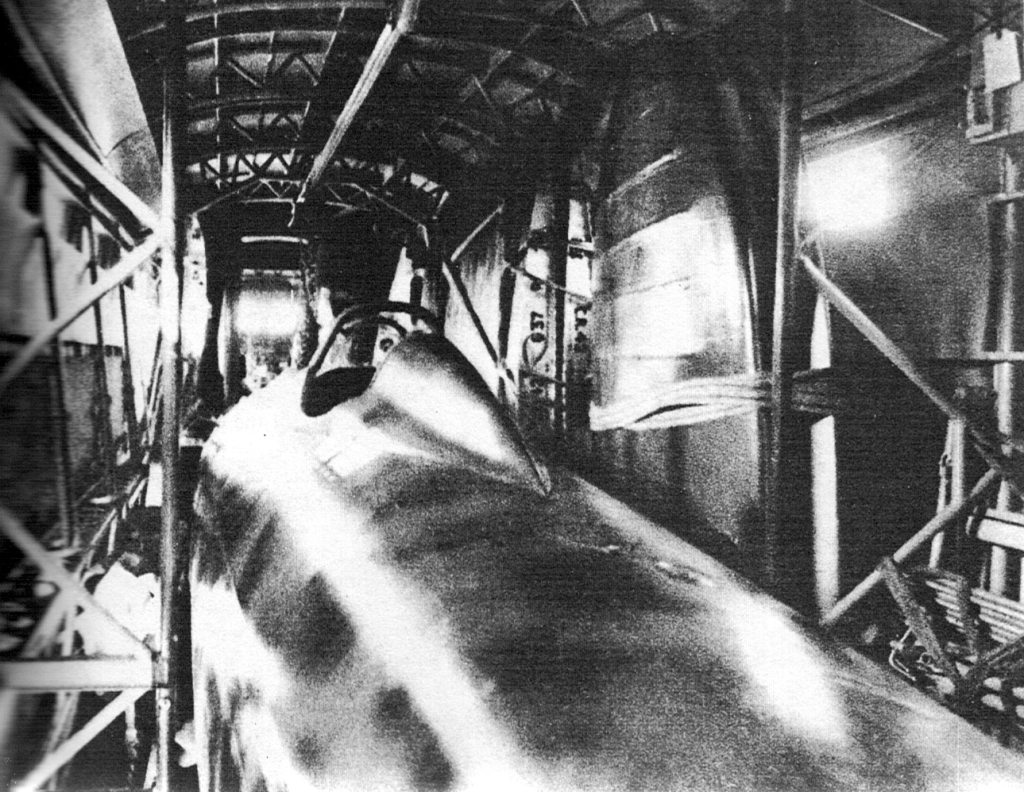
In their 1941 battles against the advancing British and their allies in East Africa, the numbers of Italian fighter planes equipped to ward off bombing raids was melting away day by day. The dense sea and land blockade surrounding Italian East Africa made it impossible for the Italians to supply their troops with fresh aircraft from Italy. Soon they had no fighters left except for a dozen Fiat CR.42 Falco biplanes which although they had outstanding flight characteristics were powerless against superior numbers oft the British Gladiator fighters. In this desperate situation they seized on an inspiration of Colonel Galante, and transported the needed fighter planes in dissembled pieces inside the fuselage of Savoia-Marchetti SM.82 Canguro (Kangaroo) transport planes whose range made it possible for them to ferry their cargo to East Africa from Libya. By the Spring of 1941, over 50 Falco fighters had landed in Ethiopia by this method.

Fiat CR.42 inside a Savoia Marchetti SM.82 on the way to East Africa

When used for night attacks, the C.R.42CN (Caccia Notturna) limited night-fighter conversion was equipped with radio and was also fitted with twin underwing searchlights and exhaust flame dampers.
One Falco, designated C.R.42B, had a 1010 hp Daimler¬Benz DB 601 inverted V type engine instal¬led, with which it was hoped the aircraft would achieve a speed of 520 km/h (323 mph), but this did not leave the experimental stage. Neither did the CMASA built IC.R.42 (I = Idrovolante: seaplane), which was fitted with twin floats and was much heavier than the landplane, though speed loss from the increased weight was negligible.
After the Italian Armistice, 2,000 examples of the slightly modified CR.42LW were ordered from Aeronautica d’Italia (based in Northern Italy) for the Luftwaffe. Intended for nocturnal attack missions, the CR.42LW served with the Nachtschlactgruppen, the Luftwaffe receiving 112 of some 150 completed. These aircraft were used by the Luftwaffe during 1943 44, being flown against the Allies from bases in Austria, Italy and Yugoslavia. The last operations flown by CR.42s took place in May 1945.

CR.42 with smoke screen fitment

Experimental versions included the CR.42DB, which was tested in prototype form with a 753-kW (1,010-hp) Daimler Benz DB 601A engine for a speed of 323 mph, and the ICR.42 (alias CR.42 Idro) twin float fighter.

CR.42DB

The CR.42DB, flown in March 1941, had a 1175 hp Daimler-Benz DB 601E engine and attained a max speed of 323 mph / 20 kph, and climbed to 9840 ft / 3000 m in 3.34 minutes.

Production totalled at least 1,780, and variants included the initial CR.42 Falco (falcon) with one 12.7-mm (0.5-in) and one 7.7-mm (0.303-in) machine-guns for Belgian, Hungarian and Italian orders, and the CR.42ter version of the CR.42bis with two additional 12.7-mm (0.5-in) machine-guns.
In 1939, 34 were ordered by the Belgian air force; delivered from January 1940 (although in the event received only 25). Fifty-two were exported to Hungary, appearing on the Eastern Front from mid 1941; and in 1940 41 the Swedish air force took delivery of 72 aircraft. Designated J11, they remained in service until 1945, after which a few remained in civil use.

Production of the type ceased in late 1942 when a total of 1781 had been built. Only 113 remained when the Italians surrendered in September 1943, of which 64 were still ser¬viceable. Most of these were seized by the Luftwaffe or employed with the Repubblica Sociale Italiana, Mussolini’s short lived pup¬pet regime, based at Salo, northern Italy; but a few escaped to join the Italian co-¬belligerent air force that fought on the Allied side, and continued with that Italian air arm until 1945, when they were finally declared obsolete. Some still remained, as modified two seat trainers, until as late as 1950.

FIAT CR 42 Falco
Length : 27 ft 2 in / 8.27 m
Height: 11 ft 9 in / 3.59 m
Wingspan : 31 ft 10 in / 9.7 m
Wing area : 241.114 sq.ft / 22.4 sq.m
Max take off weight : 5060.5 lb / 2295.0 kg
Weight empty : 3929.3 lb / 1782.0 kg
Max. speed : 227 kts / 420 km/h
Service ceiling : 33465 ft / 10200 m
Wing load : 20.91 lb/sq.ft / 102.0 kg/sq.m
Range : 418 nm / 775 km
Engine : Fiat A. 74 R1C.38, 828 hp / 626kW
Crew : 1
Armament : 2x MG 12,7mm Breda-SAFAT

CR.42 Falco
Engine: Fiat A.74 R1C.38, 840 hp.
Prop: three bladed wooden.
Span: 31ft 10in.
Length: 27ft 1.5in.
Height: 11ft 9.25in.
Wing area: 241.12sq.ft.
Empty wt: 3,790 lb.
Loaded wt: 5,070 lb.
Max speed: 267 mph.
Service ceiling: 34,450ft.
Initial climb: 2,400ft/min.
Endurance: 4hr.
Armament: 3 x 12.7mm and one 7.7mm machine gun

CR.42AS Falco
Engine: l x Fiat A.74 RC 38, 626kW (840 hp).
Span: 9.70m (31 ft 9.75in)
Length: 8.26m (27 ft 1 in)
Armament: 2 x 12.7-mm (0.5-in) mg plus 200 kg (441 lb) bombs
Normal T/O weight: 2295 kg (5,060 lb).
Max speed: 280 mph at 17,485ft.
Operational range: 480 miles.

CR.42B
Engine: Daimler-Benz DB 601, 753-kW (1,010-hp).
Max speed: 323 mph.

CR.42bis
Armament: 2 x 12.7-mm (0.5-in) mg.

CR.42CN

CR.42ter
Armament: 4 x 12.7-mm (0.5-in) mg.

Fiat CR.32 / Hispano HA-132-1 Chirri

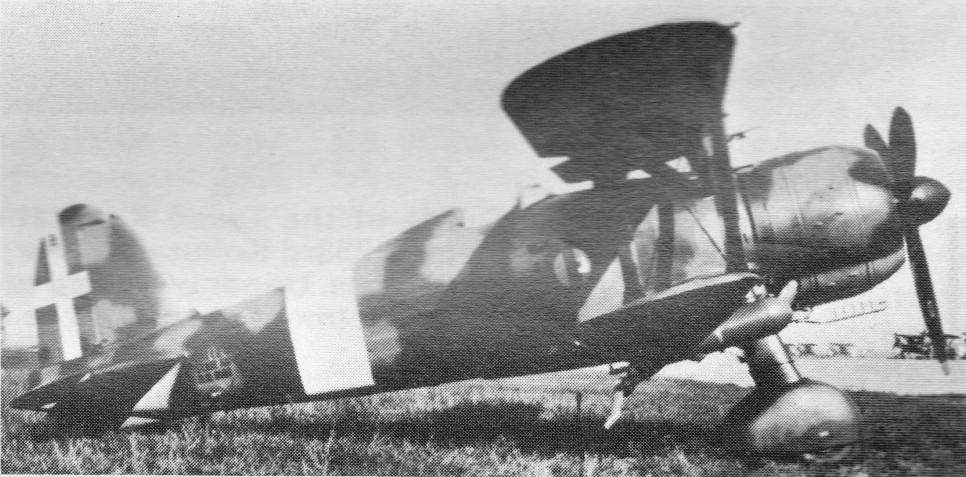
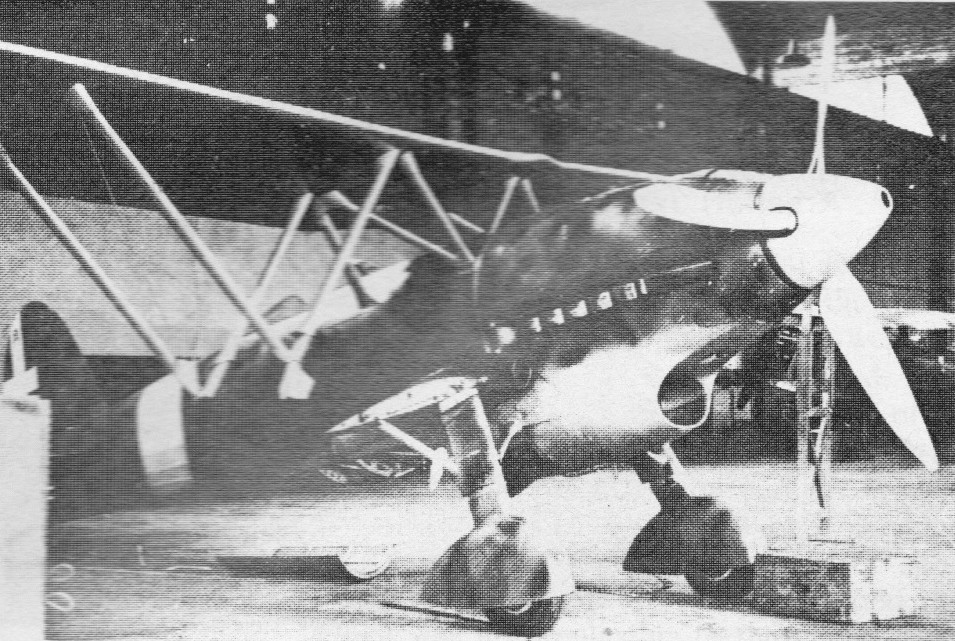
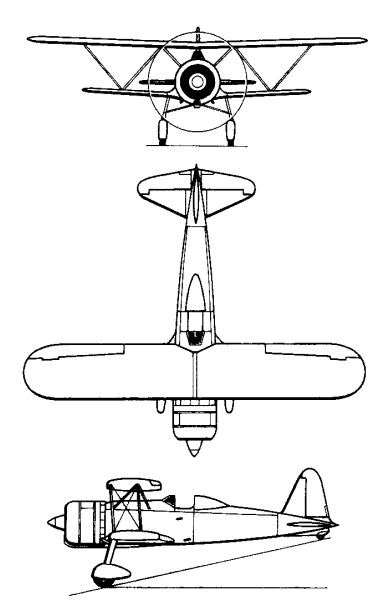
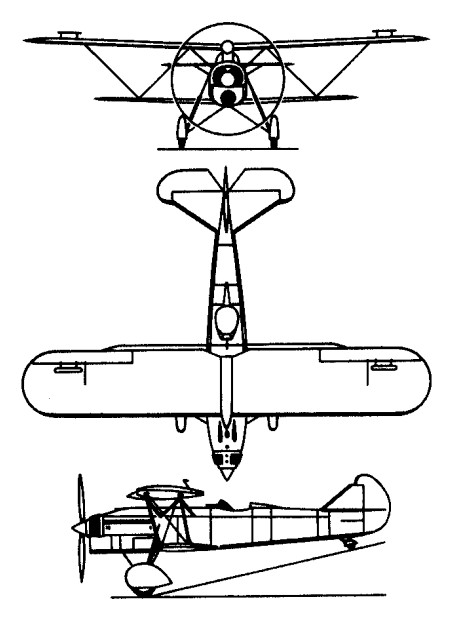
Italy’s most important fighter of the late 1930s, the CR32 biplane was first flown in August 1933 as a development of the CR30 using the same type of metal/fabric-covered all-metal structure and Warren-type interplane bracing but with smaller overall dimensions plus improved performance and agility, and Fiat A 30 RA engine.

First flown on 28 April 1933, the initial production series of 24 was supplied to China. Between March 1934 and February 1936, 282 CR.32s were delivered to the Regia Aeronautica and this fighter first saw active service in the Spanish Civil War with the Aviacion del Tercio in August 1936.

Fiat CR.32 Article

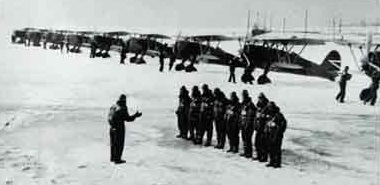
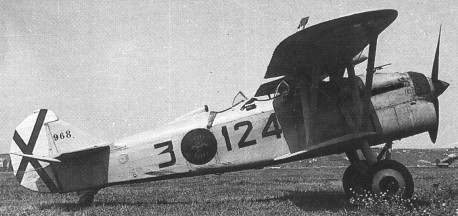
The CR.32 was numerically and operationally the most important fighter fielded by the Nationalists and their Italian allies in the Spanish Civil War, and the first 12 examples reached Nationalist units in Morocco as early as August 1936. A total of 377 of this type were sent to Spain, where they equipped the Nationalists’ 2-G-3 and 3-G-3 fighter units as well as five Italian gruppi. The CR.32 was faster in level flight and in the dive than the 1-15, and was also better armed when there arrived the CR.32bis and CR.32ter with heavier machine-guns; and by comparison with the -16 the CR.32 was more agile and more heavily armed. By a judicious use of tactics, therefore, Nationalist and Italian pilots were generally able to prevail over the Republican fighters.

The initial CR.32 delivered in 1935 had the 447-kW (600-hp) Fiat A.30 RAbis engine and two 7.7-mm (0.303-in) machine-guns, and these 350 aircraft were followed by 283 examples of the CR.32bis close-support version.

The CR.32bis had the improved 600 hp A 30 Rabis engine, two 12.7 mm and two 7.7-mm (0.303-in) machine-guns

Forty-five similar examples were supplied to Austria and 52 to Hungary (who eventually acquired 38 from Austria).

Next came 150 examples of an improved CR32, the CR.32ter for the Regia Aeronautica in July-December 1937, with revised landing gear and improved equipment, and the final aircraft here 337 CR.32quater fighters essentially similar to the CR.32ter but with a lightened structure and updated equipment.

CR.32quarer

Examples similar to the V were purchased by Paraguay (5) and Venezuela (9).

It was used in the early months of World War II in Greece and East Africa.

Hispano Aviacion SA manufactured over 100 Fiat CR. 32quater biplane fighter as the HA-132-1 Chirri between 1938- 1942. Forty of these later converted as two-seters.

Production of the CR.32 totalled 1211 aircraft.

FIAT CR 32 Chirri
Engine: FIAT A.30 RAbis, 592 hp / 440kW
Length: 24.442 ft / 7.45 m
Height: 8.629 ft / 2.63 m
Wingspan upper: 31.168 ft / 9.5 m
Wingspan lower: 6.2 m / 20 ft 4 in
Wing area: 237.884 sqft / 22.100 sq.m
Max take off weight: 4079.3 lb / 1850.0 kg
Weight empty: 2921.6 lb / 1325.0 kg
Max. speed: 202 kts / 375 km/h / 233 mph
Service ceiling: 28871 ft / 8800 m
Wing loading: 17.22 lb/sq.ft / 84.0 kg/sq.m
Range: 367 nm / 680 km
Crew: 1
Armament: 2x MG 7,7mm Breda-SAFAT

CR.32bis
Engine: l x Fiat A.30 RAbis, 447 kW (600 hp).
Span: 9.50m (3lft 2.25in).
Length: 7.47m (24ft 6in)
Normal T/O weight: 1975 kg (14,350 lb).
Max speed: 224 mph at 9,845 ft.
Operational range: 466 miles.
Armament: 2 x 12.7-mm (0.5-in) and two 7.7-mm (0.303-in) mg plus 100 kg (220 lb) of bombs

CR.32ter
Engine: l x Fiat A.30 RA bis, 447kW (600 hp).
Span: 9.50m (31ft 2in).
Length: 7.45m (24ft 5.25 in).
Height: 2.63m / 8 ft 7.5 in
Wing area: 22.10 sq.m / 237.88 sq.ft
Empty weight: 3205 lb / 1454 kg
Max T/O weight: 1915kg (4,222 lb).
Max speed: 295 mph / 330 kph at SL / 220 mph at 9840 ft. / 3000 m
Time to 3280ft / 1000m: 1.58min
Operational range: 485 m / 780 km at 196 mph / 315 kph
Armament: 2 x 12.7-mm (0.5-in) mg plus bombs

CR.32quater

CR.32quater

Fiat CR.1 / CR.2 / CR.5 / CR.10

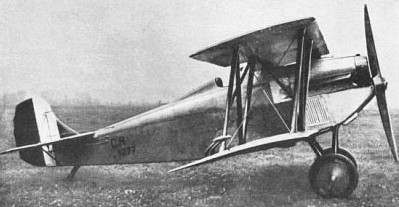
Two prototypes of the Fiat CR.1 biplane fighter, designed by Celestino Rosatelli, were flown in 1923, and the type was selected for large- scale production for the newly formed Regia Aeronautica.
First deliveries of an eventual 240 production aircraft, designated CR.1, began in 1925.
During the 1930s many Italian CR.1s were given more powerful Isotta Fraschini engines, and these were to continue in service until 1937.
Nine aircraft were exported to Latvia. The Fiat CR.2, CR.5 and CR. 10 were variants of the basic aircraft fitted with different engines, usually on an experimental basis.

Fiat CR.1
Engine: 1 x 300hp Hispano-Suiza 42 8-cylinder
Take-off weight: 1154 kg / 2544 lb
Wingspan: 8.95 m / 29 ft 4 in
Length: 6.16 m / 20 ft 3 in
Height: 2.40 m / 7 ft 10 in
Max. Speed: 272 km/h / 169 mph
Ceiling: 7450 m / 24450 ft
Armament: 2 x 7.7mm machine guns