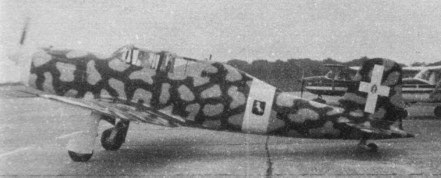
The Fiat G.46 was developed by Giuseppe Gabrielli as a military trainer in Italy shortly after World War II, the all metal G.46 was a conventional, low-wing monoplane with tailwheel undercarriage, the main units of which retracted inwards. The pilot and instructor sat in tandem under a long canopy hinging to the right.
The first prototype G.46 1, powered by a 205 hp (153 kW) Alfa Romeo 115-Ibis engine driving a two blade constant speed propeller, made its maiden flight on 25 June 1947.
Testing revealed excellent flying characteristics and suitability for aerobatics, and the type was ordered into production.
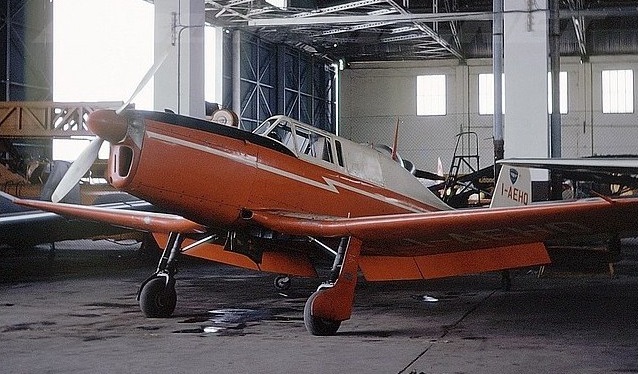
Production versions were the G.46 2 with a 205 hp de Havilland Gipsy Six or 250 hp Gipsy Queen 30, and the 3, 4 and 5 with 225 hp Alfa 115ter.
223 were built: The Italian Air Force operated 141 Fiat G.46 from 1949 until 1960; the Argentine Air Force operated 70 Fiat G.46; the Syrian Air Force operated 12 G-46Bs; and the Austrian Air Force operated five former Italian Air Force G-46Bs.
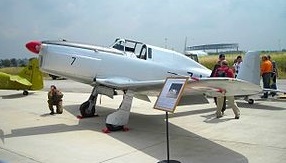
Variants:
G.46-1B
two-seater with Alfa Romeo 115bis engine, one prototype and initial production of 25 for the Italian Air Force.
G.46-2B
two-seater with de Havilland Gipsy Queen engine for the Argentine Air Force, 70 built with an additional 12 for the Syrian Air Force.
G.46-3B
two-seater with Alfa Romeo 115ter engine for the Italian Air Force, 25 built.
G.46-4B
two-seater with Alfa Romeo 115ter engine for the Italian Air Force, 55 built.
G.46-5B
two-seat navigation trainer (prototype only)
G.46-4A
single-seater with Alfa Romeo 115ter engine for the Italian Air Force, 35 built.
Specifications :
G.46 2
Maximum speed: 325 km/h (200 mph)
Gross weight: 1430 kg (3150 lb)
G.46-4B
Engine1 × Alfa Romeo 115-1ter, 168 kW (225 hp)
Length: 8.48 m (27 ft 10 in)
Wingspan: 10.40 m (34 ft 1¼ in)
Height: 2.40 m (7 ft 10 in)
Wing area: 16 m2 (173 ft2)
Empty weight: 1,110 kg (2,442 lb)
Gross weight: 1,410 kg (3,102 lb)
Maximum speed: 311 km/h (194 mph)
Cruising speed: 263 km/h (164 mph)
Range: 900 km (560 miles)
Service ceiling: 5,300 m (17,400 ft)
Rate of climb: 5.8 m/s (1,150 ft/min)
Crew: 2, pilot and instructor

