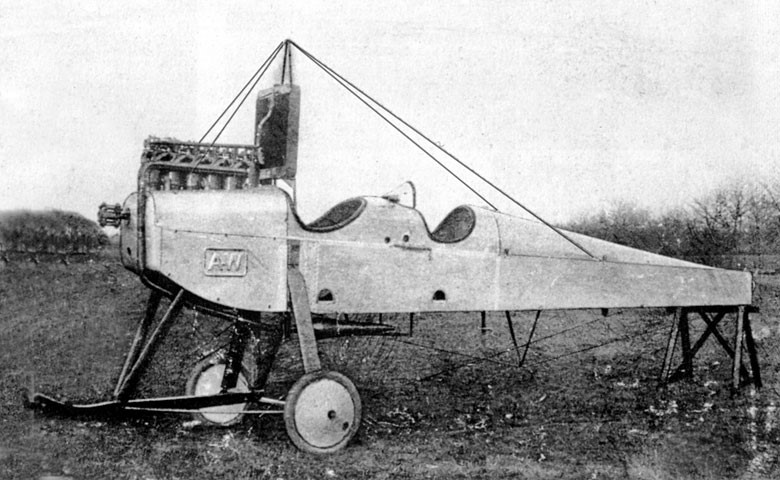
1926: Arrow Aircraft & Motors Corp Lincoln NB. USA In late 1920s made three models of two-seat sport or training biplane (the Arrow Sport and Arrow Sport Pursuit). Standard type of 1935 was Model F two-seat low-wing monoplane with Ford V-8 converted automobile engine, awarded contract by the Bureau of Air Commerce.
1936: Arrow Airplane & Motor Corp 4133 North 56 St Lincoln NB pres: Mark W Woods
1940: Bankruptcy, taken over by State Securities financial group.
UK Largely designed by A. C. Thornton (responsible for Blackburn Bluebird of 1924), the Arrow Active 1 of 1931 was a single-seat all-metal aerobatic biplane with military-training potential. Active 2 of 1932 was re-engined and had new center-section; but though company made aircraft components it built no airplanes in quantity.
At West Drayton, Middlesex, UK, built during 1937-1938 a two-seat pusher cabin monoplane, the A-1, with MacLaren crosswind tricycle undercarriage. Re-engined 1939 for Army evaluation, but not adopted.
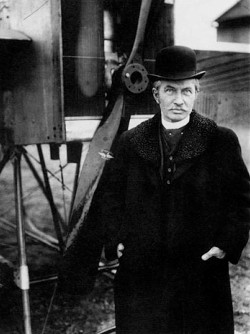
The French aeronautical engineer René Arnoux was a pioneer in the development of the tailless airplane. Arnoux’s work is very significant in that he is the real originator of the “flying plank” class of tailless airplane. All his planes used a plain straight rectangular (or slightly tapered) wing, without any sweep-back, dihedral, stagger, or stabilizing wing tips.
Mike Arnold was a film-maker by trade but that didn’t stop him from wowing aero engineers with the world’s most efficient aircraft with his AR-5.
Arnold had originally planned to sell plans for the AR-5 but, while he was satisfied with the design, he decided to wait and see how the gathering storm of product liability suits would play out.
Instead, Arnold fell back on his first craft, producing a series of movies about his plane and selling video copies to homebuilders and aviation enthusiasts. The full set of films is:
Why It Goes So Fast
How It’s Made
Moldless, Low-Drag Wheel Pants
The AR-5 In Action
Making Fibreglass Molds
Making A Molded Fuselage – Shaping The AR-6
There is no CGI or even a pretty diagram in any of them. Each documentary offers an engaging story as well as plenty of information.
Mike Arnold died on October 6th, 2015. He considered his aviation films his legacy and, after his passing, the Arnold family generously shared all six on YouTube.
Sir W G Armstrong Whitworth & Co Ltd was a major British manufacturing company of the early years of the 20th century. With headquarters in Elswick, Newcastle upon Tyne, Armstrong Whitworth engaged in the construction of armaments, ships, locomotives, automobiles, and aircraft.
In 1847, engineer William George Armstrong founded the Elswick works at Newcastle, to produce hydraulic machinery, cranes and bridges, soon to be followed by artillery, notably the Armstrong breech-loading gun, which re-equipped the British Army after the Crimean War. In 1882, it merged with the shipbuilding firm of Charles Mitchell to form Armstrong Mitchell & Company and at the time its works extended for over a mile (about 2 km) along the bank of the River Tyne. Armstrong Mitchell merged again with the engineering firm of Joseph Whitworth in 1897. The company expanded into the manufacture of cars and trucks in 1902, and created an “aerial department” in 1913, which became the Armstrong Whitworth Aircraft subsidiary in 1920.
In September 1914 built the unsuccessful F.K.1 single-seater. Later (during the war) the F.K.3 and F.K.8 two-seat observation aircraft were delivered in quantity, as improvements on the Government designed B.E.2c.
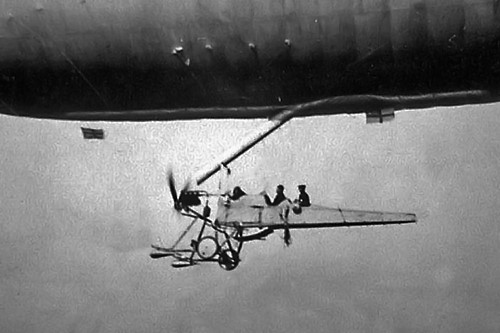
Armstrong-Whitworth built in 1914 a gondola for non-rigid naval airship HMA No.2 “Willows IV”. This was followed by gondolas for SS.40-49 airships in 1915, developed from F.K.3 fuselage, with 100 hp Green (probably 20 built as spares required), a gondola for SS.27 (also from an F.K.3 fuselage) but with a Renault engine.
SS Airships (B.E.2c car)
The F.K.15 is described as an airship gondola design for the Beta II, F.K.16 and F.K.17 as an airship gondola design for North Sea airships based on the F.K.3 fuselage.
F.K.4
Experimental First World War types included quadruplanes and Armadillo and Ara biplane single-seat fighters. The Airplane Department closed in late 1919, but a new company, named Armstrong Whitworth, was formed in 1920. Products between the wars were the Siskin single-seat fighter and Atlas army cooperaton aircraft for the RAF, both introducing some steel construction. The Scimitar fighter (1934) was among the world’s fastest with a radial engine, partly due to company’s associations with engine-builder Armstrong Siddeley.
By the end of 1924 Armstrong’s was virtually bankrupt. The bank of England discreetly moved in, and eventually brought pressure to force a merger with Vickers, using the Sun Insurance Company as their front to guarantee the new company, now called Vickers Armstrong. It was a condition of the rescue that the new company would restrict themselves to ship building, heavy engineering, and predominantly armaments.
In 1927, it merged with Vickers Limited to form Vickers-Armstrongs.
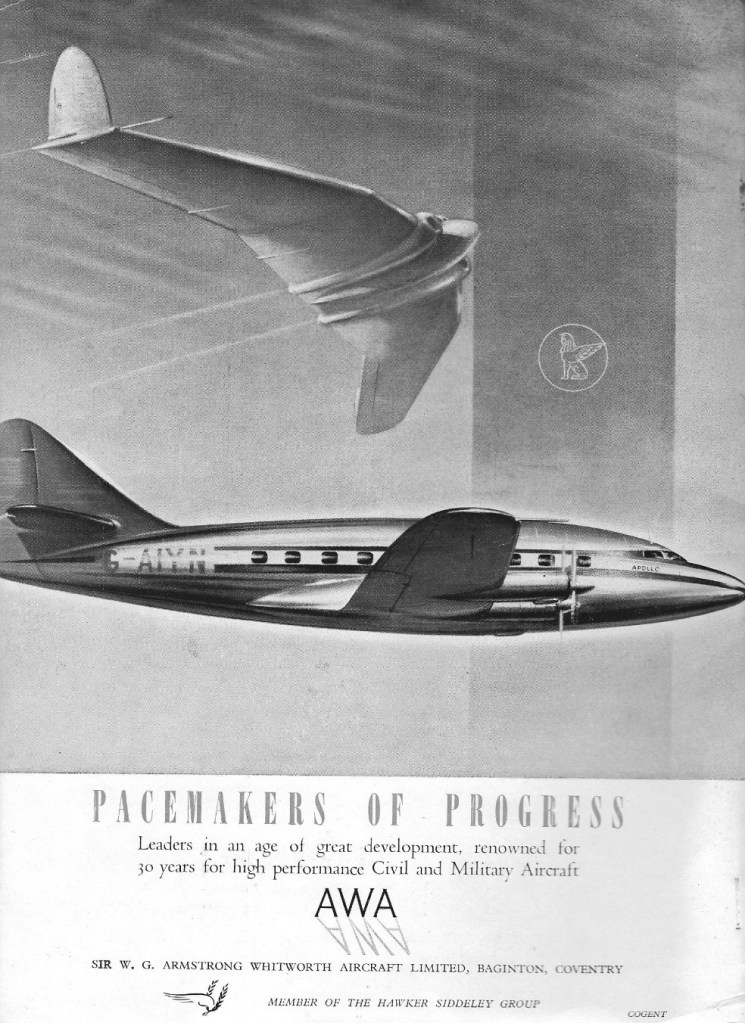
Notable airliners were the three-engined Argosy biplane (1926), four-engined Atalanta monoplane (1932), and the much larger Ensign (1938). The company’s most famous product was the Whitley twin-engined bomber of 1936, in which year Hawker Siddeley Group was formed, with Armstrong Whitworth as a member company. In July 1943 the 1,824th Whitley left the assembly line at Baginton, Coventry, the type having achieved several historic “firsts” in RAF service. The Albemarle (600 built) was used as glider-tug and transport, and Avro Lancaster bombers were built in dispersed factories. After the war, from the basic Gloster design, the company developed and produced in quantity Meteor two-seat nightfighters. When this type was well advanced they undertook development of the Hawker Sea Hawk naval fighter. Avro Lincolns, Hawker Hunters, and Gloster Javelins also produced. Experiments made with flying-wing aircraft and prone-pilot position were undertaken. The Apollo turboprop airliner (1949) had no commercial success, though the Argosy twin-boom four-turboprop freighter (1959) gained limited civil and military orders.
January 1951
Gloster, Armstrong Whitworth and Avro joined Hawker Siddeley Aviation in 1965.
In April 1919 Siddeley-Deasy was bought out by Armstrong Whitworth Development Company of Newcastle upon Tyne and in May 1919 became Armstrong Siddeley Motors Ltd a subsidiary with J. D. Siddeley as Managing Director. In 1927, Armstrong Whitworth merged its heavy engineering interests with Vickers to form Vickers-Armstrongs. At this point, J. D. Siddeley bought Armstrong Siddeley and Armstrong Whitworth Aircraft into his control. In 1928, Armstrong Siddeley Holdings bought Avro from Crossley Motors.
Armstrong Siddeley manufactured luxury cars, aircraft engines, and later, aircraft. In 1935, J. D. Siddeley’s interests were purchased for £2 million by Tommy Sopwith owner of Hawker Aircraft to form Hawker Siddeley, a famous name in British aircraft production. Armstrong Whitworth Aircraft became a subsidiary of Hawker. The aviation pioneer Thomas Octave Murdoch Sopwith – Tommy, later Sir Thomas, Sopwith – became chairman of Armstrong Siddeley Motors, a Hawker Siddeley subsidiary.
Armstrong Siddeley was merged with the aircraft engine business of Bristol Aero Engines that had developed the Olympus engines for the TSR 2 (that engine was subsequently developed for used in Concorde) to form Bristol Siddeley as part of an ongoing rationalisation of the British aerospace sector. Armstrong Siddeley produced their last cars in 1960. Bristol Siddeley and Rolls-Royce merged in 1966, the latter name subsuming the former.
In June 1972, Rolls-Royce (1972) Ltd. sold all the stock of spares plus all patents, specifications, drawings, catalogues and the name of Armstrong Siddeley Motors Ltd to the Armstrong Siddeley Owners Club Ltd.
However, the name survived with Hawker Siddeley Aviation and Hawker Siddeley Dynamics joining with others to become BAe – British Aerospace, and with further mergers has now become BAE Systems the premier defence contractor, which among other things builds Aircraft Engines, Aircraft, and Aircraft carriers.
Throughout the 1920s and 1930s, Armstrong Siddeley produced a range of low- and mid-power aircraft radial engines, all named after big cats. They also produced a tiny 2-cylinder engine called the Ounce, another name for the snow leopard, for ultralight aircraft.
The company started work on their first gas turbine engine in 1939, following the design pioneered at the Royal Aircraft Establishment by Alan Arnold Griffith. Known as the “ASX” for “Armstrong Siddeley eXperimental”, the original pure-turbojet design was later adapted to drive a propeller, resulting in the “ASP”. From then on, AS turbine engines were named after snakes. The Mamba and Double Mamba were turboprop engines, the latter being a complex piece of engineering with two side-by-side Mambas driving through a common gearbox, and could be found on the Fairey Gannet. The Python turboprop powered the Westland Wyvern strike aircraft. Further development of the Mamba removed the reduction gearbox to give the Adder turbojet.
Another pioneer in the production of the RAE engine design was Metrovick, who started with a design known as the Metrovick F.2. This engine never entered production, and Metrovick turned to a larger design, the Beryl, and then to an even larger design, the Sapphire. Armstrong Siddeley later took over the Sapphire design, and it went on to be one of the most successful 2nd generation jet engines, competing with the better-known Rolls-Royce Avon.
The company went on to develop an engine – originally for unmanned Jindivik target drones – called the Viper. This product was further developed by Bristol Siddeley and, later, Rolls-Royce and was sold in great numbers over many years. A range of rocket motors were also produced, including the Snarler and Stentor. The rocket development complemented that of Bristol, and Bristol Siddeley would become the leading British manufacturer of rocket engines for missiles.