Born in 1901 at Newcastle-upon-Tyne, C.H. Lowe-Wylde built his first glider at the age of 14. On 3 January 1930 he founded the Kent Gliding Club, then designed the first British Primary glider, the B.A.C.1, which was thwn built bu members of the Kent Club.
The British Aircraft Company (1935) Ltd was founded by C.H. Lowe-Wylde in 1930, the company set up a factory in a disused brewery in Lower Stone Street, Maidstone, Kent, UK.
The British Aircraft Company (1935) Ltd. built a series of eight glider types in the early 1930s. In 1932 one was fitted with landing gear and a Douglas motorcycle engine driving a pusher propeller. A small number were produced before designer and company owner C. H. Lowe Wylde was killed while flying the initial conversion on 13 May 1933. Company taken over by Austrian pilot Robert Kronfeld, becoming Kronfeld Ltd.
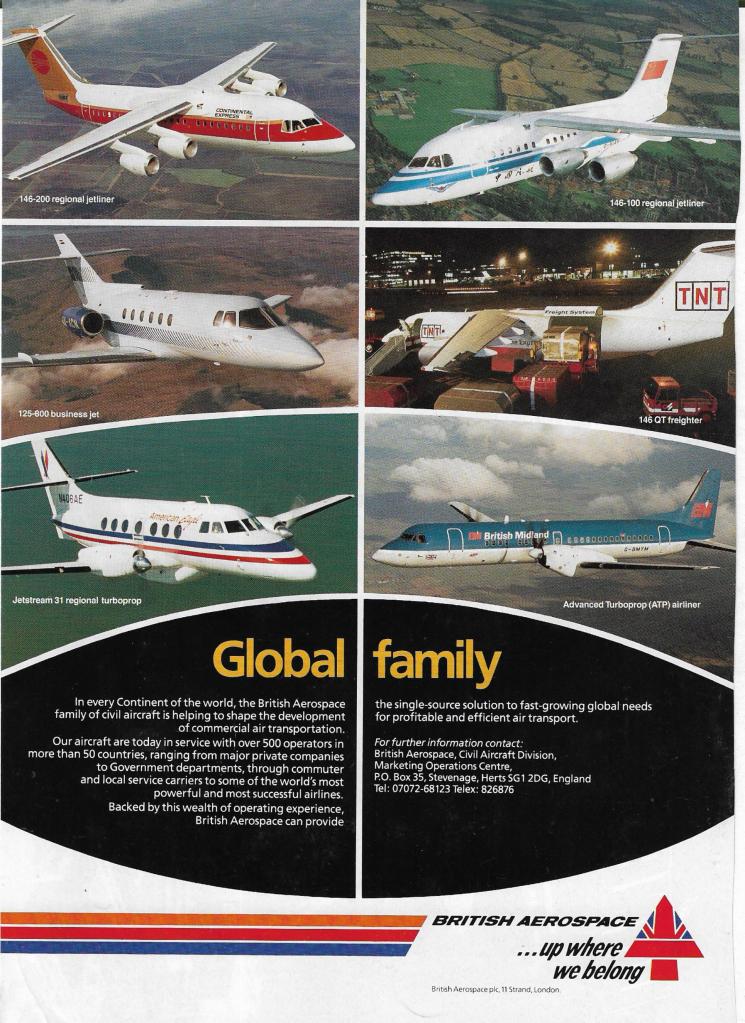
Nationalized enterprise, founded in April 1977, uniting British Aircraft Corporation, Hawker Siddeley Aviation, Hawker Siddeley Dynamics and Scottish Aviation. Companies retained their identities initially, but subsequently became divisions of British Aerospace. Many aircraft of former constituent companies continued as BAe products, initially under old company names, although former British Aerospace Corporate Jets division sold to Raytheon of the U.S.A. in August 1993 (becoming Raytheon Corporate Jets), thereby losing the Hawker bizjets. BAe reorganized into new business units, namely Defence, Commercial Aerospace and British Aerospace Regional Aircraft Ltd. (BARAL), which is the structure in 1999, with additional organizations for international marketing and sales, spares and logistics, Jetstream Aircraft Ltd. (offers engineering management for Jetstream customers), etc. Commercial Aerospace division encompasses British Aerospace Airbus (working on Airbus airliner programs), and British Aerospace Asset Management. British Aerospace Regional Aircraft Ltd. (BARAL) encompasses Avro International Aerospace (producing RJ airliners), plus Jetstream Aircraft, and Spares & Logistics Center.
Military aircraft activities, some as continuations of programs begun by pre-BAe companies, included the Hawk basic/advanced jet trainer and light attack aircraft, with air defense capabilities (first flown August 1974 and sales continuing in Hawk 50/60/100 two-seat and Hawk 200 series single-seat versions); development/upgrading/production of STOVL Sea Harrier F/A Mk 2 for Royal Navy; joint development and production with Boeing in the U.S.A. (formerly McDonnell Douglas) of land-based STOVL Harrier II (first flown November 1981) and Harrier II Plus (first flown September 1992) plus T-45 Goshawk carrier-capable jet trainer for U.S. Navy (Hawk variant); share of the Eurofighter program; share of the Tornado program; share of the Jaguar program; development and rework of existing Nimrod maritime patrol aircraft into Nimrod 2000 form for RAF service as MRA Mk 4s from the year 2003 (first flight 1999; program involves more than 200 British companies and some foreign suppliers). Civil aircraft activities included continued marketing and production of the Avro RJ family of 70- to 128- seat short-range regional airliners and freighters (developed from the previous BAe 146; RJ85 first flew March 1992). Manufacture of the Jetstream 31 (first flown March 1982 in production form) and Super 31 (April 1988), Jetstream 41 (September 1991), ATP (August 1986, as development of former HS/BAe 748) and its derivative Jetstream 61 (1994, but none sold), ended in 1998.
A merger with GEC-Marconi Avionics Ltd. was being finalised in 1999.
Founded in 1917 by Samuel Waring in premises previously occupied by the Joucques Aviation Company. The British Aerial Transport Company’s chief designer was Frederick Koolhoven, formerly with Sir W. G. Armstrong, Whitworth & Company Ltd. His first design for the new company was the BAT F.K.22 Bat, a small single-seat fighter. Failure of the ABC Mosquito engine for which it was designed resulted in a new and smaller aircraft being created, the F.K.23 Bantam, powered by the ABC Wasp. Only nine production aircraft were built, and none saw wartime. Other BAT designs included the F.K.24 Baboon, F.K.25 Basilisk and, finally, the F.K.26, a civil transport aircraft with accommodation for four passengers, of which only four were built. The F.K.27 was a single side-by-side, two-seat variant of the Bantam. When the company went bankrupt in 1919, its assets were distributed between Alliance Aeroplane Company Ltd. and Nieuport & General Aircraft Company, also founded by Samuel Waring.
Bristol Aero Engines (formerly Bristol Engine Company) merged with Armstrong Siddeley Motors in 1959 to form Bristol Siddeley Engines Limited (BSEL) which in turn was taken over by Rolls-Royce in 1966.
In 1910 Sir George White, the wealthy owner of the Bristol Tramways Company, formed the Bristol and Colonial Aeroplane Company Ltd. With head offices in Bristol and a factory at nearby Filton, the aircraft produced by the company were generally known as ‘Bristols’.
Founded at Bristol, Somerset, in February 1910 as British & Colonial Aeroplane Company Ltd, a factory was set up in two sheds in the village of Filton in south Gloucestershire, just north of Bristol. Sir George White was a wealthy Bristol businessman and his company was registered on 19 February 1910 with a capital of £25,000. First began construction of a number of biplanes under license from Societe Zodiac, but these were not completed because the sample aircraft bought from France could not be induced to take to the air.
First aircraft produced were Bristol biplanes, usually known as the Boxkite, which initially were little more than copies of the Henry Farman biplane. The first of these, the Boxkite, was based on a Henri Farman design. The Boxkite made its debut at the Third International Aero Exhibition in 1911 and went on to become the first commercially produced aircraft in Britain with two per week rolling out of the factory. It was sold to the British and Russian military as well as being exported throughout the British Empire.
Flying schools established at Larkhill, on Salisbury Plain, and at Brooklands, Surrey, 1911. February 1911 Deutsche Bristol-Werke established at Halberstadt, Germany, to operate a flying school and build Bristol airplanes; arrangement canceled June 23,1914.
First military aircraft were monoplanes designed by Henri Coanda; No. 105 shared third place with a Deperdussin in the Military Aeroplane Competition of 1912. Bristol Scout, or “Baby Biplane”, evolved by Frank Barnwell 1914. The two-seat Bristol Fighter entered service in 1917 and became regarded as the best general-purpose combat aircraft of the First World War. During the final year of the war the company produced 2,000 aeroplanes from its own factories. By the Armistice the payroll had risen from 200 in August 1914 to 3,000 and the original tram sheds were now part of a factory with eight acres of floor space. Following the acquisition of the Cosmos Engineering Company in 1920, the Bristol Company was also a major builder of aero engines. Renamed the Bristol Aeroplane Company on 9 February 1920. Problems of readjustment and survival were intensified by the general world wide economic depression that succeeded the brief postwar boom. Diversification was one of the expedients adopted to keep the nucleus of the skilled workfiorce in being at Filton. Aircraft manufacture was augmented by produc¬tion of bus and coach bodies and later of motor car bodies. Between the wars Bristol Bulldog biplanes had equipped nine RAF Squadrons by 1932 and were most widely used fighter until 1936. In 1935, Bristol’s directors, realising that the company’s capital resources were inadequate, resolved on 15 June to re organise the firm as a public limited liability company with a share capital of £1.2million. Bristol Type 138A of 1936 captured world altitude record in September, 1936, then regained it from Italy in June 1937 with an altitude of 16,440m. Bristol Type 142, built as executive aircraft for Lord Rothermere, became the military Blenheim, an important light bomber in the early Second World War period. Beaufighter, first flown July 1939, became RAF’s first nightfighter, subsequently an important antishipping aircraft armed with rockets, torpedoes, and bombs. Designed and built prototype of eight-engined 100- passenger Brabazon I, first flew September 4, 1949; scrapped 1953 for financial/political/technical reasons. Type 170 Freighter first flown December 2, 1945 and 213 built subsequently. Turboprop powered Britannia first flew August 16, 1952, made the first non-stop airliner flight London, Vancouver (8,208km), June 29, 1957, and first North Atlantic passenger service to be flown by a turbine-powered airliner on December 19 of the same year. A helicopter department was set up in 1945 as part of the aircraft division at Filton. Austrian born Raoul Hafner headed a research and development team which produced the Type 171 Sycamore. Subsequently entering service with RAF as its first British-designed helicopter in 1952.
1955
In January 1956 the Bristol Aeroplane Company had reorganised into three wholly owned companies; Bristol Aircraft Ltd, Bristol Aero-Engines Ltd, and Bristol Cars Ltd.
September 1957
Four years later Bristol Aircraft Ltd joined with Vickers Ltd and English Electric to become the British Aircraft Corporation.
In 1960 Westland Aircraft took over the Bristol Helicopter Department.
In 1960 Bristol Aircraft Ltd joined with Vickers Ltd and English Electric to become the British Aircraft Corporation.
Bristol Aero Engines (formerly Bristol Engine Company) merged with Armstrong Siddeley Motors in 1959 to form Bristol Siddeley Engines Limited (BSEL) which in turn was taken over by Rolls-Royce in 1966.
Research and development ot the tandem-rotor helicopters resulted in Type 192 Belvedere which entered service with the RAF, in 1961.
On 28 December 1963 the separate companies merged their identities and Bristol Aircraft Ltd became the Filton Division of BAC. Four years later the Bristol title was lost from the engine side when Bristol Siddeley Engines Ltd became the Bristol Engine Division of Rolls Royce Ltd. The nationalisation of the aircraft industry in 1977 resulted in the formation of British Aerospace (BAe) and the works at Filton became part of the Weybridge Bristol Division of BAe Aircraft Group while the BAC Guided Weapons Division at Fillon became part of the Stevenage Bristol Divi¬sion of the BAe Dynamics Group.
Bristol Aero Engines (formerly Bristol Engine Company) merged with Armstrong Siddeley Motors in 1959 to form Bristol Siddeley Engines Limited (BSEL) which in turn was taken over by Rolls-Royce in 1966.
BRM Aero Ltd was established for development, production, sale and maintenance of ultralight and light sport aeroplanes. The company is mostly oriented on individual orders. The company finished colaboration with ROKO AERO company and stopped sale of NG 4 aircrafts built from ROKO AERO quick built kits, but continued to support the NG 4 customers with spare parts, repair and any kind of modifications on their aircraft.
2012: Václava Kulíška 1224 686 05 Uherské Hradiště Czech Republic
One of the USA’s pioneer sailplane designers, William G. Briegleb built and flew his first glider in 1928, and later formed the Sailplane Corporation of America to market gliders of his own design. Just before World War 2 he produced the BG 6 and BG 7 strut-braced high wing designs with fabric-covered steel fuselages,; a few of these were used by the USAAF for training as well as by private owners and clubs. Recently Mr Briegleb’s firm re-introduced construction of the BG 6 and BG 7 as a plans-only service to homebuilders, and by the beginning of 1978 59 sets of BG 6 plans and 29 sets of the BG 7 had been sold.
Founded in the mid-1930s, the first product of this company was a two-seat scout/bomber for the U.S. Navy designated SBA. When this aircraft entered production in 1937-1938 the company had inadequate productive capacity and 30 were built by the Naval Aircraft Factory as SBNs. The F2A Buffalo which followed was the first monoplane fighter to serve with the USN, and was also used by the armed forces of Belgium, Britain, Finland, and Netherlands East Indies. The later SB2A Buccaneer, though built in quantity, proved totally unsuitable for frontline service. Manufacturing rights of the Fleet trainers were sold in 1939 to Brewster Aeronautical Corp.