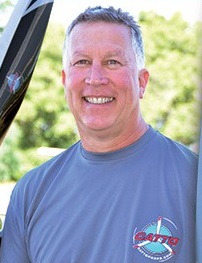
The Icarus II motorization began in 1975, when Catto was just 15—before he even had a driver’s license (though he had just gained his glider ticket). “I can’t believe my parents let me do that,” he quips, as he recounts the story. When I ask how he had the confidence to attack such a project, he laughs and simply says, “I had no clue. I didn’t know any better.”
The Icarus II was a foot-launched glider, and when Catto first took his motorized version to the sand dunes along Pismo Beach (south of San Jose where he grew up), the rat finks in their dune buggies laughed at the tall geeky kid with the Rube Goldberg contraption of wings and wires. Undaunted, Catto dove into the wind, at first “barely moonwalking over the ground,” he laughs, but soon buzzing along 12 feet above the dunes, a bevy of Super Beetles trailing behind and cheering him along as he flew up several miles of coastline. He landed with his 15 minutes of fame secured, and an entrepreneur. His first aviation business was selling the Icarus II motorization kits—complete with hand-carved propeller, of course.
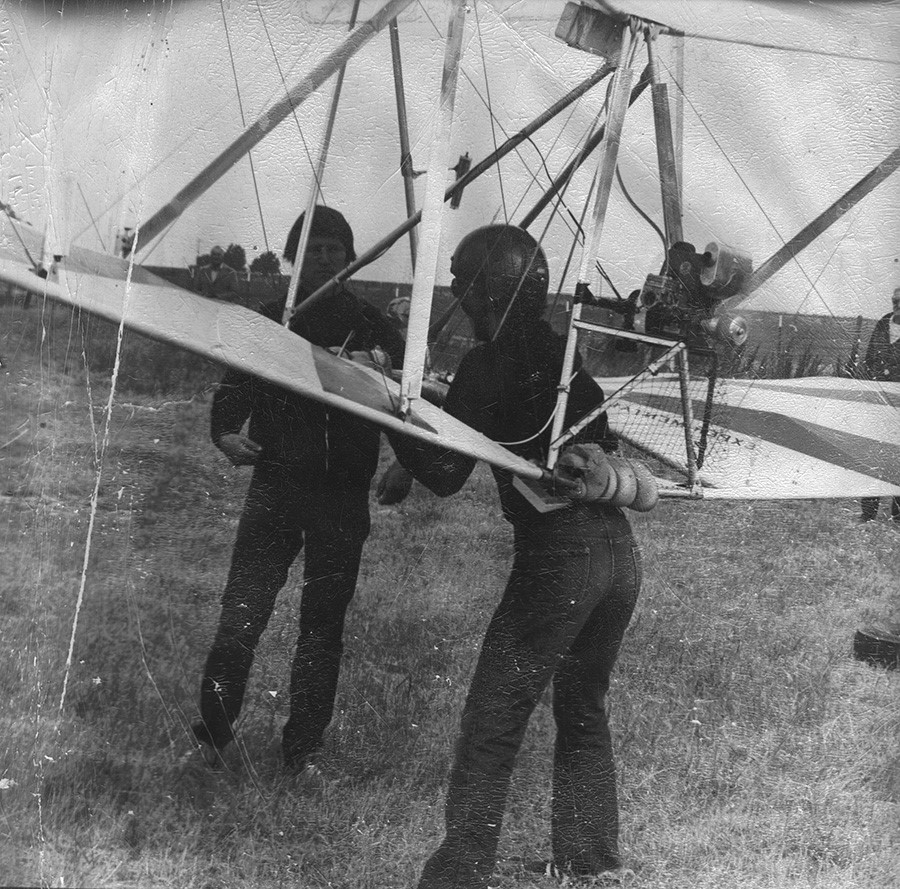
Within two years, he was selling kits for a pair of flying-wing gliders of his own design, the CA-14 (wood wing) and CA-15 (fiberglass and stamped aluminum). He still has the informational brochure, which is surprisingly professional in its layout for someone fresh out of high school (Catto graduated high school in just two years). He continued to buzz around in ultralights of his own design, winning “best float” at the 1977 Everett, Washington 4th of July Parade (flying 200 feet above the parade route with the King Broadcasting logo on the underside of his wings), and being featured on the TV show, To Tell the Truth, that same year, and in People magazine a year later. All while still a teenager.
In 1979 Catto jumped into a Citabria and went airport hopping along the west coast, north from Grass Valley, down south to Mariposa, looking for a place to set up shop (to the relief of his parents’ neighbors, no doubt). At Jackson County Airport, about 40 miles southeast of Sacramento in the foothills of the Sierras, he found a large hangar he could rent for $500 per month. There he established a factory to build kits for a canard ultralight he’d designed called the Goldwing.
In conjunction with Brian Glenn, to whom he had licensed the rights, Catto built more than 1500 kits—his first large production success. “The first six months were great, but then Glenn realized he wasn’t making any money, and things got harder after that,” says Catto.
When production ended in 1982, Catto decided to build propellers full time. He moved his shop up to his home atop Mokelumne Hill, where it has been ever since, until moving back down the hill to a new 10,000 square foot facility at Jackson Airport earlier this year. That said, Catto’s curiosity and entrepreneurial spirit run wide and his professional work extends far beyond propellers: in addition to hang gliders and ultralights, he built two airplanes of his own design, the Solo (a composite ultralight resembling the Cessna 150) and Acro-X (a composite knockoff of a Star Wars TIE-fighter). He has built wings and tails for several gold class Formula 1 Reno racers (Endeavor, Outrageous and Scarlet Screamer), patented an articulating snowboard, and even sold his design for a solar-powered electric standup scooter to a Japanese company.
Craig Catto is nearing his fifth decade building propellers for Experimental aircraft. Those first propellers still hang above his desk: small hand-carved wood props that spun at 8000 rpm in front of the McCulloch 12-hp two-stroke go-kart engine he was using to motorize his Icarus II hang glider. He tells the story of testing them in the backyard of his childhood home, using bathroom scales to measure thrust and methanol to send the tips past Mach 1.
Word quickly spread to other Experimental communities about the performance of Catto props. His props have a four- to six-month wait time, and if he gets the type certificate for Super Cubs, he figures he’ll be able to take orders for $1,000,000 worth of props over the three days of the Alaska Aviation Trade Show.
Catto’s propellers dominate the biplane class at Reno and hold numerous world records in speed, time to climb, and altitude. His props have powered the last four consecutive winners in the Experimental bush class at the Valdez fly-in STOL competition, helped take Bruce Hammer and his Glasair 1 to first place in last year’s AirVenture Cup, and pulled NASA’s Pathfinder to more than 80,000 feet in 1998. Recently, Catto props have become popular among unlimited aerobatic pilots due to their excellent performance and low inertia; Australian unlimited aerobatics champion Paul Bennett has a Catto up front on his.