Dassault Belgique Aviation SA / SABCA

French transport, utility and trainer aircraft. When Marcel Dassault (the prewar Marcel Bloch) recovered from his wartime experi­ence in Buchenwald concentration camp, he set up in the aircraft business with a factory at Talence and a scheme for his universal twin‑engined machine. Civil markets proved elusive, but the Armee de l’Air bought con­siderable numbers.

Marcel Dassault designed under his original name, Marcel Bloch, before the Second World War. It was not until after World War II that Marcel Bloch, born a Jew, converted to Ca­tholicism and changed his name to Dassault.

The surviving private portion of Bloch became Dassault in 1948.

As Avions Marcel Dassault built the MD 315 Flamant light transport for the Armee de l’Air in 1945. A successful line of fighters for France and export began with the Ouragan (1949); followed by swept-wing Mystere (1952). Afterburning Super-Mystere (1959) was first European supersonic production aircraft. Etendard naval fighter appeared 1958.

By 1958 Dassault was one of the richest men in France and owned 98% of the company.

Large family of aircraft included Mirage prototype (1956), Mirage III (1958), Mirage IV supersonic bomber (1959), Mirage V (1967), Mirage III/VVTOL strike fighter prototype (1965), F2 interceptor (1966), and G8 variable-geometry prototypes (1967), Mirage F1 (1966), and Milan (1969). Also produced Mercure airliner (1971) and successful executive Falcon 10 (1970), and 20 (1963) twin jets (originally called Mystere; U.S. production called fan Jet Falcon). Involved in formation of Air-Fouga (Etablissements Fouga), 1956.

Dassault acquired majority holding in Breguet Aviation, becoming Avions Marcel Dassault-Breguet Aviation on 14 December 1971.

Completing the arrangements first proposed in mid-1977, the French government acquired 32% of the shares in Avions Marcel Dassault-Breguet Aviation at a cost of £64m. The deal gives the government nominees on the board a blocking vote. The transfer of stock was made on 1 January 1979.

The Dassault name was adopted in 1990 for the former Avions Marcel Dassault-Breguet Aviation, with programs including Atlantique 2, Mirage 2000, Rafale air-superiority and strike fighter for the French Air Force and Navy (first flown July 1986), Falcon 50 series, Falcon 900 series and Falcon 2000 (first flown March 1993).
da Silva, Abeillard Gomes

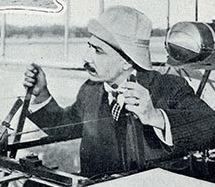
In 1909, Abeillard Gomes da Silva, was in Beira in the then Portuguese colony of Mozambique. Working there, at customs, was Abeillard Gomes da Silva, who that year had the opportunity to visit Europe during a holiday. At his own expense, he set off for France with an interest in heavier-than-air flight.

Upon arriving in France, he promptly spent 23,000 francs to build an airplane of his own invention: the Gomes da Silva I.

Gomes da Silva died in Mozambique in 1930, and holds the distinction of being a Portuguese air pioneer, as evidenced not only by his invention, but also by the title of honorary member of the Aéro-Club de France and by his pilot’s licence, obtained in Germany during his European tour.

Dart Aircraft Co / Zander & Weyl / Dunstable Sailplane Co

Founded as Zander and Weyl Ltd at Luton Road, Dunstable in 1934 when E.P.Zander and A.R.Weyl went into partnership to build and repair gliders and light aircraft, along with the Dunstable Sailplane Company in 1935 with works at Hockliffe. W.L. Manuel joined as manager.

In July 1935 the company moved to new premises at the Luton Aerodrome, Barton-in-the-Clay, Bedfordshire, when Latimer-Neeham formed Luton Aircraft Ltd.

Several Zogling gliders were built and in 1935 a series of replicas of early gliders were made for the film “The Conquest of the Air” which was filmed by Alexander Korda at the Denham studios. These replicas included two Lilienthal types, a Wright 1902 glider, and one of Catley’s early gliders. Also, at the time the firm built a ‘Flying Flea’ from approved aircraft materials. This was the first powered aircraft built by Zander and Weyl.

The Flea was followed by the Dunstable Dart which was built after a suggestion, by members of the London Gliding Club, that the Slingsby Falcon 3 would possibly make a reasonable ultralight aircraft if it was fitted with a small engine. Weyl eventually came up with a completely new aircraft.

In 1936 to designs of A. R. Weyl, Zander & Weyl built the Dart Flittermouse single-seat ultralight aeroplane in 1936. Built aircraft subsequently as Dart Aircraft Ltd. First were Dunstable Dart, later named Dart Pup, and Flittermouse, both with parasol wing and pusher propellers. Three Dart Kittens were built in U.K., as well as one in Australia from plans.

In September 1936 the company moved to Phoenix Works at Gerrard Cross, Buckinghamshire, and concentrated on kits and plans for Minor aircraft for home constructors. At the same time Dunstable Sailplane offered kit drawings for the Kestrel sailplane.

In 1936 the company was re-organised financially and the name was changed to Dart Aircraft Ltd. New premises were obtained at 29 High Street North, in Dunstable. The Dunstable Dart aircraft was renamed the Dart Pup, and two new sailplanes were designed and built; the Cambridge and Totternhoe. Also introduced in 1936 was the Dart Flittermouse aircraft and, at the end of the year, the first Dart Kitten ultralight.

In 1937 a revised version of the Kitten was built but financial difficulties followed. E.P. Zander later left the firm to establish another company in Dunstable; Scott Light Aircraft.

Weyl continued to develop the Kitten and in 1938 designed a two-seat version as the Dart Weasel. This was an enlarged version of the Kitten, having tandem seating and a tricycle undercarriage, and was intended for possible Civil Air Guard training but it was not completed.

Operations ceased in 1939 and after the war Weyl continued development of the Kitten and introduced a Mark 3 version for homebuilt construction.

He died in 1965.

Dart Aircraft Article

d’Arrigo, Angelo

D’Arrigo was born in Catania, Sicily, April 3, 1961, but grew up from a very early age in Paris, as his parents emigrated there in search of work. He returned to Sicily after graduating from the university in Paris, and from his base on Mt. Etna gained a number of world records and world titles in the field of ultra light flying and free flying.

In 2001 he initiated a sequence of breath-taking events which saw him flying alongside various birds of prey as he attempted to learn from them their techniques for migratory flight by taking advantage of thermal air currents for long distance flight with low energy consumption.

In 2002 he crossed the Sahara and the Mediterranean with an eagle. His hang glider was launched from a microlight.

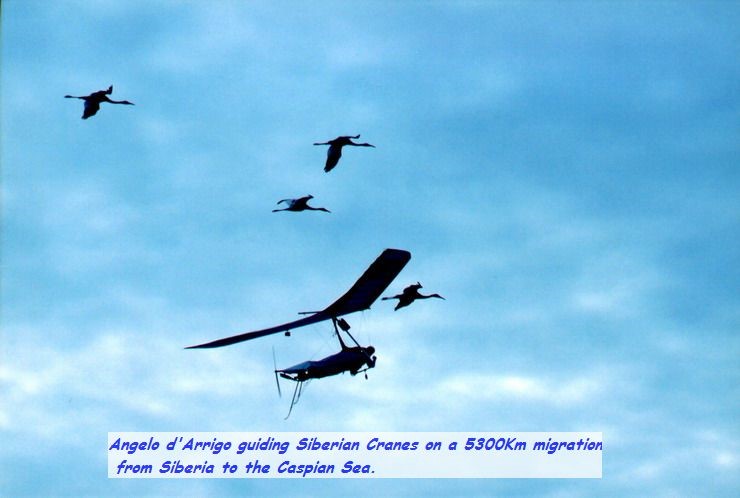
In 2003 he flew 5,500 kilometres from northern Siberia to the Caspian Sea in Iran in the company of a flock of Siberian cranes who had been born in captivity and, due to imprinting, considered him their parent. The bird is at risk of extinction, and, in order to try to save the species, Russian ornithologists hatched a plan. It called for having the eggs incubated under Angelo’s hang-glider, so the chicks saw this as they hatched. Angelo would then be with the chicks as they fledge. When they were ready to fly, they would fly alongside Angelo so they would consider him their mentor. That way, he could show them the traditional migratory route for their species. They had no other way to learn it. This approach was similar to the one taken in the movie Fly Away Home.

In 2004, he was aerotowed by Richard Meredith-Hardy and released over Mount Everest another world record. He reportedly made this flight over the summit of Everest with a trained Nepalese eagle. However, there were no eyewitnesses to this achievement, even though climbers saw and photographed Meredith-Hardy’s microlight aircraft. No evidence in the form of videos or photography has ever been brought forward, either, despite the fact that d’Arrigo’s hang-glider was equipped with three video cameras and two still cameras. The story is fully narrated in the documentary Flying Over Everest by director Fabio Toncelli.

In 2006 he followed the migratory routes of the condor over Aconcagua in the Andean Cordillera, the highest mountain in the Americas.

On March 26, 2006, he died in an accident during an airshow at Comiso, Italy, at the age of 44. A small Sky Arrow airplane, in which he was a passenger, fell 200 meters to the ground. Both d’Arrigo and the pilot, a general of the Italian Air Force and ex-test pilot, were killed on impact. At the time of his death, Angelo was engaged in planning an expedition to Peru to re-introduce two Andean condors bred in captivity and raised by d’Arrigo at his home on Mount Etna. A documentary about this was being made at the time. It was called “Born to Fly”.

In memory of her husband, his widow Laura instituted a charity, the Fondazione Angelo d’Arrigo, with the aim of helping children in Peru. Angelo d’Arrigo was posthumously given the alternative sportsperson’s award at the 2006 Laureus World Sports Awards.

Darmstadt University Aviation Soc.

Klaus Holighaus started his career in gliding as an engineer when he was a student at the University of Darmstadt. With two of his fellow students, Waibel and Lemke he developed and built a prototype of the DG36. This was just the beginning of his revolutionary glider designs. After he completed his University Diploma he joined Schempp-Hirth.