1997: Rue de Poiriers, 7 Gembloux B-5030, Belgium.
Following the closure of the Aviasud factory, the Mistral was constructed by Aériane, and the Albatros by Micronef ULM (1998).
1998: 7 rue Poiriers, B-5030 Gembloux, BELGIUM
LSA/UL
Aeolus Aviation Aeolus
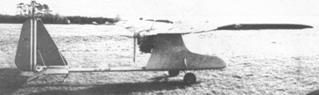
Designer Kevin McGrath wanted to produce an aircraft which could be flown regularly even in British weather conditions, so he deliberately made the wing loading as high as possible within the British microlight definition and gave the aircraft a snug cockpit. The transparent canopy at the front hinges at the top to allow entry and exit and can be removed completely for summer days. Another novel feature is that behind the pilot is a compartment suitable for 13 lb (6 kg) of baggage.
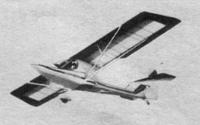
Introduced in prototype form at the beginning of 1983, the Aeolus is most notable for its fully enclosed glass fibre fuselage; this is a structural part of the aircraft rather than just a pod, and supports the engine at the rear.
A single seat, single engined high wing mono¬plane with conventional three axis control. The wing has unswept leading and trailing edges, and constant chord, with a conventional tail. Pitch control is by elevator on the tail; and yaw control by fin mounted rudder; roll control is by full span ailerons; with control inputs through stick for pitch/roll and pedals for yaw. The NACA 63412 profile; 100% double surface wing is braced from above by struts and cables, from below by struts. The undercarriage has three wheels in tail dragger formation; steel spring suspension on the tailwheel and aluminium spring suspension on the main wheels. No ground steering (tailwheel castors) or brakes are fitted. The glassfibre fuselage is totally enclosed, and the engine is mounted below the wing, driving a pusher propeller.
The prototype machine was to be modified for production, using V belts instead of a toothed belt reduction drive. Other changes for production included a 25% increase in tailplane and elevator areas, a reduction in aspect ratio from 7.3 to 5.6/1, a more rigid wing of composite construction with heat shrunk fabric skin and strut bracing, plus replacement of the coil spring suspension on the main wheels by a wire-braced aluminium cantilever arrangement.
Prototype
Engine: Robin EC34PM, 30 hp at 7500 rpm.
Max static thrust: 160 lb, 73 kg.
Propeller: 53 x 36 inch, 1.34 x 0.91 m.
Reduction: Toothed belt ratio.
Length overall: 17.0ft, 5.18 m.
Height overall: 5.5ft, 1.68m.
Power/unit area: 0.21 hp/sq.ft, 2.3 hp/sq.m.
Fuel capacity: 6.0 USG, 5.0 Imp gal, 22.7 lt.
Wing span: 32.0ft, 9.76m.
Constant chord: 4.4ft, 1.34m.
Dihedral: 2 degs
Sweepback: 0 degs
Tailplane span: 7.5ft, 2.29m.
Fin height: 4.0ft, 1.22m.
Total wing area: 140 sq.ft, 13.0 sq.m.
Aileron area: 9.0sq.ft 0.84 sq.m.
Fin area: 3.0 sq.ft, 0.28 sq.m.
Rudder area: 5.0 sq.ft, 0.46 sq.m.
Tailplane area: 15.0sq.ft, 1.39 sq.m.
Elevator area: 10.0 sq.ft, 0.93 sq.m.
Wing aspect ratio: 5.6/1.
Wheel track: 4.0ft, 1.22m.
Wheelbase: 11.0ft, 3.35m.
Tailwheel dia: 4 inch, 102 mm.
Main wheels dia: 12 inch, 305 mm.
Empty weight: 280 lb, 127kg.
MTOW: 550 lb, 249kg.
Payload: 220 lb, 100 kg.
Max wing load: 3.92 lb/sq.ft, 19.1 kg/sq.m.
Max pwr loading: 18.3 lb/hp, 8.2kg/hp.
Load factors: +4.0, 2.0 design; +6.0, 4.0 ultimate.
Max level speed: 65 mph, 105 kph.
Vne: 80 mph, 129 kph.
Max cruise: 58 mph, 93 kph.
Economic cruise: 58 mph, 93 kph.
Stalling speed: 28 mph, 45 kph.
Max climb SL: 550 ft/min, 2.8 m/s.
Best glide ratio: 11/1 at 45mph, 72kph.
Take off dist: 200ft, 60m.
Landing dist: 200ft, 60m.
Service ceiling: 10,000ft, 3050m.
Range ave cruise: 120 mile, 193km.
Aeolus Aviation
1983: Poisestar Ltd t/a Aeolus Aviation, 10 Western Road, Reading, Berkshire RG1 6PD, Great Britain.
Adventure Air Ltd
1995-7: Tortola V.P.I., PO Box 368, Berryville, AR 72616, USA.
Has produced kits for 2 + 2 Amphibian (2 + 2 seating) and Adventure Twin two-seat amphibian, Super Adventurer and Adventurer 4-Place.
Advanced Aviation VIP / Enforcer / Ag Cobra
Double-surface mono-wing and tail of aluminum tube, Dacron. Conventional 3-axis controls with spoilers. Undercarriage: Tricycle, aluminum. Price 1984: $6,262. Sold through dealers only.
Engine: Cuyuna 430cc, 43 hp
Wood prop: 72in x 30in
Wingspan: 35 ft 3in
Wing area: 162 sq.ft
Empty weight: 300 lb
Gross weight: 750 lb
Cruise speed: 50-55 mph
Stall speed: 25 mph
Vmax: 65 mph
Climb: 1000 fpm
Takeoff run: 50-100 ft
Landing roll: 100 ft
Setup time: 25 min
Advanced Aviation Seawolf
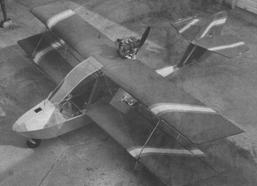
A single pusher engine (of many different sizes) cabin class; conventional-tail amphibian fly¬ing boat, negative stagger biplane, with conventional three-axis control (differential ailerons); retractable tricycle gear for water operations and outrigger floats for lateral stability on the water; and caster¬ing nosewheel and main wheel brakes for steering on land.
Of bolted aluminum tube construction with interbay cable and strut bracing and covered with pre-sewn Dacron envelopes. The Seawolf, has a semi-monocoque hull. Aluminum sheets (2024-T2 alloy) are riveted together with self-sealing pull rivets. All bulkheads and stiffeners are formed aluminum. The cross section is a deep ‘N,” and low-porosity foam blocks inside the hull help distribute water loads and give additional flotation. Three sections provide housing for the retractable nosewheel, anchoring for the main structure and gear, and structural support for the tail and tail skid. In the ladder-style wing construction is the internal cable brac¬ing, with 85 percent span ailerons, and a torque-tube control system. The tail group is also Dacron and tube, with fold-down capa¬bility for trailering. Control linkage is via stainless-steel cable for rudder, and teleflex-type for elevator. The landing gear is a conventional tri¬cycle setup, with retraction via a single lever in the cockpit. Advanced Aviation planned to offer several different engine packages, either air or liquid cooled, in power ratings up to 65.
HB-35
Horsepower: 35
Thrust: 250 lb
Pwr loading; 18.4 lb/hp
Prop: 68 in
MTOW: 644 lb
Empty wt: 304 lb
Max pilot wt: 260 lb
Fuel cap: 5 USG
Length: 21 ft 3 in
Wing span: 23 ft 6 in
Wing area: 165 sq.ft
Aspect ratio: 6.93
Wing loading: 3.93 lb/sq.ft
Stall: 24 mph
Max speed: 63 mph
Vne: 79 mph
Vr: 29 mph
Cruise 75%: 57 mph
Best climb angle: 34 mph
Best glide: 31 mph
Cruise 65% power: 52 mph
Max ROC: 750 fpm @ 38 mph
Baggage cap: 50 lbs / 20 cu.ft
Range(30min res)75%: 152 sm
Range(30min res)65%: 157 sm
Manoeuvre speed: 53 mph
Land T/O dist: 125 ft
Water T/O dist: 250 ft
Ldg dist land: 125 ft
Ldg dist water: 250 ft
HB-43
HB-48
HB-65
Advanced Aviation Cobra / King Cobra
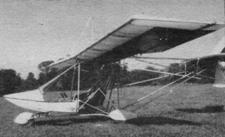
The Cobra was a completely new design according to the releases from Advanced Aviation. The wing is totally new and, although the aircraft still has a cruciform empennage, it has been completely changed to fit it for its role as a three axis device. The Cobra was presented for the first time at the 1982 Oshkosh and was next shown at the Sun ‘n’ Fun event at Lakeland the same year.
Advanced Aviation Cobra / King Cobra Article
Recognition points include a rectangular plan form wing with triangular wing tips and double skin fabric over the whole chord. It has spoilerons of single thickness cloth and the trailing edge is notched between each batten, giving the impression of a batwing. Options are a braked steerable nosewheel, wheel fairings, reserve petrol tank, floats, skis, a parachute and an instrument panel. A single seat, single engined, high wing mono¬plane with conventional, three axis control. The wing has unswept leading and trailing edges, and constant chord except for triangular wing tips; cruciform tail. Pitch control by elevator on tail; yaw control by fully flying rudder; roll control by half span spoilerons; control inputs through stick for pitch/roll and pedals for yaw. The wing was braced from above by kingpost and cables, from below by cables; wing profile; 90% double surface. Undercarriage has three wheels in tricycle formation; torsion bar sus¬pension. Optional push right go right nose¬wheel steering connected to yaw control. Optional brake on nosewheel. Aluminium ¬tube framework, without pod. Engine mounted above wing driving pusher propeller. Tubing used is 6061T6 anodized aluminium; wing covering is Dacron. Rigging is vinyl ¬coated stainless steel cable. Price (January 1983) $4995 in kit form.
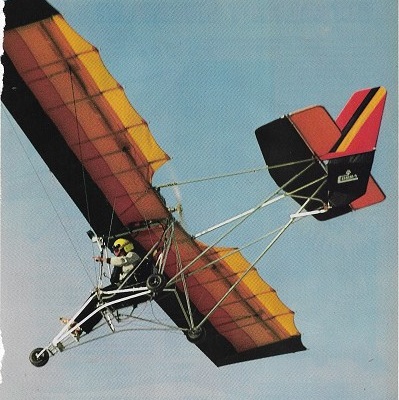
The two seat King Cobra debuted at 1983’s Sun ‘n Fun. The two seat trainer version of the Cobra and has side-by-side seating configuration, with dual flying and engine controls for instructional purposes. The nose wheel is steer¬able on both models, in-line planetary gear, optional floats.
Cobra
Engine: Cuyuna ULII-02 (429 cc) 35 hp.
Static thrust: 225 lb.
Empty wt: 250 lb.
Wing span: 35ft.
Wing area: 152 sq.ft.
Aspect ratio: 8.0.
Height: 9ft 3in.
Length: 17ft 6in.
Fuel cap: 5 USG.
Max wt: 525 lb.
Stall: 26 mph.
Max speed: 63 mph.
Vne: 70 mph.
Design limit: +5, -3g.
Climb rate: 800 fpm @ 38 mph.
Glide ratio: 9-1.
Wing loading: 3.39 lb/sq.ft.
Power loading: 15 lb/hp.
Construction: Aluminium, Dacron.
Engine: Cuyuna 430RR, 30 hp at 6500 rpm.
Propeller dia/pitch: 54x28in, 1.37×0.71m.
Reduction, ratio: 2.1/1.
Power per unit area: 0.20 hp/sq.ft, 2.1 hp/sq.m.
Fuel capacity: 4.8 US gal, 4.0 Imp gal, 18.2 lt
Wing span: 35.0ft, 10.7m.
Constant chord: 4.3 ft, 1.30 m.
Sweepback: 0 Degs
Total wing area: 152 sq.ft, 14.1sq.m.
Wing aspect ratio: 8.0.
Empty weight: 235 lb, 107 kg.
Max take off weight: 525 lb, 238 kg.
Payload: 290 lb, 132kg.
Max wing loading: 3.45 lb/sq.ft, 16.9 kg/sq.m.
Max pwr load: 17.5 lb/hp, 7.9 kg/hp.
Max level speed: 65 mph, 105 kph.
Vne: 70 mph, 113 kph.
Max cruising speed: 55 mph, 88 kph.
Economy cruise: 50 mph, 80 kph.
Stalling speed: 24 mph, 38 kph.
Max SL climb: 1000 ft/min, 5.1 m/s.
Best glide ratio: 9/1.
Take off dist: 60 100ft, 18 30m.
Landing distance: 100 ft, 30 m.
Service ceiling: 9900ft, 3000m.
Range at cruise: 130 mile, 209 km.
Cobra B
Engine: Rotax 447
Empty wt: 250 lb
Max wt: 625 lbs
Wing span: 35ft
Wing area: 140 sq.ft.
Wing loading: 3.6 lb/sq.ft
Power loading: 13.13 lb/hp
Max speed: 60 mph
Cruise: 52 mph
Stall: 25 mph
Vne: 75 mph
Seats: 1.
King Cobra
Engine: Rotax 532
Empty wt.: 325 lb
Max wt.: 775 lb
Wing span: 34ft 6in
Wing area: 146 sq.ft.
Wing loading: 5.3 lb/sq.ft
Power loading: 12.11 lb/hp
Max speed: 65 mph
Cruise: 50 mph
Stall: 31 mph
Vne: 75 mph
Seats: 2
Advanced Aviation Carrera
Engine: Rotax 447
Empty weight: 265 lbs
Max wt: 550 lbs
Wing span: 27ft 8in
Wing area: 134 sq.ft.
Cruise mph: 60
Stall mph: 26
Vne mph: 85
Max speed: 75 mph
Wing loading: 4.1 lb/sq.ft
Power loading: 13.75 lb/hp
Advanced Aviation Huski / Hi Nuski / Hi-Nuski-Huski / Coyote
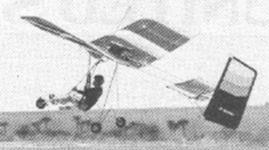
The Hi-Nuski was a three axis (actuated by weight shift) ultralight, a clone of the Eipper Quicksilver. The changes were a 2 in. square wing-root tube, more forward engine placement, re-engineered prop drive shaft, harness actuated ailerons, open wing tips, larger rudder and tricycle undercarriage. First built in 1978, this appeared at Oshkosh 1979 and by June 1981, 147 had been delivered.
Advanced Aviation Huski Article
The Hi-Nuski, was fitted with a twin Chrysler engine pack and trim elevators, and created the Hi-Nuski-Huski. A mono-wing with conventional tail, control is accomplished by weight shift, with rudder and ailerons attached to a movable harness. The separate rudder is all-flying. Pitch is controlled by variable CG. Con¬struction consists of aluminum tubing covered with 3.9-ounce Dacron on the wing and tail surfaces. The fuselage uses square tube. The engine was one Cuyuna mounted in pusher position at the center of the wing. Direct drive turns a two-blade Woods wooden propeller. Fuel is carried in a nylon rotocast tank, which is attached by one bolt through the center and cushioned on a foam pad. The landing gear was coil-spring tricycle gear with a steerable nosewheel and no brakes. All wheels were 10-inch.
The Huski in its various forms (it was originally called Hi Nuski, then after some improvements the Hi Nuski Huski, and final¬ly just Huski), was produced for several years and was complemented by the Huski II. The Huski is a single seat single engined high wing mono¬plane with hybrid control. Wing has unswept leading and trailing edges, and constant chord; cruciform tail. Pitch control by fully flying tail; yaw control by fully flying rudder; roll control by one third span spoilers; control inputs through weight shift for pitch/yaw/roll. The single surface wing is braced from above by kingpost and cables, and from below by cables. Undercarriage has three wheels in tricycle formation; steel spring suspension. Nosewheel steering is independent from yaw control. No brakes. Of aluminium ¬tube framework, without pod. Engine mounted above wing driving pusher propeller. Tubing used is 6061T6 aluminium; wing covering is Dacron.
The Cuyuna engine is mounted above the wing and drives a twin bladed propeller in line with the trailing edge of the wing, between the two tubes which are angled back to support the tailplane.
The Huski is a hybrid, in that although its control inputs are solely weight shift, the change in direction or attitude caused by this alteration of centre of gravity is assisted by one or more control surfaces, in this case elevator, rudder and spoilers.
The Huski II has a similar motor, but whereas the Huski made use of the Cuyuna 430D twin cylinder in line engine producing 30 hp and with direct drive, the Huski II used the 430RR Cuyuna of the same capacity but with a reduction drive of 2/1 to improve fuel efficiency, power and noise level, and twin ignition. Apart from this engine difference, the aircraft are basically the same and used 6061T6 aluminium ¬alloy tube and Dacron fabric with rigging by stainless steel wires. The Huski II was offered with optional floats, nosewheel brake, instrument panel and parachute. Both the Huski and Huski II were discontinued by 1982, the company having decided to concentrate production on the three axis Cobra.
Another option, introduced in 1982, was the Coyote, a smaller engined version of the Huski.
The Coyote used the single cylinder Cuyuna of 215 cc with a reduction drive, and had an optional float kit. The model was discontinued early in 1983.
Hi-Nuski
Gross wt: 450 lbs
Empty wt: 190 lbs
Max pilot wt: 250 lbs
Hi-Nuski-Huski
Engine displacement: 430cc
Rated hp: 30
Static thrust: 190 lbs
Wingspan: 33ft 6in
Wing area: 166 sq.ft
Aspect ratio: 6.76
Overall length: 17ft 3in
Empty weight: 200 lbs
Usable payload (inc fuel): 268 lbs
Wing loading: 2.2lb/sq.ft
Power-off glide ratio: 6:1
Cruise speed (85% pwr): 48 mph
Stall speed: 20-22 mph
Approach speed: 30 mph
Flare speed: 22-24 mph
Liftoff speed: 25 mph
Takeoff roll dist: 40-100ft
Rate of climb: 800 fpm
Fuel capacity: 3 USG
Range at cruise: 90 sm
Huski II
Engine: Cuyuna 430RR, 30 hp/6500 rpm
Reduction ratio: 2.0/1
Fuel capacity: 4.8 US gal, 4.0 ImpGal, 18.0 lt
Pwr loading: 0.18hp/sq.ft, 1.9 hp/sq.m
Length overall: 16.8 ft, 5.10 m
Height overall: 9.8 ft, 2.97m
Wing span: 33.5 ft, 10.21m
Constant chord: 5.0 ft, 1.52 m
Sweepback: 0 Degs
Wing aspect ratio: 6.8/1
Total wing area: 166 sq.ft, 15.4 sq.m
Main wheels diameter: 10 in / 25 cm
Empty weight: 212 lb, 96 kg
Max take off weight: 470 lb, 213kg
Payload: 258 lb, 117 kg
Max wing loading: 2.83 lb/sq.ft, 13.8 kg/sq.m
Max pwr loading: 15.7 lb/hp, 7.1 kg/hp
Max level speed: 55 mph, 88 kph
Vne: 60 mph, 97 kph
Max cruise: 45 mph, 72 kph
Economy cruise: 35 mph, 56 kph
Stall: 22 24 mph, 35 39 kph
Max SL ROC: 1000 ft/min, 5.1 m/s.
Pwr off glide ratio: 6/1
Take off dist: 40 80 ft, 12 25 m
Landing distance: 100 ft, 30 m.
Huski
Engine: Cuyuna 430D, 30 hp/6500 rpm.
Propeller dia/pitch: 36 x 16 inch, 0.91 x 0.41 m.
Reduction: None
Power/unit, area: 0.18hp/sq.ft, 1.9 hp/sq.m
Fuel capacity: 4.8 US gal, 4.0 ImpG, 18.0 lt
Length overall: 16.8ft, 5.10 m
Height overall: 9.8 ft, 2.97 m.
Wing span: 33.5 ft, 10.21m.
Constant chord: 5.0 ft, 1.52 m.
Sweepback: 0 Degs
Total wing area: 166 sq.ft, 15.4 sq.m
Wing aspect ratio: 6.8/1
Main wheels dia: 10 inch 25 cm.
Empty weight: 198 lb, 90 kg
Max take off wt: 468 lb, 212kg
Payload: 270 lb, 122 kg
Max pwr loading: 15.6 lb/hp, 7.07kg/hp.
Max wing loading: 2.82 lb/sq.ft, 13.8kg/sq.m
Max level speed: 53 mph, 85 kph.
Never exceed speed: 60 mph, 97 kph.
Max cruise: 43 mph, 69 kph
Economy cruise: 35 mph, 56 kph.
Stalling speed: 22 24 mph, 35 39 kph.
Max SL climb rate: 800 ft/min, 4.1 m/s.
Best glide ratio: 6/1
Take off distance: 50 100ft, 15 30 m.
Landing dist: 100 ft, 30 m.
Coyote
Engine: Cuyuna 215R, 20 hp/5500 6000 rpm
Reduc¬tion ratio: 2.0/1.
Pwr/unit area: 0.12hp/sq.ft, 1.3hp/sq.m.
Length overall: 16.8 ft, 5.10 m.
Height overall: 9.8 ft, 2.97 m.
Wing span: 33.5 ft, 10.21 m.
Constant chord: 5.0 ft, 1.52 m.
Sweepback: 0 Degs
Total wing area: 166 sq.ft, 15.4 sq.m.
Wing aspect ratio: 6.8/1.
Main wheels dia: 10 inch 25 cm.
Empty weight: 185 lb, 84 kg.
Max take off wt: 422 lb, 191 kg.
Payload: 236 lb, 107 kg.
Max wing load: 2.54 lb/sq.ft, 12.4kg/sq.m.
Max pwr load: 21.1 lb/hp, 9.6 kg/hp.
Max level speed: 45mph, 72 kph.
Never exceed speed: 60mph, 97 kph.
Max cruise: 35 mph, 56 kph.
Economy cruise: 30mph, 48 kph.
Stalling speed: 20 22mph, 32 35 kph.
Max SL climb rate: 450 ft/min, 2.3 m/s.
Best glide ratio: 7/1.
Take off distance: 60 100ft, 18 30 m.
Landing distance: 80 ft, 25 m.
Advanced Aviation
Advanced Aviation began with Stanley Richter in 1977 as Lafayette Aviation.
In September 1981 Richter sold his business to son Wayne, who converted the company with his sons Kerry and Mark, into Advanced Aviation and moved to larger industrial premises to allow for an increase in production.
1982: Advanced Aviation, Route 7, Box 569 D, Orlando, Florida 32805, USA.
1984: PO Box 16716, Orlando, FL 32861, USA.
Department UP
319N. Ivey Land
Route 7, Box 569
Orlando
FL 32805
(305) 298 2920

