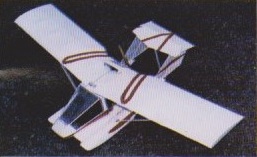
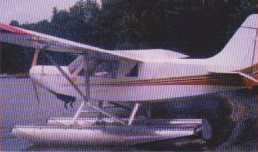
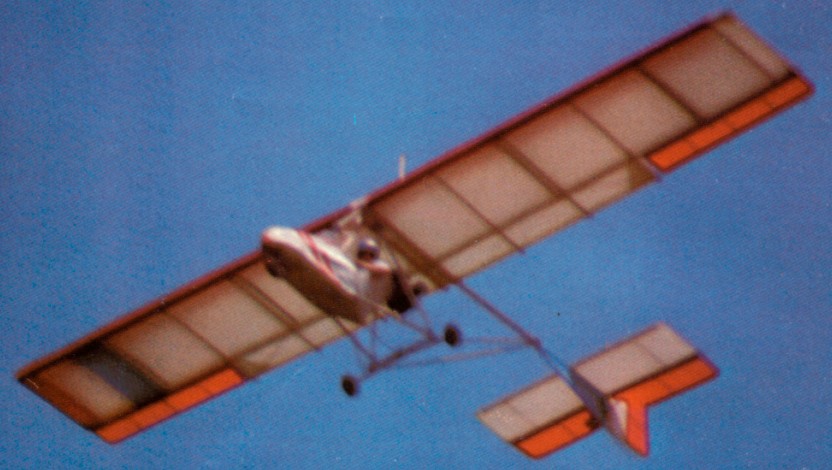
Created by Claude Guilbault, the Delta is an amphibious pusher with retractable undercarriage. The cabin is carbonfibre, and the floats and tail are aluminium. Wings are fabric covered aluminium. The Delte was in the experimental stage in 1998.
Engine: Arrow 1000, 100 hp Wing span: 9.75 m Wing area: 16 sq.m MAUW: 610 kg Empty weight: 390 kg Fuel capacity: 136 lt Max speed: 195 kph Cruise speed: 180 kph Climb rate: 3 m/s Seats: 2 Plan price (1998): Can$200 Kit price (1998): Can$18,000
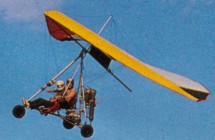
In production since 1977, the Mustang is a weight shift trike, made from certified aviation hardware and with a wing tested to +5, 43g. Car toppable with only 10 minutes rigging time.
Mustang 1 Engine: JPX 425 (424 cc) 26 hp Wing span: 10 m Length: 3.88m Empty wt: 62 kg Max wt: 162 kg Max cruise: 65 kph Range: 220 km.
Side by side two seat single engined highwing monoplane with conventional three axis control. Wing has unswept leading and trailing edges, and constant chord; cruciform tail. Pitch control by elevator on tail; yaw control by fin mounted rudder; roll control by ailerons; control inputs through stick for pitch/roll and pedals for yaw. Wing braced from above by kingpost and cables, from below by cables; wing profile double surface. Undercarriage has three wheels in tricycle formation with additional tailskid; steel spring suspension on nosewheel and torsion bar suspension on main wheels. Push right go right nosewheel steering connected to yaw control. Optional brake on nosewheel. Aluminium tube framework, with optional pod. Engine mounted below wing driving tractor propeller. Designed by Philippe Tisserand, the two seat version made its first flight in December 1982. Apart from the engine position, very few changes were deemed necessary on this machine, which is directly descended from the single seater. First sales were in February 1983. Like its elder, it is of conventional three axis control with large control surfaces. The two seater retains the advantage of being foldable to small dimensions, so it can be car topped or carried on a trailer; folded it measures 16.5 x 1.8 x 1.8ft (5.50 x 0.50 x 0.50m). It is offered as standard with the Hirth 2701R engine of 43hp or the Rotax 503 of 46 hp with toothed belt reduction. A partial fairing of the cockpit area is offered as an option. Also, Aeronautic 2000 offers it in kit form complete, for export only, a move aimed particularly at the American continent. Composed of pre formed factory built units, cut and drilled, this kit requires 100h for assembly. The Baroudeur Biplace is fitted with dual controls as standard version.
Engine: Rotax 503, 46hp at 6500rpm Propeller diameter: 63 in, 1.6 m Reduction ratio: 2.5/1 Max static thrust: 287 lb, 130 kg Power per unit area: 0.30hp/sq.ft, 3.3hp/sq.m Fuel capacity main: 5.3 US gal, 4.4 Imp gal, 20.0 lt Fuel capacity reserve: 6.6 US gal, 5.5 Imp gal, 25.0 lt Length overall: 18.1 ft, 5.5 m Height overall: 8.2 ft, 2.5 m Wing span: 29.6 ft, 9.0 m Constant chord: 5.1ft, 1.55m Dihedral: 2 degs Sweepback: 0 degs Tailplane span: 7.9ft, 2.40 m Total wing area: 151 sq.ft, 14.0 sq.m Total aileron area: 16.2 sq.ft, 1.5 sq.m Rudder area: 7.5 sq.ft, 0.7 sq.m Fin area: 4.3 sq.ft, 0.4 sq.m Tailplane area: 16.2 sq.ft, 1.5 sq.m Total elevator area: 9.7 sq.ft, 0.9 sq.m Wing aspect ratio: 5.78/1 Wheel track: 4.5 ft, 1.35 m Wheelbase: 4.9 ft, 1. 45 m Nosewheel dia. Overall: 12 in, 30 cm Main wheels dia. Overall: 12 in, 30cm Empty weight: 287 lb, 130kg Max take off weight: 662 lb, 300kg Payload: 375 lb, 170kg Max wing loading: 4.38 lb/sq.ft, 21.4kgsq.m Max power loading: 14.4 lb/hp, 6.5kg/hp Load factors: +6, 2.5 design Max level speed: 62 mph, 100 kph Never exceed speed: 71 mph, 115 kph Max cruising speed: 56 mph, 90 kph Economic cruise: 50 mph, 80 kph Stalling speed: 24 mph, 40 kph Max climb rate SL: 600ft/min, 3.0m/s Min sink speed: 37 mph, 60 kph Min sink rate: 350 ft/min, 1.7 m/s Best glide ratio: 10/1 at 37 mph, 60 kph Take off distance: 165 ft, 50 m. Land¬ing distance: 165 ft, 50 m Service ceiling: 10,000ft, 3050 m Range at ave. cruise: 186 mile, 300 km
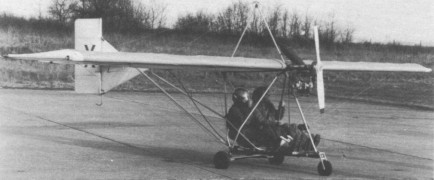
Single seat single engined high wing mono¬plane with conventional three axis control. Wing has unswept leading and trailing edges, and constant chord; cruciform tail. Pitch control by elevator on tail; yaw control by fully flying rudder; roll control by ailerons; control inputs through stick for pitch/roll and pedals for yaw. Wing braced from above by kingpost and cables, from below by cables; wing profile double surface. Undercarriage has three wheels in tricycle formation with additional tailskid; suspension on all wheels Push right go right nosewheel steering connected to yaw control. Optional brake on nosewheel. Aluminium tube/fabric framework, partially enclosed. Engine mounted below wing driving pusher propeller. Baroudeur prototype number 01 made its first flights in September 1981. The machine had been designed by a specialist team directed by Henri de Beaufort with Philippe Tisserand, and coupled a fully flying wing, free to move in three axes, with fixed tail surfaces. Next came serial 02, with wing warping and fully flying elevator. After various modifications this became prototype 03, eventually being succeeded by 04, which appeared with ailerons and a classic empennage. The structure of this was re used for the fifth, similar prototype, and fitted with a stick which was articulated from above the pilot. At the same time, 06 was built with a stick placed conventionally, between the pilot’s knees. These latter two were pre production aircraft. Designed for low power engines, the Baroudeur was initially fitted with the flat twin French JPX PUL425 engine, developing 26 hp at 4600 rpm with toothed belt reduction. It was offered with a Robin EC34PM, Robin EC44 or Hirth HL2701 RR179 engine. On sale since February 1982, the machine has acquired a reputation for robustness and ease of operation and rigging. It has also been designed with military uses in mind. Options include a cockpit, a special pod, a nosewheel brake and resin reinforced leading edges. The Baroudeur is transportable on a trailer or on a roof rack. Folded dimensions are 16.5 x 1. 8 x 1. 8 ft (5.0 x 0.5 x 0.5m).
Engine: Hirth HL2701 RR179, 40 hp at 3800 rpm Prop¬eller diameter: 47 in, 1.20m Reduction, ratio: 2.0/1 Max static thrust: 199 lb, 90 kg Power per unit area: 0.26hp/sq/ft, 2.9 hp/sq.m Fuel capacity main: 7.9 USG, 6.6 Imp gal, 30.0 lt Fuel capacity reserve: 6.6 USG, 5.5 Imp gal, 25.0 lt Length overall: 16.5 ft, 5.0 m Height overall: 8.2ft, 2.5m Wing span: 29.6ft, 9.0m Constant chord: 5.1ft, 1.55m Dihedral: 2 degs Sweepback: 0 degs Tailplane span: 7.9ft, 2.40 m Total wing area: 151 sq.ft, 14.0 sq.m Total aileron area: 16.2 sq.ft, 1.50 sq.m Rudder area: 7.5 sq.ft, 0.70 sq.m Tailplane area: 16.2 sq.ft, 1.50 sq.m Total elevator area: 9.7 sq.ft, 0.9 sq.m Wing aspect ratio: 5.78/1 Wheel track: 4.9 ft, 1.50 m Wheelbase: 5.3 ft, 1.6 m Nosewheel dia. Overall: 12 in, 30 cm Main wheels dia. Overall: 12 in, 30cm Empty weight: 220 lb, 100kg Max take off weight: 552 lb, 250kg Payload: 332 lb, 150kg Max wing loading: 3.65 lb/sq.ft, 17.9 kg/sq.m Max power loading: 13.8 lb/hp, 6.25 kg/hp Load factors: +6.0, 2.5 ultimate Max level speed: 63 mph, 100 kph Never exceed speed: 71 mph, 115 kph Max cruising speed: 56 mph, 90 kph Economic cruise: 50 mph, 80 kph Stalling speed: 22 mph, 35 kph Max climb rate SL: 690 ft/min, 3.5 m/s Min sink rate: 335 ft/min, 1.7 m/s Min sink speed: 37 mph, 60 kph Best glide: 10/1 at 37 mph, 60 kph Take off distance: 130 ft, 40 m Land¬ing distance: 130 ft, 40 m Service ceiling: 13,120 ft, 4000 m Range ave. cruise: 373 mile, 600 km
The Aeronautic 2000 company was founded in 1981 by Henri de Beaufort and Roland Magallon, to distribute the Baroudeur. One of the first participants in hang gliding in France and a man who became one of the most important manufacturers of hang gliders in Europe, Roland was the first to produce trikes units to fit under an unmodified hang glider wing. With the marketing of the Baroudeur single-seater in the summer of 1982, he became the first European manufacturer to offer a complete range of machines from weight shift machines (which are marketed separately under the name Veliplane) to three axis conventional control types. 1983: Aeronautic 2000, 14 16 rue du Ratrait, 92150 Suresnes, France.
This ultralight maintains all the characteristics and reliability of its predecessor Moragon M-1, but with improved performance. Price 2009: 42000 EURO
MTOW: 450 kg / 992 lb Empty Weight: 270 kg / 595 lbs Stall: 27 kt / 31 mph / 50 kmh Cruise: 89 kt / 103 mph / 165 kmh VNE: 124 kt / 143 mph / 230 kmh Climb Rate: 1600 ft/min / 8 m/s Glide Ratio: 1:5 Take-off distance (50ft obstacle): 330 ft / 100 m Landing distance (50ft obstacle): 660 ft / 200 m
The Moragon is a two-seater monoplane. The wings and the fuselage are carbon fiber AS4C GPA-GP 210-245 with 2024-T3 and extruded 6061-T6 aluminium. The fuselage is constructed entirely out of carbon fiber monocoque, with the fixed parts of the vertical and horizontal stabilizer integrated with the fuselage. It can be equipped with: 80 hp Jabiru, Rotax engines (from 80 to 100 hp) or a 80 hp Verner Engine.
M-1 P MTOW: 450 kg / 992 lb Empty Weight: 280 kg / 617 lbs Stall: 32 kt / 37 mph / 60 kmh Cruise: 89 kt / 103 mph / 165 kmh VNE: 124 kt / 143 mph / 230 kmh Climb Rate: 1000 ft/min / 5 m/s Glide Ratio: 1:6 Take-off dist (50ft obstacle): 660 ft / 200 m Landing distance (50ft obstacle): 330 ft / 100 m