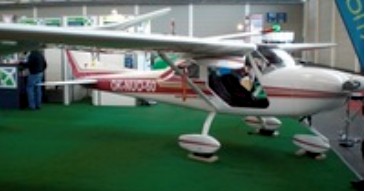
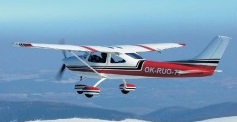
Skylane is classic design, two seat, shoulder-wing monoplane. Although it is an ultralight, this plane is noted as a “small Cessna“.This plane can be used for towing of sail planes too.
The wing is strut-braced, wooden design, with a semi-laminar profile MS (1)-313. The centre section is rectangular and outer parts are trapezoidal, with short winglets on the tips. The main spar, situated in 37% of chord, is made of wood. In front of main spar, in rectangular part, is torsion box, with integral fuel tanks (2×35 litres). Trapezoidal part of torsion box is coated by plywood. Behind the main spar, wing consists of wooden ribs and short auxiliary spar. The ribs are coated by aviation fabric.
Landing flaps are single-slotted, in 29% of depth, made of wood and consist of spar, ribs, plywood and fabric coating. They have fixed positions at 13°, 29°and 37°, and are electric servo operated.
The ailerons are all-wood, with one spar, ribs, plywood and fabric coating and are operated by rods with diferential deflections.
The all-wood tail assembly structure is with elevator and rudder. The profile of fin and tailplane is symetric, NACA 0012. Design of tailplane assembly is the same as design of landing flaps and the fin is integrated part of fuselage.
The undercarriage is fixed, three wheel type and the main landing gear is laminated spring. The wheels have independent hydraulic brakes, controlled by pedal brake on the rudder steering. Towed type nose gear is spring loaded by steel spring with hydraulic absorber. It is not steered; freely slewing round about 360°.
An engine of 50-100 HP can be used and propeller can be fixed blade, adjustable blade or variable pitch blade with diameter of 1700 mm. Weight of engine assembly should be 50-80 kg.
Ailerons and elevator are controlled by rods and levers, and the rudder is controlled by steel cables.
Stall: 35 kt / 40 mph / 65 kmh
Cruise: 97 kt / 112 mph / 180 kmh
VNE: 112 kt / 129 mph / 207 kmh
Empty Weight: 258 kg / 569 lbs
MTOW Weight: 450 kg / 992 lbs
Climb Ratio: 1200 ft/min / 6 m/s