1998: American Ghiles, 522 E.Washington St, PO Box 3666, Orlando, FL 3280, USA.
LSA builder
LSA/UL
American Air Technology Solo

Centre mounted yoke, rudder pedals, nosewheel steerable through rudder pedals.
Engine: Rotax 277 (268 cc) 27 hp
Static thrust: 185 lbs
Wing span: 30 ft
Wing area: 128 sq.ft
Height: 7 ft 6 in
Length: 19 ft 6 in
Empty wt: 275 lbs
Max wt: 500 lbs
Fuel cap: 5 USG
Construction: Aluminium, Foam, Kevlar, Epoxy carbon
Stall: 27 mph
Max speed: 62 mph
Vne: 82 mph
Climb rate: 550 fpm @ 40 mph
Design limit: +3.5, -2g
Glide ratio: 12-1
Wing loading: 3.91 lbs/sq.ft
Power loading: 18.52 lbs/hp
American Air Technology
1984: 1290 Bodega Ave, Petaluma, CA 94952, USA.
UL builder
American Aircraft Falcon / American Aerolights Falcon
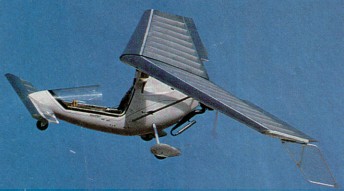
In March 1981 Romuald Drlik began the design work for a new lightweight canard-type aircraft, tentativly named Falcon and in May 1981 Romuald and helpers began construction on the first Falcon prototype (model “A”). After first trying a single-wheel gear and side-stick (neither successful) the #1 Falcon flies in late July 1981 using tricycle gear, a double-surface variable camber Dacron wing, centre hinged-stick, and a Robin 240 cc single-cylinder engine.
American Aircraft Falcon Article
The Falcon’s fuselage is moulded Kevlar and graphite. The wings and canard, though constructed by standard techniques with aluminium and foam, are covered with “Tedlar”, a durable and resilient alloy of Teflon and mylar.
Falcon performance figures reach the established limits for an ultralight, with cruise speed at 60, stall at 26 and maximum at 63. Powered by a small single-cylinder, 26-hp Rotax engine, the Falcon’s highly efficient configuration affords the highest allowable performance, while the incidence angle of the canard limits excessive speed. Controls are standard three-axis, with full-span ailerons.
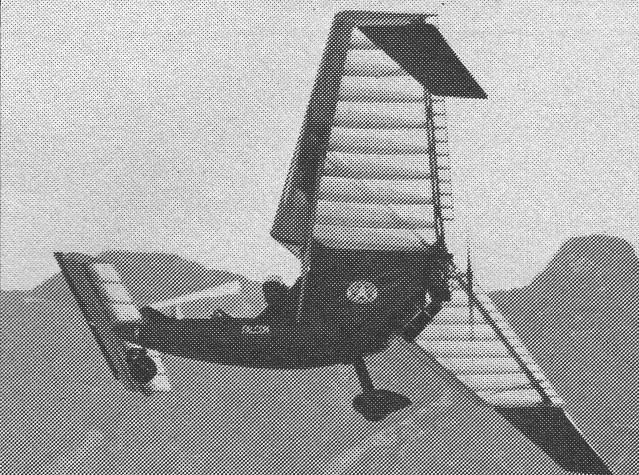
The Falcon was to be available as a complete, ready to fly craft, not a kit. The finished Falcon featured in-flight restarting, cockpit choke system, five-function AeroGage panel, nosewheel steering and brake, shoulder harness/seat belt, padded seat, ¾ canopy, cabin heat and choice of several fuselage colours. Projected price was $7500 (in August 1983).
In August 1981 the #2 Falcon prototype was displayed (static only) at Oshkosh and during the winter of 1981-82, the development continued on prototypes #2 and #3, altering forward wing position wing incidence, engine (changed to Cuyuna 215), wing camber, gear geometry, and rudder shape.
In Jan 1982 the #3 Falcon prototype was flown in an Arizona race but DNF’s due to a reduction system failure. The empty weight of this (registered) aircraft was 215 lbs.
Testing in Feb 1982 showed static loads tests on the #3 prototype go beyond 7 g’s positive and three negative before yield. In March 1982 Prototype #4 (Model 1B) was flown at the Sun N’ Fun Fly-in, using a Cuyuna 430 engine. Testing continued with Prototype #5 first flying in April 1982.
Prototype #6 began flight tests July 1982, having a shorter span (31.5 feet) and a totally different wing design using a single strut, D-tube spar, and doped Ceconite wings.
November 1982 brought the first flights of prototype #7 (model “C1′), using fiberglass D-tubes for wing structure, 36 ft. span, and lighter Rotax 277 engine. This craft was made in response to the release of FAR Part 103 in October of 1982, to meet the requirements of the new ultralight air vehicle category.
In January 1983, prototype #7 won first-in-class at the Arizona Air Race. This same month, #7 makes flights to 13,000 feet, is flown in snowstorms and rainstorms, and flown in 25-30 mph winds.
March 1983 brought first flights of prototype #8, N 918 M, incorporating 36-ft aluminum D-tube wings, all-fiberglass fuselage structure (eliminating tube-style engine and wing mount), and Tedlar wing covering.
Prototype #8 won Grand Champion and Outstanding Craftmanship awards at Sun &’ Fun March 1983.
During 1983, N 918 M was exhibited at many airshows, with continued flight testing in Albuquerque as well.
In August 1983 three pre-production ultralight-legal Falcons were flown at Oshkosh, utilizing Kevlar-and-graphite fuselages and numerous refinements. Two of the planes were delivered to Falcon dealers. One craft won Reserve Grand Champion, then was flown home in one afternoon to Minneapolis (over 260 miles), averaging 57 mph ground speed.
In August 1983, load tests to destruction were performed on the other Oshkosh plane (prototype #9, which was weighed by the EAA at 240 lbs), documenting a load-carrying strength of 7 g’s positive, three negative for the main wing and over 10 g positive 5 negative for the forward wing. January 1984 – Deliveries of production Falcons begin.
Wing has swept back leading and trailing edges, and tapering chord; no tail, canard wing. Pitch control by elevator on canard; yaw control by tip rudders, roll control by fullspan ailerons; control inputs through stick for pitch/roll and pedals for yaw. Wing braced from below by struts; wing profile; double surface. Undercarriage has three wheels in tricycle formation; steel spring suspension on nosewheel and axle flex suspension on main wheels. Push right go right nosewheel steering connected to yaw control. Brake on nosewheel. Glass fibre fuselage, partially enclosed. Engine mounted below wing driving pusher propeller.
The Falcon XP two seat tandem version became available in early 1984.
Falcon
Engine: Rotax 277, 28hp at 6200rpm
Power per unit area 0.15 hp/sq.ft, 16.3 hp/sq.m
Fuel capacity 5.0 US gal, 4.2 Imp gal, 18.9 litre
Length overall 10.6 ft, 3.20 m
Height overall 5.0ft, 1.52m
Wing span 36.0ft, 10.97m
Mean chord 4.5ft, 1.34m
Canard span 10.3 ft, 3.12 m
Canard chord 1.9 ft, 0.53 m
Total wing area 185 sq.ft, 17.2sq.m
Main wing area 165 sq.ft, 15.3sq.m
Canard area 20 sq.ft, 1.9sq.m
Main wing aspect ratio 7.9/1
Wheel track 5.2ft, 1.57m
Wheelbase 5.5 ft, 1.65 m
Nosewheel diameter overall 11 inch, 28 cm
Main wheels diameter overall 11 inch, 28 cm
Empty weight 2501b, 113kg
Max take off weight 4931b, 223kg
Payload 2431b, 100kg
Max wing loading 2.66 lb/sq.ft, 13.0kg/sq.m
Max power loading 17.6 lb/hp, 8.0kg/hp
Max level speed 100 mph, 161 kph
Max cruising speed 63 mph, 101 kph
Stalling speed 26 mph, 42 kph
Max climb rate at sea level 500 ft/min, 2.5m/s
Min sink rate 250ft/min at 40mph, 1.2 m/s at 64 kph
Best glide ratio with power off 16/1
Service ceiling 15,000 ft, 4570 m
Range at average cruising speed 300 mile, 483 km
American Affordable Aircraft Vision
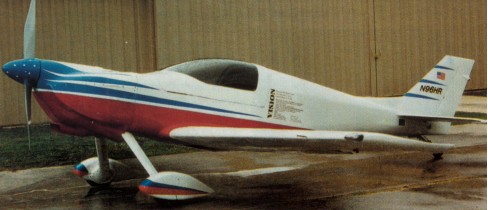
The American Affordable Aircraft Vision is an economical, 2 seat, all composite aircraft that is built from construction manuals. Designed by Steven Rahm for first time builders, each of the sub-assemblies cost less than $500.00 on the prototype. This plane was constructed by first time builders to test the construction manuals and no construction manuals were sold until testing of the prototype. The plane is all composite with no wood under-structure and uses no foams. There is a full sandwich skin on both sides. This is a plans built plane with supplemental parts. It can be built from manuals and raw materials or pre formed parts. The aim is to keep the wet-layup moldless airframe as low a cost as possible. Required power is 85-115 hp giving a cruise of over 150 mph. Engines up to 300 lb and 160 hp are acceptable.
The prototype was first flown in 1996.
Landing over 50 ft requires 1200 feet and takeoffs require 1500.
Stall with flaps is 54 mph but touchdown can be slightly slower with ground effect.
Climb rate solo with full fuel is 1400 fpm at sea level on 85 degree day with this prop and the economical Subaru engine.
Two models are available – The sportier SP model and the extended wing EX version which is more suitable for high altitude flying, heavier loads, and lower experience pilots. Both versions are supplied with the plans. Construct entirely from the manuals using raw materials or from pre-formed parts. Most of the Visions are built with 44″ to 46″ wide cockpits. Even pilots as tall as 6’5″ can be accommodated.
Weight should be at 850 lb empty, the prototype is close to 900. Intitally the gross weight has been set at 1350 lb. pending further testing and the aerobatic weight is at 1250 lb. (With SP wing, engines over 115 hp raise gross to 1450. With “EX” wing and engines to 120 hp gross is 1500 and for engines over 120 hp gross is 1600. +6/-4 g rating is always at 1250 lb.)
When the Vision was designed in 1994 there was no thought of LSA. However, since each builder is the manufacturer of their own aircraft they also determine and set the gross weight. Setting the gross weight within LSA limits is simple enough as the Vision is well under any structural or performance concerns for an EX version. In order to fit the stall requirement with flaps up a full time leading edge slot would need to be installed; this is a simple matter once you understand just how easy it is to work with and modify composite structures.
In the interest of having the most useful load it is critical that the empty weight is a low as possible since the gross weight can not be higher than 1320 lbs. The use of the carbon pre-built spar and Fold-a-Plane panels provided by Pro-Composites will greatly reduce the weight of the Vision – beyond what can be obtained through building according to the plans. Also important is using a light power plant such as the 120 hp Jabiru. Using these recommended changes a Vision should be in the 700’s empty weight. Keeping the top speed down is simply a prop choice so the whole equation of meeting LSA requirement is no major undertaking.
Vision SP
Engine: 100 hp
Engines: 100-160 hp
Wing Span: 21 ft 8 in
Wing area: 85 sq.ft
75% cruise: 157 mph
Empty Weight: 850 – 950lbs
Useful Load : 500 – 750 lbs
Gross Weight: 1350 – 1600 lbs
Fuel cap: 22 USG (optional 40USG + 15USG)
Cockpit width: 40-44 in
Vne: 207 mph indicated
Va: 143 mph indicated
Vd: 231 mph indicated
Vf: 105 mph
Airfoil: root 63a415, tip 63a412.
Cruise: 155 mph – 200 mph
Climb Rate: 1400 fpm
Stall: 55 mph
Load factor: +6g / -4g (at 1250 g.w.)
Take-off dist: 600 ft
Landing dist: 900 feet
Aspect Ratio: 5.5
Seats: 2
Landing Gear: Fixed conventional or Tri-gear w/castering nose wheel
Vision SP
Engine: 160 hp
Wing Span: 21 ft 8 in
Wing area: 85 sq.ft
Aspect Ratio: 5.5
Empty Weight: 850 – 950lbs
Useful Load: 500 – 750 lbs
Gross Weight: 1350 – 1600 lbs
Fuel Load: 22-40 Gallons
Cruise SL: 175 mph
Cruise 8000ft: 200 mph.
Vne: 207 mph indicated
Va: 143 mph indicated
Vd: 231 mph indicated
Vf: 105 mph
Airfoil: root 63a415, tip 63a412
Take-off dist: 600 ft
Landing dist: 900 feet
Stall: 55 mph
Load factor: +6g / -4g (at 1250 g.w.)
Cockpit Width: 40-46 in
Landing Gear: Fixed conventional or Tri-gear w/castering nose wheel
Vision EX
Wing span: 25 ft 6 in
Wing area: 96 sq.ft
Length: 19.93 ft
Height: 7.324 ft
Wheel track: 5.638 ft
Empty Weight: 850 – 950lbs
Useful Load: 500 – 750 lbs
Gross Weight: 1350 – 1600 lbs
Fuel cap: 22 USG (optional 40USG + 15USG)
Cockpit width: 40-44 in
Vne: 207 mph indicated
Va: 143 mph indicated
Vd: 231 mph indicated
Vf: 105 mph
Airfoil: root 63a415, tip 63a412
Cruise: 155-200 mph
Climb Rate: 1400 fpm
Stall: 55 mph
Load factor: +6g / -4g (at 1250 g.w.)
Take-off dist: 600 ft
Landing dist: 900 feet
Aspect Ratio: 6.6
Landing Gear: Fixed conventional or Tri-gear w/castering nose wheel
American Affordable Aircraft Inc.
1996: 210 Cessna Blvd., Unit 1C, Daytona Beach, FL 32124, USA.
Aircraft/LSA builder
American Aerolights Eagle / Double Eagle / Electra Flyer Corp Eagle
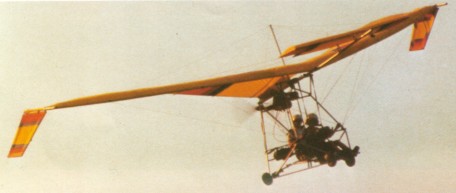
Staff at Electra Flyer (an Albuquerque-based hang glider company) sensed the presence of a growing demand for a powered, portable, super lightweight aircraft.
American Aerolights Eagle / Double Eagle Article
Subsequent development was intermittent encountering several obstacles. Although it flew well, it was not unlike other conventional powered hang gliders. Being heavier than desired, it failed to offer the portability necessary for convenience.
While its performance fell within normal parameters, it lacked certain handling characteristics required for acceptance by the general flying community. It would be one thing to sell it to an experienced pilot, but another to sell it to a person with little or no flying background. They also wanted to produce a craft completely built and test-flown by the factory.
Early in 1979, Romauld Drlik called to say that his research efforts had produced a craft so unique that Electra should halt their own ultralight development until hearing further from him. Romauld’s design was built around a power system, (as opposed to most ultralights which are hang gliders with engines added) and employed a canard wing. Conceived to be extremely portable, it could be carried on one’s shoulder, transported without special car racks and stored inside an apartment. And it could be built from available hang glider components.
When the craft it had logged over 100 hours and undergone numerous changes, an agreement to manufacture the ship was made.
Back in Albuquerque, the prototype was refined, employing a semidouble-surfaced airfoil and a flexible airframe which could be assembled/ disassembled in only 25 minutes.The result was EAGLE.
In EAGLE, as the pilot’s body moves aft, the elevator automatically deploys in the “down” position, causing the nose to climb. Since the canard’s angle of incidence is higher than that of the main wing, it stalls first. Yet when this happens, it is in a relatively unloaded state. The resultant force is a slight oscillation or porpoising of the nose.
Turning is accompanied by a steering wheel which controls drag rudders at the tips. The drag of the tip rudder causes the craft to turn, producing a coordinated roll.
Pitch is controlled by fore and aft pilot movement which activites the elevator attached to the canard.
While on the ground, the, foot controlled nosewheel is used for steering. At higher speeds, prior to takeoff and just after landing, the tip rudders can be used to steer.
EAGLE folds up into a hang glider like package which can be carried on one’s shoulder (with the landing gear and engine over the other) and transported via car top. And the frame can be further disassembled to 12-foot lengths for airline transportation.
Performance is a realistic 200-250 fpm climb at sea level (using the standard Chrysler engine), and over 400 fpm with the optional Chrysler Twin-pak engines.
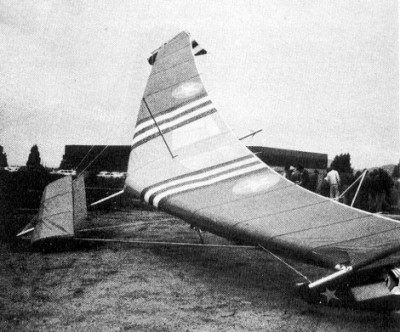
The Eagle was never really a hang glider, being intended for motorized flight. It was foot-launched only once, as part of an early FAA requirement for ultralights, by one of the factory pilots.
Cruise speed is about 35 mph with the standard unit. Glide ratio is 10:1. Takeoff and landing speeds are 16-17 mph, and top speed is close to 50 mph. Mush speed is approximately 16 mph.

Canard ultralight Controlled by tip rudder for roll; elevator plus variable cg for pitch; twist grip throttle for climb and descent; steerable nose wheel. The 215B is a canard design with tip rudders, built and test flown before delivery. Elevator on canard responds to weight shift for pitch control. Steering handlebar moves tip rudders for roll con¬trol. Aluminum tubing, Dacron covering. POWERPLANT: Cuyuna two-cycle engine with in-flight restarter. LANDING GEAR: Trike, steerable nosewheel. Price 1982: $4,395 (with engine). Units delivered to June 1981: 1,016.
The Eagle SL is a canard ultralight Controlled by tip rudder for roll; elevator plus variable canard for pitch; twist grip throttle for climb and descent; steerable nose wheel. Seat fixed. First year built: 1981. Price 1982: $4,695 (with engine).
The prototype of the Eagle XL used a double skinned wing and retained the tiller of the previous models, but on the production models a side stick was substituted, controll¬ing the spoilers and the elevator hinged from the trailing edge of the canard. What was new also was the canard was fitted with fixed slats on the leading edge. The pushrod controlling the elevator has been replaced by a flexible control, similar to those fitted to outboard motors. The rudder bar works the tip rudders which were initially triangular as on the Eagle of 1981, but were redesigned in a trapezoidal shape and enlarged. The nosewheel steering is connected to the rudder bar.
Appearing also in 1982 under the confusing title of Double Eagle, this single seat machine was renamed the Eagle 430B at the Sun’n’Fun fly in in March 1983 at Lakeland, Florida. It is designed for heavier pilots and has a pilot weight range of 200 300 lb (91 136 kg). It has been equipped from the start with the twin cylinder Cuyuna 430RR 35 hp engine, which makes it stand out from the ordinary Eagle, which has the 215RR 20hp engine. However, it retains the hybrid control of the latter: in pitch, the elevator responds to the pilot’s body movements, while the tip rudders respond to the tiller to control yaw. The frame of the Eagle 430B has been enlarged com¬pared with the basic model and the structure reinforced as a result.
The Eagle 2 Place was a side by side two seat single engined high¬wing monoplane with conventional three axis control. Wing has swept back leading and trailing edges, and tapering chord; no tail, canard wing. Pitch control by elevator on canard; yaw control by tip rudders; roll control by one third span spoilers; control inputs through stick for pitch/roll and pedals for yaw. Wing braced from above by kingpost and cables, from below by cables; wing profile; double surface. Undercarriage has three wheels in tricycle formation; no suspension on nosewheel and suspension on main wheels. Nosewheel steering by lever between seats. Brake on nosewheel. Aluminium tube framework, without pod. Engine mounted below wing driving pusher propeller.
The prototype two seat Eagle appeared in 1982, fitted with controls operating on all three axes, adopting spoilers as on the XL model but retaining the swing seat as used in the hybrid model 215B.
It was originally equipped with the Cuyuna 430RR 35 hp, but this was dropped for the production machines in favour of the 50hp twin cylinder in line Rotax 503. This announcement was made in March 1983 in the course of the Sun’n’Fun Fly in at Lakeland, Florida where American Aerolights revealed full information on the Eagle 2 Place, which was classed as an experimental aircraft in the US.
The aircraft was provided as a complete kit requiring 100hr for completion. The kit includes as standard the fairings for all three wheels, which are an option on the other Eagles, and also a nosewheel brake.
Electra Flyer Eagle
Engine: Chrysler.
ROC: 200- 250-fpm.
Cruise: 35 mph.
Electra Flyer Eagle
Engine: Chrysler Twin-pac.
ROC: 400 fpm.
Eagle
Gross wt: 430 lbs.
Empty wt: 165 lbs.
Max pilot wt: 265 lbs.
First year built; 1980.
Eagle 215B
Wingspan: 35ft.
Wing area: 180 sq.ft.
Length: 15ft.
Empty weight: 175 lbs.
Pilot weight: 90-180 lbs.
Minimum sink rate: 300 fpm.
Cruise speed: 32 mph.
Min speed (ground effect): 23 mph.
TO and Ldg rolls: 50-100ft.
Climb rate: 550 fpm.
Fuel capacity: 4 USG.
Double Eagle / Eagle 430B
Engine: Cuyuna 430RR, 35 hp at 6000 rpm.
Prop diameter x pitch: 54 x 36 inch, 1.37 x 0.91 m.
Toothed belt reduction, ratio: 2.2/1.
Max static thrust: 240 lb, 109kg.
Power per unit area: 0.19hp/sq.ft,2.1 hp/sq.m.
Fuel capacity: 5.0 US gal, 4.2 Imp gal, 18.9 litre.
Length overall: 15.0 ft, 4.57 m.
Height overall: 10.0ft, 3.04m.
Wing span: 35ft, 10.67m.
Mean chord: 4.3ft, 1.31m.
Canard span: 7.8ft, 2.38m.
Canard chord: 3.7 ft, 1.13 m.
Total wing area: 180 sq.ft, 16.7sq.m.
Main wing area: 151 sq.ft, 14.0sq.m.
Canard area: 29 sq.ft, 2.7sq.m .
Main wing aspect ratio: 8.1/1.
Nosewheel diameter overall: 16 inch, 41 cm.
Empty weight: 210 lb, 95kg.
Main wheels diameter overall: 16 inch, 41 cm.
Max take off weight: 520 lb, 236kg.
Max wing loading: 2.88 lb/sq.ft, 14.1 kg/sq.m.
Payload: 310 lb, 141kg.
Max power loading: 14.9 lb/hp, 6.7kg/hp.
Load factors: +8.0, 3.0 ultimate.
Max level speed: 55 mph, 88 kph.
Economic cruise: 37 mph, 60 kph.
Stalling speed: 25 mph, 40 kph.
Max ROC sea level: 750 ft/min, 3.8 m/s.
Min sink rate: 400 ft/min, 2.0 m/s.
Best glide ratio pwr off: 8/1.
Take off distance: 100 ft, 30 m.
Landing distance: 50 ft, 15 m.
Service ceiling: 17,500 ft, 5340 m.
Range ave cruise: 50 mile, 80 km.
Pilot weight: 180-300 lbs.
Eagle SL
Gross wt: 405 lbs.
Empty wt: 180 lbs.
Max pilot wt: 225 lbs.
First year built; 1981.
Eagle XL
Engine: Cuyuna 430RR, 35 hp at 6000 rpm.
Prop diameter x pitch: 54 x 36 inch, 1.37 x 0.91 m.
Toothed belt reduction, ratio: 2.2/1.
Max static thrust: 240 lb, 109 kg.
Power per unit area: 0.20hp/sq.ft, 2.13 hp/sq.m.
Fuel capacity: 4.0 US gal, 3.3 Imp gal, 15.1 litre.
Length overall: 15.0 ft, 4.57 m.
Height overall: 9.0ft, 2.74m.
Wing span: 35.0ft, 10.67m.
Mean chord: 4.4ft, 1.35m.
Canard span: 10.0 ft, 3.04 m.
Canard chord: 2.2 ft, 0.67 m.
Total wing area: 177 sq.ft, 16.5sq.m.
Main wing area: 154 sq.ft, 14.4sq.m.
Canard area: 22sq.ft, 2.0sq.m.
Main wing aspect ratio: 8.0/1.
Wheel track: 5.4ft, 1.62m.
Wheelbase: 5.6 ft, 1.67m.
Nosewheel diameter overall: 11 inch, 28 cm.
Empty weight: 225 lb, 102kg.
Main wheels diameter overall: 11 inch, 28 cm.
Max take off weight: 464 lb, 211 kg.
Max wing loading: 2.62 lb/sq.ft, 12.8 kg/sq.m.
Payload: 239 lb, 109 kg.
Max power loading: 13.2 lb/hp, 6.0kg/hp.
Load factors: +8, 2.5 ultimate.
Max level speed: 50 mph, 80 kph.
Vne: 55 mph, 88kph.
Economic cruising speed: 35 mph, 56 kph.
Stalling speed: 26 mph, 41 kph.
Max climb rate at sea level: 850 ft/min, 4.3 m/s.
Min sink rate: 300 ft/min, 1.5m/s.
Best glide ratio with power off: 7/1.
Take off distance: 125ft, 40m.
Landing dis¬tance: 125ft, 40m.
Service ceiling: 17,500ft, 5340m.
Range at average cruise: 50 mile, 80 km.
Pilot weight range: 120-240 lbs.
Eagle 2 Place
Engine: Rotax 503, 50 p at 6000 rpm.
Propeller diameter and pitch: 58 x 27 inch, 1.47 x 0.69 m.
Max static thrust: 285 lb, 129 kg.
Power per unit area: 0.28hp/sq.ft, 3.0hp/sq.m.
Length overall: 15.0 ft, 4.57 m.
Height overall: 10.0ft, 3.05m.
Wing span: 35.0ft, 10.67m.
Mean chord: 5.0ft, 1.52m.
Canard span: 10.0 ft, 3.05 m.
Canard chord: 3.1 ft, 0.94 m.
Total wing area: 177 sq.ft, 16.5sq.m.
Main wing area: 146 sq.ft, 13.6sq.m.
Canard area: 31 sq.ft, 2.9sq.m .
Main wing aspect ratio: 8.4/1.
Wheel track: 6.4ft, 1.93m.
Wheelbase: 6.6 ft, 1.98 m.
Nosewheel dia. Overall: 16 inch, 41 cm.
Main wheels diameter overall: 16 inch, 41 cm.
Empty weight: 310 lb, 141 kg.
Max take off weight: 660 lb, 299 kg.
Payload: 350 lb, 159 kg.
Max wing loading: 3.72 lb/sq.ft, 18.2 kg/sq.m.
Max level speed: 45 mph, 72 kph.
Max power loading: 13.2 lb/hp, 5.9 kg/hp.
Cruising speed: 42mph, 67kph.
Stalling speed: 30mph, 48 kph.
Max ROC sea level: 400 ft/min, 2.0 m/s.
Min sink rate: 500 ft/min, 2.5 m/s.
Best glide ratio pwr off: 4/1.
Take off distance: 250 ft, 75 m.
Landing distance: 250 ft, 75 m.
Service ceiling: 8000 ft, 2440 m.
American Aerolights
1983: 700 Comanche N E., Albuquerque, NM 87107, USA.
UL builder
Alpi Aviation Pioneer 400

Pioneer 400 V.L.A
Engine: Rotax, 100hp
Propeller: Variable Pitch
Wing Span: 8,8 m
Wing Area: 11.2 sq.m
Length: 7 m
Cabin Width: 1.10 m
Empty Weight: 360 Kg
Max Takeoff Weight: 750 Kg
Load Factor: +3,8/1,92 G
Load Factor @ 560 Kg: +4 / -2 G
Fuel Capacity: 80 Lt
Payload: 390 Kg
Baggage Volume: 315 Lt
Max Baggage Load: 30 Kg
Maximum Level Speed: 135 kts
Cruise Speed (@ 75% Power): 120 kts
Stall Speed: 43 kts
Best Angle Of Climb Speed (Vx): 80 kts
Best Rate Of Climb Speed (Vy): 65 kts
Best Climb Rate: 800 ft/min
Roll Rate: 90°/sec
Glide Ratio: 13:1
Range (@ 75% Power): 900 km
Fuel Consumption (@ 75% Power): 18.5 l/h
Service Ceiling: 5000 m
Take Off Distance: 280 m
Landing Distance: 200 m
Pioneer 400 U.L.M.
Engine: Rotax, 100hp
Propeller: Variable Pitch
Wing Span: 8,8 m
Wing Area: 11.2 sq.m
Length: 7 m
Cabin Width: 1.10 m
Empty Weight: 290 Kg
Max Takeoff Weight: 450 Kg
Load Factor: +3,8/1,92 G
Load Factor @ 560 Kg: +4 / -2 G
Fuel Capacity: 80 Lt
Payload: 160 Kg
Baggage Volume: 315 Lt
Max Baggage Load: 30 Kg
Maximum Level Speed: 135 kts
Cruise Speed (@ 75% Power): 120 kts
Stall Speed: 35 kts
Best Angle Of Climb Speed (Vx): 80 kts
Best Rate Of Climb Speed (Vy): 65 kts
Best Climb Rate: 1500 ft/min
Roll Rate: 90°/sec
Glide Ratio: 13:1
Range (@ 75% Power): 900 km
Fuel Consumption (@ 75% Power): 18.5 l/h
Service Ceiling: 6000 m
Take Off Distance: 120 m
Landing Distance: 120 m
Alpi Aviation Pioneer 330 Acro
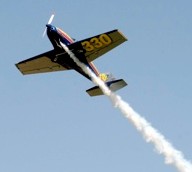
Developed in 2004, the Pioneer 330 Acro basic level aircraft trainer is designed to be equipped with the inverted flight engine kit for the Rotax 912S and a smoke system.
Based on the P300 structure, the P330 has been strengthened to reach from +9 g up to -4.5 g, giving +6 to –3 usable.
The wing has a pass through main spar and fully plywood skin covering, and a three axis trim system.
Engine: Rotax 912S
Propeller: Variable Pitch
Wing Span: 7.55 m
Wing Area: 10 sq.m
Fuselage Length: 6.25 m
Cabin Width: 1.05 m
Cabin Height: 1.05 m
Empty Operative Weight: 295 Kg
Maximum Takeoff Weight (Ulm): 450 Kg
Maximum Design Takeoff Weight: 530 Kg
Load Factors : +6 / -3 G
Tank Capacity: 80 lt (2 x 40 lt)
Auxiliary Tank Capacity: 22 lt
Payload Limit (Ulm): 165 Kg
Design Payload Limit: 245 Kg
Baggage Volume: 226 lt
Maximum Baggage Amount: 20 Kg
Maximum Level Speed: 270 Km/H
Cruise Speed (@ 75% Power): 240 Km/H
Stall Speed: 65 Km/H
Best ROC Speed : 120 Km/H
Best Angle Climb Speed: 100 Km/H
Best Rate Of Climb: 460 M/Min (1500 Ft/Min)
Roll Rate: 180°/Sec
Range @ 75% Power: 12.5:1
Range @ 75% Power With Auxiliary Tank: 1260 Km
Operative Ceiling Altitude: 6000 m
Take Off & Landing Ground Run: 120 m

