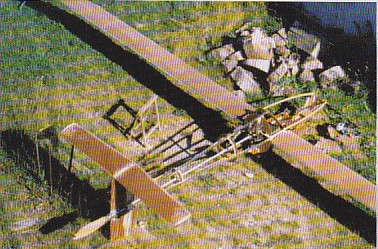
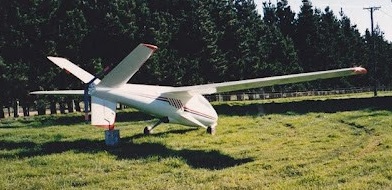
Optionally a powered light sailplane circa 1998, the Graal is of plywood construction with carbonfibre longerons. The Graal conforms to french and FAI ultralight rules.
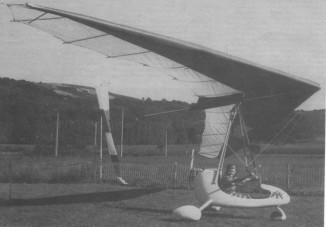
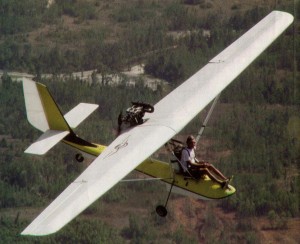
Single seat or two seat single engined flexwing aircraft with weight shift control. Rogallo wing. Pilot suspended below wing in trike unit, using bar to control pitch and yaw/roll by altering relative positions of trike unit and wing. Undercarriage has three wheels tricycle formation; glass fibre/carbon fibre suspension on all wheels. Nosewheel steering independent from yaw control. Glass fibre/ Kevlar/carbon fibre trike unit, partially enclosed. Engine mounted below wing driving pusher propeller. Other data dependent on customer’s specification. Robert Bardou is a craftsman who specialises in the fabrication and building of single seat and two seat trike units suitable for fitting to unmodified hang gliders without modification to them. Called Choucas, these ‘chariots’ are built according to the desires and requirements of the purchaser. Each model is designed according to the power pack chosen, virtually all engines being suitable, and each Choucas is built of laminated glass fibre and epoxy with reinforcements of uni directional Kevlar and carbon-fibre. The legs of the main landing gear and the nosewheel fork (steerable and fitted with a brake), are also made of uni directional glass fibres, criss crossed with reinforcement of carbon fibre. The engine mountings are formed from Duralumin inserts incorporated at the time of moulding wherever bolts are considered necessary. Of remarkable lightness around 441b (20kg) for a single seater without power pack, these Choucas trike units attach to the wing with a fork built of two Duralumin struts, forming an inverse V. Each of these tubes is held to the shell of the trike unit by two bolts through the strong points. Derigging the two lower bolts allows these two struts to fold forward onto the trike unit for transport. No two are alike.
Bill Barber conceived, designed and built three members of the Snark family with no outside assistance. The first Barber Snark was a single place Snark HA 1.
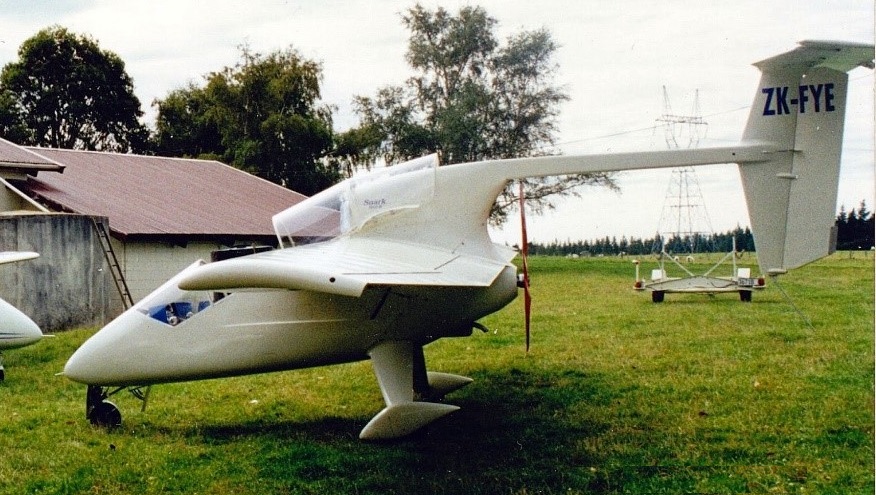
Snark HA 2 ZK-FYE (c/n MAANZ 450) was Bill Barber’s first attempt at a two-seat aircraft and it was first registered to him on 30/5/91.
HA 2
The HA 2 was literally designed on the back of an envelope but is an efficient carbon fibre and Kevlar design with the cockpit/main undercarriage/engine mount structural area being very compact with only a single bulkhead. The cockpit layout gives both the pilot and passenger almost helicopter-like visibility. The HA 2 model was powered by a Rotax 503 engine. It also had a retractable front wheel which Bill found to make no appreciable difference to the performance so his later Snarks have fixed front wheels. It was sold to JM Young of Wanaka on 24/4/98. It crashed on take off from a strip near Wanaka on 3/2/01.
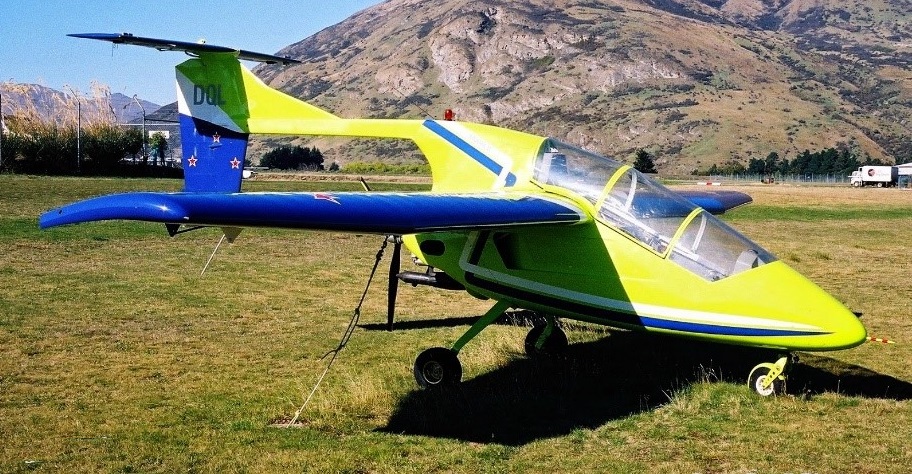
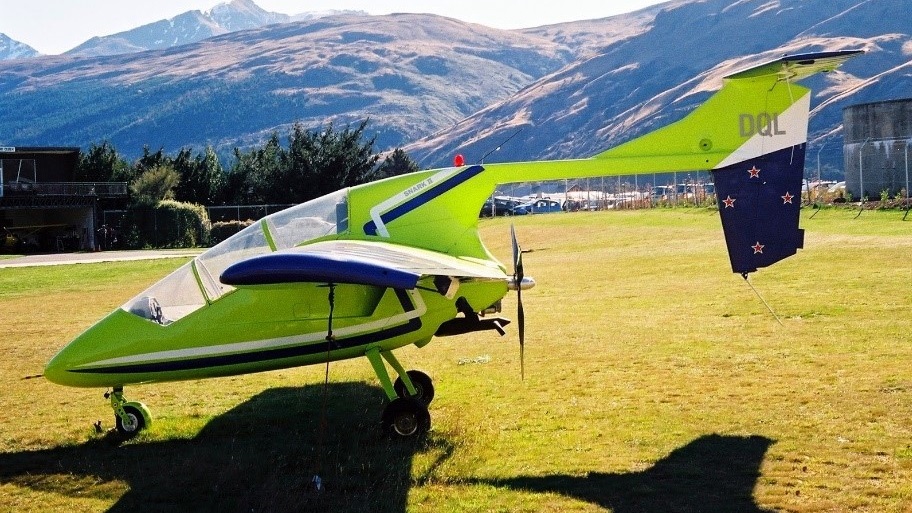
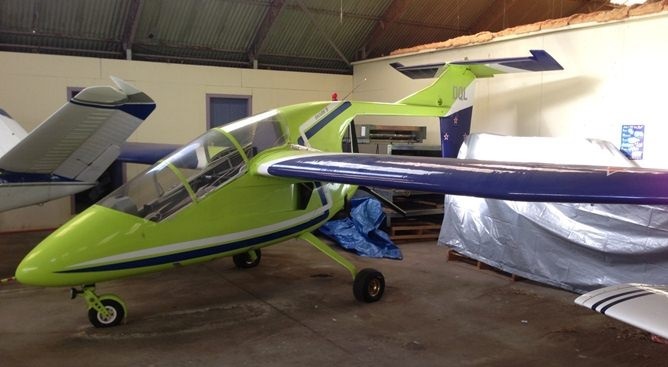
The damaged aircraft was sold to GD McMillan of Invercargill on 26/3/01. He employed Bill Barber to rebuild the aircraft and he re-registered it as ZK-DQL on 16/11/01.
HA 2
HA 2
It is photo’d here at Queenstown on 10/9/05 where it can be seen that an addition had been made to the upper fin.
Bill Barber built the Mark II Special NZ Flag Anniversary Version repowered with a 93 HP two stroke engine, offering very smooth acceleration right up to 120MPH using a variable speed prop along with communications gear, Ballistic Shute and F16 cockpit seating arrangement. The extensive wing and low aspect ratio allows for low speed approaches recorded at only 20 MPH under full 4 notches of flaps. The wing leading edge and full composite body with carbon back end tail boom strut offers very high strength and low weight ratios to enable full in flight soaring and thermal lift comparable to a low end glider. The take off angle can be close on 65 degrees with such a low stall speed. The lift off rotation is achieved at 30mph in limited space at 6,700 revs. Full rear brakes and castoring nose wheel, hi-strength aluminum sprung undercarriage are on cast wheels on new rubber tubed tyres
Snark Mark II Special NZ Flag Anniversary Version
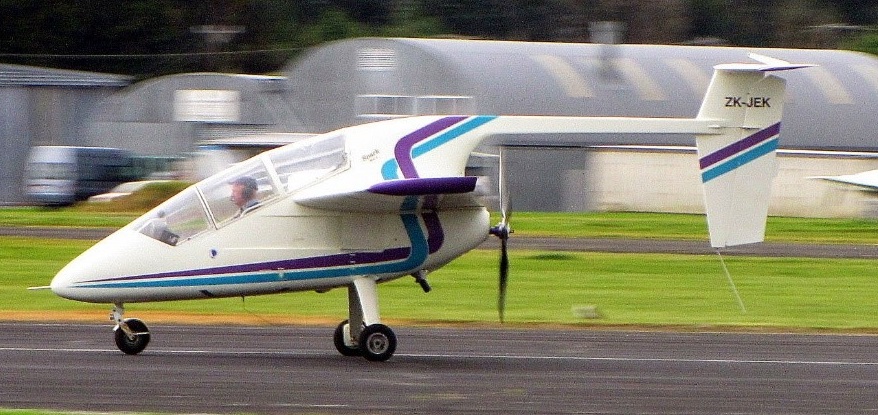
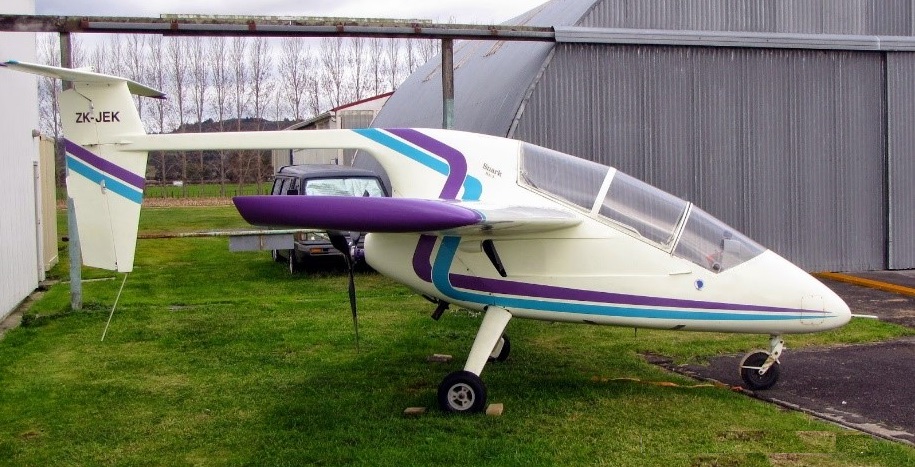
Snark 2 was the prototype and the Snark 3 machine (registered ZK-JEK) is a much more swept up development with a different wing, altered tail and different construction. All three have made extensive use of composite materials, Snark 3 being entirely of composite – mainly carbon and kevlar.
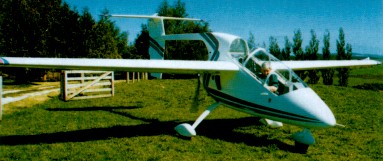
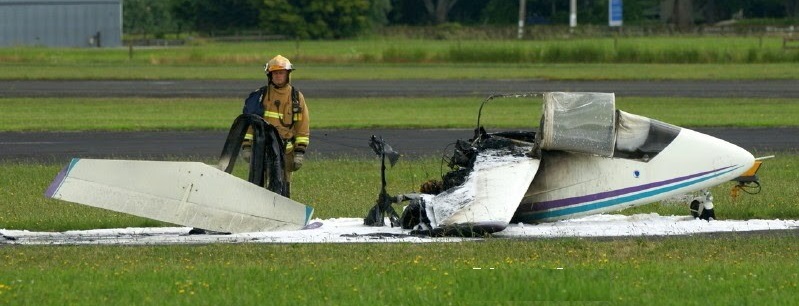
ZK-JEK (c/n 001) originally had the c/n of MAANZ/528, and was first registered to Bill Barber on 20/3/95. This aircraft was the first HA 3 model and was powered by a Suzuki G 13 engine. It had less wing area than ZK-FYE and it had full span flaperons. It was sold to MC Hopper of Otautau on 1/1/03, and he later moved to Whitianga and based the aircraft there. Later he replaced the 1300cc G 13 Suzuki engine with a twin carburettor 1500cc Suzuki engine, and the performance was spectacular. J & C Dale of Papakura purchased the aircraft on 31/10/12, and it was based at Ardmore.
It is photo’d above at Ardmore on 20/7/13. It was destroyed at Ardmore on 4/1/14 when it suffered an engine fire. Fortunately, it made it back to the runway for the occupants to get out before the fire completely destroyed the aircraft. It was cancelled on 28/4/14.
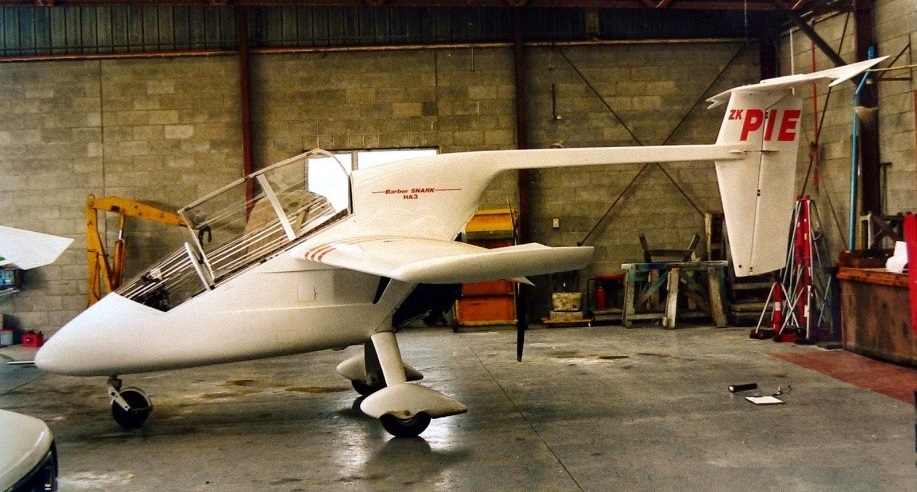
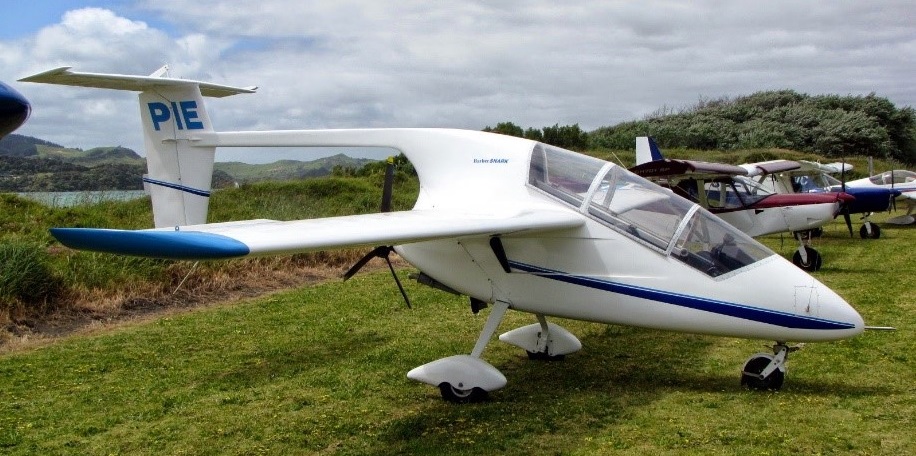
The second HA 3, ZK-PIE (c/n 002) was built by David Laing of Dunedin from moulds supplied by Bill Barber. It was registered to the Duncan Laing Trust of Dunedin on 28/2/96.
ZK-PIE also was powered by a Suzuki G 13 engine, but it had slotted flaps and ailerons instead of flaperons – as all subsequent Snarks have had. ZK-PIE suffered an engine failure on take-off on a test flight from Taieri on 25/1/98 and went through a fence.
Snark H/A3
It was repaired as seen in a hangar at Timaru on 6/10/99. It was sold to JR Lissington of Otorohanga on 1/11/99.
Above at the 2009 Black Sands flyin at Raglan on 7/11/09. Finally, it was sold to J & C Dale of Papakura on 23/3/14 to replace their departed ZK-JEK.
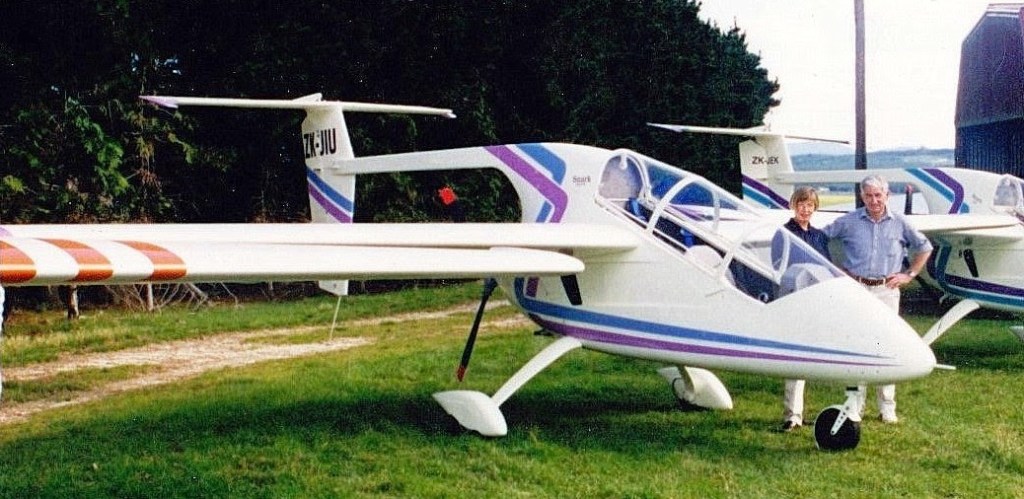
ZK-JIU (c/n 003) is a HA 3B model and was first registered to Bill Blair on 12/11/97. It had a Suzuki G 13-GTI engine. It was sold to P Dunn of Mildura in Australia and its registration was cancelled on 19/2/99 and transferred to the Australian microlight register as 19-3116. It was sold to B Cooper of Melbourne in 2005, and still registered in Australia.
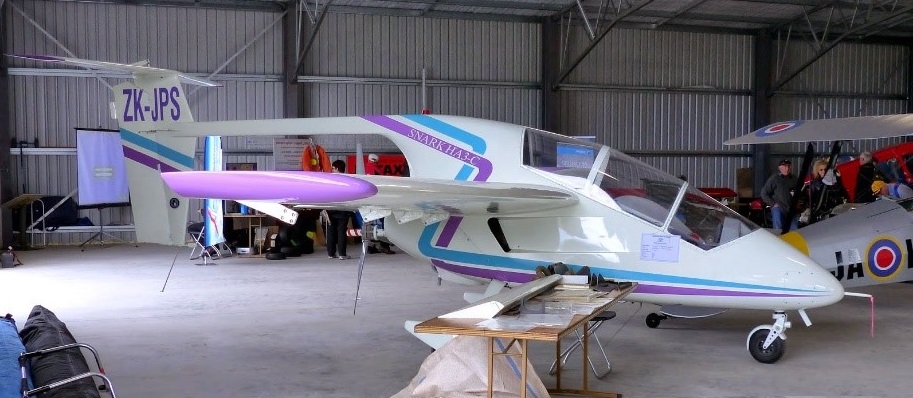
Snark HA 3C model ZK-JPS (c/n 004) was registered to Bill Barber on 10/7/03. It is powered by a Rotax 912 engine which is 30 kg lighter than the Suzuki. Bill has based his aircraft at Cromwell and flown it locally. It is shown at the 2014 Wings Over Wanaka airshow, on 18/4/14.
The Snark was flown and reviewed by experienced UK general aviation and microlight pilot Tim Cripps for Today’s Pilot Magazine where he stated “This is the most enjoyable of the many aircraft I have flown – and that includes the Hunter”. There were plans for UK production but those have not come to fruition.
Snark HA 3 Engine: Rotax 912 Wingspan: 9.3 m / 30 ft 6 in Length: 6.24 m / 20 ft 4 in Height: 2.43 m / 7 ft 9 in Empty weight: 263 kg / 580 lb MAUW: 450 kg / 992 lb Cruise: 104 kt Stall: 32 kt
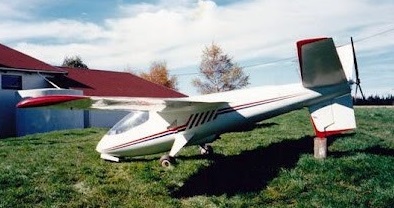
Bill Barber of Dacre in Southland, New Zealand, started off with the Snark HA 1 which was a single seater. Barber Snark HA 1 ZK-FOU (c/n MAANZ 409) was first registered to Bill Barber on 11/8/87. It was built of Kevlar foam sandwich construction with carbon fibre spars and full flaperons. It had a Rotax 503 engine driving a 3 bladed propellor through an 8 foot long driveshaft.
Barber flew the Snark HA 1 twice, for two short hops, and on reflection thinks it was a good aircraft. However, development problems caused him to go on to design and build his two seater Snarks.
This view shows the unusual tail configuration. ZK-FOU was withdrawn and cancelled on 26/7/95. It is currently stored on a trailer at Mandeville.
Ballard Sport Aircraft Ltd. is a privately held company founded in 2007 by Professionnal Engineer Serge Ballard. The company’s headquarters and manufacturing facilities are located in Sherbrooke (CYSC) Quebec, Canada. Ballard Sport Aircraft Ltd. was founded to manufacture and commercialize the Pelican aircraft products.
Serge Ballard is a private pilot since 1989. He holds a Bachelor degree in Engineering from Ecole Polytechnique of Montreal. In 1993, while looking for a replacement to his Cessna 172 1956, he felt in love with the Pelican at its first sight in Mascouche, Qc, Canada. Only one flight convinced him that the Pelican was for him. He took a sabbatic and built his own Pelican PL in only 4 months. He is enjoying every flight since then. The aircraft is so good that Serge decided to buy all the assets related to the Pelican kit planes after Ultravia’s bankcruptcy.
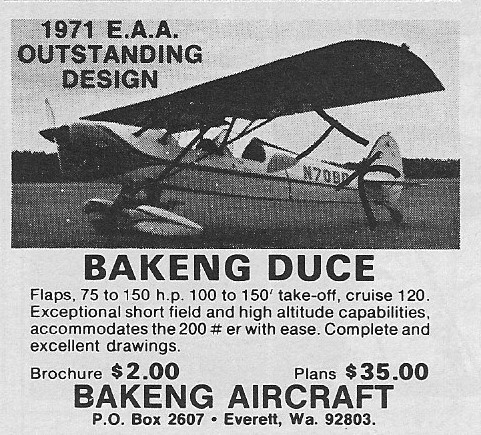
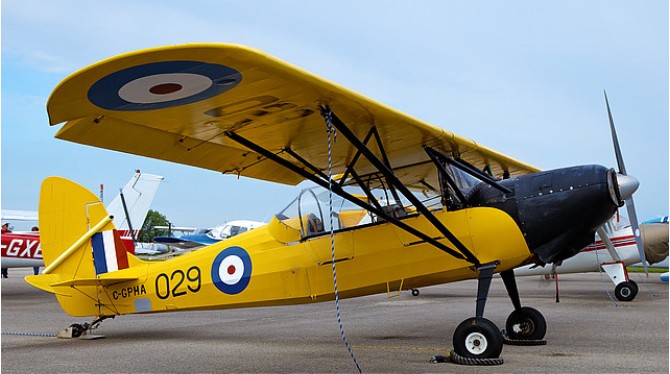
The Bakeng Deuce is a two-place parasol design utilizing a steel tube fuselage. The structure is faired with plywood and aluminum formers which support spruce stingers. Wings are of basic wooden construction with solid spruce spars.
First flown on 2 April 1970, this homebuilt received the ‘Outstanding New Design” and “Design improvement’ awards from the EAA in 1971. The V-strut braced wing utilizes both metal and spruce construction and is covered with fabric. The fuselage is also fabric-covered but is built from steel tubes. The landing gear is the conventional tailwheel type, and the two seats are arranged in tandem fashion. Bakeng has also designed a biplane version of the Duce, called the Double Duce. Both horizontally opposed and radial engines can be used, from 85-150 hp. Baking Deuce Airplane Factory purchased the rights to the Bakeng Duce in March of 1999. The name was changed to “Deuce” to separate those aircraft built before and after. The new Deuce incorporates the design of the old Duce with improvements based on analyzing the aircraft and listening to builders who have built and flown them for the past thirty years.
Dec 1973
Design Improvements are changes only to enhance integrity, reliability, ease of construction or function. These changes include: Beef up fuselage behind the landing gear legs. Complete redesign and relocation of the rudder pedals, cables and toe brakes. Complete redesign of the elevator control (pushrods instead of pulleys). Completely new lift strut attachments (individual, like old Pipers). Different tail mount structure New attachments for turtle deck Entirely new rudder design and mount (now removable). New method of attaching cross wire bracing in front of front cockpit. Removal of all elevator pulleys and cables. Larger fuel tanks Comfortable, factory-built bucket seats CAD drawings of the original plans have been completed.
The Bailey B200 is a British single cylinder, four valve, four stroke aircraft engine, designed and produced by Bailey Aviation, specifically for paramotors, powered hang gliders, microlights and ultralight aircraft.
The B200 was designed specifically as a more fuel efficient and quieter replacement for small two-stroke engines that are typically used on this class of aircraft. The B200 has a displacement of 200 cc (12.2 cu in), includes standard electric starting and capacitor discharge ignition. It produces 22 hp (16 kW) and drives a propeller through a 3.2:1 gearbox style reduction drive.
Applications Airborne T-Lite
B200 Type: Single cylinder aircraft engine Displacement: 200 cc (12.2 cu in) Starting: standard electric Cooling system: air Reduction gear: gearbox-type, 3.2:1 Power output: 22 hp (16 kW)
Built by Bob Bailey, circa 1991, the Connie utilises a single Cosmos trike float and qualifies as a Pt.103 ultralight. The float is the primary structural unit. Baily fitted a modified version of his Tempest ultralight sailplane wing and a Rotax 447. The main undercarriage retracts with a simple lever. On the prototype, the tailwheel retracts but this may change in a production version. The Connie may be produced with Baliey’s partner, Bill Moyes.
Prototype Engine: Rotax 447, 40 hp Wingspan: 35.1 ft. Length: 18 ft. Wing area: 118 sq.ft. Empty wt: 328 lbs. Gross wt: 570 lbs. Vne: 90 mph. Cruise: 65 mph. Stall: 35 mph. Fuel cap: 5 USG. ROC: 900 fpm. TO dist: 200 ft. Ldg dist: 300 ft.