Akaflieg Braunschweig SB-10 Schirokko

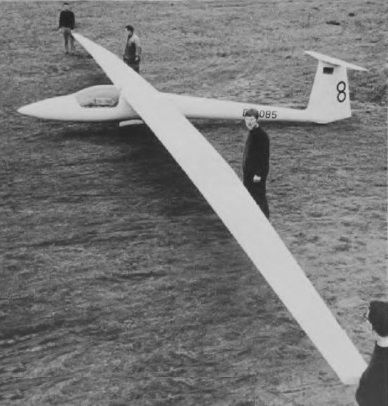
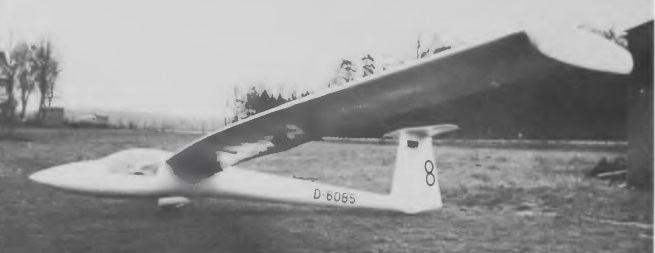
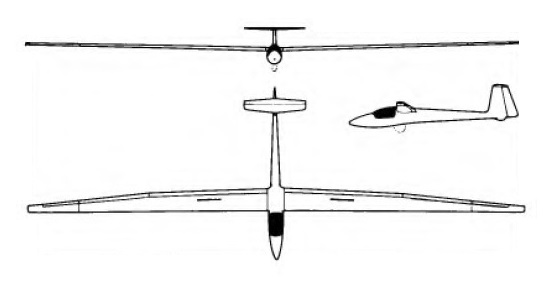
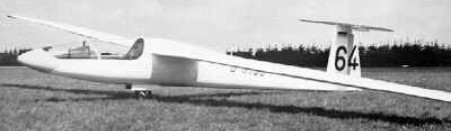
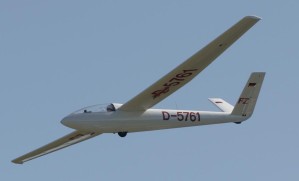
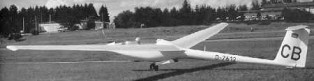
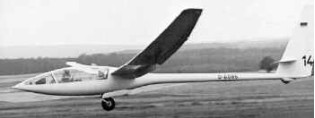
The SB-10 Schirokko is an attempt to create a tandem two-seater sailplane of exceptional performance and aerodynamic refinement, and the choice of a high aspect ratio (36.6) wing of 29m (95ft 1.75in) span has enabled a best glide ratio of 53:1 and a minimum sinking speed of only 1.3ft/sec to be achieved.
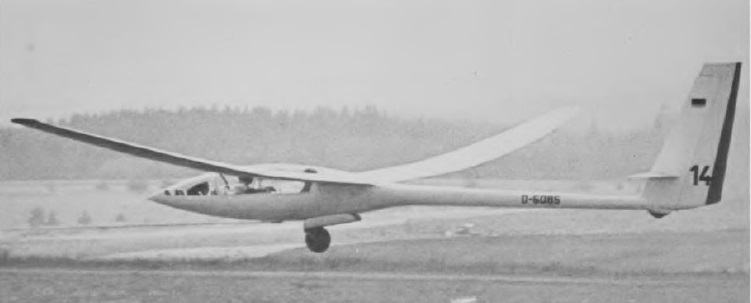
Design of the SB-10 began in 1969 and it first flew in prototype form on 22 July 1972; it can also be flown with a wing of 26m (85ft 3.25 in) span instead of the 29m one. The wing structure is in five parts: the centre section is of plywood, balsa wood and carbon-fibre, while the outer wing panels and air brakes, as well as the wing tips, are the same as those of the SB-9 Nimbus, but of balsa wood and glassfibre construction with foam filling. Foam-filled carbon-fibre is used for the camber-changing flaps, which can be drooped in conjunction with ailerons; there are three of the latter each side on the 29m wing. The pod-and-boom type fuselage has a finely streamlined forward part, housing the pilots, tapering to a thin boom carrying the tail, and is a steel tube frame covered with a balsa/glassfibre sandwich shell and with light alloy at the rear. The tail unit is also of balsa/glassfibre sandwich construction and has a fixed incidence tailplane mounted low. The landing gear consists of an airassisted retractable monowheel with a hydraulic brake, and a tailskid. The landing gear, air brakes and rudder controls were later modified, and several other changes made, and in this form the SB-10 set up a German distance record of 577 miles on 16 April 1974.

The SB-10 was still used by the group for performance flights.
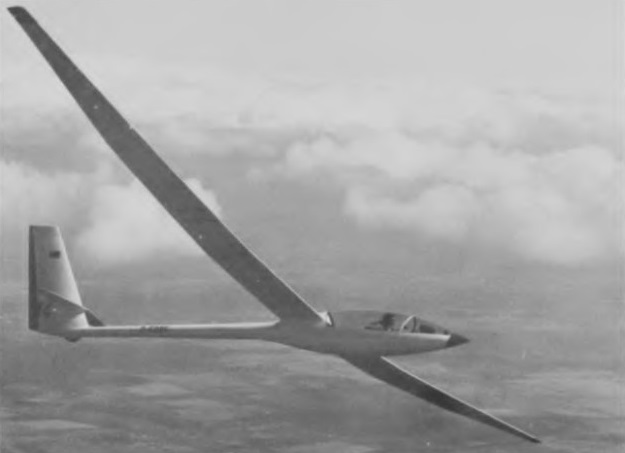
SB-10
Wing span: 29 m / 95 ft 1.75 in
Wing area: 22.95 sq.m / 247.1 sq.ft
Length: 10.36 m / 33 ft 11.75 in
Empty Weight: 608kg / 1,272 lb
Gross Weight: 889kg / 1,978 lb
Water ballast: 100 kg / 220 lb
Wing Load: 40.8 kg/sq.m / 7.98 lb/sq ft
Aspect ratio: 36.64
Airfoil: Wortmann FX 62-K-153/131 /60-126
Max speed: 124 mph / 108 kt / 200 km/h
Max rough air speed: 108 kt / 200 km/h
Stalling speed: 35 kt / 65 km/h
L/DMax: 48.5 @ 101 kph
Best glide ratio: 53:1 at 56 mph / 48.5 kt / 90 km/h
MinSink: 0.53 m/s / 1.3 ft/sec at 85 kph / 47mph
No. of Seats: 2
No. Built: 1
Akaflieg Braunschweig SB-9 Stratus

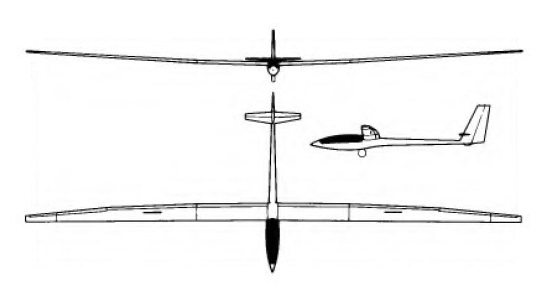
The SB-9 Stratus high-performance single-seater was developed by Akaflieg Braunschweig from the 18m (59ft 0in) span SB-8, and first flew in prototype form on 23 January 1969, making its debut at the German National championships that year. The SB-9 featured a higher aspect ratio (31.3) wing of 22m (72ft 2.5in) span, this giving a best glide ratio of 48:1 compared to 42:1 for the SB-8, a lower minimum sinking speed and otherwise improved performance.

But some problems were encountered with the wing geometry, especially aileron length, load distribution over the wing and rudder action, and as a result the maximum speed had to be limited to only 107mph. Later, wing span was reduced to 21m (68ft 11 in), this giving an improvement of 12mph in the maximum speed. The SB-9’s wing is of PVC foam construction for lightness, and has a glassfibre roving spar; the HKS type flaps are of elastic glassfibre construction with no hinge or gap.

The fuselage is of glassfibre construction with balsawood support, and the landing gear is an unsprung retractable monowheel with a drum-type brake. A T-tail is featured, the tail unit being of glassfibre and balsa construction.

SB-9
Wing span: 22 m / 72 ft 2.5 in
Length: 7.5 m / 24 ft 7 in
Height: 1.4 m / 4 ft 7 in
Wing area: 15.48 sq.m / 166.6 sq.ft
Aspect ratio: 31.27
Airfoil: Wortmann FX 62-K-153/131
Empty weight: 321 kg / 692 1b
Max weight: 412 kg / 917 lb
Water ballast: None
Wing Load: 26.6 kg/sq.m / 5.53 lb/sq ft
Max speed: 107 mph / 97 kt / 180 km/h
Stalling speed: 32 kt / 59 km/h
Max rough air speed: 97 kt / 180 km/h
Min sinking speed: 1.5 ft/sec at 45 mph / 39 kt / 72 km/h
MinSink: 0.51 m/s / 1.5ft/sec @ 81 kph
Best glide ratio: 48:1 at 53mph / 46 kt / 85 km/h
L/DMax: 46 @ 81 kph
No. of Seats: 1
No. Built: 1

Akaflieg Braunschweig SB-7 Nimbus

The SB-7 Nimbus is a development of the Akaflieg Braunschweig SB-6 Nixope, an ultra high aspect ratio high-performance single-seater with an 18m (59ft 0in) span wing, an aspect ratio of 25 and a best glide ratio of 42:1.

The SB-7 Nimbus, which first flew in October 1962, featured a 15m (49ft 2.5in) span wing for Standard
Class requirements with a lower aspect ratio, and a T-tail instead of the SB-6’s lower-mounted tailplane.

The SB-7’s shoulder wing has a box spar with glassfibre flanges and is covered with diagonally-laid glassfibre skin stabilised with balsa; the ailerons are of wooden construction and there are two Schempp-Hirth air brakes on each side at the 75% chord line. The fuselage, again like the SB-6’s, is a glassfibre monocoque stabilised with balsa. The tail unit is of similar construction to the wing, with the one-piece all-moving tailplane on top of the fin.

Landing gear is a retractable monowheel with friction brake and there is also a tailskid.

In Switzerland an SB-7 was modified by Paul Kummer and Oskar Wiesendanger of Zurich to have a completely new wing of increased span (54ft 2.5 in) and aspect ratio (20.85) and with an Eppler 417 aerofoil section; trailing edge air brakes replaced the Schempp-Hirth ones of the standard SB-7 and a tailbraking parachute was fitted. The first of two prototypes of this modified SB-7 made its maiden flight on 20 May 1967, and two more prototypes were built.

SB-7
Span: 17m / 49 ft 2.5 in
Length overall: 22 ft 11.5 in
Height over cockpit: 2 ft 8 in
Wing area: 12.66 sq.m / 127.6 sq.ft
Aspect ratio: 19 / 22.83
Airfoil: FX 61-163
Empty equipped weight: 283kg / 562 lb
Max take-off weight: 390 kg / 794 1b
Wing Load: 30.8 kg/sq.m
Max speed (smooth air): 158 mph
Min sinking speed: 0.60 m/s / 2.20 ft/sec at 56 mph
Best glide ratio: 37.5:1 at 85 kph / 56 mph
No. of Seats: 1
No. Built: 1

Akaflieg Braunschweig SB 6 Nixope

The SB-7 Nimbus is a development of the Akaflieg Braunschweig SB-6 Nixope, an ultra high aspect ratio high-performance single-seater with an 18m (59ft 0in) span wing, an aspect ratio of 25 and a best glide ratio of 42:1. The SB-6, which made extensive use of glassfibre in its structure, first flew on 2 February 1961 but was destroyed in August 1964.

The SB-6’s shoulder wing has a box spar with glassfibre flanges and is covered with diagonally-laid glassfibre skin stabilised with balsa; the ailerons are of wooden construction and there are two Schempp-Hirth air brakes on each side at the 75% chord line. The fuselage was a glassfibre monocoque stabilised with balsa. The tail unit is of similar construction to the wing, with the one-piece, low, all-moving tailplane.

Akaflieg Braunschweig SB-5 / Eichelsdorfer SB-5

The Akaflieg, or Akademische Fliegergruppe, of Brunswick (Braunschweig) University designed and built the SB-5 Danzig being a Standard Class (15m span) single-seater which first flew in prototype form on 3 June, 1959.

The type is of conventional all-wood construction, with a single spar shoulder wing with plywood covering and a butterfly tail; Schempp-Hirth air brakes are situated at the 50% chord line. The landing gear is a non-retractable unsprung monowheel with a friction brake, and there is also a tailskid. The plywood monocoque fuselage has an outer coating of glassfibre.

The SB-5C, which first flew in 1965, incorporated several design changes. The SB-5E, which entered production in 1974, had the wing span increased to 16m (52ft 6in) to comply with Club Class regulations. SB-5B or SB-5C Danzigs can be modified up to SB-5E standard.

Licence production was undertaken by Firma Eichelsdorfer at Bemberg, and over 100 SB-5s of all variants were built.

Wing span: 16.2m
Wing area: 13sq.m
Empty Weight: 250kg
Gross Weight: 350kg
Wing Load: 25kg/sq.m
No. of Seats: 1
No. Built: 50
L/DMax: 33 @ 85 kph
MinSink: 0.63 m/s @ 72 kph
Aspect ratio: 17.31
Airfoil: NACA 633-618
Structure: Wood

SB-5C Danzig
Span: 49 ft 2.5 in
Length overall: 21 ft 10 in
Wing area: 140 sq.ft
Aspect ratio: 17.3
Empty equipped weight: 485 lb
Max take-off weight. 716 lb
Max speed: 124 mph (in smooth air)
Min sinking speed: 2.07ft/sec at 41 mph
Best glide ratio: 32.5:1 at48 mph

Akaflieg Berlin B-12

Design work on the B 12 began in October 1973. The students at Akaflieg Berlin set out to improve the performance of modern gliders by reducing drag. To reduce costs the group utilised production wings from a Schemp-Hirth Janus B, shortened to 18.2m, allowing the students to concentrate their efforts and budget on improving the fuselage.
The shape and profiles of the new fuselage were developed at the Institut für Luftfahrzeugbau (Institute for aircraft industry) and a new two-seat fuselage constructed using GFRP (Glass-fibre Re-inforced Plastic) techniques in a monocoque shell. The B12 uses monocoque construction, and the cockpit seats two in tandem under large plexiglas canopies with the instructors seat, in the rear, set at a higher level to improve the instructors view ahead.
The wings are standard ‘Janus B’ items built using identical construction methods. The wing has a sweep forward of 2° 18′ on the leading edge with glassfibre monocoque ailerons, flaps and Schempp-Hirth air brakes on the upper surfaces. The tail unit was originally built as a cruciform unit using an extremely thin NACA 0009-64 aerofoil section formed with ‘ Rohacell’/GFRP sandwich supported by CFRP (Carbon-Fibre Re-inforced Plastic) spars. After a trailer accident during road transport in 1986, which destroyed the rear fuselage and tail-unit, a T-tail was fitted during repairs. A specially developed Wortmann FX-71 L 150/30 profile was utilised for the fin and rudder.
The single retractable main undercarrriage wheel is supported on a tall leg assembly which was originally built with electric actuation, but after a field landing with a flat battery caused a wheels-up landing a manual system was fitted. A rubber tailskid, capped with hardened steel, under the rear fuselage completes the undercarriage. Pullup doors fair over the main undercarriage well when the gear is retracted. In the original fuselage a braking parachute, used for approach control, was housed at the extreme rear, but this feature was not carried through to the replacement rear fuselage during repairs.
After the first flight of the B12 on 27 July 1977, piloted by Jürgen Ehlers Thorbeck, the B12 was used for research, cross country and competition flying until the trailer accident in 1986, whilst being transported by road, destroyed the tail section and twisted the rear fuselage. Repairs were carried out and the B12 was flying again on 1 August 1987 at the IDAFLIEG (Interessengemeinschaft deutscher akademischer Fliegergruppen e.V. – interest group for academic flying groups) summer camp at Aalen-Elchingen, sporting a T-tail identical to that of the Akaflieg Berlin B13. The B12 continues to fly but rarely emerges from the hangar unless the soaring weather is good.
The measured glide-ratio (Idaflieg-summer-meeting 1978) is 40.5.

Wingspan: 18.2 m (59 ft 8.5 in)
Length: 8.7 m (28 ft 6.5 in)
Wing area: 16.58 sq.m (178.5 sq.ft)
Aspect ratio: 19.97
Wing profile: Root – Wortmann FX-67-K-170, Tip – Wortmann FX 67 K 150 [3]
Height: 6 ft 6 in
Empty weight: 446 kg (983 lb)
Gross weight: 620 kg (1,367 lb)
Wing Load: 37.4 kg /sq.m
Maximum speed: 200 km/h (124 mph)
Max aero-tow speed: 93 mph
Maximum glide ratio: 40.5 @ 110km/h (68mph)
Rate of sink: @90km/h (56mph) 0.68 m/s (133.9 ft/min)
No. of Seats: 2
No. Built: 1
L/DMax: 40.5 @ 110 kph
MinSink: 0.68 m/s @ 90 kph
Structure: GFRP