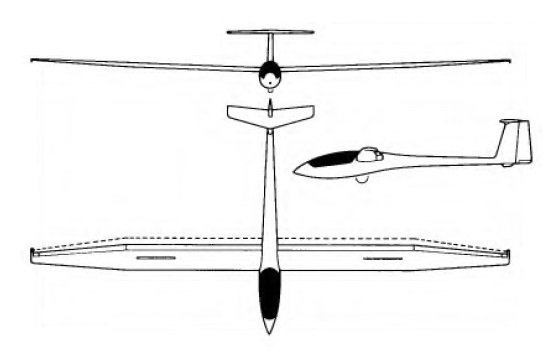
The Akademische Fliegergruppe of Darmstadt Technical High School has been involved in designing, building and flying gliders since as far back as 1909, and among its more successful designs was the metal high-performance D-30 Cirrus, which had an unusual pod-and-boom type fuselage and a minimum sinking speed of only 1.6ft/sec, being among the most efficient of the prewar German designs.
Glider
Akaflieg Darmstadt D-7 Margarete
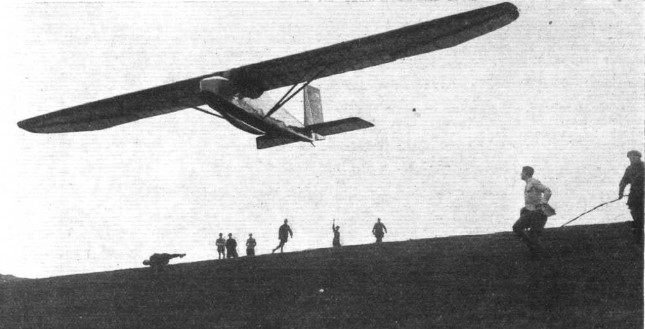
The Akademische Fliegergruppe of the Technical University of Darmstadt was first formed in 1921. It was, and is, a group of aeronautical students who design and construct aircraft as part of their studies and with the help and encouragement of their University. Designed by Fritz Hoppe, R. Kercher and E.Schatzki, the 1923 D-7 monoplane was their first two-seat design and one of the first of its kind, though the Fokker FG-2 two seat biplane glider flew the previous year; the D-7 was named after the wife of an Akaflieg Darmstadt student killed at the first Rhön (Wasserkuppe) glider meeting in 1920.
The Margarete was a wood framed aircraft with a high, braced, two spar wing with ply covering from the front spar to the leading edge and fabric covered aft. The wing had a thick and cambered profile inboard of the tips, which had a thinner and more symmetric profile. Initially the wing plan was rectangular, with triangular ailerons mounted on straight hinges which were attached to the front spar at the tips, reaching the trailing edge inboard. Later, the aileron area was reduced, partly by cropping them inboard and also by tapering their trailing edges and rounding their tips. Each wing was braced from the lower fuselage with an asymmetric, V-form, streamlined strut to the two spars at about one-third span.
The fuselage was plywood covered with a flat top, deep, slightly curved sides and a V-shaped bottom. The nose was blunt and the open, unscreened cockpit used for solo flying was well forward of the wing leading edge. The separate second cockpit was under the wing, close to the centre of gravity so that its occupation did not seriously affect the trim. The wing centre section was supported above this cockpit on an extension of the upper rear fuselage, which dropped away aft to become slender at the tail. There was a short undercarriage skid attached directly to the fuselage underside, aided by a small tailskid. A narrow, triangular, ply covered fin carried a fabric covered, trapezoidal rudder which extended to the bottom of the fuselage. The fabric covered tailplane was mounted on the top of the fuselage; in plan, tailplane and elevators were straight edged, only slightly tapered and with angled tips. A small elevator cut-out allowed rudder movement.
The D-7 Margarete first flew in 1923 and took part in both the 1923 and 1924 Rhön events, setting an unofficial record at the latter with a passenger-carrying flight of 21 minutes. It was later used for passenger flights, though not for basic training, until it was written off in 1927 when an aileron cable broke during landing.
Wingspan: 15.30 m (50 ft 2 in)
Wing area: 25 m2 (270 sq ft)
Aspect ratio: 9.36
Airfoil: Göttingen 533 at root, more symmetrical at tip
Length: 7.65 m (25 ft 1 in)
Empty weight: 180 kg (397 lb) structure
Gross weight: 320 kg (705 lb) in flight
Wing loading: 12.8 kg/m2 (2.6 lb/sq ft)
Crew: 1
Akaflieg Darmstadt Konsul
The Akademische Fliegergruppe of Darmstadt Technical High School has been involved in designing, building and flying gliders since as far back as 1909, and among its more successful designs was the Konsul, which was the first 18m (59ft 0.5in) span glider.
Akaflieg Darmstadt Edith
The Akademische Fliegergruppe of Darmstadt Technical High School has been involved in designing, building and flying gliders since as far back as 1909, and among its more successful designs was the Edith of 1922.
Akaflieg Darmstadt FSV.X
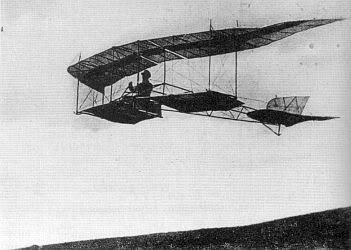
The foundation laid by Lilienthal and Ursinus was advanced by Darmstadt Technical Institute’s tests at Wasserkuppe in July 22, 1912 when a new record for time aloft and distance was established by pilot Hans Gutermuth, who flew the F.S.V. X. glider for one minute fifty-two seconds covering a distance of 840 meters. A replica of that plane, built by Otto Becker’s team is now on display in the Glider Museum at Wasserkuppe.
Akaflieg Darmstadt
Akaflieg Darmstadt
Akafliegheim Flughafen
38110 Braunschweig
Germany
Established in 1921 by students at the Technical High School, Darmstadt, for building and testing aircraft. Produced a number of sailplanes, and from 1924 a series of advanced light aircraft that held several class records. Work on powered aircraft ended 1939.
Akaflieg Braunschweig SB-14
Wing span: 18m
Wing area: 10.8sq.m
Structure: GFK
No. of Seats: 1
No. Built: 0
Akaflieg Braunschweig SB-13
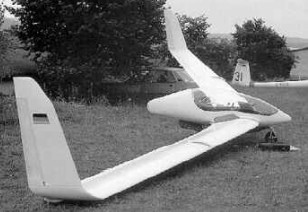
Wing span: 15m
Wing area: 11.6sq.m
Empty Weight: 285kg
Gross Weight: 427kg
Wing Load: 37kg/sq.m
Aspect ratio: 19.4
Airfoil: Hq 34 N/14,83
Structure: GFK
No. of Seats: 1
No. Built: 1
Akaflieg Braunschweig SB-12
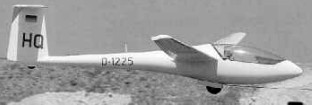
Wing span: 15m
Wing area: 10.02sq.m
Empty Weight: 238kg
Gross Weight: 450kg
Wing Load: 45kg/sq.m
L/DMax: 41 @ 98 kph
MinSink: 0.59 m/s @ 80 kph
Aspect ratio: 22.5
Airfoil: HQ 14
Structure: GFK
No. of Seats: 1
No. Built: 1
Akaflieg Braunschweig SB-11 Antares
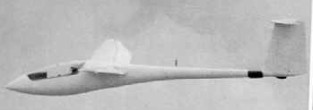
The SB-11 Antares is a single-seat high performance research sailplane categorised in the FAI Unlimited Standard Class and intended to test a new variablegeometryflap system and to evaluate the use of carbon-fibre reinforced epoxy resin as a constructional material for all parts of a glider.
Design work on the SB-11 started in the spring of 1974 and construction of the sole prototype began in April 1976; this made its first flight in May 1978.
The constant-thickness Fowler flap system is designed to achieve a high average cross country speed without the operational and technical difficulties of a telescopic wing, as tried on the Akaflieg Stuttgart FS-29, a high aspect ratio giving a very long span wing or a slotless Fowler flap-type wing. To retain conventional sailplane handling characteristics a constant thickness Fowler flap was devised that avoided friction between wing and flap and the need for a flexible lip at the lower surface of the wing. A special Wortmann wing section was evolved for the SB-11 and this was flight-tested mounted on the nose of a DFS Kranich 3 sailplane; the results were sufficiently encouraging to believe that the SB-11, with flaps extended, could outclimb any other Standard Class sailplane and, with flaps in, it would perform as well as a conventional Standard Class type. The cantilever shoulder wing is of 15m (49ft 2.5 in) span and has an aspect ratio of 21.3 with flaps in or 17 with flaps out; in the former condition the best glide ratio is 41:1. There is a single carbonfibre spar with roving spar flanges; the outer shell is a carbon-fibre/plastics foam sandwich. Each wing trailing edge is made up entirely of a 25% chord slotless Fowler flap inboard and outboard a ‘flaperon’ of 22% chord when in and 17% when extended; both flaps and ‘flaperons’ are of carbonfibre/plastic foam sandwich construction. They are supplemented by Schempp-Hirth air brakes on the upper surfaces of carbon-fibre/balsa wood sandwich construction, and wing tanks provide for up to 100kg (220lb) of jettisonable water ballast. The fuselage is a carbon-fibre monocoque and the cantilever T-tail, which as an all-moving tailplane with spring trim, is a carbon-fibre/plastic foam sandwich except for the rudder, which is a glassfibre/plastic foam sandwich. There is a retractable unsprung monowheel with an internal drum brake, and a rubber-spring tailskid.
The carbon-fibre monocoque fuselage front was cast in Schleicher AS-W 20 moulds. The T-tailed rear fuselage was made on Schempp-Hirth Janus moulds.
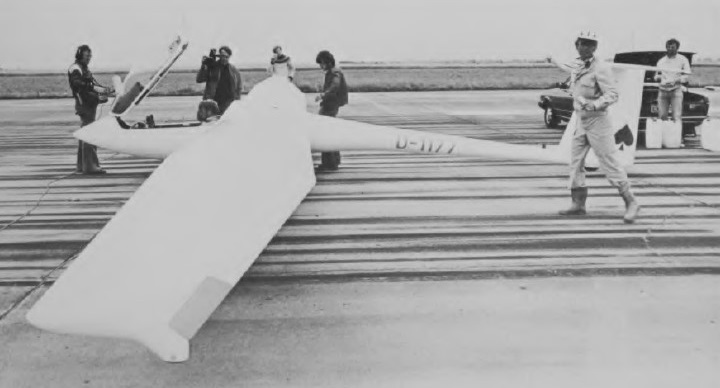
The SB-11 made its international debut at the 1978 World Championships at Chateauroux, France, when it was flown into first place in the 15m class by Helmut Reichmann, and in November that year it was named Antares.
SB-11
Span: 49 ft 2.5 in / 15m
Length: 7.4 m / 24 ft 3.25 in
Height: 1.47 m / 4 ft 6.25 in
Wing area (flaps in): 10.56 sq.m / 113.7 sq.ft
Wing area (flaps out): 142.1 sq.ft
Aspect ratio (flaps in): 21.3
Aspect ratio (flaps out): 17.0
Airfoil: Wortmann FX-62K-144/21-VG-1.25
Empty weight: 573 lb / 265 kg
Max weight: 1,036 lb / 470 kg
Water ballast: 100 kg / 220 lb
Max wing loading: 44.5 kg/sq.m / 9.11 lb/sq ft
Max speed (flaps in; smooth air): 155 mph / 140 kt / 260 km/h
Max aero-tow speed (flaps in): 112 mph / 97 kt / 180 km/h
Stalling speed: 31.5 kt / 58 km/h
Min sinking speed (flaps in): 0.62 m/sec / 2.03 ft/sec at 50 mph / 43 kt / 80 km/h
Best glide ratio (flaps in): 41:1 at 64.5 mph / 56 kt / 104 km/h
Best glide ratio (flaps out): 36.1 at 53 mph
No. of Seats: 1
No. Built: 1