From February 1948 Aerocar Inc had under development a flying automobile designed by M. B.Taylor. A prototype was completed in October 1949. Other light aircraft were made, including Coot and Sooper-Coot amphibians.
As Aerocar Associates, has marketed plans to construct Mini-Imp single-seat metal/composites monoplane with tail-mounted pusher propeller, and Coot-A two-seat amphibian.
Post WW2
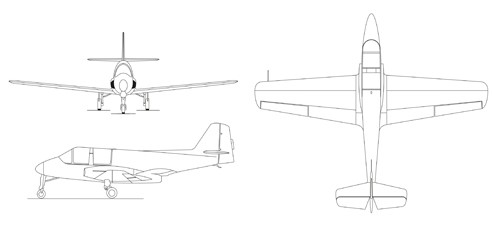
Aero Caproni Trento F5
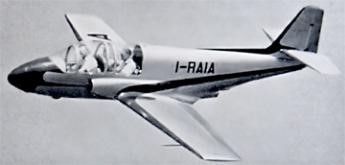
Postwar Caproni released the F5 in its new identity”Aero Caproni Trento”. It is a small low-wing monoplane, tandem two-seater.
An all wood, simple structure, the air inlets have been designed so they do not interfere with the wing. The Caproni F-5 is a cantilever monoplane, with the lower surface flush with the ventral surface of the fuselage.
The fuselage shell is oval section and single box, covered with birch plywood. The fuselage is in two parts; the first comprises the cockpit (two seats in tandem) and supports the front leg of the undercarriage; the second contains the engine and the empennage. The two sections are joined by bolts. The tail is cantilever.
The landing gear is a retractable tricycle. The front has oleo-pneumatic damping, with steering controlled by the rudder. This wheel retracting rearward. The main gear has oleo- pneumatic damping, with hydraulic brake swingarm (the hinge rotates around the wing spar). The landing gear retraction is mechanical ; it is effected by means of a crank attached to the right front position.
The first flight was performed by test pilot Ernesto Zanlucchi on 17 May 1952 on the Milan Malpensa airport.
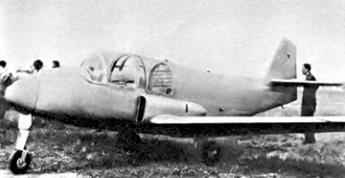
The same day as the first flight, Zanlucci and Vico Rosaspina, flew a range of acrobatics including looping and incipient spin.
The first tests made it possible to record the maximum ground speed at 360 kph, and at 3,000 m the F5 reached 315 km.h.
During the test dive conducted at 3,000 m, having two people on board, 520 km / h were reached without showing any vibration
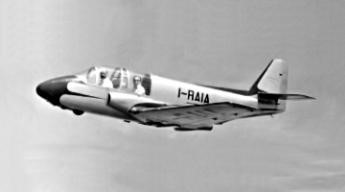
Engine: Turbomeca Palas, 150 Kgp
Wingspan: 7.65 m
Length total: 6.625 m
Height: 6.2 m
Wing area: 10 m²
Empty weight: 490 Kg
Max weight: 750 Kg
Max speed: 360 km
Range: 300 km
Ceiling: 8000 m
Time to 3,000 m: 11 min
Landing distance clean: 241 m
Landing distance flaps & brakes: 154 m
Aero Boero AB.260 AG
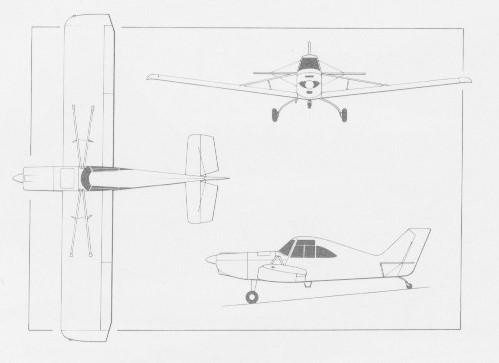
Manufactured by Aero Boreo and first flown in December 1972 was the single seat AB 260 AG, Lycoming O 540 powered “fumigacion” aircraft for ag work. Built as a spray aircraft, it features a 500 litre spray capacity.
Engine: Lycoming O-540, 260 hp
Wingspan: 35 ft 9.25 in / 10.90 m
Length, tail up: 24 ft 5.25 in / 7.45 m
Empty weight: 1587 lb / 720 kg
MTOW: 2976 lb / 1350 kg
Ag tank capacity: 110 Imp.Gal / 500 lt / 1102 lb / 500 kg
Max cruise SL: 109 kt / 125 mph / 201 kph
Max ROC SL: 1345 fpm / 410 m/min
Service ceiling: 21,000 ft / 6400 m
Range max fuel: 377 nm / 435 miles / 700 km
Seats: 1
Aero Boero 180
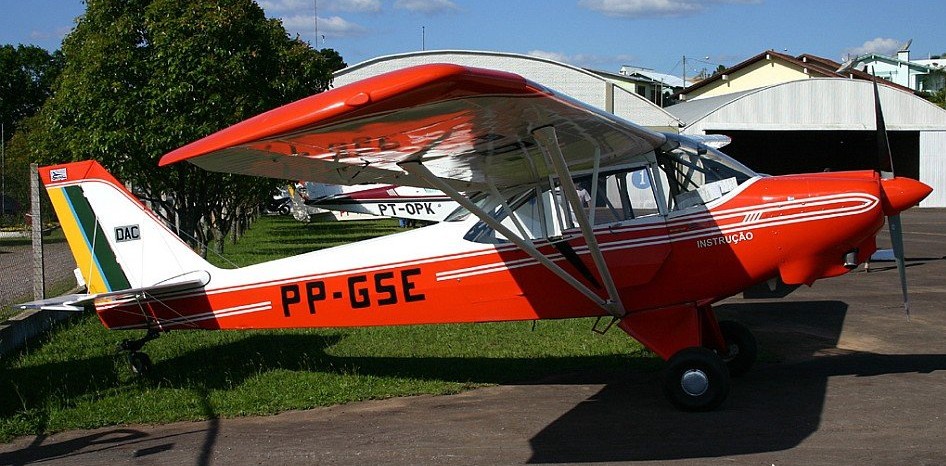
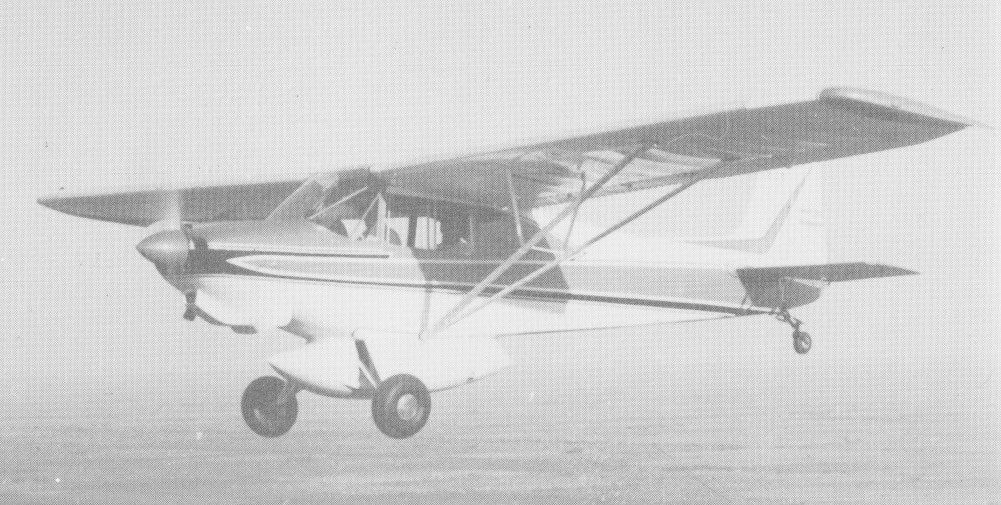
The 180 horsepower, 4 seat AB 180 (O 360 Lycoming) first flew on 12 March 1959 and is capable of a 131 mph cruise over a range of 733 miles. It was produced in the AB 180 AG agricultural, PSA military pre-selection and RVR glider-towing forms.
An unorthodox variant of the most powerful of the Argentinian lightplane series is the 180SP, an Ag version, which has two additional lower wings.
Variants:
AB 180
Initial 4 seat variant
Engine: Lycoming O-360-A1A
Wingspan: 35 ft 1 in / 10.70 m
Also produced as 3 seater; wingspan 34 ft 2.25 in / 10.42 m
AB 180 RV
3 seat version first flown 1972
Recontoured fuselage, sweptback fin & rudder, extra fuel
Engine: Lycoming O-360-A1A, 180 hp
Wingspan: 35 ft 2 in / 10.72 m
Length OA: 23 ft 10.25 in / 7.273 m
Empty weight equipped: 1212 lb / 550 kg
MTOW: 1860 lb / 844 kg
Max cruise SL: 114 kt / 131 mph / 211 kph
ROC SL: 1180 ft (360m) / min
Service ceiling: 22,000 ft / 6700 m
Range max fuel: 429 nm / 495 miles / 800 km
Seats: 3
AB 180 RVR
3 seat version first flown 1972
Wingspan: 35 ft 2 in / 10.72 m
Recontoured fuselage, sweptback fin & rudder, extra fuel
Glider tow hook
AB 180 Condor
High altitude version of AB 180 RV
Modified wing tips
Optional turbocharger
Pilot & passenger or 220 lb / 100 kg under fuselage cargo pack
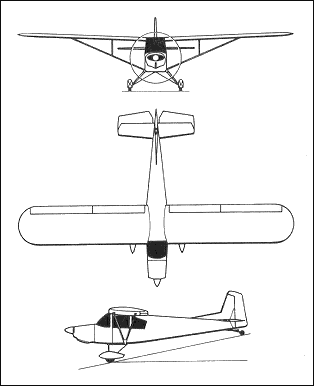
Aero Boero 150
The lower-powered AB 150 series was developed from the AB 180.
Aero Boero 115 / 115/150
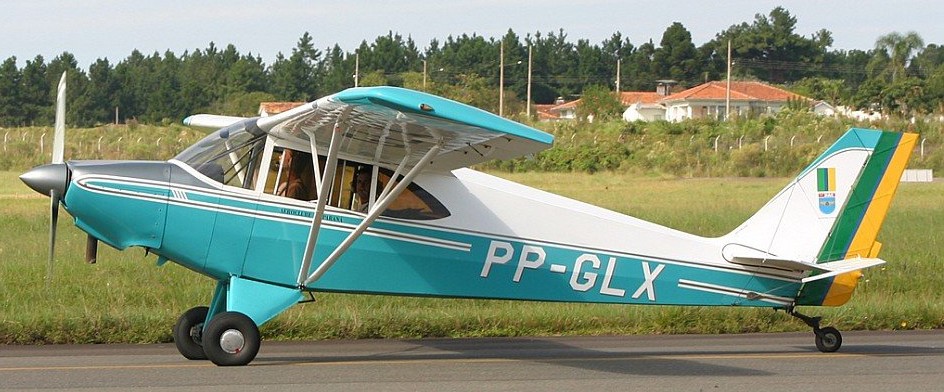
De¬signed and built by Aero Boero s.a. of Cordoba, Argentina, is the AB115, powered by a 115 hp Lycoming. Based on the three seat 95 hp Aero Boero 95, the 115 hp variant first flew ten years later in February 1973 with an Avco Lycoming O 235 and with alloy and reinforced plastic for engine cowls, flaps and ailerons. The AB115 by 1990 had a metal wing and fabric fuselage.
The AB115 was in production in basic training and recreational form and as the AB 115/150 higher-powered version that can undertake agricultural work.
Aero Boero 95 / 115BS
The Aero Boero 95 three-seater first flew on 12 March 1959 with a 95 hp Continental C-90-2F engine and production was initiated in 1961.
Versions built included the AB 95 Standard with a 71kW Continental C-90-8F flat-four engine. The AB 95A De Lujo with a 74.5kW Continental O-200-A engine entered production in 1963 and was to be manufactured under licence in Peru and Uruguay. The AB 95A Fumigador agricultural version with an O-200-A engine, a 55 Imp.Gal / 66 US Gal chemical tank and dusting or spraying equipment; AB 95B with a 112kW engine; and AB 95/115, which was similar to the AB 95B but with an 85.5kW Lycoming O-235-C2A engine, mainwheel fairings and a more streamlined cowling.
Aero Boero 115BS was a final production version of the Aero Boero 95 and 95/115 series. First flown in February 1973. Similar to the AB 95/115 but with a sweptback fin and rudder, increased wing span and greater fuel capacity, twenty-five were built. Production ended in 1976.
A further version of the basic design, the 95B with a 150 hp engine was under development.
The Aero Boero 95 is of all-metal construction with fabric covering overall. It can be adapted for glider towing.
Variants
AB 95 Standard
Initial 3 seat production version
Engine: Continental C-90-12F, 95 hp
Wingspan: 34 ft 2.25 in / 10.42 m
Wing area: 176.1 sq.ft
Length: 22 ft 7.5 in
Height: 6 ft 10 in
Empty weight: 882 lb
Max loaded weight: 1543 lb
Max speed: 127 mph
Max cruise: 106 mph
Econ cruise: 100 mph
ROC: 1000 fpm
Service ceiling: 17,000 ft
Range: 600 miles
AB 95A De Lujo
Engine: Continental O-200, 100 hp
AB 95A Fumigador
Agricultural version of AB 95A
AB 95B
Engine: 150 hp
AB 95 / 115
Similar to AB 95B
Main wheel fairings, more streamlined cowling
Engine: Lycoming O-235-C2A, 115 hp
Aero Boero 115BS
Engine: 1 x Lyc. O-235-C2A, 85kW
Take-off weight: 770 kg / 1698 lb
Empty weight: 490 kg / 1080 lb
Wingspan: 10.4 m / 34 ft 1 in
Length: 6.9 m / 23 ft 8 in
Height: 2.1 m / 7 ft 11 in
Wing area: 16.4 sq.m / 176.53 sq ft
Max. speed: 210 km/h / 130 mph
Cruise speed: 190 km/h / 118 mph
Ceiling: 5200 m / 17050 ft
Range w/max.fuel: 900 km / 559 miles
Crew: 1
Passengers: 2
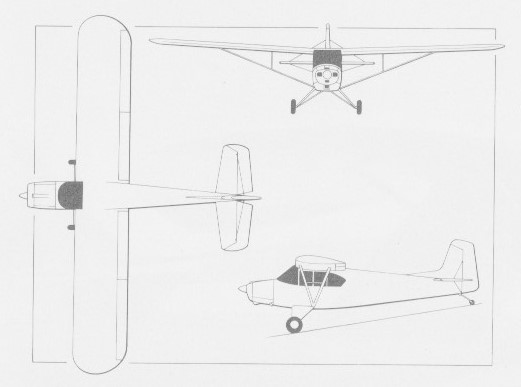
Aero Boero sa
Aero Talleres Boero srl
Aero Boero sa
Founded 1959 and based at Cordoba, Argentina, Aero Boera developed the three-seat Aero Boero 95 (first flown March 1959) from the Piper Cub.
Aero VSB 66 Orlice
Members of the VSB (the Aircraft Faculty of Brno Military Academy, Czech Republic) produced the VSB-66-S Orlice V-tailed single-seat Standard Class design which first flew on 17 September 1970.
Length: 26.509 ft / 8.08 m
Wingspan: 60.696 ft / 18.5 m
Wing area: 174.377 sq.ft / 16.2 sq.m
Max take off weight: 1102.5 lb / 500.0 kg
Weight empty: 829.1 lb / 376.0 kg
Max. speed: 130 kts / 240 km/h
Landing speed: 36 kts / 67 km/h
Wing load: 6.36 lb/sq.ft / 31.0 kg/sq.m
Glide ratio: 43.0
Crew: 2
Aermacchi MB-339
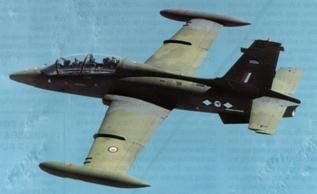
The 1972 designed Viper 632 powered Aermacchi MB339 produced in Varese, Italy, became the successor to the MB-326 and the Fiat G91. Sharing much of the MB-326K airframe structure, the MB-339 has a redesigned forward fuselage to allow the tandem seating to be staggered vertically, for the instructor to see over the pupil, the vertical tail enlarged, raised fin, a revised nose gear, stronger wings, Martin-Baker Mk.10 zero-zero seats, nose wheel steering and modern avionics. Six hardpoints (up to 1815 kg/4,000 lb) al¬low a combined trainer/light strike role. The wing is NACA 64A212 at the root and NACA 64A114 at the tip.
The first prototype MB-339X (I NOVE) made the type’s maiden flight on 12 August 1976, the second prototype was registered I NINE. Beginning production in 1976 was the MB.339A, of which the first of 100 for the Aeronautica Militare were handed over for pre service trials on 8 August 1979. Customers have included Argentina, Dubai, Ghana, Malaysia, Nigeria, and Peru.
MB.339As were the only operational jet aircraft deployed to the Falklands by the Argentineans during the hostilities, the Port Stanley runway being unable to accommodate Mirages or A 4s. An Argentine Navy MB.339 attacked a Royal Navy frigate, causing damage with 30 mm DEFA cannon fire and four Zuni 5 inch rockets. The trainer also has provision to carry the AGM65 Maverick ASM, the AIM 9 Sidewinder and the Sistel Marte II fire and forget sea skimming anti ship missile.
The MB.339B is basically a standard MB.339A advanced trainer with an uprated Viper 680 engine, enlarged tip tanks, and increased weapons carrying capability, enhanced for the ground attack role.
The MB.339C is designed to train pilots to use modern front-line mission management systems and powered by an uprated Viper 680-43 turbojet. Envisaged as a close support/maritime attack aircraft, the MB.339C first flew on December 17, 1985, equipped with a digital navigation/attack system including a GEC navigation computer, two Kaiser Sabre headup displays, a Litton inertial platform, CRT multifunction displays, a Fiat P-0702 laser rangefinder, an ELT-156 radar warning receiver, and a GEC AD-660 Doppler radar. Armament options included AIM-9L Sidewinder, AGM-65 Maverick ASMs, and Marte Mk.II anti-shipping missiles.
The MB-339CB with the Rolls-Royce Viper 680-43 jet engine experienced a number of engine problems. Flameouts on wet runways, compressor stalls during rapid acceleration/deceleration, defective fuel supply components, and turbine blade cracks. The subsequent repairs reduced the maximum thrust of the Viper to 4,280 lbs.
In 1991 the RNZAF purchased 18 of the model MB-339CB for use an advanced pilot trainer and weapons trainer with 14 Squadron based at Ohakea.
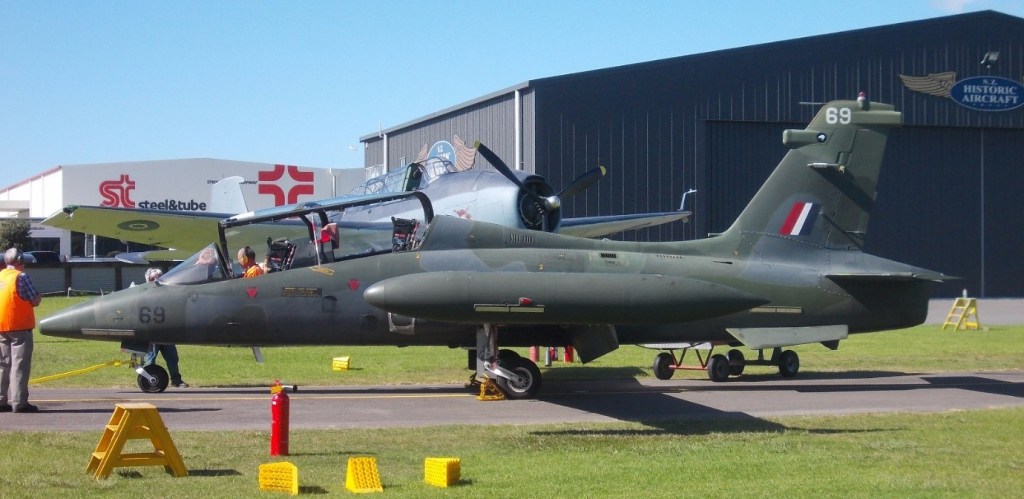
The “CD” model was offered with HOTAS (Hands on Throttle and Stick), HUDs display and three LCD screens.
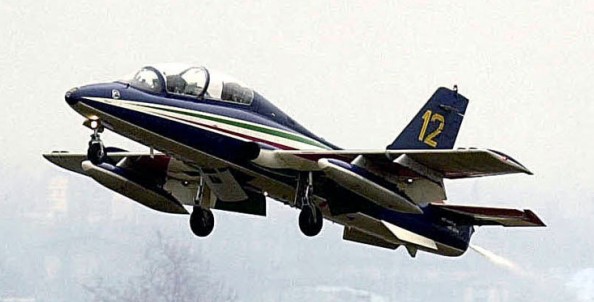
Development of the MB-339 has included the MB-339RM calibration model and 15 MB-339PAN delivered in 1982 for the Italian “Frecce Tricolori” aerobatic team.
The Viper 680 engined MB-339K, also known as the Veltro II, was a single-seat attack version. This aircraft first flew on 30 May 1980. In production form, the single-seat MB.339K Veltro 2, which flew in May 1980, was avail¬able with the digital navigation/attack system from the MB.339C.
Prototype
Wing span: 35 ft 7.5 in (10.86 m).
Max speed: 558 mph (898 km/h).
MB-339A
Engine: 1x R-R Viper 632-43.
Installed thrust: 17.8 kN.
Span: 10.9 m.
Length: 11 m.
Wing area: 19.3 sq.m.
Empty wt: 3125 kg.
MTOW: 5900 kg.
Warload: 1815 kg.
Max speed: 925 kph.
Initial ROC: 2010 m / min.
Ceiling: 14,600+ m.
T/O run: 465 m.
Ldg run: 415 m.
Fuel internal: 1410 lt.
Endurance: 2hr 50min.
Combat radius hi-lo-hi: 590 km.
Hardpoints: 6.
MB-339C
Engine: Viper 680, 1995-kg (4,400 lb) thrust.
Max speed SL: 480 knots
Max speed 25,000 ft: 460 knots
ROC SL: 6500 fpm.
Time to 30,000 ft: 7 min 6 sec.
TO wt clean: 10,000 lbs.
Endurance: 2 hr 50 min.
Fuel Burn: 2500 lb/hr.
Max extenal load: 4000 lb on six pylons.
MB-339CB
Engine: Rolls-Royce Viper Mk.680-43, 4000 lb thrust.
Span: 11.22m.
Wing area: 19.3 sq.m.
Length: 11.24m.
MTOW: 6350 kg.
Internal fuel: 1430 kg. (+2 x 400 kg tip tanks).
Empty wt: 3414 kg.
Height: 3.9 m.
Max speed: M0.8, 575 mph.
T/o run: 550m.
ROC: 8500 fpm.
Service ceiling: 46,000ft.
Limits: +7.33 & -4g.
Ferry range: 1190 miles (2200 km)
MB-339K Veltro 2
Engine: 1 x Piaggio RR Viper 680-43 turbojet, 4,450lbs / 19.8 kN thrust.
Length: 36.88ft (11.24m)
Wingspan: 36.81ft (11.22m)
Height: 13.09ft (3.99m)
Wing area: 19.3 sq.m
Empty Weight: 6,889lbs (3,125kg)
Maximum Take-Off Weight: 13,999lbs (6,350kg)
Fuel internal: 2030 lt
Maximum Speed: 506mph (815kmh; 440kts)
Maximum Range: 231miles (371km)
Rate-of-Climb: 6,595ft/min (2,010m/min)
Service Ceiling: 46,719ft (14,240m)
T/O run: 580 m
Ldg run: 450 m
Armament: 2 x 30mm DEFA cannons / 1935 kg external
Seats: 2
Hardpoints: 6
Air refuel: No.