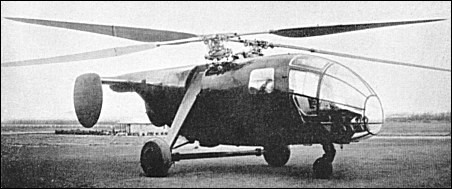
Aerocentre NC.2001 Abeille

The Helicopter Division of SNCAC was established by Rene Dorand and designed and built three prototypes of the NC.2001 “Abeille” helicopter, the second of which was flown on 28 June 1949, following ground destruction of the first machine. It had twin inter-meshing two-blade rotors, an all-metal fuselage with an extensively glazed nose and accommodation for five people. The undercarriage was a fixed tricycle type and it had a tailplane with twin fins. The NC.2001 was powered by a 450hp Renault 12S00 piston engine. The project was discontinued on the dissolution of SNCAC in 1949 with only one flight having been made.
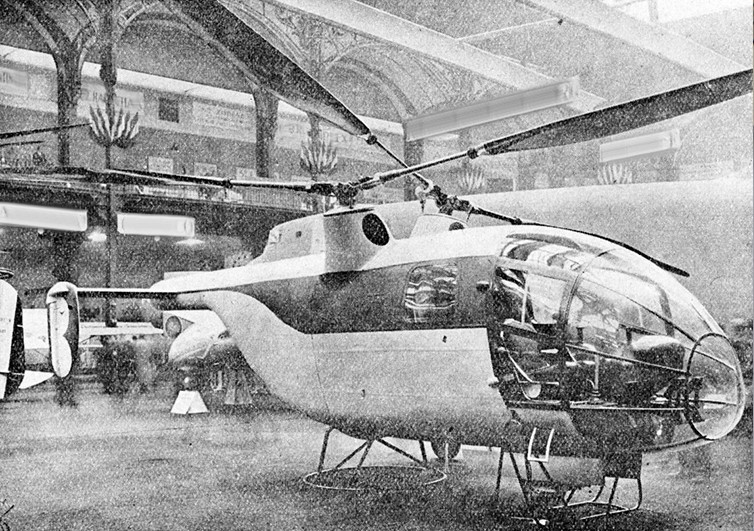
NC.2001
Engine: 1 x Renault, 335kW
Rotor diameter: 15.0m
Length: 9.7m
Max take-off weight: 2550kg
Max speed: 159km/h
Ceiling: 4880m
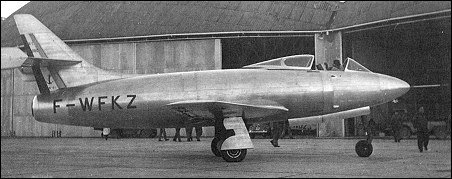
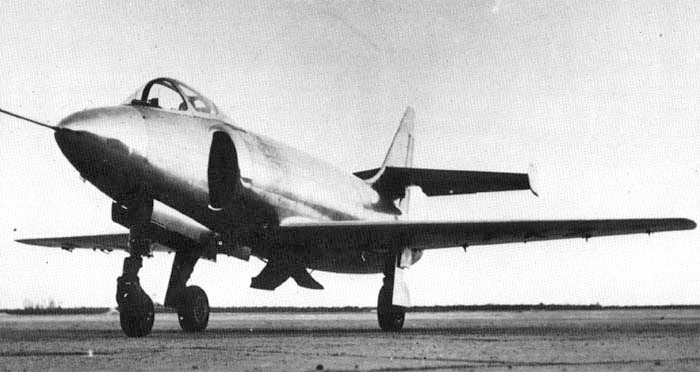
Aerocentre NC.1080

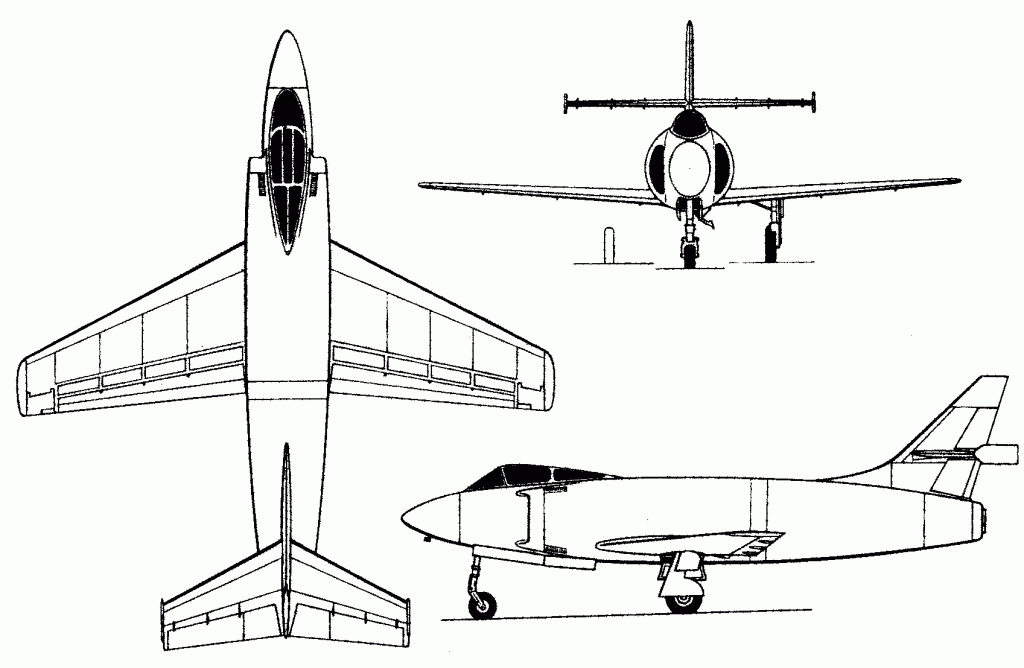
In June 1946, the Service Technique Aeronautique issued a preliminary requirement for a shipboard fighter armed with three 20mm or 30mm cannon and capable of carrying two 500kg bombs or eight 90mm rockets. Responding to this requirement, the SNCA du Nord tendered the Nord 2200, in competition with the Aerocentre NC 1080 and the Arsenal VG 90.

Designed under the direction of Ingenieur Pillon and built by the SNCA du Centre (Aerocentre), the NC 1080 was powered by a 2268kg Rolls-Royce Nene turbojet, featured 22 deg 30 min wing sweepback at quarter-chord and was intended to mount an armament of three 30mm cannon.

The prototype was flown on 29 July 1949, and modifications were immediately found necessary to the spoilers and tail surfaces. The Aerocentre had meanwhile been dispersed, but testing of the NC 1080 continued at Bretigny and Villaroche, servo controls being fitted in February-March 1950, and the aircraft being destroyed in an accident (the cause of which was never ascertained) on 10 April. No further development was undertaken.

Max take-off weight: 7700 kg / 16976 lb
Empty weight: 5141 kg / 11334 lb
Wingspan: 12.00 m / 39 ft 4 in
Length: 12.87 m / 42 ft 3 in
Height: 4.70 m / 15 ft 5 in
Wing area: 28.40 sq.m / 305.69 sq ft
Max. speed: 978 km/h / 608 mph
Range: 1550 km / 963 miles

Aerocentre NC.1071

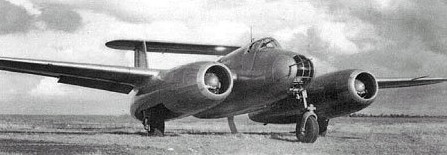
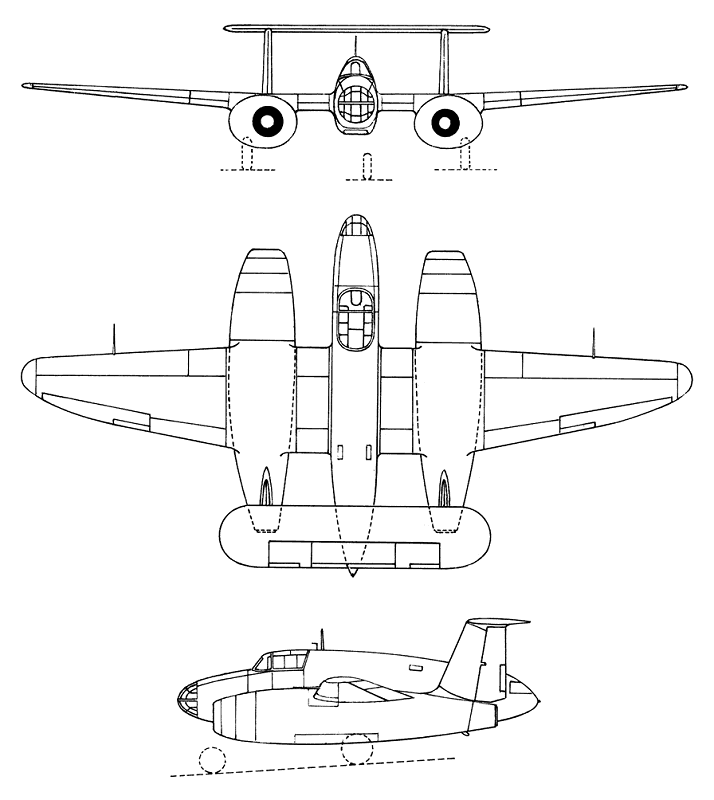
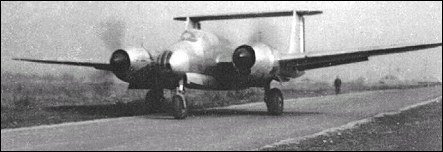
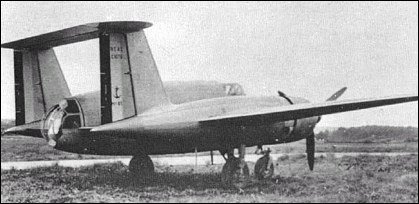
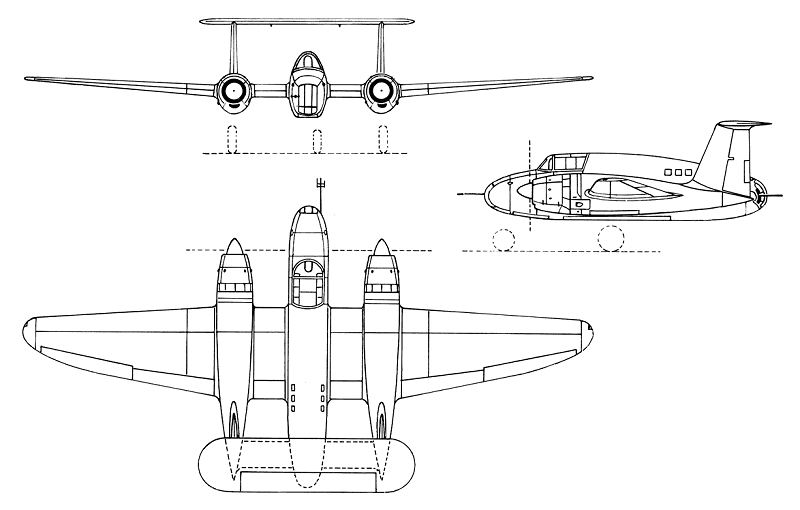
A turbojet-powered derivative of the NC.1070, the NC.1071 had underwing engine nacelles, which also carried the tailfins, connected by a tailplane on top. The first prototype flew on 12 October 1948 but the second prototype was abandoned after suffering structural damage in a flight to Mach 0.7. Aerocentre went into liquidation during 1949 and the project was cancelled in 1951.

Engine: 2 x 2350kg Hispano-Suiza (Rolls Royce) Nene 101
Take-off weight: 13750 kg / 30314 lb
Empty weight: 7980 kg / 17593 lb
Wingspan: 20.0 m / 66 ft 7 in
Length: 10.75 m / 35 ft 3 in
Height: 4.6 m / 15 ft 1 in
Wing area: 50.0 sq.m / 538.20 sq ft
Max. Speed: 800 km/h / 497 mph
Cruise speed: 724 km/h / 450 mph
Ceiling: 13000 m / 42650 ft
Range: 1000 km / 621 miles
Armament: 2 x 20mm cannon, 800kg of weapons

Aerocentre NC.1070         

The only prototype of the NC.1070 naval bomber flew for the first time on 23 April 1947. With development of the turbojet-powered NC.1071, the NC.1070 was cancelled.

Engine: 2 x 1600hp Gnome Rhone 14R-24/25 piston engines
Take-off weight: 10844 kg / 23907 lb
Empty weight: 7850 kg / 17306 lb
Wingspan: 20.0 m / 66 ft 7 in
Length: 10.21 m / 34 ft 6 in
Height: 4.15 m / 14 ft 7 in
Wing area: 50.0 sq.m / 538.2 sq.ft
Max. Speed: 578 km/h / 359 mph
Cruise speed: 526 km/h / 327 mph
Ceiling: 9950 m / 32650 ft
Range: 3400 km / 2113 miles
Crew: 3
Armament: 4 x 20mm cannon, 800kg of bombs

Aerocentre NC.853 / NC.854 / Nord NC.853 / NC.854 / NC.858 / NC.859

The NC.859 of 1947 and NC.851 were developed into the NC.853.

The NC.853 was a two-seat light monoplane powered by a 56kW Minie 4DC-32 engine, first flying on 15 March 1948.

100 NC.853s were produced for the Service d l’Aviation legere.

S.N.C.A.N. NC 858 S

Designed by the S.N.C.A. du Centre, production of the NC.853S two-seater was taken over in 1949 by S.N.C.A. du Nord.

From it were developed the 48kW Continental A65-powered NC.854, the four-seat NC.856 (78kW Walter), NC.858 (90 hp Continental C90-F), and NC.859 (105 hp Walter Minor 4-III). All are generally similar apart from the engines.

NC.853S

Gallery

NC.853
Engine: 56kW Minie 4DC-32A/B

NC.853S
Engine: 75 hp / 56kW Minie 4DC-32
Wingspan: 36 ft 11 in
Wing area: 166.2 sq.ft
Length: 22 ft 5 in
Height: 6 ft 10 in
Empty weight: 800 lb
Loaded weight: 1320 lb
Max speed: 102 mph
Cruise: 87 mph
Service ceiling: 11,480 ft
Range: 310 mi
Seats: 2

NC.854
Engine: 48kW Continental A65

NC.858
Engine: 90 hp Continental C90-F

NC.859
Engine: 105 hp Walter Minor 4-III

Aerocentre NC.271

NC.270.01

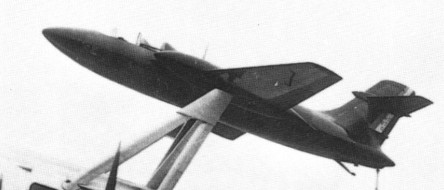
Planned shortly after the end of WW2, as a jet powered NC.270 bomber with two Rolls-Royce Nene turbojets, the airframe of this light bomber was based on curved lines with flying surfaces (including a T-tail) of modest sweep. Power was provided by two engines located in the wing roots, and the design envisaged an 11,023-lb (5000-kg) bombload carried internally plus a defensive armament of four 15-mm cannon in a TV-controlled tail barbette. Validation of the design was entrusted to a pair of reduced-scale machines, the engineless NC.271-01 and the rocket-powered NC.271-02. The NC.271-01 flew in 1949 (air-launched from a piggyback position above a Languedoc transport aeroplane), but before the NC.271-02 could be flown later in the same year the parent company folded and the whole NC.270 programne was terminated.

Aerocentre NC.211 Cormoran

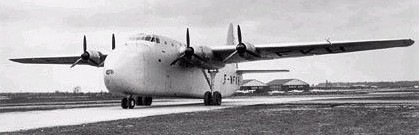
A large four-engined transport with a deep fuselage, the first prototype crashed during its first flight on 20 July 1948 killing the pilot Bertrand and his crew. The second prototype flew successfully on 9 April 1949 but the aircraft did not enter production and the project was cancelled.

Engines: 4 x 1600hp SNECMA 14R piston engines
Take-off weight: 40000 kg / 88185 lb
Empty weight: 21000 kg / 46297 lb
Wingspan: 44.00 m / 144 ft 4 in
Length: 30.50 m / 100 ft 1 in
Height: 10.1 m / 33 ft 2 in
Wing area: 200.0 sq.m / 2152.78 sq ft
Max. Speed: 410 km/h / 255 mph
Cruise speed: 320 km/h / 199 mph
Ceiling: 9000 m / 29550 ft
Range: 2000 km / 1243 miles

Aerocentre / Societe Nationale de Constructions Aeronautiques du Centre / SNCAC

In France, the Socialist Government of the so called Popular Front brought all the companies building military aircraft, aero engines and ar¬mament under its control in 1936. The im¬mediate result was the socialized oblivion of such established companies as Marcel Bloch, Bleriot, Nieuport, Potex, Dewoitine, Hanriot and Farman within half a dozen nationalized groups or Societies Nationales, named ac¬cording to their geographical location (Nord, Ouest, Centre, Midi and so on).
Farman and Hanriot formed the new Societe Nationale de Constructions Aeronautiques du Centre, known as SNCAC or Aerocentre.
After World War II, although four of the nationalized groups continued operating un¬der state control, private companies were al¬lowed to resume the design and manufacture of both civil and military aircraft.
Aerocentre conducted the final development of the Farman line of four-engined heavy bombers which had engines in tandem underslung pairs, derived from the F.211 of 1931.
Aerocentre went into liquidation during 1949, its plants and work being shared by SNCAN (Nord), SNCASO (Sud-Ouest) and engine form SNECMA.