AISA AVD-12 / I-18

The I-18, or AVD-12. was designed by Emile Dewoitine to meet the Ministerio del Aire specification issued in 1953, for a two/three seat air observation and liaison aircraft to replace the Fieseler Fi 156 Storch then in service with the Spanish Air Force.

The specification called for a maximum speed of not less than 109 mph, minimum speed of not more than 37 mph, and an endurance of 2.5 hours.

A high-wing all-metal monoplane, the A.I.S.A. I-18 has full-span high-lift flaps with prominent guides.

The AVD-12 was flown for the first time on 18 August 1954.

Engine: E.N.M.A. Tigre G-IVB, 150 hp
Wingspan: 36 ft 5 in
Length: 25 ft 5 in
Height: 6 ft 11 in
Empty weight: 1322 lb
MTOW: 2314 lb
Max speed: 140 mph
Cruise: 113 mph
ROC: 900 fpm
Service ceiling: 16,400 ft
Range: 479 mi
Seats: 2-3

AISA I-11B Peque

Designed and built in 1950 the I-11 two-seat lightweight training/sporting aircraft. Two prototypes were built.

In 1954, AISA purchased the Spanish manufacturer Iberavia and took over the I-11 light plane project, eventually building around 400 examples as the AISA I-11B, with smaller canopy and tailwheel undercarriage.

I-11B Peque

Derived from the I-11 prototype, the I-11B differed from the production model in having a fixed nosewheel undercarriage and a larger cockpit canopy. The I-11B first flew on 16 October 1953. Inaugurated early in 1954, a production batch of 70 was built for Spanish Aero Clubs.

AISA I-11B Vespa

Some aircraft were powered by a 93 hp RNMA Flecha engine. Some 450 were built.

AISA I-11B
Engine: Continental C90-12F, 90 hp
Wingspan: 30 ft 7 in / 9.34 m
Wing area: 133.472 sq.ft
Length: 21 ft 3 in / 6.48 m
Height: 6.234 ft / 1.9 m
Empty weight: 926 lb / 421 kg
Normal TO weight: 1417 lb / 644 kg
Max TO weight semi-aerobatic: 1474 lb / 670 kg
Max. speed: 108 kt / 200 km/h
Cruise speed: 96 kt / 110 mph / 117 kph
Max ROC SL norm MTOW: 726 fpm / 200 m/min
Service ceiling: 15415 ft / 4700 m
Range: 349 nm / 403 mi / 650 km
Crew: 2

AISA HM.7

The HM.7 was originally designed by the Instituto Nacional de Tecnica Aeronautica (I.N.T.A.) and was first produced in 1946.

The HM.7 is a four-seat touring monoplane powered by a 240 hp Argus As 10c engine with wing and tail assemblies of wood, the fuselage of welded steel tube with fabric covering. The enclosed cabin seats four with automobile type doors. Full blind flying equipment was fitted.

No production of the HM.7 was undertaken owing to the lack of a suitable nationally designed engine.

Engine: 240 hp Argus As 10c
Wingspan: 33 ft 5.5 in
Length: 25 ft 9 in
Height: 7 ft
Empty weight: 1540 lb
Loaded weight: 2640 lb
Max speed: 162 mph
Cruise: 118 mph

AISA HM-2

The HM-2 tandem two-seat cabin monoplane was designed by the Instituto Nacional de Tecnica Aeronautica (I.N.T.A.) and the prototype, built and flown by Aeronautica Industrial sa in 1945, was powered by a Hirth HM.506 engine.

Subsequent aircraft differ from the prototype in having a cut-down rear fuselage and the nationally-designed 150 hp E.N.M.A. Tigre G-IVB engine.

The HM-2 features retractable main undercarriage and wing and tail assemblies of wood, the fuselage of welded steel tube with fabric covering.

Engine: Hirth HM.506
Wingspan: 31 ft 8 in
Length: 25 ft
Empty weight: 1474 lb
Loaded weight: 1980 lb
Max speed: 156.5 mph
Cruise: 140 mph

AISA HM.1 / EE-4

HM-1B

The Aeronautica lndustrial sa / AISA HM-1 two-seat primary trainer appeared in 1934, powered by a 150 hp Hirth H.M.506 engine, and an order for 70 HM-1s powered by the nationally-designed 150 hp E.N.M.A. Tigre G-IVB engine was placed by the Spanish Air Ministry after World War II.

The HM-1B differs from the original HM-1 in having enclosed tandem cockpits, and the Spanish Air Force designation EE-4.

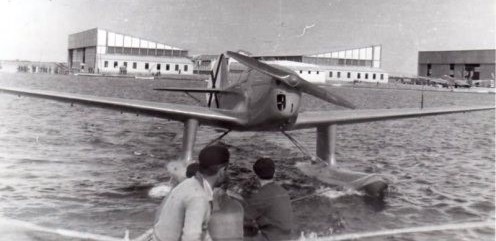
A twin-float seaplane version, the HM-3, was produced in 1947, and a single-seat, scaled-down mode, the HM-5, was also built, but neither version was produced in quantity.

HM-1
Engine: 150 hp Hirth H.M.506

HM-1B
Engine: 150 hp E.N.M.A. Tigre
Wingspan: 31 ft 8 in
Length: 25 ft
Height: 7 ft 2.5 in
Empty weight: 1364 lb
Loaded weight: 1870 lb
Max speed: 143 mph
Cruise: 121 mph

Aeromere SpA

Based at Trento, Spain, in the 1950s, Aeromere acquired from Aviamilano license for Falco series (F.8 Falco, designed by Stelio Frati, was first flown in June 1955). Aeromere SpA was taken over by Dr. Laverdas Laverdas SpA in 1964 to continue manufacture of the Super Falco under license from Aviamilano Costruzioni Aeronautiche.

Aero Industry Development Centre (AIDC)

Aerospace Industrial Development Corporation (Chinese name Han Hsiang Aerospace Industry Co Ltd.), established March 1, 1969 under auspices of Ministry of National Defense (reorganized 1996 under Ministry of Economic Affairs), in succession to Bureau of Aircraft Industry (set up in Nanking in 1946, moved to Taiwan 1948).
In 1968 a branch of the Bureau built the first Chinese-constructed PL-1B, a version of the US Pazmany PL-1. In 1969 AIDC began production of Bell helicopters for the Chinese Nationalist Army. Later undertook production of US Northrop F-5 Tiger II tactical fighter. Developed T-CH-1 turboprop trainer (flown November 1973; 50 production aircraft built) and AT-3 Tzu-Chiang advanced jet trainer and light attack aircraft (first flown September 1980; 62 built 1977-1989, with upgrades thereafter). Has developed and is producing the Ching-Kuo indigenous defense fighter, which first flew in May 1989 and achieved initial operational capability in 1995 (to replace Starfighters and Tiger IIs). Produces components for the F-16 fighter, and since 1995 has also been involved in non-military programs, including becoming a partner with Aero Vodochody of the Czech Republic in the Ibis Aerospace company, and produces components for the Boeing 717, Falcon 900, and 200 bizjets, Sikorsky S-92 helicopter, plus engines.