The first aircraft designed by Oleg Konstantinovich Antonov (1924) was OKA-1 glider, followed 1926-1929 by OKA- 3 to 7. He continued to build gliders during and after the war. The An-2 “workhorse” biplane of 1946 (when Antonov Aviation Scientific-Technical Complex organization was founded), was used for passenger, freight, exploration, ambulance, and agricultural work; fitted with wheels, skis, or floats and license-built in Poland and China.
At the Antonov Construction Bureau there lived a Ultralight Aircraft Department known for its creations: hang gliders Slavutich-UT, Sport-5 and trike T-2. These have been created according to aircraft requirements. The people working in the Department were able both to compute endurance of anything and to test a hang glider in CAGI wind-tunnel. In late 80s there started a co-operative trend and ITACO-CENTER co-operative was organised at the Ultralight Aircraft Department. This co-operative started to produce sports hang gliders C-14 and C-15, and about 150 of them were manufactured. Almost all members of USSR hang gliding national team used these hang gliders and attempts were made to sell these machines to the Western states and their certification in Germany was almost completed.
In 1991 specialists of the Ultralight Aircraft Department organised Limited Liability Association Aeros and starting from November, began to manufacture new wings: sports hang glider Stalker-14 and wings for trike Stranger which became Aeros’ “business cards” for the few next years.
Post WW2
Antonov A-15 Flying Limousine
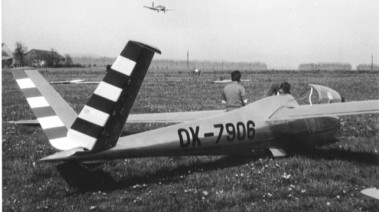
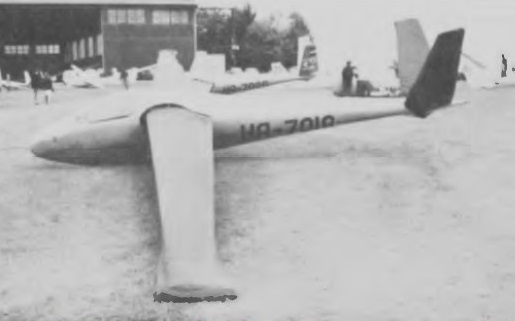
The single-seater A-15 is a high-performance Open Class design of all-metal construction like the A-11 and A-13 but considerably more refined than these earlier types, and capable of aerobatics, spinning and cloud flying. The prototype first flew on 26 March 1960 and the A-15 soon set up a number of records, including the World goal flight distance record of 443 miles / 714.023km in June 1960.
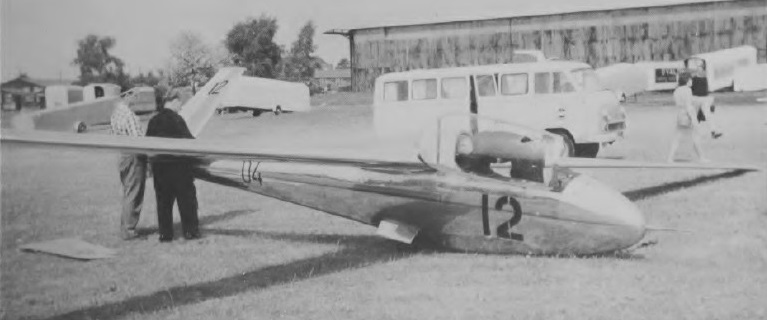
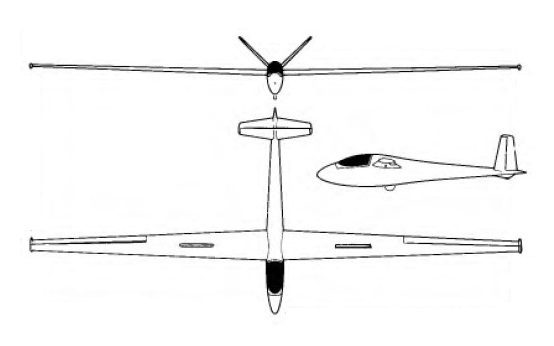
The mid-set wing has a single aluminium main spar of box section, and there is a 50 litre (13.2gal) water ballast tank built into the wing; wing covering is all-metal. The light alloy ailerons and Fowler flaps have plastic foam filling between the ribs, and there are lift spoilers on the wing upper surfaces. Small end-plate fairings called ‘salmons’ can be fitted on the wing tips. The fuselage is a light alloy semi-monocoque structure and the sideways-opening blown plastic canopy opens to starboard. The pilot’s back-rest and rudder pedals are adjustable, and there is provision for oxygen and radio. Landing gear consists of a retractable sprung monowheel with brake. The cantilever butterfly tail has an included angle of 90° between the tail surfaces; the tailplanes are of light alloy and the elevators of mixed alloy and wood construction with fabric covering.
Wing span: 17 m / 55 ft 9in
Length: 7.2 m / 23 ft 5 in
Wing area: 12.3 sq.m / 132 sq.ft
Empty Weight: 300 kg / 661 lb
Gross Weight: 380 kg/ 838 lb
Wing Load: 30.89 kg/sq.m / 6.32 lb/sq.ft
Water Ballast: 50 kg / 110 lb
Aspect ratio: 24
Airfoil: NACA 64s618/633616
Max speed: 155mph / 135 kt / 250 km/h (in smooth air)
Max aero-tow speed: 87mph
Max rough air speed: 135 kt / 250 km/h
Stalling speed 29.5 kt / 55 km/h
MinSink @ 48.5kt (90kph): 0.63m (2.07ft)/sec
Best glide ratio: 40:1 at 62 mph / 54 kt / 100 km/h
Structure: Aluminium Alloy
Seats: 1
No. Built: 350
Antonov A–13
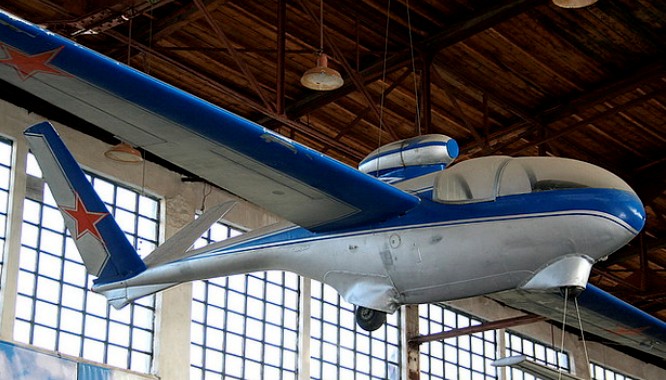
Developed in parallel with the Antonov A-11, and making its first flight exactly a week before the latter, the A-13 utilises the same fuselage, undercarriage and tail unit as the A-11 married to a shorter span (39 ft 8.5 in) wing of lower aspect ratio for aerobatic training. This wing is very similar in construction to the A-11’s, with a single spar in the root and two spars in the outer wings, and fabric covering aft of the main spar, but flaps are not fitted and the fabriccovered ailerons are not slotted. There are lift spoilers in the upper surfaces. The shorter span wing results in a higher wing loading of 7.07lb/sq ft and a much higher minimum sinking speed of 3.74ft/sec.
Altogether about 350 examples of the A-11 and A-13 were built.
Lyulka has produced the small TS-31M turbojet, which weighing only 51 lb (23 kg) and affording a thrust of 121 lb (55 kgp), is used by the Antonov A13 powered glider.
A-13
Span: 39 ft 8.5 in
Length: 19 ft 8.5 in
Wing area: 112.4 sq.ft
Aspect ratio: 13.8
Empty weight: 560 lb
Max take-off weight: 794 lb
Max speed: 217 mph (in smooth air)
Max aero-tow speed: 124 mph
Min sinking speed: 3.74 ft/sec at 60 mph
Best glide ratio: 25:1 at 70 mph
A13-M
Crew: one pilot
Length: 6.4 m (21 ft 0 in)
Wingspan: 12.1 m (39 ft 8 in)
Height: 1.6 m (5 ft 3 in)
Wing area: 10.4 sq.m (112 sq.ft)
Aspect ratio: 14:1
Empty weight: 270 kg (600 lb)
Gross weight: 360 kg (800 lb)
Maximum speed: 400 km/h (250 mph)
Maximum glide ratio: 25:1
Rate of sink: 1.1 m/s (220 ft/min)
Antonov A–11
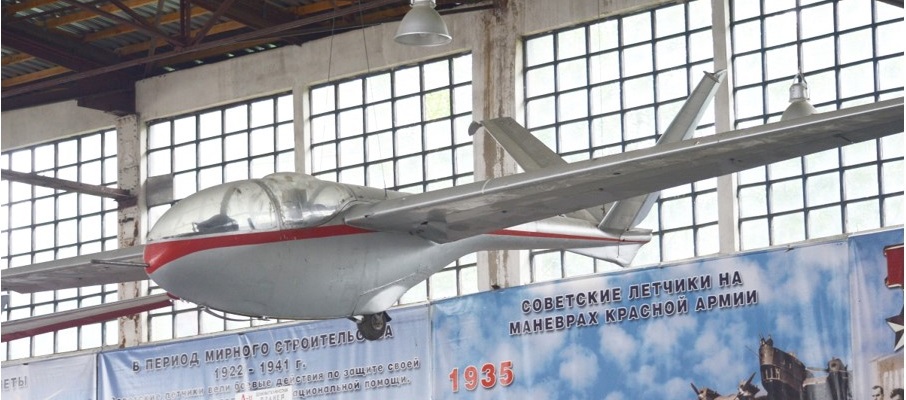
The A-11, which first flew in prototype form on 12 May 1958, is a high-performance single-seater which of all-metal construction. The steamlined forward fuselage, housing the pilot under a blown plastic canopy, tapers to a slim boom carrying the cantilever butterfly tail, with an included angle of 90 degrees between the tail surfaces.
The A-11 is aerobatic and suitable for both spinning and cloud flying, and the mid-set wing has a single spar in the root and two spars in the outer wings. The leading edge is metal-covered, with fabric covering aft of the main spar. The fabric covered slotted ailerons can be drooped through 8 degrees to supplement the slotted flaps, and there are also lift spoilers on the wing upper surfaces. The monocoque fuselage has a retractable sprung monowheel and a rubber-mounted tailskid.
Altogether about 350 examples of the A-11 and A-13 were built.
A- 11
Span: 54 ft 1.5 in
Length: 19 ft 8.5 in
Wing area: 130.8 sq.ft
Aspect ratio: 22.4
Empty weight: 648 lb
Max take-off weight: 882 1b
Max speed: 217 mph (in smooth air)
Max aero-tow speed: 124 mph
Min sinking speed: 2.43 ft/sec at 53.5 mph
Best glide ratio: 32:1 at 60 mph
Andrews A.1 Special

The idea was for an aircraft of low initial cost and low operating cost to enable the many young people of the day to follow up their Private Pilot Licence with a modestly priced 200 hours needed for their Commercial Licence. That was the original concept of the Andrews A.1 and the whole philosophy of its design. The structural design of the A.1 was heavily influenced by the limitations of small production lines and the need to be built in workshops which normally catered for maintenance with the addition of some simple tooling.
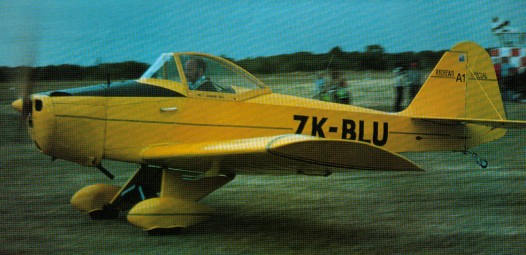
This aircraft, of which there is only one in existence (ZK-BLU), was the pioneer post-war homebuilt in New Zealand. It was built to Certificate of Airworthiness standard during the 1950’s by a CAD aeronautical engineer, Mr Cliff Andrews, although it later flew under a Permit to Fly. It first flew in 1957 but was largely inactive until 1973 when it was restored by Mr Andrews and sold to Alan Rowe of Lower Hutt. The aircraft’s construction employs a welded tube fuselage and tailgroup, and wings constructed of two wooden spars with a Warren-girder metal truss structure between. The whole airframe is fabric-covered.
Engine: Continental A65, 65 hp.
Span: 24 ft 0 in
Wing area: 115.5 sq.ft
Length: l9 ft 0 in
Height: 5 ft 7 in
Empty weight: 700 lb
MAUW: 950lb
Max speed: 102 mph at SL
Cruise: 94 mph.
ROC: 450 fpm.
Range: 270 miles.
Anderson, Greenwood & Co AG-14 / AND-51

Anderson, Greenwood & Company was organized in 1945 to design and manufacture airplanes. Its first model, the AG 14, was ready five years later. An all-metal pusher, the cabin seats two side-by-side with dual controls.

First flying on 1 October 1947, the AG 14 was certificated on 21 September 1950, but the Korean War came along and only 5 AG14’s were ever produced during 1950-1953.

One AG-14 prototype was built in 1947, NX80828, which received the Approved Type Certificate 4A1. It was later re-designated as AND-51.
The five AG-14 production examples built in 1950 were N9300K to N9304K, c/ns 1 to 5), later redesignated AND-51-A, with the same Approved Type Certificate 4A1. C/n 2 later became N4254M and c/n 3 later became N314AG.
One plane modified in 1962 as Mississippi State Univ XAZ-1. Advertised c.1964 by Space Enterprises as Space Coupe AG-14 with 100hp Continental O-220, but no record of production.
Engine: Continental C90, 90 hp
Wing span: 34 feet 7 in
Wing area: 120 sq.ft
Length: 22 feet
Height: 7 ft 9 in
Empty weight: 850 lb
Loaded weight: 1400 lb
Top Speed: over 120 mph
Landing Speed: 49 mph
Cruising range: 4 hours
Service Ceiling: 16,500
Rate of Climb: over 700 f.p.m.
Anderson, Greenwood & Co.
A Houston man¬ufacturer of valves for the oil, petrochemical, gas transmission and powerplant industries, originally incorporated 1941 for research into private owner aircraft, but closed down and re-formed after the war. Developed the AG-14 light pusher monoplane but the company completed only four production models before engaging in subcontract work.
Anderson Super Kingfisher
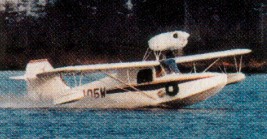
A higher powered version of the EA-1.
Engine: Lycoming O-320, 150 hp.
Wing span: 36.1 ft.
Wing area: 185 sq.ft.
Height: 8.1 ft.
Length: 23.6 ft.
Weight empty: 1130 lbs.
Gross: 1800 lbs.
Speed max: 120 mph.
Cruise: 95 mph.
Range: 425 sm.
Stall: 42 mph.
ROC: 1000 fpm.
Take-off dist: 500 ft (land), 1000 ft (water).
Fuel cap: 40.5 USG.
Seats: 2.
Landing gear: Retractable tail wheel.
Anderson EA-1 Kingfisher

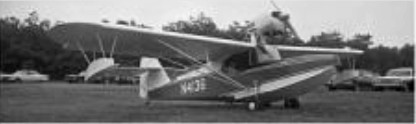
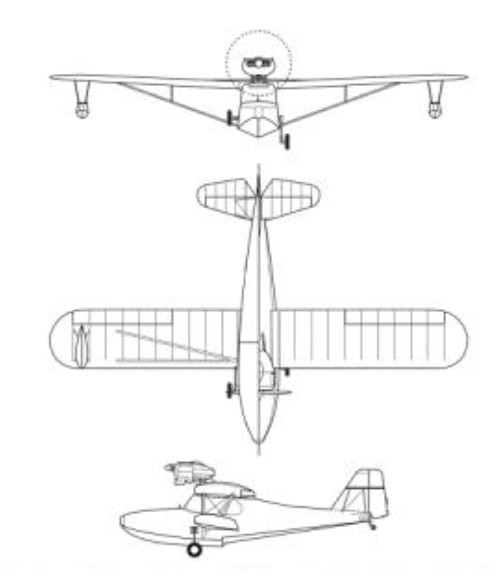
Earl Anderson, a Boeing 747 Captain, spent nine years developing the EA-1 Kingfisher at a cost of $5,500, and first flew it on 24 April 1969. At that time, it used a 100-hp Continental 0-200, similar to the Volmer VJ-22 Sportsman, which served as a design inspiration. Later, Anderson switched to a 115-hp Lycoming 0-235-C1, and by January 1975 had logged more than 600 hours on the amphibian. Seating two people side-by-side in an enclosed cabin, the Kingfisher uses standard Piper J-3 Cub wings, with tip floats of mahogany and plywood covered with fiberglass. The fuselage also is wooden, the framework covered with plywood and fiberglass. The landing gear is retractable.
200 sets of plans had been sold by 1978.
Engine: 100 hp Continental O-200
Prop: 2 blade fixed pitch, wood
Max speed: 96 mph
Cruise speed: 85 mph
Range: 322 miles
Empty weight: 1032 lb
MTOW: 1540 lb
Wingspan: 36 ft 2 in
Length: 23 ft 6 in
Wing area: 178.5 sq.ft
Engine: Lycoming O-235, 115 hp.
Span 37 ft l in.
Wing Area 185 sq.ft.
Height 8 ft 4 in.
Length 23 ft 7 in.
Gross Weight 1600 lb.
Empty Weight 1092 lb.
Fuel 20-26 USgal.
Vmax 113 mph.
Cruise 90 mph.
Climb 650 fpm.
Stall 42 mph.
Ceiling 13,500 ft
Range 330 sm.
Seats 2.
Landing gear:
Retractable tail wheel.
Engine: Continental O-200A, 100 hp.
Span 37 ft l in.
Wing Area 185 sq.ft.
Height 8 ft 4 in.
Length 23 ft 7 in.
Gross Weight 1600 lb.
Weight empty: 1050 lbs.
Fuel cap: 20 USG.
Speed max: 95 mph.
Cruise: 85 mph.
Range: 280 sm.
Stall: 42 mph.
ROC: 700 fpm.
Take-off dist: 1000 ft (land), 2000 ft (water).
Seats 2.
Landing gear: Retractable tail wheel.
Andreasson BA-6

Designed by Björn Andreasson and first flown in 1955, the BA-5 single-seat aerobatic sports monoplane was developed primarily for amateur construction.
The BA-6 is of all-wood construction and, with the exception of the fabric-covered control surfaces, has plywood covering. Fully aerobatic, The BA-6 has a Cessna-type spring-steel cantilever landing gear. Landing flaps are fitted.

The first two built were fitted with Continental A65 65hp engines and the airframe will take the Continental C85.
Engine: Continental A65, 65 hp
Wingspan: 23 ft
Length: 16 ft 5 in
Height: 5 ft
Max speed: 145 mph
Landing speed: 34 mph
Time to 20,000ft: 6 min
Range: 1200 mi

