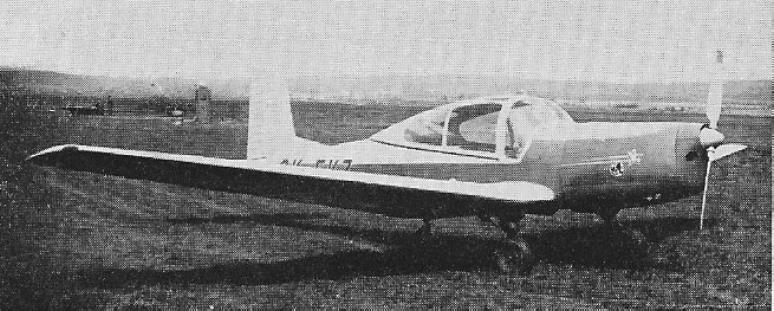
The Avia LD-40, designed and built by the former Avia factory of the Czechslovak nationalised aircraft industry in 1954, is a four-seat cabin monoplane of all-metal construction and powered by a 105 hp Walter Minor 4-III engine. A feature is the reverse tricycle undercarriage, the normal nosewheel being replaced by a wheel mounted immediately aft of the wing trailing edge. The main wheels are mounted well forward below the wing and, on the gound, the Avia LD-40 remains in flying attitude.
The LD-40 accommodates four people on two side-by-side bench-type seats, and the cockpit canopy slides backwards.
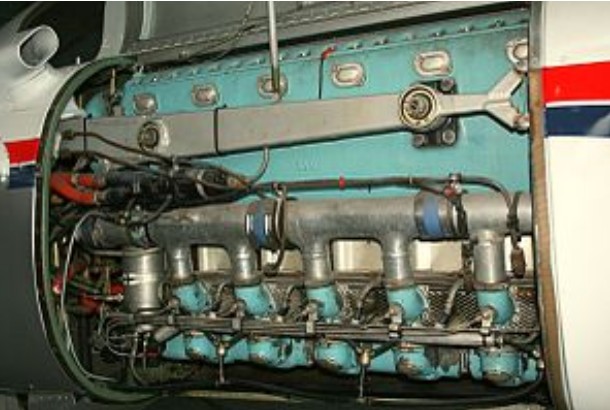
The Avia M 337 (originally designated the Walter M337) is an inverted six-cylinder air-cooled inline engine. It was developed as a six-cylinder derivative of the four-cylinder M 332 engine, going into production in 1960. An unsupercharged version of the M 337 is designated M 137. Production transferred to Avia in 1964, and to Letecke Opravny Malesice (LOM) in 1992.
Variants:
M 337A Basic supercharged engine – not rated for aerobatics
M 337R Modified for pusher installation
M 337AK modified oil system for unlimited inverted flying. “Snap” aerobatics permitted.
M 337AK1 AK fitted with alternator instead of generator
M 337B Increased max running speed (3000 rpm) – increased power – 173 kW (235 hp).
M 337BK Aerobatic version of B.
M 337C Increased compression ratio – 185 kW (252 hp)
M 137A Unsupercharged version of M 337 – 134 kW (180 hp) take-off power. Aerobatics allowed.
M 137AZ As M 137A, with filtered air feed
Applications: Falconar SAL Mustang Let L-200 Morava Zlín Z 526, Z 726 Zlín 142 Zlín Z 43
Specifications:
Aerotecknik M137A Cycle: supercharged 4 No cylinders: 6 inline Bore: 105 mm Stroke: 115 mm Compression: 6.3 Displacement: 5970 cc Cooling: Air Ignition: Double magneto Drive: Direct Weight: 147 kg Max pwr: 180 hp at 2750 rpm Fuel consumption: 43 lt/hr
M 337 Type: 6-cylinder inverted air-cooled supercharged inline engine Bore: 105 mm (4.13 in) Stroke: 115mm (4.53 in) Displacement: 5.97 L (364.3 in³) Length: 1,410 mm (55.51 in) Width: 472 mm (18.58 in) Height: 628 mm (24.72 Dry weight: 148 kg (326.3 lb) Valvetrain: two camshaft operated valves per cylinder, sodium filled exhaust valve Supercharger: Centrifugal Fuel system: Low-pressure fuel injection Fuel type: Min 72-78 Octane Oil system: Dry sump pressure feed system Cooling system: Air-cooled Power output: 157 kW (210 hp) at 2,750 rpm (take-off)
Aerotecknik M137A Cycle: supercharged 4 No cylinders: 6 inline Bore: 105 mm Stroke: 115 mm Compression: 6.3 Displacement: 5970 cc Cooling: Air Ignition: Double magneto Drive: Direct Weight: 147 kg Max pwr: 180 hp at 2750 rpm Fuel consumption: 43 lt/hr
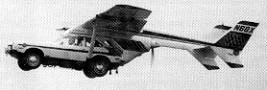
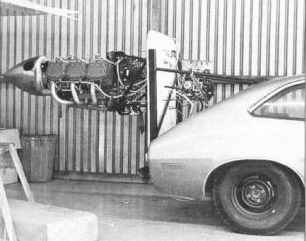
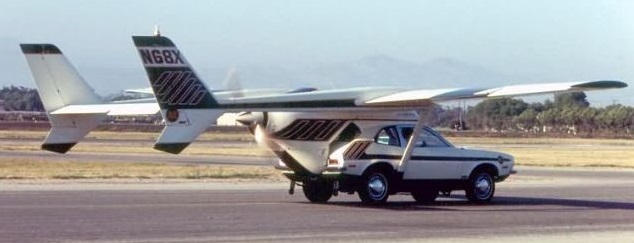
The Flight Module approach was revived by two Californians, Henry Smolinski and Harold Blake, founded Advanced Vehicle Engineers Inc in 1971 to design and build a flying car. AVE combined a standard US production automobile, a Ford Pinto, with the wings, tail and rear engine of Cessna’s push pull Skymaster aircraft as the Mizar.
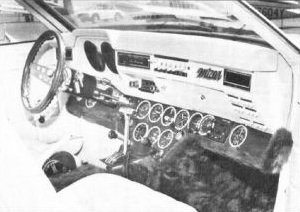
The Pinto was extensively modified, so that its steering wheel not only steered on the ground, but operated the ailerons and elevators. A pair of retractable rudder pedals fitted beneath the fur trimmed dash¬board, which had a full panel of flight instruments and avionics alongside the usual Detroit fittings.
Self locking high strength steel pins and tracking attached the flying surfaces to the car. Buyers were to be offered a choice of three modules with 235 , 260- or 300 hp engines, ranging in price from $12,319 to $22,974, Plus $5974 for the Pinto, whitewall tires included. And if you were not a Ford fan, you could have a modified Chevrolet or Pontiac.
AVE’s Mizar was surely the easiest aircraft ever to manoeuvre on the ground: you just shifted the automatic transmission to ‘Drive’ and away you went. For take off, the road drive and propeller could be used together for a swift departure, or so went the theory. In practice the Mizar performed miserably with a 210 hp engine. The powerplant failed on its first flight and Smolinski and Blake had to drive back to their airfield.
Towards the end of 1973 car and aircraft went their separate ways just after take off, killing the two inventors and their project.
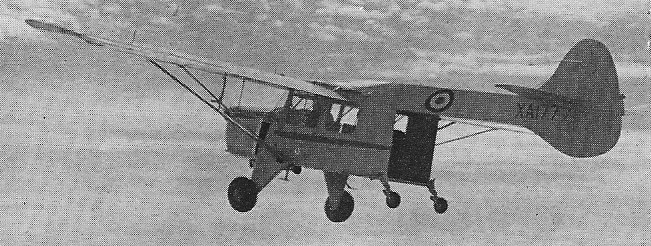
Built as a private venture, the Auster B4 was a four seat high-winged ambulance aircraft, powered by a 180 h.p. Blackburn Cirrus Bombardier 702 engine.
First flown in September 1951 as G-AMKL c/n 2983, the only example was ordered from Auster Aircraft Ltd., Rearsby, to contract 6/Acft/7708 as serial XA177.
Following initial flight trials a number of modifications were incorporated, the most noticeable being a revision of the vertical tail-surface contours.
The production model was to have the 190 hp Bombardier 203 and 7% more wing area.
Engine: Cirrus Bombardier 702, 180 hp Wingspan: 24 ft 8 in Length: 37 ft Height: 8 ft4.5 in Empty weight: 1730 lb Loaded weight: 2700 lb Max speed: 121 mph at 1000 ft Max cruise: 103 mph ROC: 670 fpm Range: 280 mi
The Auster Model S was an AOP aircraft based on the AOP.6 with an enlarged tail. Powered by a180 h.p. Blackburn Cirrus Bombardier 702 engine, one aircraft was ordered from Auster Aircraft Ltd., Rearsby. First flew August 1950 as WJ316.
The Model P Avis four seat tourer based on the J/1 with a slimmer circular section rear fuselage, new undercarriage, four doors and new wing flaps. Powered by a 145 h.p. Gipsy Major 10 engine, it was planned in two versions, the Mk 1 for civil use, and the Mk 2 for military and air ambulance duties.
Only two prototypes were built by Auster Aircraft Ltd., Rearsby, the first flying in mid-1947. The was Avis Mk.1 G-AJXW c/n 2838. The second completed was Avis Mk.2 G-AJYF c/n 2907.
Auster abandoned the project in favour of the J/5 Autocar.
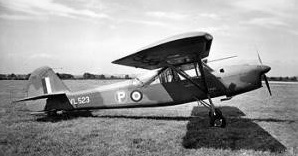
The Auster A.2/45 was a British late 1940s single-engined high-wing air observation monoplane built by Auster Aircraft Limited at Rearsby, Leicestershire. It was designed and built to meet Air Ministry Specification A.2/45 for an “Air Observation Post” (AOP) for the British Army, the requirement was withdrawn and only two prototypes were built.
The Auster Model N normally known by the specification number as the A.2/45 was a strut-braced high-wing monoplane with a single DH Gipsy Queen engine, the enclosed cabin had room for a pilot and observer seated in tandem. It had a conventional landing gear with a tail wheel.
The British Air Ministry Specification A.2/45 was issued on 20 July 1945 for an Air Observation Aircraft to meet Operational Requirement OR.176 in particularly for operation from unprepared landing grounds. Contracts for four prototypes from both Auster and the Heston Aircraft Company were placed on 21 August 1945, this was later reduced to just two aircraft from each company. The Heston competitor for the specification was the Heston JC.6.
The first prototype Auster A.2/45 VL522 flew on 27 April 1948. The Air Ministry requirement was cancelled on the 20 March 1950 and only the two prototypes were built.
Powerplant: 1 × de Havilland Gipsy Queen 34, 250 hp (190 kW) Propeller: 2-blade Wingspan: 43 ft 6 in (13.26 m) Wing area: 278 sq ft (25.8 m2) Length: 30 ft 1 in (9.17 m) Height: 8 ft 4 in (2.54 m) Gross weight: 3,365 lb (1,526 kg) Fuel capacity: 24 imp gal (29 US gal; 110 L) in a port wing root fuel tank, opt/identical 24 imp gal starboard wing root Maximum speed: 130 mph (210 km/h, 110 kn) Cruise speed: 122 mph (196 km/h, 106 kn) Economical cruise speed: 105 mph (91 kn; 169 km/h) Range: 600 mi (970 km, 520 nmi) Ferry range: 1,100 mi (1,800 km, 960 nmi) with optional second tank Service ceiling: 15,500 ft (4,700 m) service ceiling Rate of climb: 740 ft/min (3.8 m/s) initial rate of climb Take off run to clear 50 m (160 ft): 330 yd (300 m) Landing distance from 50 m (160 ft): 220 yd (200 m) Crew: 2 (pilot, observer)